
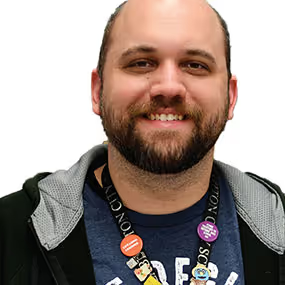
Dustin Hensley, library media specialist at Elizabethton High School in Tennessee, discusses the purpose of libraries today. Topics include political attacks on books and librarianship, the shift toward Makerspaces and Fablabs, and how libraries can transform learning through a distinct pedagogy.
transcript
Speaker 1 Hello. And welcome to episode 108 of our podcast at Human Restoration Project. My name is Chris McNutt, and I'm a high school digital media instructor from Ohio. Before we get started, I want to let you know that this is brought to you by our supporters, three of whom are Kathy Sunello, Kimberly Baker, and Bradley Hinson. Thank you for your ongoing support. You can learn more about the Human Restoration Project on our website, humanrestorationproject.org, or find us on Twitter, Instagram, or Facebook. Today, we are joined by Dustin Hensley. Dustin is the library media specialist at Elizabethton High School in Tennessee. He is an advocate for creating spaces that cultivate a student's love of learning. He was one of the cofounders of the Bartleby program, which centers community involvement and entrepreneurship with students, and is one of the winners of the XQ Super Schools competition, remaining active in the XQ community of practice. He currently teaches courses on community improvement and academic research. In this podcast, Dustin and I talk about the state of libraries today. The purpose of a library, how libraries interact with students, political forces attacking books and library and ship, transitions from libraries to makerspaces and fab labs, and how libraries provide a pedagogy that transforms learning.
Speaker 2 I was in college to be a history teacher, and I was loving my history classes. And I started into my education classes. I started noticing how much being a classroom teacher went against my philosophy of learning. It was doing my, like, residency and would see the teacher would skid up and lecture and such. And I was thinking about the students, and what if they didn't wanna learn about that today? What if they wanted to learn about something else? And that doesn't matter. That if a kid came in, like, I wanna learn about dinosaurs today, then too bad. We're learning about this instead. So the students had no autonomy or agency whatsoever in their own learning journey. And I couldn't consciously become a classroom teacher for that reason, but I wanted to work with teenagers, and I wanted to work in a learning environment. So I was trying to find what can I do that I can still do all these things that I want to do, but I'm not forced to make kids learn something they might not wanna learn? And I thought back to my my high school librarian who was an amazing human being and helped foster my learning in a lot of ways. And I thought, just wanna do what she does. So I reached out to her, and she said, this is what you have to do to become a school librarian. So I, in my senior year, dropped education as a minor and just graduated with a degree in history and went straight into the master's in school librarianship program. Most school librarians take the journey of they're a classroom teacher for several, several years, and then they, later on, will go become a school librarian. When they maybe get tired of the classroom, they want something different, but I went straight into the school library. That's all I wanted to do. The reason I became a school librarian is what guides my pedagogy and that I want to cultivate self interest in students all the time. Like, I never wanna force learning on anyone. If whenever they come in to the library, if they say this is what I wanna learn about today, then we learn about it together. And it's great that I never have to be the authority on anything, that I'm the authority on finding information, on how to verify information, but I would never have to be that person. Okay. I'm going to teach you now. It's okay. I don't know anything about this either. Let's learn about it together. Just a few days ago, there's a student that wanna know what the inside of a kangaroo pouch was like. We learned about the inside of kangaroo pouches, and it's great that every day is gonna be different. I'm sure a lot of people's view of the school library is that you're an elderly lady with the glasses on your nose and the your hair in a bun, and you shush people. The school library job is not monotonous that way. It doesn't have to be monotonous that way. It can be a new journey every day that you're learning something just completely off while they did not expect to be coming because the students really guide what happens in the library. So it's the most equitable space in a school because it's made for everyone. But it's not just for the high achievers. It's not just for a certain subsection of the population. And that that's true of libraries everywhere. That's public libraries, academic libraries, that they are made specifically to help every single person in the community. Yeah. My whole goal is that I'm gonna learn with these students and let them guide the journey, that I'm there to help get them the right kind of sources to be a conduit to the correct information, but also teach them the skills on how to correctly assess information so that we're getting accurate information.
Speaker 1 There's two things that you're saying that that really resonate with with me. The first is kind of a personal note. I kinda went the opposite route. When I first went to school, I actually wanted to be a librarian, and I got a degree in history and shifted into education. It's like a cognitive dissonance that I constantly face as someone who is a classroom teacher of can change occur from the inside versus can change occur from the outside. Because there's always that that constant resonance of we have to get through the standards. And it it could feel really gross to force kids to do those things. But at the exact same time, there's the question of, well, if no one ever attempted to make those changes from the inside, would change ever occur? Like, I totally get what you're saying, but it's just interesting that we both have relatively similar origins, in terms of understanding that. But when it comes to the library, I I was thinking back to my own high school experience, and I was not a fan of my high school classes. I was true at all the time. And, but I always loved the library. I also connected a lot with the librarian. Our librarian actually was an older lady. It was a relatively traditional space. It just basically had books and then, like, a couple computers, and it was relatively simple, but it was a very welcoming place. I also think of libraries as accepting places. A lot of folks would use it as a way to get out of class. But, really, what they were doing was they wanted to go there because it was calm and people cared about you there, and they felt like they asked you how you were doing. It was a very noncompliance, nonauthoritarian space. So, yes, it got you out of class. But the reason why you wanted to get out of class was that it felt different to be there. It's a little more complex than that. And I I think that that's a good segue into just talking about what is the purpose of a library, especially inside of a school. I think that, you know, even when I was younger, that was I don't know if it's still the case, but they used to call them instead of libraries a a media center, to focus more on, like like, research and and finding and using sources on the Internet, etcetera. In your opinion, what is a purpose of a library?
Speaker 2 Yeah. And we we still use the term media center. So I am a library media specialist. Books, Internet, all those different things are just mediums for the transference of information. So whether it be a book or it be a computer or, a video, a DVD do we still use DVDs? Blu ray, whatever it might be. All of that is just for transference of information. So, yeah, I I like the idea of the library being that accepting space because the librarian has a really special position with students and that they never have to judge performance. Students all have a favorite teacher, but at some point, eventually, that teacher's gonna judge their performance on something. They're gonna assess their abilities, and the school library never has to do that. So I'm in this great position that I get to be an advocate for students, that I get to be someone in the same position as, like, a school counselor, that I get to build a relationship with them that's completely outside of just what are you able to do, what are you able to accomplish, and that who are you as an individual and a person. That's my number one idea of what a library should be is building relationships with students because that helps create all these other opportunities for learning. That once I know them as an individual, I mean, that helps me get back to my original purpose of here's a great book that you might like, or here is a great resource that you might be able to utilize in your classes. So that relationship piece, I think, is the most important aspect of the school library. Like, me and my position used what I'm doing with relationship building to start a a lot of social emotional learning initiatives across the school. Well, like, I'm over our school survey of a social emotional learning for students. I I hate that a lot of times that students have no ownership over their own data that whether it be their grades or the GPA or whatever, like, the school owns it. They have to pay for a transcript or whatever. So I take the data from the surveys and take it to the students. Let them wrestle with the data with me because, I mean, that's it's their information. Again, libraries being this place of open source knowledge. You can come and learn about this if you'd like to learn about it, which I really look for those students that fall through the cracks that the library kids, those are the ones that are skipping class because they need a different space. I want them to feel like they're engaged somewhere, not just that here's a space where you feel, like, calm and that you're not having to deal with all the heartache or troubles or headaches or whatever of the classroom, but here's a place where you actually belong. This I know the library is so much more than just here's the the silent sanctum or the book depository, but it's a space where students can actually feel like that that's where they belong in the school and they have an adult in the building they can talk to. I I know that every bit of research about social emotional learning shows the importance of having an adult they can talk to, at least one that says their name every day. And you mentioned that with your school librarian. We are that person that they can come and talk to because they know that, like I said before, we're not gonna judge them. We're just there to accept them.
Speaker 1 Yeah. I I can't help but think as you're explaining all this, because it's it's such an important topic, that this this feeling of belonging and having that connection to the library and the librarian is, especially in in maybe the last year or so, been a lot more difficult, as different, kind of political forces, culture war forces, etcetera, have come in and said, like, hey. Like, you're not going to have this book or this book isn't appropriate, etcetera. With those books being primarily focused on student identity, race, gender, sexuality, etcetera. How do you negotiate that as a librarian knowing that, you know, your your role is very much centered on those connections, but at the exact same time, school regulatory policy, politics, whatever, might force you into
Speaker 2 restricting what it is that you can do. Right. And I think a lot of the forces right now are trying to like, there's gonna be First Amendment lawsuits and all this that happens with, everything that's going on. But I think what they're really trying to push for is silent censorship. That they want librarians to censor themselves, that I'm too afraid to purchase this material because it might get challenged, which every school board in America already has a material challenge policy. This is nothing new. There's always been a route for parents to challenge materials in a school library. That's been around for decades. But this this new push, I think, is just to fearmonger that librarians will not purchase the materials because there's always been a route for parents to challenge. And all of those usually have to go through a very lengthy process. It's not just that I don't like this book, so the librarian pulls it. There's a lengthy process of having to go through a committee that all reads the book, and we'll make a decision that goes to the school board for them to make a decision. So there's this Generally, they're really lengthy processes, which are so much more than what they're currently pushing as the if a parent doesn't like it, the librarian pulls it. Of of course, as a librarian, not a fan of a parent choosing what someone else's kids can read. If you have a problem with the topic, then that's something you should talk to your own child about and make that decision together. And even then, these are teenagers. They should be able to make their own decisions that if they would like to read a book I've had students in the past that have told me, like, I can't take this home. Can I just check it out and leave it here and read it while I'm here? Because if I get caught with this, I'll be in trouble. So, obviously, we make arrangements that they can read it while they're at school so that something doesn't happen to them at home. Currently, there's a push in Florida for the library management system called Follett to send an email to parents for every book they check out so that they couldn't just check out something at keep it at school so that that way the parent would always know, which librarians are really big on prophecy. That's one of our biggest tenants is the prophecy of the patron. That goes completely against the library bill of rights from the American Library Association. That's like I had mentioned earlier, that's their data. That's their information. That that's their, like, their reading log. What they've checked out is their private information. It should stay that way. Yeah. We're in a really strange position right now in a lot of states, like Tennessee being one of them. About a month or so ago, there was a celebrity who testified to the the state legislature, and he asked what's the difference between a school librarian and a man in a white van with no windows sitting outside the school. He said the kids the kids can run from the guy in the van. They can't run from a school librarian. So there is all kinds of attacks of school librarians being groomers and endangering children and all these things that it it's a really weird place to be in. But librarians are really fighting back because, like, we obviously care about the children, and we're trained. Like, we have master's degrees. We have advanced degrees on how to select books that are age appropriate, that are appropriate for where students at are at as human beings developmentally. It's it's an attack on professionalism. There's a a group called Freedom with the r e a d and Freedom, the Freedom for Students to Read that's out of Texas, Carolyn Foote. So we're we're pushing back and advocating as much as we can, and I think that a lot of librarians are gonna push the boundaries and see what happens, myself being one of those, that we have students that need these materials, that are have things going on in their lives that they need to be able to read about and learn about. So we'll see what happens in the next few years. Not the most exciting place to be right now because of the forces trying to censor our ability to help all students, but that's what we're here for.
Speaker 1 Hey there. I hope you're enjoying the podcast so far. I want to take a brief moment and promote something that may interest our listeners, which is our upcoming conference to restore humanity. Our inaugural virtual conference is from July twenty fifth to July 28, featuring amazing keynotes including founding theorist of critical pedagogy, doctor Henry Giroux, and organizer and co author of Black Lives Matter at School, doctor Denisha Jones. Further, we have fantastic and intriguing learning tracks on anticarceral pedagogy, designing for neurodivergence, disrupting discriminatory linguistics, and promoting childism in the classroom. And our virtual conference is designed to be a virtual conference. As in, we use flipped keynotes, which focuses on conversation rather than staring at a Zoom screen, and our courses are interactive asynchronous explorations. Learn more on our website at humanrestorationproject.org/conference. Tickets are discounted right now at a $150 for all four days, with discounts available for underrepresented communities. Now, back to the podcast. It's definitely a dangerous situation, especially from that silent censorship angle. I I think about not necessarily from a librarian angle, but from like an English teacher angle. I know so many English teachers who are not introducing certain topics because they don't wanna deal with the the parent fallout. Like, the hate you give has been a really big one, which in years past was not really that that big of a deal. But now it's just like, don't I don't wanna deal with it. I don't wanna I don't wanna have to deal with people that are constantly coming after me. And and that to me is highly concerning. I I can't help but draw the line between the the stories that you're sharing about testifying against librarians and the the role of a library and also just the cutting of funding to libraries in general, and whether or not we'll see more attacks on having a library at all. And kind of in that same vein, I I think about maybe the last ten years or so, the shift of libraries and schools moving towards, kind of like workplace centric, spaces, like makerspaces, fab labs. And, you know, I I literally teach in a maker space, a lot of the time. But our school does not have a library. That is our school's quote unquote library. And I I personally am not a huge fan of that. I personally think that you should also have books and a space to do research and a quiet space sometimes, and sometimes maybe it's a little bit softer. But, a makerspace is not that. It's very much different. I'm curious about your thoughts on the shift from the traditional library to these other spaces and perhaps how that could connect to what we're seeing from politicians and from advocates to maybe defund or remove libraries.
Speaker 2 Yeah. So I think that I I personally have nothing against makerspaces and Fab Labs. I don't have one in my library. We have a separate Makerspace in our school, which the engineering classes are taught in. So we have, like, a separation at our school, which is good because I know nothing about engineering. But I obviously wanna advocate for books being a library. Outside of just being able to be, like, a holder of foundational knowledge or whatever from all the research that you do and the information that you've learned from books, there's so much importance in just being able to read a piece of fiction. Doctor Rudean Tims Bishop has, in library world, this research on mirrors, windows, and sliding glass doors. The books provide all of those things, that they give you a mirror to yourself, but they also give you a window to glimpse into the lives of other people and then a sliding glass door to step into those lives. So that's one of the guiding principles of librarianship is that mirrors, windows, sliding glass doors that novels and fiction give you the ability to learn empathy and how other people live their lives so that we can have a better understanding of all cultures and all different peoples. With the a push towards a full makerspace, you're losing all of that. I and, again, I I love students having information, having knowledge. And then but then they need to be able to do something with that. What good does it do a student to have all those trivia knowledge if they can't do anything with it? So I I like a nice balance of here's the space in the library where you can learn, then here's the space where you can create something with that knowledge that we want them to be either generative thinkers or creative thinkers that they make something new or they take something existing and do something new with it. Like, we wanna see that happen in the library because we don't want just to see the part where they find information and leave with it. So I love the idea of them creating in the library. Whatever my students, they do a lot of design thinking in the library to try to create community solutions. So I I used before the pandemic hit, I taught a class called community improvement where our students would look at our region and then find issues that they saw and then try to create solutions alongside of users and then pitch those solutions to the people in the community that can make them happen and then actually go out and do the thing. That like, we didn't have a maker space or whatever, but we were able to take the information research that we did on a topic and do something with it. And that's what we wanna be able to see is that, okay. I'm a holder of foundational knowledge, but then I'm also able to take it and apply it to life and be collaborative with it and create new work or whatever. To me, a lot of that the work surrounding
Speaker 1 makerspaces and fab labs are not necessarily rooted in, like, a a pedagogical lens. Like, a library is a pedagogy. It's it's doing research and applying it as you're talking about. It's it's about obtaining knowledge. A makerspace is more it can have a makerspace pedagogy, but I think that typically how it tends to be implemented is more so just, hey. We did a project. Now we're gonna go make a three d model. And it doesn't really have any extension beyond that. It's just like it's a thing that exists, and it looks kinda cool at the end. It doesn't really mean anything. It doesn't have any actual purpose for for student learning outside of having an interesting end product. And it it seems like more and more, a lot of libraries are shifting into just being spaces that create as opposed to spaces that have those resources there. Sadly, tour a lot of schools, and a lot of schools are starting to remove books and instead put in, like, poster printers and those giant, three d material printers. And as you just said, it's not that those things are bad, but, over time, it's shifting the purpose of a library to be more of almost like a an engineering space, which is a a little bit different than what it is that you were just talking about here in this first half. I guess that kinda all builds into just the idea of, you know, what is the purpose of a library and specifically a school context with classroom? So, like, when you remove a library, what is the danger when it comes to a a regular classroom and the connections that they make with the library?
Speaker 2 Yeah. So like you mentioned in the beginning of the podcast about your journey of becoming a history teacher when you want to be a librarian and the idea of having to meet the standards and, like, you have your classroom materials that you're given by the state maybe. I know that's the way our state is, that here's your textbook and such, that the library has so many supplementary materials that you don't have in the classroom that we are able to offer. That whether that be a book or a database or maybe sometimes we even have, like, educational games or headsets, like, all these different things that we can offer that you don't get to have in the classroom. We're able to cater our budget based off of the needs of the school. So if the social studies department really wants to be able to do this thing, but they don't have the funding for it, they might be able to come to the library and say, we wanna be able to do this. Can you help us? Or I there's not a department in the school that I've not worked with that has come to the library and said, can we have assistance with this? Which begins a lot with me as the librarian going out and telling people this is what I can offer you. That a lot of people just assume that the library is for the English and the social studies teachers, that those are the most closely aligned to what the library does. They're gonna be reading and researching. That's what happens. So a lot of it for librarians is I need to go advocate to the whole school that I can offer all these different things for you. That whether and you mentioned earlier the budget cutting. Yes. That's totally a thing that happens. But are there other kinds of resources that I can offer you? Are there websites or lesson plans? Because we're trained educators as well. We're certified educators. We have the ability to create lessons or I've a cotaught a lesson in every subject, I'm sure, at this point. It'll range from one day I am working with a biology class, and the next day I'm working with criminal justice on looking at supreme court cases. We have that ability to kinda be chameleons and fit in with any subject and especially love doing cocurricular things, interdisciplinary, that we love working across disciplines. And one of the good things about a library is we're just a really big space. We have the ability like, if two classes wanna work together, let's say that a a science and a math class wanna do a project together, then they can't combine their classrooms because there's too many students to fit in one classroom. So the library is just a really good space for that. And when you're in my big space, you get me too. I am also available to help in all of the teaching and whatever project design that you're doing because librarians are trained in instructional design and when we're in library school. So those are things that we have the ability to do. That's one of the things we love doing the most. When I talk to other librarians, we don't wanna just be there to be the ones like, okay. This is how you use a database. Go back to your class and figure out you know, do your research. We don't wanna do that. We wanna, like, get in the research with you. Usually, whenever a class is going to come and a teacher says, can you teach them how to use the databases? I'll say, yes. Can I stay with them? Because I wanna work with the students on it. Because I don't wanna just say, here it is. Goodbye. I wanna say, okay. Let's really get into it together. I wanna make sure that you find the best material possible. Like you'd mentioned, like, have standards, and you've got pacing guides and all this stuff. So I wanna be able to use the time that I have to make sure that you get the best information possible in your work. And I think that's one of the most important things in libraries right now. They're making sure that students can volidify information, that they get the best information possible because there's so much information out there. I think about and whenever you teach freshmen, I know you see this that you talk, alright. We're gonna do a research paper, start researching topic. And the first thing they do is go to Google, and they click the first thing that pops up. And it's probably something that they paid to have the top ad or the top thing on Google, and they just start topping it out. Or something on social media has popped up, and they're like, hey. Did you see this news article? And that you can read just the URL of the website, and it's like, wow. That is definitely not valid. Look at the name of that website. It's, like, 40 characters long. And this really important aspect for librarians right now is that we need to help every subject in teaching. This is how you find valid information because one of our biggest things in libraries is that we do not wanna teach reliance on someone else. Now a lot of times in the traditional classroom, we're teaching kids to be reliant on someone to give you information. That's the last time we want in libraries is that we want students to be able to go out and find on their own so that once they graduate, they don't need to have someone say, here's the information, because that's whenever they start going to Facebook to find out their news. They need to be able to have the skills and the, like, mental agility to find information, question it, see if it's valid, and then accept it or discard it. So that that's a big thing right now is that we're teaching all subjects. Those teachers will bring them or I'll say, hey. Can I work with your students on vilifying information, whether it be an English class or history class or science or whatever?
Speaker 1 It sounds like it presents the opportunity when you work with teachers to expand upon that pedagogy and model the importance of both self determination theory and self directed learning, as well as critical pedagogy because you can be that person in that space that helps guide learners. Because you don't have to. I I recognize that there are plenty of schools where you do have to follow the standardized pacing guide. But there are a lot of ways typically to get around that in a in a even in traditional schools. And I think by inviting that space, you can show them, no. You could do it this way. Gonna feel a lot different. It's gonna be a little more probably organized chaos than everyone doing the same, topic. But there's a space there to learn to help, folks get there. And as you say, it also might help stop the negative effects of standardization on things that involve libraries, really, like the fact that a lot of adults don't read books, at all because they had negative experiences with books when they were younger. I've never met, like, a first or second grader who doesn't read. They all read stuff because it's fun. But the second that we're, like, you know, 22, like, well, I'm not gonna read a book. That's lame. I was like, well, there's actually a lot of really great literature out there that you could engage in. But the experience of schooling has really negatively impacted that. I noticed that especially with, homeschool students who transition to public school. I've noticed are always vicarious readers, whereas most of my students are not. So it both offers the opportunity for you to come in and introduce that pedagogy, and kind of transform how learning works, but also maybe potentially counteract the more negative effects of traditional classrooms.
Speaker 2 And I think that I'm glad you brought that up. There's a great book by Kelly Gallagher called Redecide. You might have seen before that talks about how schooling really destroys the love of reading. Because you think about, like, small children, and they beg to be read to, and they can't wait to learn how to read. And like you mentioned, first and second graders love reading books. Before I was a high school librarian, I was an elementary librarian. And whenever I would bring up, like, you know, it's time to find your book for the week, they would lose their minds. It was hard to keep track of them because they were all over the place just wanting to get books to take home. Like, begging to take more than just their allotted amount that they, were allowed to have. And then, yeah, we start, which accelerated reader also does this, that we start assessing based off of their reading. And that's what really kills that love of reading. And then the books that we choose to teach in our English classes are so outdated and sometimes, but not in this, that they just can't connect to. They're all written by dead white men. I know that's a a huge issue that we have that we don't have much diversity in our selections in English classes, which the library is able to provide. That I know that, again, going back to the political forces right now, that they're trying to get rid of that diversity in literature. But, yeah, we offer so much that and, again, we're not assessing you on it. Like, in English and and I have nothing against English teachers. I I love my English teachers that I work with, but they're going to guide you in what you think about what you're reading. There's so little space for you to have your own opinions on what you're reading that you're gonna have the guiding questions at the end of the chapter and all those things that really put you in a box in your understanding of literature that you don't get to explore it on your own, and the library opens up. Again, this goes back to the very beginning in the relationship building that getting the kids in the library is so important because they're gonna be surrounded by books. And, eventually, there's gonna be a cover that catches their attention. They're going to get it. I've had so many students that'll come in, and they'll tell me, like, I'm not gonna check out a book. I'm like, okay. That's fine. Just come in here and hang out, we'll talk. You know? And, eventually, they see a book and they get it. And they're they'll say, like, don't say anything. Like, don't say I told you so. I'll be, okay. I won't say a word. Just check out the book and enjoy it. That I love every time that happens because, like, eventually, their wall gets broken down just because they see the book displays or whatever. Like, I intentionally will put books at the table they sit at because I figure out, okay. This kid sits there every day. So I'm gonna start putting based on what we've talked about, I'm gonna start putting a book at that table. And I'm gonna switch my displays up. So that way, their eventual keeps seeing that book, and they're gonna check it out. It's going to happen. And most often, it does happen. So that goes back to being like, I don't think there's anything wrong with librarians being the book people.
Speaker 1 I think we do so much more than that, but I think being the person that helps instill a level of learning back into high schoolers, I think that's such an important position to have. Yeah. Promoting literacy in general is one of those, like, stables. Kids need to know how to read, but they will learn how to read by reading things that are interesting that they like to do. That's gonna be way more powerful if they're just intrinsically motivated to do it because you are when you're younger. There's no reason why you can't be older. I think about a lot of my my personal experiences with reading in school and Lexile levels and, like, being told, like, that book is either too easy or too difficult. And I was always a fan of, like, picking the hardest possible book even though I had no idea what was going on Just because I I was always fascinated by, like like, Moby Dick or something like these super thick books. So just, like had, like, this, like, ancient text with it. And it just felt like I was, like, discovering it in one of those old libraries, which coincidentally is my favorite book, which I I love that book. But but, yeah, I I I really like that concept of, how do we get learners to be intrinsically motivated and reshape schools via using libraries as transformative pedagogy?
Speaker 2 Redecide's a a great example of that, Kelly Gallagher's work in general. Curious about any final thoughts you have or, like, appeals you have to educators about libraries or the work that you do. Please utilize your school library. The librarians want to be used. If they're not advocating for themselves, I wanna advocate for them that the library is such an essential space, especially for students. So please support your school librarians, whether it be if it's administrators, teachers, whoever's listening. School library wants to be used, whether it be monetary or whatever you're doing. And don't just use the library as a backdrop for photo ops. That that's a thing that happens in a lot of places is that if someone comes in like a dignitary or something, that they'll use the school library as a great backdrop for a picture opportunity. Like, we're so much more than that. We like you coming in, but don't just come show up and take a picture and leave. We can provide so much more than just that. So So, I mean, my last minute plea is just, utilize the space. It can be so much more than what you realize it can be.
Speaker 1 Thank you again for listening to Human Projects podcast. I hope this conversation leaves you inspired and right at push the progressive envelope of education. You can learn more about progressive education, support our cause, and stay tuned to this podcast and other updates on our website at humanrestorationproject.org.
resources
- A Library Transformed · Dustin Hensley (article) Hensley describes practical steps for reimagining a high school library. link →
- #FReadom (organization) Texas-based movement defending intellectual freedom and access to books in schools. link →
- Mirrors, Windows, and Sliding Glass Doors · Dr. Rudine Sims Bishop (article) Classic framework for evaluating diverse representation in children's and young adult literature. link →
- Readicide: How Schools Are Killing Reading and What You Can Do About It · Kelly Gallagher and Richard L. Allington (book) Examines school practices that undermine reading motivation and offers concrete alternatives. link →
- Dustin Hensley (person) Library media specialist, Bartleby Program co-founder, and XQ Community of Practice member at Elizabethton High School.
- XQ Community of Practice (organization) Network supporting innovative high school redesign, including the Bartleby Program at Elizabethton High School.