

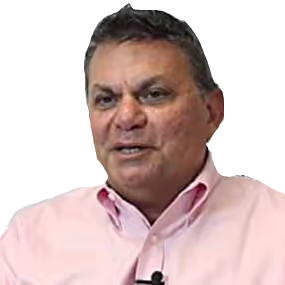
Ira Socol joins the podcast to discuss zero-based thinking as a tool for fundamentally redesigning schools. He challenges educators to move beyond surface-level student choice toward genuinely student-centered learning. The conversation covers maker spaces, project-based learning, and why these shifts can improve even traditional standardized assessment results.
transcript
Speaker 1 Hello, and welcome to Things Fall Apart. My name's Chris. Thanks for joining me on our podcast today about progressive education. This is Things Fall Apart from the Human Restoration Project, which is brought to you by our patrons, two of which are Nick Covington and Jenny Lucas. Thank you so much for your continued support. You can find out more about the Human Restoration Project as well as all of the great materials we provide, our podcasts, and our thoughts on our website at humanrestorationproject.org or on Twitter at Humerez Pro. Today, we're joined by Ira Sokol. Ira is the public education director of educational technology and innovation, a design project manager, a researcher, a specialist in universal design technology, a senior provocateur, among many other titles. Ira's latest book, written in part with Pam Moran and Chad Ratliff, is Timeless Learning, How Imagination, Observation, and Zero Based Thinking Change Schools. It explores how makerspaces, project based learning, and student centered instruction radically changes schools from assembly lines to a community learning space. So your book opens up with this idea of student centered learning, which is something that we often talk about in schools, but really what that translates to is do what I tell you just in an individualized way. So can you talk about your goals of student centered learning and how that relates to the message of timeless learning? Well, one of the things that I think the three of us have really come to the conclusion that that individualized
Speaker 3 ed is still teacher focused education. And, you know, this goes back a long way to me for me as I from my work in special education that it it isn't the job of the teacher to individualize education. It's the job of the student to personalize it and to in in a term I, have often used and written about tool belt theory, that students need to not only build their learning by themselves, but build the collection of tools they use on a on a daily or hourly basis. And it is in that learning that where the student creates the context and the environment that you actually allow the widest range of students to succeed. So child centered learning to us is all about student created context, and that means that it's our job as adults to find the moments to plug in if if we see content that is missing, to plug it into to the activities of the students. And that can range from a multi age elementary school class deciding to make a Thanksgiving dinner together and then having teachers realize that they can get measuring into the younger kids and ratios into the older kids. Or it can be a group of students, you know, building as we described tree houses in their in their middle school cafeteria and realizing all the math and communication skills and science that can be plugged into that. The the trick is is to say to the students, what do you wanna do? That's always the first question we hope educators ask. And but what goes behind that question is what we want our children to be, and and that's and we wanted them to be independent, collaborative, creative, capable of of leading their own lives in a good way. And if we do that, we really need to bring the hidden curriculum of schools into, you know, philosophical alignment with, you know, what we believe we want our children to be. And, you know, it so schools can often, you know, talk about, well, we're gonna, you know, we're gonna have a, you know, a genius hour. But when they have the genius hour, kids still have to raise their hands and ask permission to go to the bathroom. So
Speaker 1 that, you know, that's just not student centered. I would love to talk about that because it's it's one of the favorite things that I I read when I was reading through your work, which is talking about genius hour. I'll just quote you really quickly. Authentic opportunities for learners to create, design, build, engineer, and compose cannot truly coexist within the standardization model. That's why tinkering around the edges, adding a genius hour to an otherwise unchanged school day accomplishes nothing except to highlight all that's wrong with our schools for this century. So you've kind of already touched on it, but could you elaborate further on why it is that genius hour really isn't enough?
Speaker 3 Well, you know, there's the there's the famous Larry Cuban book Tinkering Towards Utopia. When you tinker, all you do is reveal everything that's wrong. So if you say to students during this hour a day or this hour a week or, you know, this two hours a week, we're gonna do learning well, what does that do but highlight what you're doing the rest of the week and or the rest of the day. And students pick up on this immediately. It's it's like saying, I need to get, you know, I need to get to the one class where the teacher cares about me. Right? It highlights what's wrong with all with all the rest. So the the problem is is that when change just something around a moment, then you say this is something we've added in. What it does for students is it it shows the gap between what education could be and and what it currently is. So I'm not saying you can't use that as a start to help teachers learn to let go, which is really what it's all about, what letting the adults in the school learn to give up the control that they usually guard so jealously. You can use that if you have a plan to go further, But if your plan is to have a genius hour, or an after school robotics club, or a, you know, or this or that, you know, maker time or whatever you wanna call it, then you will never get any further down the road. So one of the things I usually try to do in Alamo County was to say, if if someone came to me and said, we really wanna do a, say, a robotics club after school, I would say, well, I'll support that. I'll get you money for the kids. I'll even help you arrange transportation so that any kid who wants to participate can, and it's not just those with middle class parents. But before I do that, you need to come to me with a plan for how this robotics club is going to, in two years, be robotics and coding infused in all math instruction in every classroom. So it's the trick of saying, you know, you can tinker around the edges if you have a plan to get, you know, things mentally changed. The the other part of this that I think is really important is that, you know, people will always say, school leaders will often say, well, we can't change everything at once. But the trick is you need to change everything. I worked with a professor when I was in Michigan State in Fendler, and she always used to say the hidden curriculum is the curriculum. Students don't learn the content of school, they learn the context. And so if you are you are adding a genius hour, say, in middle school and you still have bells, if you are adding, you know, maker moments into elementary school, but you still say, this five minutes is purely about reading. You're defeating what you're what you're trying to teach with the structures that you're maintaining. So that's why we say, you know, it is about many things. It's about time. It's about policies regarding behavior. It's about spaces. It's about technology, and it's about practice.
Speaker 1 The idea of taking a giant leap instead of a small step, I think, is something that we could all get behind. I I really like that point that you just made about, like, finding ways to introduce teachers into taking that large step without necessarily ostracizing them for it. So like the idea of, like, the robotics club. I'm curious how then do we encourage the majority of teachers and administrators that taking that large step is valuable without, I guess, demeaning them? Because sometimes people will take the hidden curriculum if you bring it up or if you talk about critical pedagogy or anything of that nature as a personal attack or like an attack, like, on their beliefs. How do you go about
Speaker 3 convincing them that this is the right thing to do? Well, you know, a long time ago when I first started working alongside Chad and Pam, we Chad said to me, one of the things you do well, Lyra, is that you you put the philosophy as the teachers come with, the belief systems that they come with into a historical context, so that they can understand where their beliefs come from. And one of the things I, you know, always try to point out to teachers is that the American education system was designed, you know, in the late nineteenth century to to succeed with 20% of children. The the whole goal of grade level standards and the first through eight grades was designed to get 80% of the kids filtered out of the education system so that you can invest in the 20% that would go to high school, which was, you know, high school attendance at the the start of World War one. We so we have this system that's designed to do certain things that we no longer believe in. What I always say to to teachers is and administrators, it's remarkable that we have the success we have considering that we are starting from a place where 20% was the goal. So, you know, we do better than that, and we we only do better than that by the sort of sweat of the teachers, you know, to to get more kids involved. So it's not the teacher's fault that they believe this. This is what they've been shown and taught all along. For administrators, though, you have to build the environment where they understand that traditionally success in the education profession is predicated on success as a student in the existing system. So, you know, I I used to, when I was at Michigan State, I used to make this very strong argument that what we needed was a much higher level of academic diversity in teacher education programs, in administrative learning programs because if you don't have a a mix of people who did well in school and a and a people who did badly in school for a variety of reasons, you will never develop a change driven cohort because people need to understand the disconnect between success in life and success in in school as we know it. So, you know, we try to we try to make this not about a blame game except to blame the historical system, which, you know so it's it's important for people to know that everything we do, you know, in terms of those traditional practices was originally designed around a really bad intention, something we would now sort of recoil from if we if we listen to it. I I wrote a dissertation on the history of American education, and and what's what's fascinating about nineteenth century writers who created the system we have now is that they were very, very blunt about the purpose. You know, they wanted to make sure to leave people out. You know, if you go back to the '18 say, 1840 and 1875, you know, the primary goal of public education was to destroy the native culture of Catholic immigrants coming to the country. There were you know, and that's our whole class environment was built around that concept. So if we can explain to people what the history of education in this country is about, we can win them over. We can get them to say, oh, you know, okay, because teachers have been abused by this system
Speaker 1 as badly as students have. How does the concept of I mean, you might wanna define it as well. But the concept of zero based thinking play into all of this? Zero based thinking is, you know, something
Speaker 3 I latched on to a long time ago. And, you know, it comes from originally zero based budgeting back during the Reagan administration. The idea that you should start every year at at zero so you can decide, am I putting money where I want it to be, where it will accomplish what I want? Zero based thinking in education is, to use Pam's term, you know, all about the Bell Labs moment. And and she tells better than I do, there's that moment in the early fifties when the head of AT and T goes out to Bell Labs in New Jersey and says, okay. This is what we're gonna do this year. We're gonna imagine that the phone system of The United States has been completely destroyed, and you now have to come up with a plan to reconstruct the communications network. And over the next year, the engineers at Bell Labs developed at least concepts of everything we use today, cell phones and and wireless and micro, wave transmission and, you know, just dialing by put instead of spinning a, you know, rotary clicker. They just imagined into being this entirely new thing because, you know, they said, well, why would we ever put wires up again? Right? That seems like a really bad idea. And so our translation of that is imagine if you've never seen a school, you'd heard of a school, but you had to get kids from age four to say 18 or 22, what would you do? And if you can think with that blank slate, you sort of get to your North Star of thinking. This is where I wanna go. We can't make that leap all in one shot. It's not possible. You know, we have all this existing infrastructure and things like that in place, and the phone company couldn't make the leap in less than forty years either, you know, when it really came down to it. But if you have that North Star as your goal, then your tinkering will be done with a purpose to move you toward that. So, you know, what we can say for example is, man, I think this is now four years ago, but we were faced with needing to add six classrooms to an urban elementary school. And what we did instead of adding six classrooms is we built this very complex space for the equivalent of six classes of of children, k through five, with six teachers, you know, all interacting built around the kitchen in the middle because that's sort of the heart of the home kind of learning environment. With lots of ability to flow in or out, the space has multiple levels because hills are part of the world, and, you know, it has nooks to hide in and and big spaces to gather in and and all sorts of things like that. We did away with the concept of age based grades, that is we said, you know, kids might cluster around and sort of home teachers as a thing, but, but, basically, it would be this interconnected flow of things based on the idea of, you know, the the aspirational peer, you know, which means the kid who can do just the next step that you can't. So you can, you know, imitate and follow and learn from. So we we created this as a as a total change center, but at the same time, we went around the rest of that school and we changed not every bit of furniture, but certain chunks of furniture, certain places. We developed a long term plan that if this was a great success, we would be able to knock down walls in a variety of other places, to create more environments like this. It it reimagining this and led us to, you know, this this radically different space. Now we didn't make this radically different space for all 7,000 of our elementary school kids, but we made it for we made it with a plan. So since that time, we've converted an entire rural elementary school into this pattern. We just rebuilt another urban elementary school, and in this case, we we had learned enough to know that we had to redo the entire building as we added on. We had to add on 16 classrooms. We but we rebuilt the other 24, you know, at the same time. And so so it led us into a into a place. And, you know, but I will say that part of this comes from how widely do you spread your learning. One of the things that I did with doctor Moran five or six years ago is we toured a a whole bunch of schools in Ireland, and we saw that, you know, they don't think of dividing elementary school kids up by age. And so we saw this, you know, marvelous level of interconnected learning. And one of the things that struck us was Pam said to a teacher, wouldn't it be easier if you just had a room full of eight year olds? And she just looked at us and said, I don't understand. If you had a room full of eight year olds, how would anyone learn to be nine? And but you you think about the way people learn outside of school, how they learn in families, how they, you know, you you see how they learn and play with other kids, and suddenly, it all opens up to you that you can do something radically different. So the zero based thinking is not to say we're gonna throw everything out tomorrow because one of the things that we often focus on is that concept of aim small and miss small at the start. Don't do LAUSD iPad moment where you put something out to everyone and it doesn't work. But but start with your goal, which gives you the plan that allows your pilot to be, a real opportunity to to learn from.
Speaker 2 Hey there. We hope you're enjoying the podcast. The Human Restoration Project stays alive because of generous donations by our patrons. Take a second and check out our website at humanrestorationproject.org for more podcasts, our blog, and all sorts of free resources that we've designed for educators. And if you love what we do, consider supporting us on Patreon. For as little as $1 a month, Patreon support receive goodies from being listed in the credits of our resources to early access to what we do. Thanks in advance.
Speaker 1 So I I honestly hate talking about this because I feel like it's always gross, because I feel like I bring it up every single time, but it's how do you couple that with state mandates? So standardized testing or, like, seat time and an administrator or someone who comes in who's freaking out like this is not meeting the minimum requirements for x. You know, some really outlandish traditional policy. So how do you couple together these really cool innovative ideas while simultaneously meeting the demands of the outdated system that exists?
Speaker 3 It's a it's a complicated, you know, for administrators, and I'm not gonna pretend it's it's easy. But I always think back to one of the things that we we saw in Ireland, and I have seen at other trips there, is that though their primary schools, their k pre k through six experience are fabulous, their secondary experiences, which were really only introduced secondary education was really rare in Ireland until the nineteen seventies when they joined the European Union. They adopted the British system, and it's it's awful, you know, and and it so, you know, we'd have these discussions with these principles and they'd say, well, but the inspectors will come around. And so finally, I said, how often the inspector do the inspectors come around? They said, once every seven years. And I said, do you know they're coming? And they said, yeah. I said, well, you know, a little courage here, you know, you can fake it when you have to. And it is thing about courage and the willingness, you know, in the words of Neil Postman and Charles Weingartner to be subversive, your teaching. There are a couple of things that, you know, we've tried to accomplish, and and one of the things is when you do pilots of radical change, you have to document this really well. I'm a person who argues, and I think the data backs me up, that, you know, that seventies, early eighties, open education, all the things that people tend to not now, you know, whole language and and do math and all those things was was the only time in history when you saw progress by standardized testing in every group all across America. I'll also point out that group is the group that age cohort is the group that, you know, made the Internet what it is now, developed the personal computer, you know, built the you know, if you think of our titanic leaders of the moment, they're all people educated in that supposedly failing way. So you have to prove success. One of the things that we demonstrated with that first big multi age space was we there was a random group of students picked to be in there, a little heavy on the behavioral issues, but otherwise pretty much like the school. We picked the matching cohort in the same school, and we we thought that was a really fine school, you know, in terms of what we're trying to do anyway. We picked a matching cohort and then we compared their score, you know, on the state test. Well, without any teaching to the test, those kids in that multi age space did as well on Virginia's tests as the wealthiest students in the in the school district. You don't have to teach the test to succeed on the test. What you need to do is get kids learning and understanding what's going on and practice. So you have to create proof. The other thing, you know, another example of that is we had a principal of our largest high school after watching the film Most Likely to Succeed. He said to Pam and I, I gotta do something different. And he developed a program called the team program that took, and I hate to use this term, but took the 60 incoming freshmen least likely, just, incoming ninth graders, kids who had major attendance problems and performance problems and stuff like that in middle school. And he built a program where they spent half of every day with four teachers doing integrated content delivery, and then had the afternoon, to take whatever electives they had. So that we eliminated double blocking algebra, double blocking language art, all the horrible things that schools do to to kids who are in trouble. Suddenly, attendance problems disappeared, the behavior problems disappeared, and those kids have done fine on the test. And what that led us to do is to introduce that sort of across steadily across the board over the couple of years since, because it just makes sense. It builds the relationships kids have, and and it has led us to led us to a thing where we talked about high school twenty twenty two where, you know, your, your ninth grade year is all about, working together, finding out what you want to do, and sort of working in these cohorts, and then you go off and make your choices for for how you want to spend the next three years on your own. But you have to be able to produce, you know, evidence that this is working. Now when we've gone to the state, department of education, and we're gonna waive seat time this, this, and this. Or Virginia actually had a had a rule that required us to, in grade point averages, weight AP classes and got a waiver last year to eliminate that. So you can create a true environment if you're willing to be brave and do it. But I think that willing to be somewhat subversive. Teachers do all sorts of things once they're in their own classroom. I'd say one of our best middle school language arts teachers, seventh grade, opens every class with a maker ten minutes, build whatever things you want. And she said she does this primarily because middle school kids have a horrible time during passing times, or they just had a bad time in in the class before, or they just had a fight with someone at lunch, or whatever it is. She wants to break them of that and let them free. She's also furnished a room entirely with found furniture. It's all couches and, you know, different chairs and and things like that. And, you know, she creates an environment that you'd say, is that necessarily have an impact on, you know, student success? Well, of course it does. You eliminate all the silly little things teachers and kids fight about all day by making the world more comfortable for them. So I think we can all do this from both directions, but it does indeed require courage. You have to you have to have the courage to say that doing the right things for kids is what most matters to me.
Speaker 1 That's fascinating to me. It reminds me of a thing that happened to me last year at our school. Our school has always been very concerned that the state will come in and then say something or, you know, be like, what what the hell are you guys doing? That kind of thing. And we were doing a project last year, a couple other teachers and I, where we were building, a giant two story marble run. So, you know, those marbles, like, come down like this giant thing. It was representing agriculture, which is something the kids are interested in. We're like a FFA based school, if you will. Really kinda bizarre. But we were doing this crazy project in government class, and there was some government in there, but, I mean, 80% of it was woodworking. And the state came to visit randomly out of nowhere, like inspectors. And they saw us doing this project for three hours. And what was interesting was is that they weren't mad. They thought it was incredible. Like, they were like, is the coolest thing ever. You have kids doing this, and they're they're sanding things and cutting things, and you're not, like, doing it for them, and they want to interview us and put it on their website. And the whole time, I was just thinking to myself, this is so far against what it says on, Ohio Department of Education's website on what we are supposed to be doing. And for the state inspectors, it's actually what they want us to be doing. So sometimes I wonder too if maybe they just don't know what they want because it's just it's so outside of the norm. It's so not what they expect. Because I I think the perception is is that if you're trying to teach the test and you're not teaching the test very well, that's a lot different than if you're not teaching the test whatsoever, but you're doing really cool stuff. I think everyone,
Speaker 3 these people at state ed departments, what you know, I I sort of believe in people's best intentions. You know? I I don't think anybody's out there to hurt kids. You know? I don't think anybody in education comes to work and says, gonna make kids move today. So I think we often realize that, we need to realize that we can talk back to power and and make our arguments convincing. And, you know, last year, we spent two weeks with our technology department proving to the state that our kids could dictate the writing portions of the the middle school, you know, language arts test, and, it would still meet all their standards, but we did it. You know, they we got the state to come out and watch us, you know, work through this and stuff like that. But people often use that as an excuse, and I have this this story from and this goes back, like, seven years, but I was working with a group of our middle school teachers, and, you know, my plan for professional learning that day was I would collect a whole bunch of teachers and their kids and say, let's try to do something different together and see what we learn from it. We're doing a science thing, and and it was, the International Space Station had just made that video they made first orbit celebrating, you know, Yuri Gagarin's first first flight into space. And it it was a fascinating lesson because, you know, kids these days had no idea why they hadn't heard about this before and why this wasn't celebrated in this country. And when you said, well, it was Russia, that made no sense to them because it was no big deal. And, they were one of the things, Justin, this is all topic, but the kids were most fascinated by was that there were times when ground control couldn't talk to him. And and one kid said, wait. I don't they could shoot someone into space, but they couldn't get the radios to work. You know what I'm saying? It's bizarre. But we're doing this lesson with the kids, and Pam has sort of snuck in the back of the room as because she's always wandering. She's sitting there, this teacher says, well, this is all fine and good, but downtown won't let us do this. And Pam just says, wait a second. I am downtown. I'm paying this guy to help you do this. You know? But people build this world of excuses because it makes their life easier if it's someone else's fault. Because changing your practice is not easy, you know, and and moving to a model where the teacher works much less hard during the school day, but much much harder to prepare is is a difficult jump for people, because it's not easy, but you have to get away from blaming someone else. And, you know, this is true of everybody at every level. If your school environment is is problematic, really, that falls on you if you're the principal. If, your classroom behavior is problematic, that's false to the teacher to solve. You can we can spend a lot of time blaming outside influences, and lord knows we live in a world of of, you know, incredible challenges from poverty and violence and all the things that impact how our kids arrive at school. But
Speaker 1 that's not an excuse for us not taking action on our own. Now let's let's talk about that because that's that's a huge portion of your book, and I wanna ensure that we get to it. And that's that's the structured and unstructured inequity. You talk about a lot. So people coming from, you know, impoverished communities, they have this label before they even get into school. And many schools in impoverished communities, I mean, really don't have a lot of resources, and that's going to lead between, you know, a much larger gap between those that have and those that have not, even in how much they learn or what their education environment's like. How do we go about leading change towards those equitable classrooms, whether or not we're in those classrooms or not? Challenges
Speaker 3 are massive, you know, and I've I've I've worked in troubled neighborhoods, communities for for most of my most of my adult life in the nineteen eighties. I I worked in the education program for a homeless service agency in Grand Rapids, Michigan. I've worked with schools in trouble, and Albemarle County, you know, has in the top 3% of counties in America for income and equity. So it's a it's a, you know, it's a huge problem. So we have kids who go home to houses where the parents literally play polo, and we have kids who go home to dirt floor shacks with no indoor plumbing. And and everything in between, we have 70 something languages spoken in our schools. It's you know, we we face all of those things. There are there are a couple of things that I think are essential in terms of how you challenge the inequities. One is, and I had a kind of contested exchange with the XQ Super Rules Foundation a few months ago where I said I said to them, I don't think you understand. You know, you're handing out $10,000,000 grants to build great schools. There are great schools all over the country. That's not what we're lacking. What we're lacking is great system, you know, where every kid in the system has the same opportunities. And that's that's the difficult thing to create. So so there's a belief in, a, the structures of of inequity, but there's also the philosophy of inequity. And I say a lot, and we even ask this in job interviews even for people who were becoming technicians for our technology departments. You know, I I say all the time, kids in poverty don't come to school knowing less, they know different. And how do you support that difference? So long ago, I was in one of our highest poverty rural schools. And, you know, and you know this kind of school. It's where you not only get breakfast, but you send home dinner for the family every day. Right? And all weekend long. So you want you understand this, and we all understand what this kind of place looks like. But Pam had just given me a a kid's book about the ship's cat on the Titanic. And so I I walked into the school, I said to the librarian, this was sort of, you know, just off the cuff moment. I said, Christy, I want you to read this book with the kids, and while they're doing it, I'm gonna teach them how to multitask. And she was like, what? I said, let's go get a class, somebody who's we get right now, and we grab this group of fourth grade with substitute teacher. I had no idea who was gone, so it was probably really unfair. But we passed out laptops to the kids, not enough for everyone to have one, and we did that deliberately so kids had to share and and work together. And I said to the kids, we're gonna do what everyone does now, which is when they're listening to something, they look up what they don't know, you know, and they, and they, you know, spread that knowledge around. So the book opens in Belfast in Northern Ireland, and and the first question was, it said UK, and somebody said, what does UK mean? And one kid yells, University of Kentucky. And and then this other girl says, well, that's stupid. Kentucky doesn't have an ocean. And I'll point out that you don't need a whole lot of background knowledge to make the leap into where you're going. You know. So just knowing that Kentucky didn't have an ocean was enough to get this group through community cognition into a different place. And they kept moving through this and, you know, people were shouting out possibilities and answers, and So it was absolutely fascinating, you know, kids were, once they connected with the whole Google Earth thing, they were looking up, you know, Belfast and Southampton in England and, of course, houses, and you say, well, that's okay because that's part of the learning. When it was done, the teacher just grabbed the laptop, told the kids not to log out, you know, she looked through the search histories and she said everyone was on task. And I said, of course, they were sort of interested, you know, as a as a thing. She she was so excited by it. She called up a friend who was a library of our highest average income school and said, hey. You gotta try this. You know, this is so great. And two days later, I get a email back from that other librarian who says my kids can't do it. I said, what do you mean they can't do it? She said, they're not willing to take the chance of giving a wrong answer. Right? The kids in that community are are raised to believe that there's only a right answer to things, and their judgment skills are way below the judgment skills of kids who come from impoverished at risk homes where judgment is what keeps them alive. Right? So you have to look at what the capabilities are that come with kids backgrounds and jump with it. We Pam and I often show a picture when we do presentations that freaks people out. It's an eight year old on a chop saw, and he's but there are a couple of things about this picture that are okay. So say to the kid, well, this is really interesting. You know, do you think you need an adult with you? And and there were adults in sight, but, you know, the kid, I don't know why I'm the expert. Now this is again a rural kid, but who knows about tools, you know, and what he was doing was building a giant Jenga set for the kindergarten at his school. So there's empathy, there's, you know, brilliant level of measuring, there's letting him be the expert in that situation and and finding the success. One of the things we found when we converted all our summer schools into maker camps, realizing that summer school accomplishes almost nothing for anybody when it's untraditionally, because doubling down on what didn't work all year rarely has has a successful end to it. So when we we eliminated the apparent academic content, A whole group of kids who had never seen success before found it and and ran with it. And then when they came back to come back to school in the fall, they have the ability to be leaders and to be, you know, fully sort of accepted in things. The other thing that I'll say is you don't need a ton of resources to pull everything off. We, Alamo County, you know, what makes it a decent test bed is it's the median size school district in the country with the median amount of funding. But that means half the schools in the country have less. Sometimes, the way they will get less. However, our most successful things are done because you change the attitude. One of our first real classroom transfer date transformations when a third grade teacher said to me eight years ago, he said, I got two questions for you. He said, I don't know how much furniture I need in my room. And he said, I need more whiteboards. And so I looked around the room and said, Michael, why don't you get rid of three quarters of the furniture you have? Your kids are more comfortable on the floor anyway. And I said, by the way, the floor looks wide enough to me to use as a whiteboard. And that simple act, getting rid of stuff and saying it's okay to write on the floor, we can clean it up later, changed everything about that room. And I remember just a little lesson that happened, say, a month earlier a month later. Kids were talking about communities. And Michael said the teacher said, well, know, you get into groups and start drawing maps of your community on the floor. Well, the kids were all over the floor. They're drawing all these streets and buildings and stuff, and two groups bang into each other as as they're expanding out. And they get into a fight over whose ground it is that requires the other two groups in the class to mediate. Well, you couldn't have a better activity. So it's not it's not like you need to go buy steel case furniture. That's, you know, that's not the thing. Arduinos cost $15 a piece, you know, and kids can program anything they want with it. There are ways to do things much less expensively. We we did a big project this summer opening a new high school center that's that's another pilot, a school without classrooms or classes. The furniture came from Wayfair and IKEA commercial primarily. They're commercial entities. The we had an interior designer who wanted to spend $500,000 on furniture. In the end, we spent 70,000. You you do what you can and, you know, it's in 2013 well, in 2012, we we did a thing where we we simply pulled all the money left in in everybody's budgets in January, whether it was technology or building services or instruction, and we we we gathered for the 26 schools. We gathered together like a million, $1,200,000. And we said to all 26, tell us what you wanna do that will allow kids to do something they couldn't do before. And it wasn't a competitive grant thing because we funded every school. It it didn't matter what the project were. Now $1,200,000 spread across 26 schools is not very much money. Right? But one school that's majority Spanish speaking sent teachers to a Central American language immersion camp. Others knocked down walls. Others bought technology. Some bought furniture. You know, but but we wanted to show that with very little money, we could drive change in in significant ways. And if you realize that you can furnish a school, and by the way, this wasn't just a school, there were three projects together in that $70,000, a whole office suite and a whole professional learning center were were also in that. If you say this is how much money you have, you can figure out how to get where you need to go. But the the other thing is, you know, that that's critical is it's not the stuff that makes the biggest difference. It's the philosophy. And I knew we had made a transformation down here, and it was, you know, in 2013 that one of the assistant superintendents said to me, Ira, somebody's building a new house near where I am, and there's all this stuff out there, lumber and cardboard. He said, I loaded it all up in the back of my pickup truck. Who do you want me to give it to? Right? You know? So so, cardboard and the little blades they make for saber saws that you can buy, like, 20 for $2 at at Lowe's, you know, and kids can build anything. You don't you don't need the resource. You have to trust childhood and adolescent curiosity and, you know, the native,
Speaker 1 drive to learn that's in all humans. Let's let's kind of wrap up with basically, selling your book, if you will, because I think it's I think it's well written. Again, I wanna emphasize how cool it is. A lot of times when you read books about, like, innovative schools and they talk about, like, cool things going on and design thinking and all that kind of stuff, a lot of times, like, you walk away going, well, that's pretty cool. I should go visit that school. Not necessarily what can I do differently and, like, reflect on and and change in my classroom or as illustrator or whatever position I am? And I I really like the fact that it has you question things like there's actual built in reflection. I think that's really important. So essentially, tell us why we should buy your book. Well,
Speaker 3 you know, I I really struggled with the idea of writing a book at the beginning, and I think Chad, did as well. You know, I give Pam a whole lot of credit for sort of cracking the whip and getting us to to to work on it. But none of us wanted to write a how to. None of us wanted to write a 10 great steps to great schools. What we what we wanted to do was first to tell our story, how we came to think about these things, and then to show that this was a conversation, as it what has been since 2000 among the three of us and a little longer for Chad and I who actually used to fight on Twitter every night before we ever ended up working together. The and and the final thing was to say, let us help you start to think. Not let us tell you how to do it, but let us tell you how to start to think. And so we wrote a book that I think has it is based in storytelling and the way we tell stories, which is recursive and complicated and sort of all over the map because that's the way we think, and we think there's an advantage to that nonlinear thinking. But then the next step is how do we bring you into this in a in a way that can work? So I think, you know, whether you're a superintendent or an ed professor or a principal or a teacher or a wanna be a teacher, there's something in here that can get your thinking going around, what kind of changes are necessary. And I think of those your ending questions and and sort of activity thoughts are based in things we've done informally with teachers over the years. So I'll I'll tell, you know, this quick story about, you know, the absolute nightmare for a first day teacher. The we had this, like I said, this tiny rural elementary school in the mountains, and there's a new first grade teacher, brand new to teaching, you know, just out of college. And at one moment, both Pam and I arrive at this classroom at the same time. So she's got the superintendent and some guy who she's not sure of, but it's fully central office, you know, in a room at the same time, and, she has you know, wherever this came from in her teacher training, she has a bunch of comfortable furniture because we've tried to get that in most places, but she hasn't roped aloft, as she says, until the kids will learn to use it. And there's, there's one boy who keeps falling out of his chair, you know, and she gets is getting over and over exasperated as we're watching, and finally Pam just grabs her arm and says, you know, I think he needs a different chair. Right? I felt so bad for this teacher, but there's this lesson there about first about how Pam, Chad, and I have wandered schools and watched them and helped people learn to watch them. But the other thing is the simple act of saying what you see as a behavioral problem is actually a choice in comfort, a furniture problem, you know, that needs to be addressed in in this radically different way. And I think in our questions, what we're trying to get people is to question the beliefs they have that they don't even know where they come from. You know, we we asked a group of superintendents in Iowa last week, you know, what what do you do in your schools that you've never even thought about? Right? You know, what happens in your schools that you've never thought about? One of the things that, you know, we had is we have one middle school that has never used vowels to mark the ends of classes. And what was great about having that is we could ask the principals of the other four plus our high schools, well, why do you need vowels if these guys don't need them? Right? Now you've never thought about that before, but just think about that. You know? We just want people to think deeply about how to bring their practice in alignment with what they believe should have the opportunities to do. And so I love the storytelling, and I love the possibilities, and, you know, it's a book that I had to listen to after it was all done before decided I liked it. I get people may not know this, but I don't read very much that's not auditory because I really struggle with I've always struggled with reading. So it has more of a we're talking to you tone of voice than I think, you know, we're handing it up to. So I hope people like it, and I hope we, you know, we are helping the national conversation about what schools need to be for kids in this century to succeed.
Speaker 2 Hope you enjoyed this podcast. We want to connect with you and hear your thoughts. Follow us on Twitter, YouTube, Medium, and other social media, and be sure to check us out on our website at humanrestorationproject.org. If you wanna support us in our endeavor of starting a movement towards progressive ed through high quality resources, consider supporting us on Patreon. Thanks again.
resources
- Timeless Learning: How Imagination, Observation, and Zero-Based Thinking Change Schools · Ira Socol, Pam Moran, Chad Ratliff (book) Core text behind this episode; explores maker spaces, project-based learning, and school redesign. link →
- Ira Socol (person) Public education director, Universal Design technology specialist, and Senior Provocateur featured in this episode.
- Pam Moran (person) Co-author of Timeless Learning; collaborator on school redesign and zero-based thinking work.
- Chad Ratliff (person) Co-author of Timeless Learning; contributor to the book's exploration of student-centered instruction.