

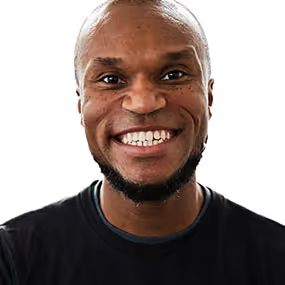
Cornelius Minor, a former Brooklyn middle school Language Arts teacher and equitable literacy reform leader, discusses his book We Got This: Equity, Access, and the Quest to Be Who Our Students Need Us to Be. The conversation blends critical pedagogy, equitable community practice, and the connection between relationships and research.
transcript
Speaker 1 Hello and welcome to season three episode nine of Things Fall Apart from the Human Restoration Project. My name is Chris, and I'm a digital art and media educator in Springfield, Ohio. Before we dive in, I'd like to give a shout out to three of our Patreon supporters, Paul Wan, Lisa Biber, and Jenny Lucas. Thank you for your support. If you wanna learn more about the Human Restoration Project as well as view our free resources and research compilation, please visit us at humanrestorationproject.org and follow us on Twitter at Humores Pro. Today, we're with Cornelius Minor. Cornelius is author of We Got This, Equity, Access, and the Quest to Be Who Our Students Need Us to Be. And he works as a leader in supporting equitable literacy reform across the world. Prior to this work, Cornelius was a middle school language arts instructor in Brooklyn. And we've recommended We've Got This as our July book of the month, and I'm really excited to talk about all the important ideas presented in this work. Let's just dive right into the questions, and we'll just see where our conversation takes us. So what was the inspiration
Speaker 2 behind writing this book? Wow. Well, there were several, actually. You know? And I and I think I've gotta give just, like, big love to my editor, Holly, who is perhaps one of the most brilliant people on the planet. But the the inspiration really for me came out of an intense desire to see, like, good things happening for kids, you know, that I've got one of the best jobs in the world. My job is to support teachers all over the country and all over the world. And and one of the things that I started seeing as I went from school to school is I started seeing that the same kind of kids suffer no matter what community we're in. So if you are born black or a girl or gay or, you know, to poor parents, it seems like, you know, you always catch the worst end of school no matter what community I went to. And so that started to kind of give me this real kind of professional discomfort. And and and I would get angry as I would go from school to school to school, and I'm like, yep. The same kids are in the basement or the same kids are in, you know, a specific track or the same kids are not getting a chance to do enrichment or the same kids are always in intervention. And so I just started asking those questions and and wanting to to approach those in a really constructive way. I think that when we have these conversations sometimes, they are fueled with with intense, not even anger, but rage, and I get that. And and there are you know, that our profession, we're teachers, and that means that we're mostly white women. And and, you know, one of the things I'm finding is that white women don't really respond well to my rage. And so, like, how do I communicate these things in ways that feel, like, really, really productive? And so so the book is a a conversation I've been having with myself for a really long time that I wanted to have with the rest of educational world. Yeah. That that's really interesting. And I appreciate the fact that you shared those measures in this book. And I I really like the way it's written,
Speaker 1 both from, like, a, like, an author standpoint, but also just the way it looks. Like, it looks pretty cool. I like the comic book aesthetic. I like the the oversized colorful pages. It's way more exciting to read than, let's say, like, Paulo Freire or something. It it's cool. Exactly.
Speaker 2 And that's what I was going for. You know? I I've got these ideas. And, again, that's the second inspiration. So how do I communicate these really heavy things in ways that people can receive? And, you know, and comic books have been my first love for a long, long time. You know, when I think about my own connection to literacy, you know, I'm a language arts teacher. And I when think about my own connection to literacy, much of it is rooted in comic books that one of the very first books that I read from cover to cover was Dwayne McDuffie's Hardware Number One in 1992, and that book has stuck with me. So no matter what I've done in terms of graduate school or my own publishing, that that book always resurfaces. And so so Dwayne McDuffie, what he set out to do with his Milestone Comics imprint is a huge part of my literary DNA. And so when I wanted to craft this book, I really turned to what I learned from reading hardware many years ago. Yeah. And let's talk a little bit about how this fits into the classroom and
Speaker 1 what this looks like. So you talk a lot in the book about the fact that this is a very oppressive system. Yes. And the work that we're doing as educators is inherently political. So how do you then balance between knowing that you're trying to push this anti oppressive dogma or narrative
Speaker 2 when you're still working within the system itself? You know? And and that's a really huge, huge thing that I think about all the time, that The United States is empire when you when you think about it in many ways. And that the function of education in empire is actually not deliberate, but it's to homogenize. True. It is to indoctrinate you into the ways of the empire. And so when we think about Rome, like, school is where you learn how to be a productive member contributing to empire. And and we know that empire works when when a few people hold many of the resources. And so one of the things that school does, it puts you in your place. That that that when you think about capitalism, capitalism needs a loser. That you cannot have the uber rich if you do not create a class of the, you know, paycheck to paycheck. And so so really looking at the function of school historically in The United States has been really important for me. You know, even when we think about when you know, we we use the term education, but one question that I often ask is education for who? Because, you know, if you were indigenous at the erection of The US school system, education was designed to literally divorce you from your culture. You know, if you were born a girl, education was not for you. If your parents owed money, education was not for you. You know? And so when we think of it, we we like to say education for all, but we say it in this ahistorical way where we're blind to the history that we have inherited from our forebearers. And so when you look at what school does in a contemporary sense, much of what we call a school are are set of customs and habits and traditions that we inherited from our days when school wasn't designed for people like me. And so so I think one of the things that that I realized is that when you are in a system, you can either choose to operate as expected in that system or you can choose to not. And so I use the the kind of metaphor of a cog that if you've got a machine that that continues to work in one way, and I recognize that, yeah, in many ways, I am a cog in this machine, but I can refuse to turn, you know. And if I refuse to turn, the whole machine breaks. And and now now one of the things that we know that happens is when the machine breaks, they're gonna call a repairman, and that repairman's gonna shine a flashlight on me. And so so, like, what's up with this cog that refuses to turn? And so to be in the machine and to know one's role in one's place, but then refuse to perform it, I think is a really it's a bold thing, and that's what I want this book to do in many ways. I want this book to help people to design ways to refuse to turn. And and and again, we know that the repair person's gonna show up, and the repair person's gonna have this flashlight shine on you. And I wanted to write the book that says when that repair person shines that flashlight on you for refusing to be the cog that turns, you know, one of things that happens is that repair person wants to replace the cog. They wanna take the cog out, this cog isn't turning, and I wanna replace it with another one. And so as a teacher, you like, one of the things that I think about all the time is I've gotta make myself irreplaceable. So if that repair person comes to remove the cog that won't turn, I've gotta be so great at what I do that I can't be replaced, and the whole machine has to redefine itself. And so I just kinda asked the question. I was just like, wow. What if I could encourage lots of teachers to do this? And so lots of little machines would have to redefine themselves in response to the people that we could reach through this book. I I really like that a lot. It reminds me of Jonathan Kozel's work with, like, building a coalition and Yeah. Like, having the parent community backing and no one can mess with you. It feels like it's heavily inspired by the work of, like, community activism. Exactly. I mean, you know, and I've been an activist all my life. So, you know, that so this this book is simply an extension of that. You know? And, you know, I read, you know, Kozol twenty years ago. And or and and and just like that idea that, yeah, here's a thing that we can do. And so I think it's no accident that that, you know, that I've leaned on all of these people who have been doing the work, my own family, my own community, my own ancestors, in addition to all of the ideological ancestors that I have through the literature. Yeah. Let's talk a little bit about then what that work is. And obviously,
Speaker 1 someone would need to buy the book in order to dive into, all the different portions. But I wanna focus in on a few specific things. So at a point during the book, you talk about this distinction between monologue and dialogue as in students have the answers and were there basically to understand them and inspire them to do other things or deeper things. Could you go into more detail about what that looks like and why that's important? Absolutely.
Speaker 2 You know, so much of of what I call Hallmark branded teaching, you know, that that there's the kind of the real gritty work of teaching, and then there's the what they show you on the hallmark channel or what they show you, you know, in Michelle Pfeiffer movies or, you know, Hilary Swank movies. And and and I think that we, as a profession, have really subscribed to this hallmark brand teaching where we say things like, oh, I believe the children of the future and, you know, love the kids, and and and all those things are really, really beautiful statements of ideal. But I think they they undermine our work. And so so we say things like we believe the children of the future, but then we engage in teaching that is all monologue. So I've got an adult at the front of the room pontificating. You know? And if we truly believe the kids are the future, then we believe that they have the answers, and it's our job to help them to to really, like, amplify those. And so one of the things that I've been thinking about is my pedagogy itself, that how much of the teaching and learning that happens in the classroom is my voice, and how much of it is kid voice. And one of the things that we know that is often said in education is the person doing the most talking is doing the most learning. And so one of the things that I've been thinking lots about in a very simple way is how do I design pedagogy, classroom practice that that puts the intellectual labor in the hands of the children? That if I'm standing in front of the room doing all the intellectual labor and people are passively listening to me, then no learning is occurring. That's indoctrination. But I think, you know, when we hand power to kids in this way, one of the things that that means that for me is I've gotta decenter myself. That that so much of teaching has become this kind of cult of personality about the teacher, and really it has to be about the community of kids that I'm serving. And so I'm really interested in, again, to answer the question really specific ways of moving from this, like, teacher monologue to authentic dialogue where we are engaging with children about crafting sustainable futures for them.
Speaker 1 I hope you're enjoying the podcast thus far. I sincerely appreciate you listening in. And if you enjoy the work, please head over to humanrestorationproject.org to find our free resources and wealth of writings. And then if you think we should keep going, take a gander at our Patreon page. For a dollar a month, you'll receive a professional print ready electronic magazine of our work every two months. But as always, all of that work is available free online. I I really like this idea of talking about, like, banal statements in education. Like, I I spoke about in the past on on this podcast as well, like, through blogging just talking about the idea, at a conference or something or in a teacher work room. After there's, like, even, like, a hint of disagreement amongst people, there's this idea, like, oh, well, we're all doing what's best for kids because we all love and care about kids. But that's not really true. I mean, there are plenty of teachers that think they're maybe doing the right thing, or maybe maybe they're not at all. I mean, I think that these kind of conversations are important that we get a little bit uncomfortable every now and then and really examining our own practice because, obviously, there are a lot of serious problems in education that are going unaddressed. And kind of building off that exact point, I wanna talk about because this is a a kind of a happening topic right now with all the different, like, ed conferences going on as well as kind of how education is shifting towards, a certain type of PD model. Basically, what worries do you have about the current education market? So hinting
Speaker 2 at basically, you know, maybe a a few pirates or, you know, something something of that nature. Yeah. And I and I love the the the idea that you use the term market. You know? I think it's exactly that. That's the problem. You know? One of the things that I I like to separate in my work is there is education in the profession, and there is education in the industry. And and and the profession is is what I know and what I love, and it's the people that stay up late with me to craft lesson plans. It's the people that get up early with me to, like, go to soccer practice with the kids at 7AM. You know, that's education of the profession. You know? But then there's education of the industry, and education of the industry is disaster capitalism. It's like, how do we create problems and then ensure that those problems never go away so that we can profit from, you know, from attempting to solve them? You know? So it's it's this idea that when we create standardized tests that are culturally biased and ill suited to measuring a kid's true worth as a human. When we create these tests, we are creating a class of people who will fail them. And when we create a class of people who will fail them, we get to profit off of all the materials. And so so it goes back to this idea that there's there's, you know, the the money is never in the cure. The money is in treatment. You know? That we we know how to teach literacy, and we know how to teach literacy well. And we know that teaching literacy well is relational. You know, I studied Dawn Graves so that we know that you gotta sit next to kids, and you gotta care about kids, and you gotta be, like, tuned into their communities, and to their needs, and to their voices. We know that, you know, and and we can do that for every kid. You know, we put people on the moon. So so so we can deliver solid literacy to every kid, but it behooves the industry to not do so. Because now I can sell you intervention plans, and now I can sell you workbooks, and now I can sell you conferences that promise to be cure alls. And so so, absolutely, I am in love with education, and I have serious, serious, serious misgivings about education industry.
Speaker 1 Going right off of that too. My my favorite line probably in the entire book is when you start talking about this idea of classroom cool. It reminds me of I wish I I'll probably link it in the show notes, but there was a blog I read that was someone who's a teacher talking about how the number one feedback that they get from kids was the fact that they were quote unquote laid back or like a cool teacher. And I like how you lay it out in the book on what exactly that means. As in it's it's not this performative person that goes up and is super zany and weird and like, captures all this attention, but it's more about the relationships that you build. Absolutely. So how do you go about kind of shifting
Speaker 2 the focus from classroom control or putting on a show to making more connective moments with your students? And it's really that idea. It starts with shifting the conversation again. So that that traditional notions of classroom cool means that I need a shtick or a gimmick that I gotta show up and put on a show, you know, which we can all do. But but to really think about cool in the sense of kids trust me, kids believe in me. And one of the things that we know about basic relationship building is you trust people who listen to you, and you trust people who act on what they hear. And and so if I make a demonstrative effort to hear kids and then to craft the kinds of classroom experiences that reflect what I've heard, kids trust me more. And and so so if you tell me like, I had a conversation with a kid the other day. Actually, I was talking to him about, like, how he's gonna spend his summer, and and he happened to mention that he was gonna be traveling to a Pokemon tournament to play Pokemon cards. And and I I, you know, I thought that was really cool way to spend your summer, so I asked him a few questions about And then the next day, I was wrapping up some things in science, and when I used the term evolution, I just kinda happened to drop in via positive phrase, like Pokemon. And that kid sat up straight because and so I'm talking about evolution. I make a reference to Pokemon just because he told me the day before, and and, like, in that moment, in his eyes, what I could see is, like, this guy hears me, You know? And so do I have to know how to name all a 150 original Pokemon? No. Do I have to know how to play the card game? No. But do I have to listen to a kid when they talk about what's important to them and what they value? Absolutely.
Speaker 1 Then when I find little ways to connect what I'm doing every day to what they value, that's the win. Yeah. And you talk in the book too about building spaces to make that happen as well. Absolutely. As in like, you talk about, it doesn't have to be formal. It could be informal. Could you talk a little bit about, this idea of the classroom meeting? Certainly. Like, I am always meeting with kids, you know, in the way that
Speaker 2 you know, I learned this from I had a a physician that would she would talk to me. You know, I'd go to to see her, you know, about every year for my annual checkup, and she would come get me in the waiting room and we would chat. She was like, oh, what are doing there? I see you're wearing a soccer jersey. Have played any good games lately? And she would talk to me about, like, you know, like, my shoes and, like, just, you know, small talk, I thought. But then we would go back to the exam room and she would say things like, okay. So you played three soccer games in the last week. And I'm like, how did you know that? And she's like, well, when you're talking about your jersey, you happened to mention that you were in a game on Thursday. And, you know, and so she would have these ways of, like, getting information from me, but in these really kind of, to use the term, laid back in cool ways where I had no idea she was assessing, you know, my physical health by making small talk. And and I remember being so envious of how much information she was able to collect about me in a short amount of time. And so I I stole that from her, I was like, I wanna be able to do that with kids in my classroom. Like, I wanna be able to make small talk that teaches me about kids and their lives, and and that I could use, and I could act on it, that, you know, that I received. She's probably the best physician I've ever had in my life because everything I said, like, mattered to her, and she used it to her advantage in terms of my physical care. And so I would just really wanted to ask the question, how could I be that as a teacher? How could I listen to them in a way where everything they say, like, becomes part of how I take good intellectual care of them. And so so meetings, the classroom meetings are just a really informal way to do that, that I'll bring up topics just because I wanna hear kids' responses to them. And I wanna hear kind of their disposition, and I wanna see if they get excited when they talk about that thing. I wanna see if they get scared or, you know, or angry when they talk about that thing because that informs, like, what I can bring into the classroom. That informs how I can teach. I really like all the ideas because most of them are I mean, lot of this stuff is common sense to an extent. Yeah. But it's laid out in a way where it feels very scientific. So what I mean by that is is like you have like like a lot of like flow charts and like things where it's just you're organizing your thoughts in a way that makes sense without necessarily reinventing the wheel. Yeah. And, you know, it is scientific. You know, people have studied relationships. You know, I draw a lot from, you know, the neuroscientist David Rock, and I draw a lot from, you know, what we know about behavioral science, you know, Piaget and, you know, development. You know? So I draw a lot from, you know, people's thinking about this. But you're right. It is common sense that if you listen to people, they respond. And so then how can I be really strategic in my listening? It's what I wanted the book to do. You know, if I, you know, show people that I heard them through my teaching and through my being, then they're more likely to work hard for me. So how can I demonstrate this in the book? So those are really big questions for me. And one of the things, again, to to resist this idea of market, I wanted to do things in the book that were free. So many books are setups for you to buy more stuff. And so I'm gonna write about this thing in the book, but then you're gonna have to buy the companion workbook, and then you're gonna have to pay for the other thing. And so it was really important to me that all the resources in the book be free. And so if you go online, all the stuff associated with this book is free from podcasts to videos to printable materials. Because, like, you're right. This is the wisdom that our grandparents handed us. Like, this doesn't belong to anyone. It's it's it's what we've always known about children. And so in many ways for me, it's a return to who we once were as as educators
Speaker 1 in a more inclusive way. Yeah. So let's talk let's kinda shift conversation then to talking more about the system itself and how you go about changing things within said system beyond just your classroom or beyond beyond yourself as just as an individual. And there's a segment in the book where you talk about colonialism and how oppressors tend to fall into that role after failing to fight oppression for a lot of time, drawing from like Freire or like Bava So or could you talk a little bit about the connection that There's veterans that say Veteran teachers that say something like, Well, I'm set in my ways, which is usually not the thing that you want to hear because that's followed by something that's really bad. They're not open to changing in any way. What advice then do you have for bringing those potentially jaded educators
Speaker 2 back into that radical change that they they might have felt before? Yeah. You know, one of the things and, again, this goes back to my physician. I should probably credit her in much of my research. There was a like, I I'm I'm a skateboarder, and I banged my knee up pretty bad one year, and and I had to go have a procedure. And and it was a pretty intense procedure. I I they had to go in with a laser and get something. And I don't know if you've ever had a knee procedure, but you're awake during the whole thing. So they put, like, this blanket on you, and so you can see the whole thing happening. Like, you're numb from the waist down, but you can see everything they're doing. And and and I'm a nerd. And so before the procedure, like, two nights before the procedure, I went online, and I watched every video of that procedure that I could find. Like, you know and so I watched the procedure being done on the left knee, on the right knee. I watched the procedure in old people and younger people, you know, and so I just wanted to be like, I wanted to know what they were gonna do to me. And so by the time I showed up for my surgery, I had probably seen the procedure 30 times performed already. And so I knew what I was in for. And and and so, you know, they they kind of, like, numb me. They start their work on on my knee. And and about two minutes into the procedure, I stopped my physician. And I was like, wait. I've seen this procedure, and you're not doing what they did in the video. Like, what's up? Like, you know? And and she kinda looked at me, and she put her tools down, and really calmly, she said to me, she's like, Cornelius, the video that you watched was eight months old. Like, we have much better medical technology now than we had eight months ago. So if I were doing what you saw in that video from eight months ago, that would be malpractice today. And and and it was just such this clear statement of purpose and understanding. She was just like, yep. Everything you saw in the video was correct eight months ago. But, like, I know more now, and you would sue me if I did that procedure right now to you. And and I think about my teaching in the same way. It really caused me to reflect on my teaching that the thing I did eight months or eight years ago, like, we know a lot more about kids, and we know a lot more about reading and math and science. And and so that we're still teaching like we taught eight years ago, that we're still teaching like we taught eighty years ago is highly problematic to me. And and that if we truly you know, and I think so much of teaching, we say we want the best for kids with our mouths, but then we do what's best for us with our efforts. And and and so so the teacher who says that they're set in their ways ain't here for kids. You know? And I've been really clear about that in public that that when people ask me about my politics all the time, I say that I'm radically pro kid, that that it is our job to create opportunities for children. I think that no teacher would argue that, that that we are ultimately teachers because we want to create opportunities for kids, and really because we want to eventually teach them how to create opportunities for themselves and for others in their community. And so that being said, anything that abridges opportunity for a child is my enemy. Like, that and so if my belief in yesterday's teaching is limiting a kid's opportunity, I gotta stop that. You know? And and I think that that's been really important. And so when when talking to those teachers, one of the things that often happens in in community discourse is we make it about the person. So we're like, oh, that person is a bad person because they wanna do this thing. It's not about the person. It's about the work. And so often when I talk to those people,
Speaker 1 yeah, like, you're here because you love kids, but let's work in in smarter or more efficient ways. And I guess actually this builds into the final question. I'm I'm really curious about your thoughts on this, because it it's something that it's like a really awkward thing to talk about because teachers don't usually like getting too political. But at the same exact time, if we're going to be radically pro kid, mean, there's no denying it. There is systemic racism, systemic classism, serious issues where kids come into our rooms that it's very difficult to give them a satisfactory education because they don't have food or they don't have basic human needs. So is there a place for teachers to be banding together for political organization
Speaker 2 in order to change these systems of inequity that are occurring? First of all, like and I think it's really important to name that teaching is political. That the greatest lie that hegemony ever told was that our work is apolitical. That that, you know, our salaries are decided in some communities by vote. You know, that's political. You know, that school districts are made and gerrymandered by city councils. These are political, that budgets are made you know? And so, literally, the food that I put in my mouth that I draw from a paycheck that I get from New York City, that's political. You know? And so so for the belief that teaching is apolitical, we're lying to ourselves. That that that the city councilman that I elect dictates how much money I take home every month. You know? And and and the city council people that I elect dictate, like, the curriculum that we adopt, the textbooks that we buy, the resources that we're allowed to share. And so so teaching is inherently political. But I borrow a lot from I have a great mentor, Bob Probst. And one of the things that he has pointed out to me time and time again is, you know, when we, like, you know, kids come to school in kindergarten and we teach them kindness. Right? And so the first lesson you learn I've got a five year old daughter who started kindergarten this fall. And the first lesson that you learn in kindergarten is that you are kind to others. And and if we teach kids to value kindness, we are implicitly condemning those who promote cruelty and indifference. And so so so that I'm teaching kids in class to be kind, that's an implicit condemnation of politicians who are unkind. You know? That if I teach kids to judge individuals on their merits, that's an implicit condemnation on those who judge based on stereotypes. And so even my teaching is political. So, like, yeah, kids come to kindergarten. I'm like, yeah. Be nice to others. And yep. So that is a statement on those politicians who use their office to not be kind to others. And I think when we really look at what we're teaching, everything is political. You know that I'm a reading teacher. I teach kids to value information. And one of the things that Bob Probst has taught me is that when I teach kids to value information, that's an implicit condemnation of those who create misinformation. And so and so I'm teaching you to value evidence in my classroom, and we've got certain politicians who do not value evidence. My lesson that teaches you to value evidence is a condemnation of those people. It's implicit. And so so everything that we do is political. I mean, it's obvious that educators
Speaker 1 have a lot of work to do, especially in certain segments of the country Yeah. Given the fact that, I mean, there's literally concentration camps going on right now. So, I mean, there's there's a lot of work to do. Exactly. You know? And that's
Speaker 2 yeah. You know? And that's been, you know, it's when we think about oppressive systems, and this is why school like, this is why I choose to work in school, that that that for the most part, most of the kids that we encounter will, you know, hopefully never be in a in a camp, a state sanctioned camp. You know, most of the kids we encountered will not be murdered by the police. Most of the kids that we encounter will not be, you know, you know, victims of some, you know, voter, you know, disenfranchisement. But all of the kids that we meet will encounter a teacher. And and so when I think about state sanctioned violence, much of the state sanctioned violence that is suffered by children happens at the hands of school and teachers who work in them. And and when I talk about violence, I'm not you know, I don't mean, like, putting your hands on kids. But when you when I think about you know, there are many scholars who have noted that that when somebody as powerful as a teacher constructs a world through books and text and media and experiences, and they construct a world that and I'm not in it, that's an act of violence. And so so if I'm a teacher and I've got books that don't reflect the true diversity of the community that I serve and kids don't see themselves or there are vast silences in the curriculum, kids go home feeling less than human, and that's an act of violence. You know, if I'm a teacher and I fail to see the full humanity of my children with disabilities, that's an act of violence. You know, if I'm a teacher and I fail to teach in ways that honor how kids learn, that's an act of violence. And so, again, you know, we live in a world where not every kid is gonna encounter a bad cop or not every kid is gonna encounter a state sanctioned camp, But every kid encounters a teacher, and if that we're perpetuating these implicit and silent acts of violence, then it's just as bad as the other things. You know? And, you know, that when we think about just like the human condition, one of things that we know from Piaget is that people are born with, like, infinite capacity to learn and to grow and to care about things and to be curious. But but through school and schooling, people become less curious over time. That's violence. And and that's a direct result of the kind of institutionalization that we do to people when they enter our doors. And so I really wanted to use We Got This as an opportunity to undo that kind of violence. You know, because if we can undo that really benign violence that happens in classrooms, that will give us the practice to undo the more vicious forms of violence that we're seeing in our headlines today.
Speaker 1 Thank you again for listening to Things Fall Apart from the Human Restoration Project. I hope this conversation leaves you inspired and ready to push the progressive envelope of education. If you have time, I'd love for you to leave us a review on iTunes, social media or anywhere that you see fit. I mentioned iTunes specifically because the more ratings we have there, the higher we rank on the education podcast list. And the more listeners we have, the better we're gonna do. We can't do this without you and I'm humbled by the opportunity to help broadcast this message to as many people as we possibly can. And we've grown so much our average unique podcast listener number has jumped from maybe two to 300 an episode to over 2,000 in the last year. And our website traffic is up 10000% in the last three months and our Patreon supporters continue to climb. So let's push forward together and restore humanity.
resources
- We Got This: Equity, Access, and the Quest to Be Who Our Students Need Us to Be · Cornelius Minor (book) Blends critical pedagogy, equitable community practice, and relationship-driven research in an accessible format. link →
- Kass and Corn · Cornelius Minor (website) Minor's professional website offering resources on equitable literacy reform and community practice. link →
- Heinemann Author Series: Cornelius Minor and Kwame Alexander · Heinemann (video) Author series exploring literacy leadership perspectives from Minor and Alexander. link →
- Cornelius Minor (person) Former Brooklyn middle school Language Arts teacher and global leader in equitable literacy reform. link →