

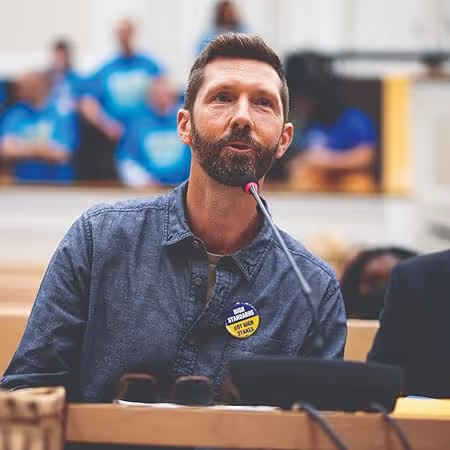
Jack Schneider and Ethan Hutt discuss their 2023 book Off the Mark, which examines how grades, transcripts, and standardized tests undermine learning. They trace the historical roots of these tools, explain why reform has stalled, and outline realistic paths toward change that educators must build together.
transcript
Speaker 1 I think my great hope for this book is not that people will read it and say, great. Look. We're gonna go with double clickable transcripts. We're gonna go with overwritable grades. We're going to restore the use value of education. Right? That's not our hope. At least it's not my hope. My hope is that we will just make visible the water in which we swim. That's my hope.
Speaker 2 Let's start with the bad news is how the conclusion to my guest's book about changing grading practice begins. No one is coming to save us. No consultant is going to sweep through and fix things for a fee. No new technology, digital, online, or otherwise, is going to change the game. The game, of course, is school, and the currency of that game is grades. Jack Schneider is Dwight W Allen distinguished professor in the College of Education at UMass Amherst. He's the executive director of the Beyond Test Scores Project, director of the Center for Education Policy, co editor of the History of Education Quarterly, and co host of the Have You Heard podcast. Ethan Hutt is the Gary Stuck faculty scholar in education and associate professor at the UNC Chapel Hill School of Education. Their 2023 book, Off the Mark, How Grades, Ratings, and Rankings Undermine Learning, but Don't Have To, is a thorough and at times frustratingly pragmatic exploration of the flawed necessity of the load bearing pillars of real school. Grades, transcripts, and standardized tests. Their origins in our nation's history. The distorting effects they tend to have on the outcomes and goals of education. Why nothing has arisen so far to replace them at scale, and why there are no magic potions. No one is going to wake up one morning and realize that the answer was staring us in the face all along, they remind us. Balancing the real with the ideal, they also chart a path toward the possibility for something different. And like the grand experiment of public schooling itself, it's something we'll have to figure out and build together. Jack and Ethan, thank you so much for taking the time to be with me today. Yeah. Thank you for having us.
Speaker 1 Yeah. That was an amazing introduction.
Speaker 2 I I think we're gonna have to transcribe We'll just do that for sure. And use it ourselves. Yeah. So I I figured we would just start right away with that bad news part. Let's start at the end. Right? Tear the bandage off right away. Because if I understand the book correctly, we won't be getting rid of grades, transcripts, and standardized tests for public schools at scale anytime soon. So why the heck not? So let's start there.
Speaker 1 Yeah. It's a really good question. And one of the things that I continue to joke about when we're doing interviews about the book is the fact that we probably could have sold a lot more books if we had said something different, if we had said, you know, all you need to do is follow the Hutt Schneider four step plan for weaning yourself off of grades, tests, and transcripts. The problem is that they are so baked into not only the infrastructure of schooling and education and credentialism, but also to the culture of of schooling and American life. So let's start with the latter of those two. Right? If you dropped your kid off at a school that didn't give grades, right, what are the odds that you would say, this is fantastic. I love that the school is going to focus on intrinsic motivation rather than extrinsic motivation or any of the other positive things you might say about that. Right? I think most of us would say, well, how is my kid gonna get into college then if there are no grades? Right? If you dropped your child off at a school that had no transcripts. Right? Let's imagine it's it's a college or university. Right? Your child has already successfully passed that hurdle. You would likely wonder, well, how is my kid going to be motivated to work hard knowing that, you know, he or she or they is they're now 18 years old living on their own, and and there is nothing holding them accountable for making good on tuition payments there. So there's the cultural piece that we need to deal with, which is reinforced by the fact that we've all been through school ourselves. So this isn't just about the culture of the present and the ways that we use grades, tests, and transcripts in our lives. It's also about the fact that we have expectations about what a real school is and does. And then there's the infrastructural piece, which is that there are all kinds of decisions that are being made all the time on the basis of test results, grades, course titles. Right? That that's a feature of transcripts that we often ignore. We often think of transcripts merely as places where grades and test scores reside forever permanently, but there are also places where course titles live. That offers an additional venue for students to game these metrics, and that's something that I'm sure we'll get into in this conversation. But that infrastructure would be very hard to totally upend when we're talking about 13,000 school districts, 98,000 public schools, never mind, you know, 20,000 or so, 30,000 private schools that we could add into the mix, and thousands of colleges and universities. So it's a major, major undertaking to do anything. And I think what we're trying to do in this book is convince people this is this is worth our time and energies.
Speaker 3 One of the things that we try to do, as historians of education is try to understand, like, where do these practices come from? And what Jack is talking about, both the cultural piece and the idea that it really holds our system together, the idea that we use common metrics, the idea that, we have a common way of presenting the work of school and that works not just for, parents of students, but also future audiences of those transcripts, so colleges, employers, that all of these things, and we often in the book talk about grades, tests, and transcripts as technologies because that's what they are, that these technologies were invented for a particular purpose, and those purposes endure in our system. So we need to communicate. We need to motivate. We need to synchronize our system. And so as much as we would love to sell more books and just be like, well, to hell with grades, you are you're you're removing a core function of the system, and you should expect that the system is gonna respond. And so we'll, I'm sure, talk about it, but lots it's not that people have had no ideas about alternative ways, but it's whether those ideas can actually fulfill the purposes for which we first invented these things. And so part of the conversation in the book and one that we're hoping to have with educators around the country is, okay. Let's think about those purposes. Let's think about what our technologies are doing, And maybe it's time to take advantage of new technologies to update some of our practices, but you're never gonna get away from those sort of core functions that, grades, test scores, and transcripts perform. And if you if you pretend otherwise, you're just you're just selling something.
Speaker 2 Yeah. I I think you all said it very well in the book over and over again that schools, you know, the American education system, as much as it might be anathema now to kind of say this, but they're inherently conservative institutions that resist, you know, these kinds of radical changes. And and we'll get to, I think, the solutions that you all offer, but really reducing the the potential for both top down and the bottom up reforms back to those first principles and really seeing how can we change it to help meet communication, meet the need for synchronization, and meet those other needs that grades, transcripts, test scores help communicate really does chart a very clear path forward. But I think before we we get to that forward path, let's actually look back to perhaps the origins of the book. You know, you wrote in the introduction that the the project started before COVID. I don't know if that was, you know, 2019 or just early twenty twenty, but, you know, COVID, for all of its horribleness, did provide a kind of case study for how the education system responds to these drastic dramatic changes. And perhaps we can talk about more of what we saw in that, but I just wanna know too what led you both to start collaborating on this topic, on this project, the stuff that eventually became off the mark.
Speaker 1 Well, we're looking at each other. The project started, I think, way back when we were in graduate school together. Ethan and I shared a dismal And, basement office with each you know, to bring people really behind the curtain, this office was so bad that if you sat at Ethan's desk and your office mate was not sitting at his desk, that the light sensor that needed to sense movement from you in order to provide illumination would not register that anybody was in the office. So I would often come back to our office and Ethan would be quietly working in the dark. But but we have been friends and collaborators for, gosh, at this point, you know, fifteen years, maybe closer to twenty years. And one of the things that we're both really interested in, and I'll defer to Ethan for a more detailed description here because he tends to to be more precise in the way he talks about this stuff than I am. But one of the things that we're both really interested in is the way that behavior and action is shaped by things like rules and measurement and systems that are often based on really thin information. Right? I just speaking only for myself here, we are such interesting, complex, thoughtful, capable life forms. And yet we pin ourselves in with these very thin rules that are not able to capture the thickness of life or the richness of what we can work through in terms of human deliberation. And for me, that irony, and it's a kind of tragic irony, is really interesting, and we could look at it anywhere. But I think it's it's most interesting and sometimes most tragic in education because we do it at such large scale, and we do it for what we think is, you know, the the best interests of 50,000,000 young people who are in the schools.
Speaker 3 Yeah. I was just I I mean, we've always I think Jack and I have always shared an interest. We had a mutual mentor in David Tyak who always talked about, you know, the important part of the grammar of schooling. So those things in the school that we take for granted and they're just you know, when Jack was talking earlier about, like, when you show up at a school, how do you know it's a school? You know, all those things. You know, that's part of the grammar of schooling. It's what we expect. It's how we communicate about, you know, education systems. And I think we've always shared an interest, in kind of thinking about, okay, the pieces of that grammar and where they came from and what they do. And I have had in my work, both with Jack and without is, a particular interest in how we communicate about the work of schools to the public. So, you know, whether it's test scores and grades. And so one of the interesting things about these technologies, these assessment technologies, is that they have multiple audiences, and those audiences have expanded in scope over time. And so thinking about how these practices have evolved has always just been really fascinating to me. And just, you know, we we wrote a piece, our very first, I think, collaboration together, I think it was in 2014, we we first wrote about the grading system. And, you know, we just kept coming back to those kinds of of questions. And then, obviously, you know, we've all experienced together No Child Left Behind, which added another layer of, you know, this sort of communication. So thinking about those practices, and, again, coming from them, as you said, like, from a a place of, like, there's preserved wind wisdom in in some of these inherited practices doesn't mean they're perfect and can't be improved. But I think, especially when you look at the history of school reform, too often, we have reformers who are like, I know better. The teachers don't everything is broken. Let's throw it out. And, you know, my sister is a second grade teacher. My mom was a teacher. When you talk to teachers, they have a lot of of understanding and knowledge about the system. And so this idea that schools are conservative or that reform should approach things in a conservative way, what we're talking about a lot of times is preserving the both the shared experience of folks, but also the the knowledge. When teachers look at a lot of reforms, they go, that's not gonna work. You can make me try to do this, or maybe I will just not do it, but it's not gonna work. And so thinking and treating the system with care rather than just taking a wrecking ball to it, which may may speak to our kind of, like, our deeper, you know, let's let's burn it all down. But practically speaking, those reforms are not are not built to last. No.
Speaker 2 That's what I think I mentioned in the intro, right, was that frustrating pragmatism. As someone who kind of considers them you know, myself as a when I was in the classroom practicing grades, really leaning into ways that I can diminish, you know, the salience, the importance of of grades and grading, really changing reporting practices in my own practice, and now, you know, working at that big systems level to try and say how can we improve the system both for students, but also make it workable for teachers and and community and parents alike. Like, trying to triangulate all of those needs can't be done simply by changing one part of that equation. Right? You have to get all of those folks at the table and ask what is gonna work to meet the needs of everybody. And really, you know, primarily the work that we that my organization does is focus groups with kids, with community members. And when you actually sit those two groups down and look at what they say about the changes they want the system to be, kids and parents predominantly, like, agree on the ways in which that system could change. So there's a lot more, I think, collaboration there than, again, leaders who are kind of at the top of the system trying to move those top down reforms without getting buy in from teachers, or teachers not getting buy in from students, or schools not getting buy in from parents. Right? We've kind of lost that community aspect to it. I really wanna know then in the process of researching and and writing the book, which sounds like it'd been going on for basically, this is the culmination of a of a decade of of work on this, a fifteen year collaboration. What about that process of research and writing this book either challenged, affirmed, or, changed your perspectives on grades, transcripts, testing, any one of those kinds of concepts that you guys look at?
Speaker 3 So it's interesting. I mean, there's so much that that you learn. I think the very first thing, that I learned was, you know, the way it's sort of where you started where, you know, you kind of are led to believe, you know, when you enter, like, oh, American public education is bad and the you know, Finland has the answer and Germany has the answer and, you know, Korea has the answer and the Soviets have the answer. And, like, the very first thing I you sort of realize as you look at other practices, and especially if you take seriously the idea that, you know, it's that there's a cultural element to these, practices, that there's no secret sauce in. I mean, it's like, you can you can take some exotic, you know, practice. It's like taking a plant out of, like, you know, the rainforest and then moving it to, like, the desert of LA. It's like it's like there's so much that goes into these prank it's not a it's not a technical problem in the sense of, like, oh, you just you just grab something off the shelf or grab some secret practice. I've spent time abroad, I figured this out. You know? And once once you sort of give up the idea that there is some holy grail out there of practices, And as you say, focus on, like, the sort of human element. Like, what are the problems that these folks were trying to solve over time? You know, you just realize how embedded they are. Like, one of the things that never really had occurred to me in a in a real concrete sense until I got into it was, like, how there really is historically a real symbiotic relationship between this idea of local control, the idea that we want communities to be able to make decisions for themselves and have flexibility in talking about what practices make sense, what courses make sense, what trajectory for our students makes sense. And this need, because we live in a very large country that's has a decentralized system, and I think most of us, like, on a on a regular basis like that, that we have a school board and we have teachers that have flexibility, that that almost requires somewhere in the system some standardization, some points of synchronization, as we call it in the book, that allows people to move from that decentralized local practice to some higher level. And you see this with transcripts and this idea that we need a common currency to record, like, well, how much learning is learning? We need a unit, and we give time, you know, pride of place there. But same with, you know, things like the SAT. I've done work on the g the GED. Like, having these these tests that kinda sit on top and allow for flex in the system, those practices come together. So we often talk about standardized tests and grades as separate. And one of the things that we really liked about the book, because we had done that in our own writing, having them separate, was putting them together and actually say, like, you can mess with these, but often the other one is picking up the slack. So if you wanna get rid of the SAT, you're putting more weight on grades. And if you wanna get rid of grades, like some countries do, they're no one looks at transcripts. Gonna put all the weight on, you know, attested. So thinking about how these are actually sort of in conversation, they're they're linked in the system was one of the big revelations is that we have to think about these as a whole system set of practices and not just, like, tinker with one practice or the other.
Speaker 1 Yeah. Ethan got into this in in his response there, but one of the things that I learned from him along the way was to be a cold hearted realist about this and not just be a dreamer. I am a former classroom teacher, and and I think it is my inclination to try to take big swings at things. And I think had I tried to write this book or do any of this work without Ethan, I might have verged into, you know, not snake oil sales, but, you know, I think dreaminess. Right? Like, I'm good at identifying all of the problems that exist. I I I can just rattle off all of the ways that grades distort motivation and undermine the kind of communication that educators in their hearts want to do with young people. I can tell you all of the ways that standardized testing, whether it is run by the state or an external entity like the college board, is designed in a manner that fails to incentivize real authentic learning, undermines the practices of educators that are responsive to the real needs of young people. Right? I can go on this all day, but what I don't naturally do is think about the usefulness of things like standardized tests or the ways in which grades actually do serve a real important purpose, including for equity, which is often a critique that I will level against grades. But, you know, one of the things that I learned from Ethan in doing this project was that a grade has just enough vagueness to it, right, that it can allow for important kinds of of slippage. And what I mean by that is that we take for granted that a course title has a particular meaning and that a grade in that course has a particular meaning. And that allows for formal equity in our educational system in a way that I think it is hard to imagine existing if we said, well, let's allow let's allow people to just use their own judgment with no formal guidance, no restrictions, no rules here in interpreting what it means that a student in a high poverty community from a historically marginalized group took a particular math course and has a particular kind of recommendation from their teacher. Right? And so although I, earlier in our conversation, you know, made a little speech about, you know, the thinness of information and the way we pin ourselves in with rules, you know, I think I'm speaking to my my natural interests there. But one of the things that I learned in this project is rules also at the same time are really important. And so one of the things that I think we do in this book is try to help people think in clear ways. Like, we have a lot of faith in educators and in families and some faith in policymakers, but to to try to structure for them a way of thinking through when are rules useful. Right? When is data productive? When are these kinds of assessment technologies really important? And then where do we need to really blur the edges? Where do we need to remove some of the rules? Where do we need to to pull the guardrails a bit wider?
Speaker 2 I will say it was definitely interesting to read because I felt that tension, that push and pull between, you know, that pragmatic realism and then that but that that the pull of the the push of the idealism there too. And I think as an idealist or as a dreamer, you know, myself, I I found myself having to sit in that tension, right, and and grapple with that reality of it. And, again, I appreciated how the book just brings it back to the first principles, to the history of how these practices even emerged and just kind of distilled them down into their most component parts to say, look, the the we can kind of change within this range of options here to diminish distortions distortions or to increase equity. And basically, we can fiddle with the sliders, but these three ideas have emerged to serve a particular role. And I think kind of shifting the conversation perhaps towards those potential solutions where where you guys found them, either internationally. There's a whole section in the book where you spoke with international teachers abroad and spoiler alert for anyone out there. Right? They didn't find magic potions out there either in in any country that they they talked about. But what, you know, what does the successful reform of these practices, be they grades or transcripts or the standardized testing components, what does that look like in your view? Like, what examples did you find abroad, here at home, contemporary ones in the mastery transcript or historical examples that you pulled? You guys draw from such a wide well of disciplinary knowledge. Right? And then, yeah, how do we realign the goals of grading assessment reporting with the goals of learning?
Speaker 3 So I'll give my favorite one and then Jack, I know has a different favorite one from from the book. So and first I'll say, you know, idealist out there who just needs someone to ruin their day, I'm happy to get on the phone and just, you know, tell you I've often joked that I should just start, start a consulting firm that's just called, dude, that's not gonna work. And I'll just explain to you why it's not gonna work. And you can take it early. You know, you're not please don't listen to me. That's no fun. That it's the what's nice about writing with someone who has a little bit of a different temperament is, like, you do get that push and pull, and I am glad that it that it came out in the book as as being a real conversation between, you know, the two of us. And we've had people say, so which sections did you write and which section and it's like, no. There it's it's really, like it's it's really interwoven in that way. So I'm I'm glad it comes through. So I'll give a good example of of something that it feels like the the history of the practice helps inform, you know, kind of a a new way of thinking about it that recognizes the value and recognizes the the the challenge, but actually moves us forward. So, you know, historically, if we think about a transcript, there were very concrete, practical, physical reasons why you needed a transcript to be short. It needed to have it needed to to to distill all the richness of an education to a single sheet of paper. Because in the world before computers, like, those transcripts were housed in physical spaces, in filing cabinets, and you needed the school to keep that for a very long time. So there's a real physical space reason why it made sense for schools to try to distill and have a real economy of communication, economy of record keeping around student transcripts and student, you know, student performance. But those space constraints don't really apply anymore. I mean, we you know, my transcript takes up, like, a few bytes of space on a computer that basically has with the cloud, like, infinite space. So one of the ideas, that we talk about is that, you know, if one of the challenges of the transcript is that the information is so thin, I can I can bug Jack to give me a slightly higher grade, and he can record an a instead of an a minus, or let's be honest, an a minus instead of a b plus, then, we can you know, then I know that, you know, mission accomplished? No one's ever gonna see that essay, and no one is ever gonna be able to decide whether my final project was or wasn't an a minus or b plus or whatever. It's like once it's on the transcript, like, that's the end of the game. But and and for reasons like I explained, like, the the the the lack of space means that there's no work behind that grade. And so one of the things we talk about in the book, one of the things that seems very within reach is if we made transcripts what we call double clickable. So if you could, for instance, not only deliver your transcript, but behind the grade of that transcript existed any, any amount of work that reflected the work behind that grade. We argue, and I think it's it feels right to me that that helps focus the learner and the the the whole enterprise of education around what is the learning that is associated with that grade. By reattaching the work and the work product to the grade that sits on the transcript, you allow people to to to to focus on not just the letter, but what's actually learned. And you can tell someone, a student, say, look, these are not gonna be detached forever. Like, someone's gonna look, and you should actually want them to look because then they can see all the things that you did and all the things that you accomplished, and maybe they even see the whole process of your accomplishment. So by making a transcript, by thinking about, like, okay, the limitations no longer apply, we can recenter learning. We can recenter the actual product of learning rather than just have students motivated by that, by that letter on that transcript.
Speaker 1 Yeah. Ethan allowed me to to go with my favorite here. So I am really enamored by the idea of an overridable grade. So, you know, I'll start with the buzz phrase there where we are referring to basically the digital capacity to replace old information with new information. And I'll back into an explanation of how we arrived at that as a possible way of tinkering towards reform. So one of the things that we talk about in the book is the fact that these assessment technologies arose to serve different purposes. And those purposes can be, you know, sort of shorthand conveyed as the purpose of communication. And there are actually two distances of communication that we talk about in the book, a short haul communication, right, an educator trying to communicate with a student and or their family and a long haul communication. Right? So the school, the educator, and sometimes even the student themselves having an interest in this communicating with distances. And long haul communication where an educator or sometimes the students themselves have an interest in communicating with audiences at a distance that is either geographic or temporal. Right? Communicating with people who are really far away or who are in the future. So that's communication. Then there's also motivation. That one's pretty obvious. Right? The use of assessment technologies as a way to try to get young people to work hard and show up. And we'll just name the fact that, you know, we have compulsory education laws for a reason. Right? There are lots of other things to do in this life than go to school. And then third is synchronization to try to stitch together the component parts of a very large cumbersome and mostly decentralized system. Well, let's just talk about the communication function that grades served in their origin. Right? They were serving a short haul communication function. They really were an effort to communicate in shorthand with students' families. And that was related to motivation very much, right, because the idea was maybe we can get these young people to work a little harder if their families know that they aren't applying themselves in school. And maybe we can get them to continue to work hard if their families praise them for all the good work that they're doing. So these purposes aren't always necessarily disconnected from each other, although they do often work across purposes. And so let's just consider how the fact that grades over time so as we move from the early to mid nineteenth century into the twentieth century and into the mid twentieth century, we can see the grades are increasingly being used by the time we arrive at the mid twentieth century as a way of communicating with much more distant audiences. Right? By the mid twentieth century, high school enrollment is pretty close to universal. We are moving closer to universal high school graduation. We still aren't there yet. We may never arrive there. Right? But we get close enough that we get far more students attending college as a way of trying to distinguish themselves, and we see very real labor market benefits for students who get high school diplomas, who have good grades as a result of hard work in high school, and who go to college. Right? And very real labor market returns for students who graduate from college and get good grades. And so we can see that students develop this very real interest in getting good grades in order to reap the rewards of what is essentially a credentials market there. So we've got two different forms of communication there. And if we think about the ways that they are not really designed to work together, we can begin to see problems. So the idea that grades were originally intended to serve a short haul communication function and then eventually get used to serve this long haul communication function leads to a problem where educators will often want to say, hey. You don't get this. Right? I'm trying to communicate to you with this grade that you do not fully understand this material, and I would actually like your family to know this because lo and behold, families care about the young people who live with them and want the best for them and often can intervene. And we could have a whole separate conversation about how we end up in this country mostly offshoring the responsibility of giving extra assistance to families and the free market rather than doing it systematically, which is something that grades could actually serve a useful function in. But we can see that if you're trying to send this message to students and their families, hey, you don't get it, you're also doing something at the exact same time, which is ruining that student's future. Right? That's how the student is gonna interpret it is, hey. You thought that you were sending me a message by giving me a c in algebra, but do you know what you actually did? You actually put a black mark on my record. And this can be not just a problem for ambitious students who wanna get into highly selective colleges and universities, who wanna have pristine transcripts, you know, and and have more than a four point o grade point average. Right? This can be devastating when we're talking about students for whom school isn't a natural fit, for whom, you know, there are headwinds rather than tailwinds. Right? These black marks on their records pile up. And if the incentive is, hey, go to school and work hard because that's going to open up social and economic opportunities for you. Well, if they see, hey, listen. I've already got a bad enough academic record that I'm not gonna benefit from this. Right? Then that further undermines the motivation of those students. So that's a long wind up to a way of dealing with this problem, which is to say, well, if you made it possible to overwrite the student's grade once the student gained the relevant knowledge or skill, you could actually have it both ways. You could actually communicate to the student and their family, hey. You don't get it right now. Right? Right now you've got a c in algebra or geometry or English literature or physical education. Right? You've got a c. But that's not where this story needs to end. And the example that I always give, right, Ethan's gonna get sick of this example, is that none of us knew how to ride a bike once upon a time. Nobody came out of the womb on a bicycle as far as I know. Right? But if we had been graded at the point in time where somebody had arbitrarily said, let's see if you can do it, many of us would have failed, and we would have had to carry around on our transcripts, an f in bike riding despite the fact that the vast majority of us later learned that skill. Right? Why carry around outdated information? Maybe you did fail algebra, and maybe you then learned that skill. Why carry the f forever on a transcript instead of being able to overwrite that information with more accurate information that actually is going to better serve the purpose of communicating to future audiences what you know and can do?
Speaker 2 I think that's another thing that I appreciated about the book was in in the sense that you explore historical examples of narrative reports and of portfolio systems and all of these other kind of one size fits all replacements, right, that were meant to replace, upend a revolution in grading, testing, reporting, and all these things. And really, I think, a message that I took away from the book was certainly that, you know, these hybrid models where, we're kind of Frankensteining together the best purposes of every kind of system are going to be the things that are ultimately going to make any successful grading, reporting, testing reform work in the long run is not trying to replace one the flaws of one one size fits all with the flaws of another one size fits all, but really trying to take the good where we can find it and wherever that might come from. And again, that that's not a huge appeal to my dreamer idealism, but gosh, that makes a lot of pragmatic sense as somebody who has to work within the system, who has kids in the system too, who has to attend to systemic coherence. So again, I appreciated that long view both historically and then, you know, in terms of depth of our system and the need to communicate from k 12 and beyond to employers to to the whole nine yards. I think then one thing, of wrapping up the conversation here, is just to get from both of you kind of a sense of what do you think is really missing in the public conversation around grades, transcripts, testing, the focus of the book? And what would be your goal about how we can speak about these things differently, or how we can enrich the public conversation, short of buying your book, of course, but then how can we speak to people differently about these distortions and the problems and the benefits and the equity and the need to communicate?
Speaker 1 I'm gonna beat Ethan to the buzzer here just so I can respond to the thing that I think we both wanna respond to before the question, which was your comment there. And both of us owe a debt of gratitude to David Tayak and Larry Cuban because totally embedded in the way that you were just describing our project are some ideas that entirely come from them. And this idea of Frankensteining or hybridizing, that's a Tayak and Cuban idea. And the idea that, you know, we we can't just wash away the past, that every layer of educational policy, every layer of the culture of schooling builds upon the previous layers. Right? That's a Tayak and Cuban idea. And even our dedication of the book, Right? The book is dedicated to our students is a rip off of David and Larry, which is not to say that the rest of the book is, but we would encourage people to read side by side our book with Tinkering Toward Utopia by David and Larry. So now I'll actually answer the question and try not to be so long winded and then kick it over to Ethan. But I think my great hope for this book is not that people will read it and say, great. Look. We're gonna go with double clickable transcripts. We're gonna go with overwritable grades. We're going to restore the use value of education. Right? That's not our hope. At least it's not my hope. My hope is that we will just make visible the water in which we swim. That's my hope because I know that I speak for both of us that we have tremendous confidence in the three and a half million educators who are at work every day in this country. We have tremendous confidence in the ability of the 50,000,000 students who are in our public schools to speak up for themselves, including in the kind of work that you guys do. And we have a lot of faith in families who really want the best for young people, but but we inhabit an educational policy space and an educational culture that makes invisible practices that are totally ordinary to us. Not ordinary because they don't have any negative unintended consequences or don't matter, but ordinary because we completely expect them. Right? We talked earlier about quote, unquote real school and the grammar of schooling. Right? It would be odd to us if we didn't see grades, tests, and transcripts. And in fact, we totally expect the unintended consequences as well. Right? We say things like, well, tests are just a part of life. Right? Or we will say out of one side of our mouths, you know, hey. You should be, like, really focused on learning this material. This material really matters. And then out of the other sides of our mouths, we'll say things like, hey. You have to get a better grade in this course. Right? You don't wanna have this on your transcript. And so what what my big hope is is that people will read this book and think about grades, tests, and transcripts not as ordinary features of real schools, but as technologies that we continue to choose to use often inappropriately every single day in school, one hundred and eighty days a year for all thirteen years of the k through 12 experience and then into higher ed for students who go to four or, you know, in our case, you know, ten more years after that. So if we can see what is presently invisible to us, then we can talk about it. And if we can talk about it, then we can act.
Speaker 3 Yeah. I am gonna just echo. I mean, I I the single I'm not an ideas person. I'm a I'm a I'm a grumpy person. I'm I'm a person who's telling you it's not gonna work. But I do I do think that it it strikes me when when I listen to people, like, struggle against our grading system and they you know, we saw this in the pandemic where lots of things were disrupted and people were having really difficult conversations in the public about what was fair and what was possible and what would happen and the long term consequences, and could we set this aside, and should we just give everyone an a, and what would hap like, it struck it struck me as that what we lacked was a real common language for having these conversations. And so, you know, especially, I think the project started before the pandemic, but what the pandemic, I think, really added to the book was really it it it foregrounded for me and Jack that we needed to give people one of the best things we could do is give people a language to talk about all of these different functions that grades serve and then their underlying like, where they come from in the system. And once we provided that and if you look at the last chapter, it's we really imagined the last chapter being like, we we thought, like, well, maybe my sister and her colleagues, you know, would sit down with the book and say, okay, let's think about our practices. And now that we have this language, maybe we can talk about, okay, what about this and what about this? Because we really do believe in the in the strength of a of a of a plural approach to to learning and that there isn't a one size fits all. And so providing a language why that people could be on the same page and talking about it, but arrive at different conclusions about what makes sense for them and their students or their communities. That to me was the big, the big step that we can take forward because I will not I mean, we have solutions. We we pitch some to to your listeners. But it would be totally fine with me if everyone decided that those were bad ideas. If they said, okay. Actually, what what we're what we need is not the double clickable. What we need is this and this, and we can serve those functions. So providing some clarity, and hopefully, the history kinda comes through and people can see why we got to where we were. It wasn't just bad actors. It wasn't just random. It wasn't just some, like, factory model that someone you know, it these are these are learned things that that have accreted over time. So that's the big thing that I hope people will take from the book, whether they like our solutions or not. And that's the whole thing I hope that will endure and and sort of animate or help illuminate conversations in the future.
Speaker 2 Right. None of these systems fell from the sky in a single piece to be implemented as is. Right? They're the result of, you know, that both the social construction, the historical construction, but I think to emphasize that construction part recognizes how it's situated in the past and in a in a collective reality, but also kind of recognizes the potential and possibility that, hey, we can do something different to help meet our needs and the needs of our kids here in the present or perhaps in the future too. So, again, I just I really appreciate that that that balance of that realism, that idealism, that that that pragmatism, I think for me was a was a huge appeal of the book. So the book, of course, is off the mark, how grades, ratings, and rankings undermine learning, but don't have to, from Jack and Ethan. Thank you guys both so much for joining me today.
Speaker 3 Thank you for having us. Yeah. Thanks for having us. This was fun.
Speaker 4 Thank you again for listening to our podcast at Human Restoration Project. I hope this conversation leaves you inspired and ready to start making change. If you enjoyed listening, please consider leaving us a review on your favorite podcast player. Plus, find a whole host of free resources, writings, and other podcasts all for free on our website, humanrestorationproject.org. Thank you.
resources
- Off the Mark: How Grades, Ratings, and Rankings Undermine Learning (but Don't Have To) · Jack Schneider and Ethan Hutt (book) Core text for this episode; examines origins and effects of grades, transcripts, and tests. link →
- Jack Schneider faculty profile · UMass Amherst College of Education (person) Dwight W. Allen Distinguished Professor and Executive Director of the Beyond Test Scores Project. link →
- Ethan Hutt faculty profile · UNC Chapel Hill School of Education (person) Gary Stuck Faculty Scholar and associate professor specializing in education history and policy. link →
- Have You Heard Podcast · Jack Schneider (podcast) Co-hosted by Schneider; covers education policy topics relevant to grading and school reform.
- History of Education Quarterly · Co-edited by Jack Schneider (article) Peer-reviewed journal providing historical context for grading and schooling practices.