

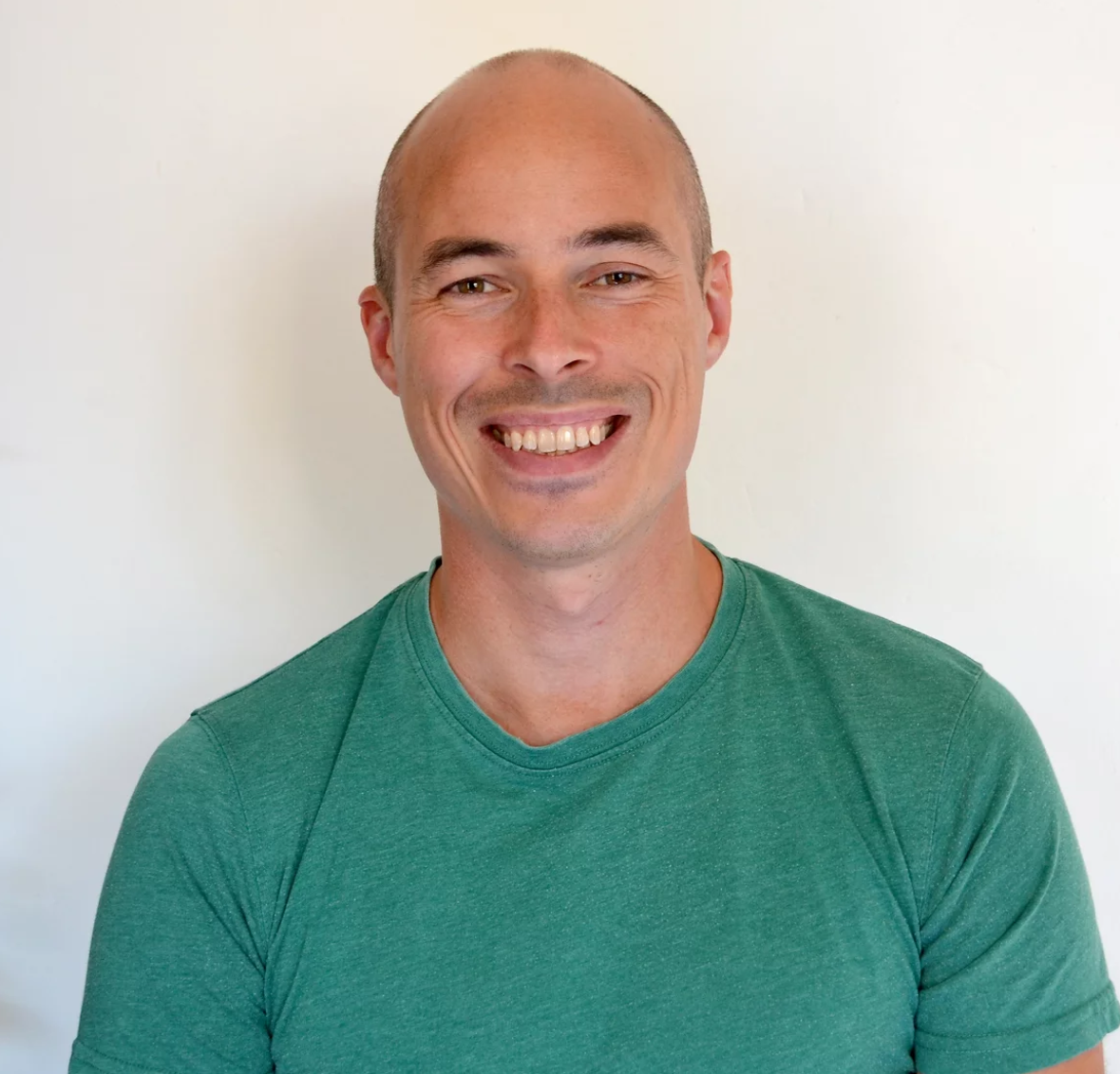
Biology teacher Christian Moore-Anderson explains how cybernetics, systems theory, and enactivism can sharpen classroom teaching. He frames good pedagogy as a feedback loop he calls 'recursive teaching,' where teachers continuously act, interpret student responses, and adjust. His book, Difference Maker, grounds these ideas in biology education practice.
transcript
Speaker 1 And you begin from that premise, and then you have to think, okay. Well, then how do I teach? You know, I can't just tell. I can't just define things because that definition is is something that has meaning for me. But by writing a definition or telling a definition, then the meaning isn't somehow made in the words. The student has to sense that in the same way they sense the water on the back of the leg and think, what is this? And make meaning of it themselves.
Speaker 2 Hello, and welcome to episode 164 of the Human Restoration Project Podcast. My name is Nick Covington. Before we get started, I wanted to let you know that this episode is brought to you by our supporters. Three of whom are Leah Kelly, Daniel Holman, and Jennifer Mann. Thank you all so much for your ongoing support. And with the help of teacher powered schools, So Call Moran Partners, STEM punks, and What School Could Be, we've also officially announced our fourth annual virtual conference to restore humanity for July twenty first through twenty third twenty twenty five, focused this year on the quest for connection. In stressful, uncertain times when cynical powers attempt to divide and isolate us, community and solidarity are acts of resistance. But there are no superheroes here and no simple answers to be found, only the quest for connection. In 2025, we are responding to the need for community and solidarity in uncertain times by turning Conference to Restore Humanity into a model for humanizing critical discourse and dialogue, bringing together students and teachers, researchers and doers, thinkers and visionaries to explore complex topics in education and illuminate a path forward together. To accomplish this, we're taking our flipped keynote model one step further by adding fireside chats to the conference model, moderated panel discussions followed by audience q and a about the challenges facing education and how to overcome them from AI and ed tech in education, the role and future of the humanities, overcoming so called divisive topics laws and book bans, and indigenous perspectives on education and more. Instead of week long learning tracks as we've had in the past, we're including daily workshops with expert practitioners in the areas such as collaborative community building, pedagogical documentation, and rethinking assessment. If you're interested in joining us, tickets start at just $50, and you can find the full lineup at humanrestorationproject.org/conference. Today, I'm joined by Christian Moore Anderson. I wanted to have Christian on to talk about the ideas that drive his teaching practice and that he shares in his book, Difference Maker, Enacting Systems Theory in Biology Teaching. And while that title may seem daunting, Christian's teaching would immediately look and feel to observers like just good teaching. But that's just the tip of the iceberg. Informing his theory and practice is a set of related ideas that I was largely unfamiliar with before encountering it in his book. Cybernetics, systems theory, and inactivism. Cybernetics is simply a feedback loop. Just as someone steering a ship adjusts the rudder based on feedback from the ocean, so too does good pedagogy depend on what Christian calls recursive teaching or a constant feedback loop of action, interpretation, and learning between teachers and students. You can connect with Christian on Blue Sky at c more anderson dot b sky dot social.
Speaker 1 I'm Christian. I'm from England, but I currently live in Barcelona. I teach in a hybrid British, Spanish school. And there, teach IV biology, which I think Americans are quite familiar with. And I teach biology to 14 to 16 year olds and then general science below that. I've been working the last I don't know how many years, six, seven, eight years, trying to revolutionize biology education, really, but that's kind of overlapped quite a lot with just general pedagogy, as I suppose you can imagine.
Speaker 2 Just as a quick follow-up, I'm because I'm so curious. What is the what's the journey that took you from from The UK to Barcelona?
Speaker 1 Well, I I actually lived abroad before. Before I became a biology teacher, I taught English. And when I graduated from university, I went to South America, and I lived there. And that's when I wanted to be a teacher. And then I lived in Madrid for a bit. Then I became a biology teacher. Worked in The UK for a few years, and and there I met my wife who's Spanish, and we moved to to Barcelona.
Speaker 2 Oh, that's a great story. For love. Dude, for love. So we're talking about the ideas in your book, Difference Maker, Enacting Systems Theory and Biology Teaching. And in that introduction, you frame your discovering systems theory as a bit of a conversion story. It seems to be like the missing piece in your pedagogy that connected students to content, and you never looked back. Could you recount that for us? Because it just seems like such a powerful personal and professional moment.
Speaker 1 Yeah. And what the audience probably probably need to see is that, first of all, it started with with biology. And there was a lot of going on in The UK at the time, say, ten years ago with the cognitive science revolution and teaching and and all of this. And I was I was interested and I was and I was following it all, but I was a bit worried because biology is a very specific subject that had that is famous for having humongous quantities of content and facts that you need to know. So maybe I was slightly more sensitive to things that were happening at that time because of my subject. And I was worried that, the knowledge, the swing towards knowledge and retrieval practice would actually make things worse in biology because, we already have too much content, and you can almost, it's very easy to slip into this mode of, of just knowing facts and missing out on something much bigger. So I it was it was around that time that I decided to do a master's degree in education, and I started delving into the the literature on biology education. And I was trying to find then something that was specific just to biology that was that was deeper than just knowledge. You know? Like, there must be more to biology than just just knowing things. So that's when I came across systems thinking, which back then, it was applied to teaching biology and learning biology. So not necessarily applied to pedagogy as as what I've done. That's that's how I first came across it, and I was I was fascinated by this thing. I felt like I found something deep in my own subjects that would really help my students look, you know, beyond the content. There were ideas here that were key that could be generalized. And and the dig in the deeper and deeper, first, it was the systems thinking, and and lots of people know that term systems thinking. And then you dig deeper and you dig deeper and you start and you and I found cybernetics. I was like, woah. What's this what's this thing cybernetics? And cybernetics was a huge thing back in the fifties and sixties. Not many people know about it. Now it's become this word that is associated with, like, computers and the Internet. But but back then, it was the thing. You know? Everybody knew it. It was the new science. It was the science of so many different things. That's why the word ended up in so many different places. And now it it's it's kind of forgotten in that sense. And and there were some really, really deep ideas in cybernetics purely because for teachers, they started to get these ideas about systems. And around the nineteen seventies and eighties, they started applying them to the mind. It wasn't just about when about computers and and things like as it began, systems, computer systems, automatic systems. It was like, hold on. What about if we apply these to ourselves? And and they started what was probably the first general science of mind, back then. What is mind? And and it it suddenly got really quite deep into epistemology, theories of knowing, And that sort of stuff then then hit me. It was like, wow. This systems stuff doesn't just exist in my subjects. It's not just biology. And suddenly, I realized this is pedagogy. This isn't just content. It's us, and it's learning, and it's it's humans. And and cybernetics really opened up this kind of new philosophical way of seeing the whole classroom and teaching and learning. That's what ended up being indifference maker was was bringing all these ideas that were kind of left behind. Not many people know them and putting them into a a narrative that maybe teachers would could then take and and, you know, revive again.
Speaker 2 It seems kind of ironic, I think, that that cybernetics idea that you were saying was developed through the forties, fifties, and sixties, it actually seems to have a more advanced way of thinking about information, information processing, and as it relates to knowledge and the brain before the sort of storage metaphor came by as as far as information storage and retrieval, which seems to be a real dominant idea, not just in education and pedagogy, but also in the computing side of things. I I think for people who perhaps that cybernetics, that that phrase is a little bit intimidating. Can you just explain what that is? And I guess in its simplest form, how that applies to information,
Speaker 1 the brain, and learning and pedagogy? Yeah. I mean, it's it it was Gregory Bateson who eventually said that cybernetics he thought was had taken the biggest chunk out of the apple of knowledge in the last two or three thousand years, he said. And what what his daughter went on to say was, like, almost a correction in the way that we see the world. So it's a like you said, it can be intimidating, but, really, there's a few key ideas there that once you get them, you start to see slightly differently. Cybernetics started really as a interdisciplinary project right from the beginning, which makes it quite unique. And one of the reasons it got forgotten and was lost was because it didn't really have a university department. It wasn't a subject. And it began in the forties, and a lot of people from different areas, there was people from psychiatry, people from business, people from physics, and they they were getting together. They were saying, we've got this new idea. We wanna talk about it, and they called the idea control. People can get worried about this when you say control because it sounds like you're some sort of authoritative thing. But it was actually more in the idea of self control, like how do how how do organisms may control themselves? How do they adapt, in other words? And that's when all of these people got together and they said realized that there was something deep here that all of science had missed, and they started working on it. At the beginning, it was in machines, and it led on from the World War. So it had this kind of flavor, and a lot of some people think of it that way as in machines. The first big book by Norbert Wiener was about the control of man and and machines, and and there was this big big fad and part of where people were imagining half human, half machine.
Speaker 2 In fact, if you put cybernetics into Google, that's what the the images you get. There's, like, cybernetic art and and stuff like this. It's almost synonymous with cyberpunk in, like, an aesthetic kind of sense. That's really not the gist that I got from your explanation of in the book, which is why I think there might be a disconnect in, like, a colloquial popular way of thinking about cybernetics versus its real
Speaker 1 practical application to classroom learning and teaching. Yeah. Yeah. Definitely. But the the the thing that's quite interesting to know is that because it was such a big thing in the nineteen fifties and forties, cybernetics actually gave birth to the two of the main strands of cognitive science now. So cybernetics back then gave birth to the computational metaphors and that side of cognitive science and then gave birth to the biological side, which is what I'm interested in, which is now called inactive cognitive science. So if if you can trace all of this back to cybernetics, and you can trace artificial intelligence back to cybernetics. So there's so much there. But the deep what what was really good is finding those deep ideas. And the deep idea, the the main thing back then about control was this idea of circularity. And that that's gonna be important for me to be able to explain something in a moment, but it meant that causes were circular instead of linear. So like in physics, you've got a car hits another car and that hits another car, or you're playing billiards and and and the billiard ball hits the next one and the next one and that's the end of the story. There's just a line of cause and effect. And in cybernetics, they started to study the idea of circularity, and that was in the idea of of machines. So then the machines could self control. They could cause a change. For example, a missile could could detect a change in direction, and that change in direction would cause their thrusters to change, and then the thrusters would change the direction. And and that was the very, very beginning. The very beginning was this idea of circularity. And it was later that the later cyberneticians got this idea of circularity and they started applying it to the human mind. And they were saying and that's when it starts getting into the idea that's interesting for for teachers. Is, like, what what is the brain doing? And, of course, the brain isn't connected to the outside world. We all know that our neurons are inside the body. They don't come out of the body. It's suddenly you realize that the brain is really just communicating with itself in circularity.
Speaker 2 That was the beginning, the real insight that started most of the stuff. And I think because I can see how we're headed into recursive teaching and the model that you propose over here. I wanna just take a step back because you had mentioned this word inactive cognitive science, and that's part of the title of enacting systems theory. And that might be another term kind of like cybernetics where, okay, there is cognitive science. There's an active cognitive science. What I guess, what is that and how does it distinguish it from, I guess, it's alternative passive cognitive science, passive systems theory? What does it mean to be inactive in this sense?
Speaker 1 This is exactly what I'm talking about. That this what the answer that I'm gonna tell you depends on the idea that I just said, that the mind is is the the neurons, the nervous system is inside the body, and it only really can communicate with itself. And if you start from that moment, if you start from that on premise and you say, okay. But what do what would does that actually mean? If you follow the root of the cognitive science that had the computational metaphor, that began with the idea that you can plug computers into something or you can get now where you could get a hard drive and plug it into another computer. And and there's now there's this direct connection, and that means that the data is directly connecting from one to another and transferred. And if you follow that computational metaphor, you can start to feel that way about learning. Now if you begin with the premise that the nervous system in itself doesn't come out of the body, so we're not connect it's not like that film Avatar, you know, in Avatar and they get the nervous systems and connect to each other, you know, it's not like that. Where our nervous systems are completely and utterly closed to the outside, and they use that word closed. They use the word closed for closed to information. So if it if the brain if the nerves are not coming out, I mean, even if when you're touching something, you're sensing it behind the skin. Let's say there's let's say you've got a pressure sensor. So you're touching something and you feel it because you feel the pressure on your finger. But let's say instead in the laboratory, I open up your finger and I put some vinegar on that pressure sensor. And what does that pressure sensor say? It doesn't say vinegar. It says pressure. You see? And suddenly you realize the the nervous system is not is not open to information. It's not it's not gaining information in in that sense. Like, the vinegar is giving information. What you're doing is you've got your own nervous system that's closed off to the world, and and the nervous system is just trying to make sense of what it's what it's sensing. There's no information really in the environment. The information is created when you make sense of what you sense. That that's a big difference between because the computational metaphor suggests that there is data out there that can be transferred in one place to another. Whereas if you think of the nervous system as closed, you think, oh, so the nervous system just has to try and work out what it's sensing and make and make kind of associations between itself. When I sense this, it it becomes this. It's like when I I when I teach to my students, like, you get splashed with water in the back of your leg, how do you know that it's water? And the first thing they say is it feels wet. And I say, well, what what does that feel like? And then they start thinking, there is no wetness. You know? If and then they realize it feels cold. So, really, you don't feel the water. You feel a sudden change in temperature. And that is the information you've re that you've then you've got to deal with. It's like, oh, there's a change of temperature in the back of my leg and what could that be? And then you have and then you make sense of that in some sort of way. So the big the big problem with the nervous system is not is not obtaining information, but it's making sense of what it's sensing.
Speaker 2 And those things, pressure, temperature change, are proxies that your brain then makes meaning of to say, oh, there has been a change, files through past experience, knowledge, etcetera, to say, ah, something wet has hit my leg or, I don't know, like a bug or something else has had that happen. And and so I can see how those metaphors then, those computing metaphors of knowledge transmission, knowledge retrieval are really unsatisfactory for describing they're they're describing a particular way of teaching. I don't know if we wanna call that more like a behaviorist, but like a computer operator kind of programming information on here and expecting some sort of outcome. I think that metaphor, that way of thinking about teaching has really come to dominate. Is that why you see the the meaning making inactive systems theory so angular to kind of the current vogue of cognitive science?
Speaker 1 Definitely. Yeah. For me, the the key one of the key premises that comes from what we were just saying is the is the meaning making. If you look at computers and you see that computers don't make meaning, they don't, but but organisms do. And computers can get data transferred into them, and we don't. And we have to then make meaning of the things we sense. And when somebody's speaking to you and they're giving you ideas, that isn't information. What happens is you have to make sense of those words. The meaning isn't coming in the words. You just hear some hear some sounds and then you kind of work out that they're words and then you sometime somehow have to make meaning of those words, and you can only make meaning of those words with the other meanings that you already have within you in your mind. And so you've got this this big gulf between these two ways of thinking about learning. One is I can give you ideas, and the other is you just cannot give me ideas. All you can do is provoke me into into making sense of things. That's all you all you can do. You can show me things, put things in a certain way, but there's no way that what you your ideas can come into me. And you begin from that premise and then you have to think, okay, well then how do I teach? You know, I can't just tell I can't just define things because that definition is is something that has meaning for me. But by writing a definition or telling a definition, then the meaning isn't somehow made in the words. The student has to sense that in the same way they sense the water on the back of the leg and think, what is this? And make meaning of it themselves.
Speaker 2 There's this great passage that I was trying to find in the book while you're explaining this because I just found myself underlining every other paragraph, it seemed like. But you say, in this sense, there is no information in a classroom except that which the student decides is information. Again, it's not floating out there in the world waiting for students to grab it or not being transmitted from one side of the communication chain into another one, you know, like some kind of information processing. You say what logically follows is that teachers can't simply transmit, give, or tell students their understanding and expect them to make the same distinctions. And, again, that struck me as being so angular to a modern focus on, you know, clear perfect communication from teachers into students. That's that's not the part of the equation that we should be focusing on. The part we should be focusing on is on the student sense making part, which is where your recursion the recursion in your model really comes into play as this constant feedback loop between teachers and students to help understand their sense making, help them respond and provoke them to respond to more information, and to help that help equip them, although that seems like a a less inactive thought, but help equip themselves with lenses to view the world as pattern seeking creatures and then test, you know, those hypotheses as you go through that. Do you wanna speak at all to then, like, what is, I guess, that alternative, that recursive alternative that you've developed and that's the central key of the book that really seems to me, again, kind of an antidote to just an emphasis on explanation, but actually an emphasis on recursion and student sense making. Yeah.
Speaker 1 What you I'm glad you you brought that up because it's it's reminded me to connect again from this idea that we are closed to meaning. We have to we can only make our own meaning. And and you I mentioned in the book that you've got a contrast with the idea that comes from Engelman in direct instruction, is the faultless communication. I find this interesting, and I've tried reading some of what he was trying to say when he said these things. And what I find interesting about Engelman, he was he was coming out he was writing around the time that behaviorism was declining, but but had been important obviously during his life, and the cognitive revolution was taking off. And he seems to have this kind of mix between a bit of behaviorism with a bit of this kind of what was then the new cognitivism. And he he says this faultless communication. One a big difference between behaviorism and an activism is behaviorism seemed to focus on it was the environment that caused the action. So you're kind of abstracting away the individual and their mind and their ideas and their meanings. And that's that faultless communication is suggesting that if you get the explanation right, you can cause that person to to make meaning. So you you are the environment of the student, and you are causing them to learn in a precise way that you have planned. That really stems from that behaviorist way of seeing. Whereas in activism, it's the other end of the spectrum and is saying that there's absolutely no chance that you can control me. I'm completely closed. If I don't understand what you're saying, it's because I have made meaning of it in a different way to you. And and that's all it means. If you want me to make meaning the same way as you, you've gotta help me perceive what you perceive. But you can't just force me to perceive things.
Speaker 2 I came at it from a lens you know, I'm really I really am a huge fan of Hurt Bista's writing in his scholarship as well. The idea that why what works won't work for precisely all of these reasons. Right? Like, the medical model and the computational models that have become so unpopular and in vogue really are flawed models and metaphors for thinking about learning because these interventions are not deterministic in the sense that, right, a chemical reaction or an antibiotic, you know, has a certain dose response in, you know, response to the conditions and the the treatment that it seeks. If learning happens, it's because students make sense of it in the first place. Right? He says it's symbolically mediated in that sense. And so I think it's a really important clarification, but, approaching that cognitive science lens from a a really dramatically different perspective, not something that would be unfamiliar, you know, to somebody who is in critical pedagogy, who's familiar with Paulo Freire and Dubois' work, or even Seymour Papert's constructionism. Right? The idea of making models and then having those models be a recursive loop with yourself, reflecting meaning in the world and then also changing your thoughts at the same time. Yeah. You know, they talk a lot about Dewey still. They I mean, the cybernet cyberneticians
Speaker 1 saw him as like a proto cybernetician and the ideas are quite similar. And and and activism, which is kind of modern day cybernetics, they they've been recently writing a lot more about pragmatism, and and I listened to a talk the other day called the pragmatic turn in in cognitive science, and they're and they're all referring back to the Dewey and James and and and Perce. So those ideas are coming back, if you if you wanna look at that way, in in the side of cognitive science that that I think is right. You you asked me before, and I forgot to really say was, like, what what is it? Why inactive? Yeah. And this was a name that that was used to define kind of the new the new split from cybernetics, and it was Varela who'd who was like, I wanna focus on the mind, and I'm gonna I'm taking it down as a a new route branching off from cybernetics, and and he decided to use a word from English rather than something like ancient Greek or Latin. And he likes the word inactivism. If you think of the definition, can. Enact means to to carry out, but you can also enact a law. And to enact a law is to, like, bring it into being. You know, it didn't exist before. So an activism really builds on this premise that we we can only make meaning of of the world through how we sense it and and the perceptions that we have. And therefore, if the information's not coming in, we are creating the information ourselves. And that means we are enacting the the world. We're bringing our world around. We're perceiving things in like, oh, that's something I I didn't know before. And we could say, hadn't perceived that before. It wasn't part of my world, and now I perceive it, and and so my world has changed. So you've kind of brought forth your own in your own world. And that's that goes back to this idea between the the faultless communication and how how it's completely opposed to an activism is that if if I am the only person who can perceive and bring forth my world, then there is there is no possibility of faultless communication. And faultless communication would be the idea that I give you this idea and you you I've given it to you now. So if you didn't if you didn't understand it, there must be something wrong with how you're thinking. In activism, would say everybody thinks logically according to what they perceive in the moment. So the problem between a teacher and a student is whether they're able to perceive the same thing. Are we talking about the same idea? And once you get to that point where it's like, okay, I think we're both talking about the same thing. That's when you know the lesson's going well. And that's why it has to be recursive. That's why you have to have this continual conversation with students because you have to try and find out what they are perceiving. And and equally, they're trying to work out what you're perceiving until you get to a point where it's like, okay. We agree. We agree on this idea.
Speaker 2 And that's why the more that, you know, you explain this too and the more I'm thinking about the conversation that we've had about the parts of cognitive science that have become popular, it just becomes increasingly clear that that's not necessarily just rooted in this objective take because it's what the science says or it's what because it's it's research based, etcetera. There's definitely some cultural ideas, some social ideas in here about the relationship and the role of teachers and students in here too. And it's something that you touch on in the book and you frame it in the sense of, like, I think you call it meta content. And I know, you know, as educators are mostly familiar with metacognition, right, you're thinking about thinking. But you really get to this question of, like, what is the important stuff that we're teaching students? And at the end of the day, knowing that forgetting is just as much a part of learning, what are the things that students are going to hold on to long after they've left your your course? And you call this essentially the meta content. Can you explain that part of this model then? Yeah. I really I really like the meta content idea, so I'm glad you brought that up. And I was thinking, when you mentioned it, I was thinking back to when I just started teaching,
Speaker 1 and I was teaching I b biology, and and I b biology is famous for new biology teachers because it's so difficult for us to teach. We go into university and we study something quite specific, and then we have to study this high level course in lots of areas of biology that we're not so familiar with, and the learning curve is extremely high. And you sit there in those first couple of years and you say, if the students learn all of this course and knew all of it, they'd know as much as me. Now is that right, Or is there something that the teacher knows even beyond that? Is there something beyond just that content? And I always thought that there was. You know, they they were in some cases learning topics that I was just learning myself. But if they knew all of the same facts that I had been learning and we and even then the understanding it, would they know as much as me? And and I knew that it wasn't right because I was a biologist, and there were deep ways of seeing the content that they didn't necessarily have. Now maybe we could talk about the content in an exam in the same way, Well, I could perceive the content like a biologist would perceive it. I could talk about it, and it was easier for me to access new topics because I came from an angle that isn't that from which we think as biologists. So we we can think of a biologist as part of a culture, and this culture has a below the surface, there's these implicit deep ideas that we all kind of share. And we use those deep ideas to interpret what we're saying and interpret new ideas and content. And that's what I realized was actually really, really important in learning was there was not just these facts because we've got endless facts in biology. It was how we think about those facts and how we perceive those facts. And biologies biology teachers, biologists think about those facts in specific way. They think about them. We share this way of thinking about them, a way of seeing. Just like if you go to a different a different culture, maybe if you go to The Middle East, and they will just part of a culture. They have a way of seeing and perceiving ideas that you might not be familiar with because you are not from that place. And students come to us. It's a bit like that, I feel, that we are a culture. We're biologists. And what we're what we're teaching is not just a bunch of facts, but to to come and join our culture and say and say, like, what what is it that is important to you, and how do you see? And and we can teach them all these content, but at the same time, what they're seeing is like, oh, biology teachers think this way, and and they talk this way, and they are this way. If I give another another example, a student recently in our school was doing a survey on whether teachers had experienced paranormal activity, and they came to me and they said, mister Moore, have you have you experienced paranormal? I was like, no. And and they said, we knew it. We we knew that all the science teachers would say no, and we knew that the English teachers and the art teachers would say yes.
Speaker 2 They had a pool.
Speaker 1 They were taking bets. But yeah. But what where where does that come from? Why why did they know that the science teachers would say no? Because the it's not just about the content. It's about a way of perceiving the content, about the way they're perceiving the world. And so students come to us as biology teachers to learn from us, and and they come away with an idea, not just I know all these things, but they come away of like, biology teachers are this way, and I've and I've experienced and I've lived in that culture for a while. And and they can they can take from that culture what they like and and what what necessarily is useful to them in the way that they perceive the world.
Speaker 2 That's such a great metaphor that the idea of going to an unfamiliar country or a new region of the world that you haven't visited. It's not just that you're going to take away some bits and pieces of the language or or the the raw knowledge that's there, but you're gonna think differently about the rest of the world and think differently about home when you come back. So it's really not so much about the well, it's not about the content. It's how you're going to be view the world differently after having been in communion and communication with us and in this content. And you, of course, in the book, you put it in such a brilliant way. You're like, isn't this at least one purpose of teaching our subjects in schools, inviting students into an ecology of ideas? And you say, such that students don't just learn biology, they learn biology teachers and all of these ways of being. And this way of being is something our students may continue beyond our time together in the classroom. And it just really drove those points home as to, like, the purpose. Right? Why are we all here? It's not to learn this body of facts, but it's to be different on our time leaving this. And that's what you're framing as the meta content of any course, which we can deliberately craft. It doesn't just have to be vibes based. It doesn't have to be something that students just pick up vicariously. That could be something that's really intentional that we can spotlight, showcase, again, make a central pillar of our instruction as we go through it. So students practice and they become
Speaker 1 familiar with these tools and these ways of being and thinking. Yeah. That that was a big part of that chapter in the book was actually saying that meta content, it really becomes meta content when we when we make it explicit to our students instead of implicit. So I have you can't you can't put everything into a course. We all know that. So I I have a couple of things that I have as meta content, and one of them that's really important for me is what understanding is to to a biologist. An understanding into a biologist has to do with how we explain things, how we explain the natural world, and what we consider an explanation. And that's often to do with a cause a causal explanation. And this then that structure, I share with students, and we talk about it during most lessons. It's not it's not content that's like, we've done that content. We're moving to the next topic. It's it appears in every topic because it's the way I see the content. And I'm saying, listen, I there's all these facts, but what do I see? I see these explanations and I would like you to be able to explain it in a way that that I think is an explanation in biology. And so if I want the students to do that, I have to share with them what as a I think is a good explanation as a biologist. You know, what would a biologist say is a is a good explanation. Often, I think in schools, we have we expect students to to do well, and and yet we don't explain exactly what it is we see as good. And and I I make a contrast here, and I don't know how controversial this will be, but with success criteria. I I recognize that it it depends on your subject. In biology, success criteria, I don't think would work so well because they're tied to the content and not the meta content. And if they're tied to the content, it means that every every topic, have to write new success criteria. And it becomes just a kind of iteration instead of a recursion where it feeds back into each other. Whereas meta content is where we talk about what is a understanding, what is an explanation in the first topic. And students may have a go at doing that in the first topic. And when they have a go at it, it it feeds back and it and it helps them understand what what I understand as understanding. Then we go to the next topic and it comes back again. You know, we're we're not writing a whole new success criteria. We're saying, no. No. No. Listen. This is this this is different content, but I'm telling you how I see it every time. This is what I this is how I see it. So then they have another go, and and and it feeds back into how they understand the meta content. And we start talking about what we're talking about. We start saying, like, this is the meta content and we're and it becomes part of the conversation that lasts through the whole course. And then that becomes a big part of what biology is.
Speaker 2 Not just a smattering of different ideas or lists of vocabulary to be memorized, but these grand unifying ideas that we're gonna see time and time again because we're intentional about building those things in as the pillars, the meta content as the pillars of our course design to help students make sense and see and uncover those patterns as those pat as pattern seeking creatures. Now we've teed up we've teed up a lot of these ideas. We've teed up recursion. We've teed up inactivism and systems theory and meta content. Let's just try to put this in the context of a day of teaching, a day in the life. You know, you just got off work here on a Friday. Got done teaching in your classroom. How do you what does this look like in the classroom with teenagers and the and the groups of kids that you work with? Right. So so I did as I as I thought, I did bring my diagram of how I teach puberty.
Speaker 1 And I thought, is this a good idea? Is this a bad idea? But I when people wanna know, like, how am I teaching in this way? And you gotta think, well, most people don't understand biology, so I've gotta pick a topic that people know. And this is something I teach to my 11 year olds, so it's their level is not very high. And it's puberty, but it's biology, so it's not so sure. So we just it it brings out a lot of the biological ideas. I actually really love to to teaching this lesson. And because we're teaching puberty, and the students come in expecting a real kind of social lesson. And and I go, boom. This is a biology lesson. You know? And they suddenly like, well, mister Moore sees puberty in such a weird way. You know? He doesn't think about it in the way that we were thinking when he was thinking about it. You know? They thought they were gonna see videos about this, that, and the other, and and instead they start the whole lesson's about evolution. And and certainly, that that that's a real key meta content moment. It's like, wow. Biologists, you know, they were a special type of people who who never stopped talking about evolution. You know? So it does have this this recursion in it. It's recursion is mean is coming back to the idea of circularity, and and recursion is a type of circularity where it kind of feeds back into each other. And I use that word for the model that I've made because I'm talking about how I and the students form a circular conversation where I'm talking to them, they feed back to me, and I'm feeding back to them, and it becomes just this a conversation. But before I before I I get off, I gotta remind mind us all that if we take from the idea, the premise that students cannot just receive my meaning, They can't they're not passive like a computer. They're not receivers instead of instead that they're acting and enacting meaning. What I do most of the most of the lesson is I I provoke students. So I'm asking them questions all the time because instead of just telling them, I'm provoking them to act on information. It's like, I'm telling you this. What does this mean? And then and then I get them to respond, and as I and then I can from their response, I I can get an an idea of what they're perceiving, and we and we go around in circles. So back to puberty then. Back to puberty. So I go I go into the lesson and and, you know, we're talking about puberty, and I start drawing the life cycle of a of a butterfly, which is just an egg to a caterpillar, then a chrysalis to a butterfly, and then we're back again. And the first question is like, well, what the hell is going on? Why does the butterfly have these two two parts to its cycle? You know? Why why have two parts to the cycle? And we and we begin from there. We begin. So then I get to hear what they're saying, you know, and what they perceive. And it also it brings into focus by asking that question. They bring into focus what what matters to me. So I hear out their ideas, and and then I and then we we I say, okay. Well, listen. What what if I tell you that the the caterpillar's purpose is just is just to grow, and that's it, and eat? And all it all it all it wants to do is is grow and eat. Whereas the butterfly, you know, he's there for for reproduction. I've said this, but why would he have two stages? You know? So I've given them that bit of information, but this is the contrast between the two types of teaching I've given them now, but now I have to force them. You know, I I provoke them into making meaning of it. So I I tell them that there's there's there's a separation in a life cycle, but then I've gotta say, okay. But what does that mean? You know, what's the consequences of this? We established that that we need a growth phase because you have to be big enough to to be able to lay eggs. You you couldn't be tiny and have an egg that's bigger than you. And then we established that the caterpillar lives on a on one plant. And if it's going to find any other partner to for sexual reproduction, it's gonna have to get off that plant, and wings are a good way of doing that. There's a lot more in here. So we so we say, okay. So what if there was no growth phase? So I'm provoking them again. Okay. Let's just get rid of the growth phase, and we'll go straight why not just go straight to the butterfly? You know? And then we we establish some meaning there. It's like, oh, yeah. So the growth phase is important for this. You know? So what if what if there was no butterfly phase and we just had just had the growth phase? That sounds kinda simple, but for a lot of students, it's not because there's lots of humans who who don't have children. And this is like a societal choice, and you've gotta you've gotta peel that away and say, okay. We're talking about organisms here. So what if what if there was no butterfly phase? What if what if the growth phase were too long? And then we gotta think, okay. In a population, what would happen? Like, the ones who who were who were taking too long, maybe maybe they'll miss the time for meeting a partner or maybe they'll just reproduce too slowly compared to the rest. And what if this, what if that? You know, you give them a bit of information, but then you you've really got them to perceive the make meaning of it. You've got to ask them questions and and and see what they say. This is how we begin puberty. We we talk about what's flat. And then next to it, I draw the cycle of the human, which is, you know, an an embryo, a child, and then puberty and then an adult. So we've got this direct comparison, and we we then attack it with the same questions. What if humans in their growth stage, you know, what if it what if it took thirty years? You know, what if what if some some human was born and it took thirty years to get to puberty? You know? What if what if they went through puberty at at six years old? And we're starting to work out by by doing that, we see, if they went through puberty at six, they would be too small, and then they would miss out on the growth phase. If they did it too late, then then other other organisms would be reproducing, but you're not. So you're you're missing out on on that that part. Suddenly, growth phase comes into focus and the students are making meaning of of that. They they probably never even thought about that bit before. And then you say, okay. So then what is puberty? And now now they see that the butterfly and the caterpillar are quite distinct looking. And then the children and adults are not so distinct looking. But by having that direct comparison, it helps them see that the we have a we we have a reproductive stage, and the butterfly needed wings to be able to carry out its reproductive phase. And it's like, so what, you know, what's the purpose of of puberty? And then puberty then is is this moment of change where you're going from a phase in your life where you just need to grow, and then you're going to a phase in your life where you may you may be able to reproduce. We go from trait to trait that that we normally teach in puberty, and every time we talk about it in an evolutionary picture and we provoke and we say, well, why is it this way? And why is it that way? And what if it wasn't? You know? What if it wasn't this way using these counterfactuals, what would happen? And bit by bit, the students come to see puberty in a way that a biologist would see it, and they can later later go to PSAT, we call it, where the lessons like personal, social, health, education, where they will have their lessons on puberty in a social context in in which there's different meta content.
Speaker 2 I think I so appreciate that the kind of lesson that you described in my mind's eye as I sat back as the listener is in immediately recognizable as just like good teaching classically. Right? Socratically, this is just what good teaching has looked like across cultures, across generations, all of this. However, right, you have bolstered beneath all of this is a sophisticated understanding of humans as meeting makers, the the these concepts of cybernetics, all these things that we've brought into this conversation lead us back to a path that looks classically very similar and familiar, but is not necessarily something that in the course of a lesson, you have a vision probably where you're going in your mind with this conversation, but it can't be scripted because the success of that lesson depends on your response to student information. That's the key part of the recursion is this response from you taking the information in and then provoking the response from the students who are then taking this information in and all of that. I'm just coming back to earlier in our conversation where, you know, you had mentioned that the early cyberneticians, this was the a way of understanding, thinking, and modeling in the brain and perhaps contemporary ones in the current day looking back at Dewey as a pre cybernetician. And this sounds a lot like something that would happen in a classroom led by someone who is a fan, a follower of John Dewey's. So, yeah, I guess I'm just signposting this both for myself and for listeners. Kind of what we've heard in this really, I think, is recognizable at good teaching, but wouldn't it would be difficult, I think, to find in a classroom that was put in such a rigid box where it said, okay, we're gonna have to check these certain boxes to fit in with so called cognitive science or research based practices, if that makes any sense. Yeah. I I think it does. I mean, that was
Speaker 1 alludes to the title of my first chapter Yeah. Which was taken from Varela. Varela was one of the one of the big names behind in activism, and he loved Antonio Machado's poem that said, traveler, there is no path. You lay down a path in walking. And I took that and I I said, basically, the title is laying down a path in conversing. So it's like, teacher, there is no path. You lay down a path in conversing in in your lesson.
Speaker 2 I know, obviously, people should pick up the book, Difference Maker Enacting Systems Theory and Biology Teaching. But what are some of these other sources? You had mentioned I wrote down at the beginning here, the pragmatic turn in cognitive science, something that is inspiring or interesting you right now. Where else should people look if they wanted to look out the ideas of your work? As you mentioned this, I did I did write down some books because what
Speaker 1 the problem I think with cybernetics and activism is there is a real lack of kind of popular writing, which is the the book I wrote was trying to kind of bridge that that gap for teachers in a way. But there are some books that are quite accessible that take you really to the heart, and it's something that that really inspired me. So I got some names. There was two books that were were actually a dialogue between two cyberneticians, and it was the same journalist. So because it's a dialogue, it it really it's much easier to read. One of them is understanding systems, conversations on epistemology, and that's Heinz von Fursten. The the next is from being to doing, and that's that's another conversation, and that's with Matarana. Matarana was really important in developing an activism. Then if you wanna know about cybernetics in general, there's a there's a fantastic book called the cybernetic brain, and it's by Andrew Pickering. It's just such a fantastic book. And it really goes through the history of cybernetics and see shows, like, why it's so different to other ideas. And if you're more inclined towards the humanities, there is a book about Gregory Bateson, which is absolutely fantastic, called Runaway. It's about Gregory Bateson. That's in the title. And that's by Anthony Chaney. Just amazing. Like, you read these books and their ideas that are just not mainstream. They're just mind they're mind blowing. Those four books, woof.
Speaker 2 I can't recommend them. You know? I will definitely link those in the show notes as well so folks who are listening can just click on the descriptions and, you know, it'll take you to probably a publisher website. Oh my goodness. Christian, thanks so much for taking the time at the end of your day of teaching to join me in talking about the the work that you focus on in Difference Maker. It's been great. Thanks, Nick. Thank you. It's been great. I mean, I really enjoyed just talking about cybernetics, so thanks.
Speaker 3 Thank you again for listening to our podcast at Human Restoration Project. I hope this conversation leaves you inspired and ready to start making change. If you enjoyed listening, please consider leaving us a review on your favorite podcast player. Plus, find a whole host of free resources, writings, and other podcasts all for free on our website, humanrestorationproject.org. Thank you.
resources
- Difference Maker: Enacting Systems Theory in Biology Teaching · Christian Moore-Anderson (book) Core text behind this episode; applies cybernetics and systems theory to classroom biology teaching. link →
- From Being to Doing: The Origins of the Biology of Cognition · Humberto Maturana, Bernhard Pörksen (book) Recommended by Moore-Anderson; explores biological roots of cognition relevant to enactivist teaching. link →
- Understanding Systems: Conversations on Epistemology and Ethics · Heinz von Foerster (book) Recommended by Moore-Anderson; accessible entry point into cybernetics and systems epistemology. link →
- The Pragmatic Turn: Toward Action-Oriented Views in Cognitive Science · Andreas K. Engel, Karl J. Friston, Danica Kragic (Eds.) (book) Recommended by Moore-Anderson; surveys the shift toward action-grounded, sensorimotor views of cognition. link →
- The Cybernetic Brain: Sketches of Another Future · Andrew Pickering (book) Recommended by Moore-Anderson; traces cybernetics history and its broader implications for thinking and practice. link →
- Runaway: Gregory Bateson, the Double Bind, and the Rise of Ecological Consciousness · Anthony Chaney (book) Recommended by Moore-Anderson; profiles Gregory Bateson, a key figure in systems thinking and cybernetics. link →