

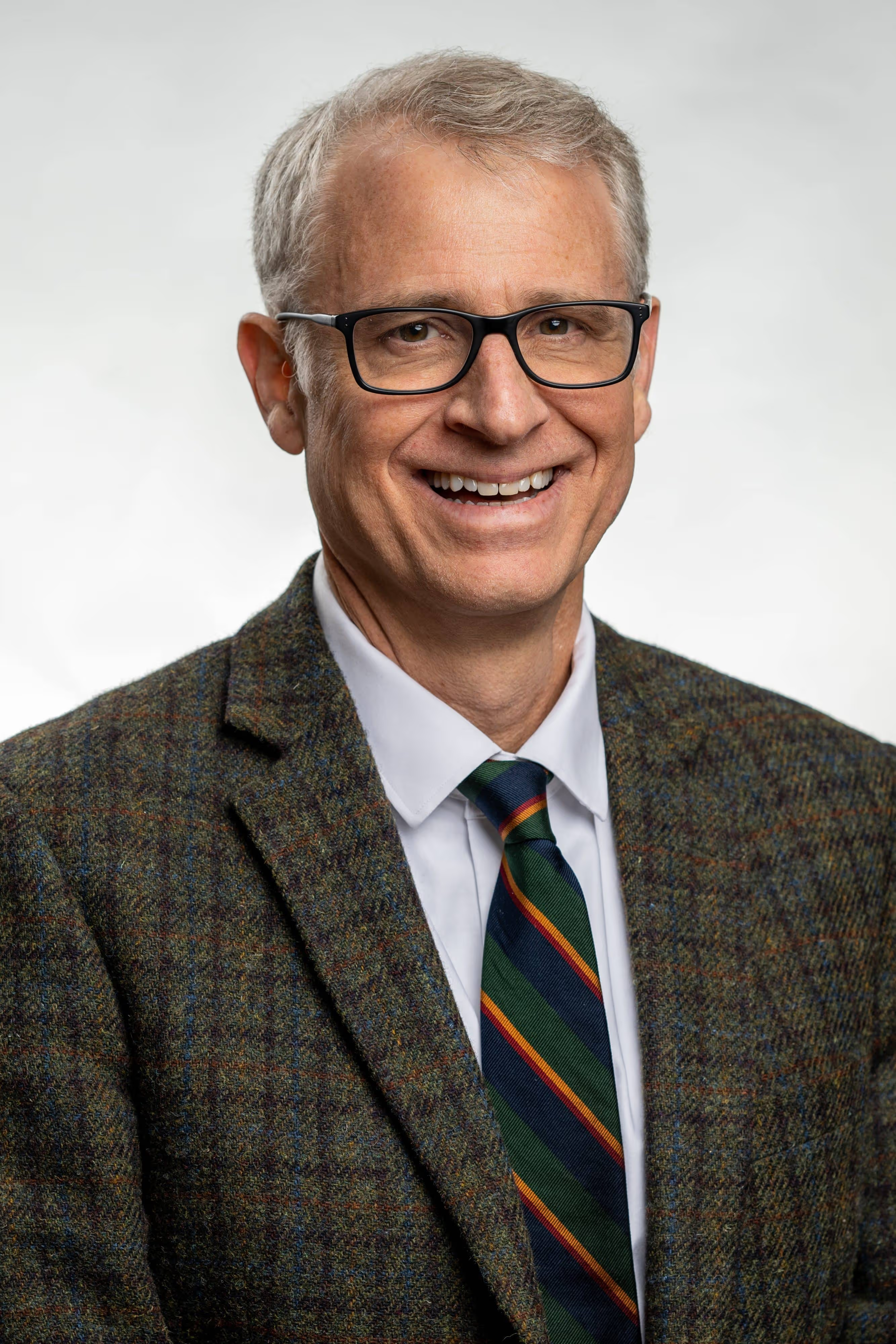
Neil Kraus, political science professor at University of Wisconsin, River Falls, argues that the 'failing schools' narrative was deliberately constructed to shift blame for economic inequality from industry and policy onto educators. His book traces how bipartisan buzzwords like school choice, STEM, and the skills gap serve corporate interests rather than students.
transcript
Speaker 1 I start the book with a quote. This is, again, Reagan administration money that's going to Columbia Teachers College. Change the mission of k 12 schools to take educational responsibility for the economic futures of all students. That is a cataclysmic shift, cataclysmic shift, that today we take for granted. We talk in a language, the assumptions we adopt, that well, yeah, of course, that's why we're we have charter schools to prepare students for these jobs. And the fact that we've put it all on the education system, and that's what I argue is killing education.
Speaker 2 Hello, and welcome to episode one fifty five of the Human Restoration Project Podcast. My name is Nick Covington. Before we get started, I wanted to let you know that this episode is brought to you by our supporters, three of whom are Julia Valenti, Brandon Peters, and Simeon Frang. Thank you so much for your ongoing support. And we're so proud to have hosted hundreds of hours of incredible ad free conversations over the years. If you haven't yet, consider rating our podcast in your app to help us reach more listeners. And, of course, you can learn more about Human Restoration Project on our website, humanrestorationproject.org, and connect with us everywhere on social media. Now stop me if you've heard these before. American public schools are failing. American students are falling behind their global peers. The future of American innovation, economic equality, and global competitiveness depends on schools today preparing students for the job market of tomorrow. And school reform is the only tool we have to fix these urgent issues. Each of these sentiments have become conventional wisdom at this point, and they have appeared in the platforms of both major American political parties, if not explicitly, then through familiar buzzwords, School choice, competition, data driven accountability, college and career readiness, STEM education, and gaps of all kinds. The skills gap, the achievement gap, and the employment gap, just to name a few. And when your only tool is a hammer, all your problems start to look like nails. But it may also be the case despite the flaws of public education throughout the nation's history that American public schools became failing schools exactly when they needed to to fit the needs of politicians and industry and to fit schooling into the new economic order that came to dominate the last half of the century. At the global level, this narrative even fuels reactionary stories of civilizational struggle and the decline of the West. As an Italian economist lamented for GIS reports earlier this year, quote, there are only two ways Western educational systems can reverse our current trend and offer more appealing prospects, allowing private schooling to flourish and bringing about radical reforms in state schooling, end quote. The most likely outcome he predicts is a steady decline, writing, quote, the vicious spiral that links poor education to inequality, social tensions, more government intervention, and finally, low productivity and stuttering economic growth will likely dominate the future of many western countries for years to come, end quote. And this last line captures what my guest today describes as the fantasy economy. Neil Krauss is professor of political science at the University of Wisconsin River Falls. His most recent book, The Neoliberalism, Inequality, and the Education Reform Movement, describes in powerful detail how exactly our popular bipartisan conventional wisdom about America's failing schools and the decline of the American student came to be as the result of a deliberate project to shift the responsibility for economic precarity and inequality away from industry and policy and place it squarely on the shoulders of educators and schools. Ultimately, he writes, we must see the fantasy economy for what it is, a misleading political campaign in the interests of corporations and the wealthy. Neil Krausz, thanks so much for joining me today. Thanks very much for having me. Happy to be here. Well, let's just start from the top. What are those core tenets, the beliefs of the fantasy economy as you describe it? And how is it different from, I suppose, you know, the real economy that we all live in? No. That's a that's a great question.
Speaker 1 There are as I see it, there are kind of two major tenets of the fantasy economy. And they're very simple, and they kind of reinforce each other. One is that the education system is always failing. It's always underperforming. It started with the k 12 education system really in the early part of the education reform movement. But then in the last fifteen or so years, that's been applied to higher ed is failing. So that's sort of the first general, assumption. It's not even really necessary to state that in the fantasy economy. It's it's like a belief we don't have to state because we all know that we all believe it. And then the second tenet, which flows from the first, is that the the characteristics of the workforce are always inadequate. They're they're never enough. There there are never and then this, is described in several different ways. There are never enough workers in general. There are never enough highly skilled workers. There are enough there there are never enough STEM workers. There are never enough manufacturing workers, that the workers that that we do have are just not up to the task and and all these different jobs. And so that feeds the first one. That's the skills gap, and that's why we have to always, always change the education system because of the fact that, see, the the workforce is failing again. We need to have more charter schools, school choice, accountability. We need to have more STEM programs in higher ed and so forth. So that's kinda how I see the logic of the of the the main tenets of the fantasy economy. I think, as you mentioned in the book, like, reports like 1983
Speaker 2 is a nation at risk, that was something that's familiar to me. I think it'll be familiar to most listeners, but it seems like a sacred text of that fantasy economy that I didn't know so much about until encountering it in your book was workforce 2000. Yeah. Yeah. And and you'd be remiss for thinking that it was written, anywhere near the year 2000. But it's kind of like, I think, a companion to a nation at risk from a little bit later on in the eighties. And while it seems like a nation at risk is more of the political document that set the t for workforce 2000 to provide the playbook for the next two decades of reform because I think what you're saying is these ideas weren't always inherent or ingrained in the way that we think about schools. So can you explain how these reports mischaracterized or misrepresented American education and how they misled policymakers on both sides of the aisle?
Speaker 1 A nation at risk, I mean, as you mentioned, has received, you know, a fair amount of attention. And and in in the book, I tend to draw on other scholars because there's a whole library full of research of of of very valid criticisms of the report and and published 1983, and and, you know, the title is kinda what stuck. You know, the the country was at risk because the assumption was the schools were failing, and, you know, it was based on commissioned research. In other words, researchers were, paid presumably by the Reagan administration. It was not based on, scholarly work or, the the standardized testing, analysis was focused mainly on the SAT, which I talk about in the book and how that changed over time. And it changed because more a lot more people were taking it. A lot more students were taking it in the the seventies and early eighties than they were in the in the sixties. And that was a really important in the popular mind at the time. I mean, I graduated from high school in 1986, and I I remember, you know, sort of vaguely, but I do remember the the the just the the uproar in the popular press about the schools in the eighties, that the schools were failing, all these jobs were leaving the country, not because of anything other than the fact that we didn't have enough skilled workers. Right? There was nothing, no other factors if in most of the coverage I remember at that time. But then as you mentioned, the report workforce 2,000 was published in 1987. It was funded by the Reagan administration. It was produced by the Hudson Institute, which is still around, by the way. The Hudson Institute is still a think tank. I don't know if they do much domestic policy anymore, but they they they're sort of this futuristic business think tank that that had been around at that point for a while. And they produced this report, workforce 2,000, and as I read that report, I quote from it, throughout the book. I think almost in every chapter, there's something on workforce 2,000 because it it's really so revealing. And and what was amazing to me was that there wasn't more critical scholarship on workforce 2,000. I mean, there's some academic work, but it was just confined to to, you know, major journals that nobody's you know, that that media is not gonna read and so And but, I mean, it's the whole playbook for the last forty or fifty years. I mean, if it starts with the preface, which is written by, and I don't have it here in front of me, but, Reagan's, secretary secretary of labor, I believe. And I quote from that. And and he, you know, he talks about and this is what Republicans won't you know, haven't really said out loud in decades, and that is that all these social programs from the thirties and the sixties, and he and he named several of them, may no no longer be relevant in this high skill, high education, economy because they're gonna be because the whole report is is just painted this, utterly fictional picture of what the the labor market would be in in 2000. And it, you know, it it used some official data, but most of it, it just you know, throughout the report, the Hudson Institute cites the Hudson Institute, as a source. And, you know, there's no bibliography, and I ended up buying 20 some copies, and they're actually different copies that were produced. The the front and back cover are different. Right? The the the contents of all the 20 some I I own, physical copies, are are identical. The technical appendix is not in any of the published versions that I was able to find. And then I I just stumbled. Nobody I didn't see them cited. I stumbled upon a couple of partially declassified versions of this report with all these supporting materials and pages left out and which, I don't know. I I I I think I sent an inquiry of Freedom of Information Act request to the CIA library, and I I don't think I got a response. Like, why was anything related to a report on the workforce ever classified in the first place? And I have I have no idea that somebody else should write that book because, it seems to me to be pretty unusual. But but that report laid out, you know, the notion that that, and then preface was, well, these social programs might not be necessary anymore. And then the other the the 100 or so pages in the report were all these trends of business and the population, and the and the gist of it was the gist of it was that there are going to be all these these high skill, high education jobs by the year 2000. So this is 1987. Right? And that, therefore, we have to make all these changes and including reforming the schools and changing the education educational system in order to prepare students for for that. It it it's usually cited as the the origins of what has come to be known as the skills gap, which is, again, is sort of a an assumption that nobody even questions ever since. So, yeah, those two reports and then the former, again, a nation at risk has been written a lot about, a lot of great stuff. And, workforce 2,000, not not quite as much. So I I I did spend a lot of time with that in the book.
Speaker 2 Yeah. I I found that to be incredibly, like, illuminating because, yeah, it seems like that that part of the narrative kind of gets forgotten, or it's ignored, as you said, by the by the press or popular education writers, media, and that and it seems like that became then the playbook, not just for the tail end of Reagan, you know, the the first Bush administration, but then throughout the nineties in the Clinton era teeing up, it really is like the thing that sets in motion all of the ed perform, that we have lived in and live currently live with today. I wonder if we could speak to those foundations, as you'd mentioned, the Hudson Institute, because that plays a big role in formulating and perpetuating the idea of the fantasy economy in the popular imagination as well. Because I think a lot of people imagine these foundations, whether it's the Hudson Institute, maybe more obscure for the popular perspective. But, like, the Gates Foundation, you mentioned the Center on Education in the Workforce, and all of these to kind of be more, I don't know, apolitical or supportive even or benign at worst in their influence on schools and education policy. But I think you make a pretty convincing case that they're working in their own self interest, and have an outsized influence on shaping, both popular conversations about schooling and the policy that guides those. Could you elaborate on that at all? Sure.
Speaker 1 Sure. You know, many years ago I mean, I teach public policy and American politics. I teach a bunch of different classes, but among them is is public policy. And I started reading on conflicts of interest in medicine and and health care re research. And, you know, I came across, the federal government's open payments database in which we can all look up our medical providers and see where they're getting outside money from. This became a very big political issue. I mean, it was that was put in the Affordable Care Act. And and and I remember at the time thinking, wow. That's significant. I mean, there are all these doctors and and and and teaching hospitals and and, you know, across the country that are receiving some receiving large sums of money from pharmaceutical firms, from device firms, from all kinds of medical interests. And now we have a right to to know where they're getting their money because social psych psychology research shows us that if you receive gifts from and this is also this is why we we got that database because it's been shown in in psychology for decades that if you receive gifts from someone and you have there's sort of a norm of reciprocity, you have a, not because you're corrupt or not because you're you're intentionally doing something wrong, but because you're human. Right? If you give me something, then I naturally wanna wanna give you something. And and so I I started looking into all this funded research because it in education, because it it it's it's really at odds with, a lot of official data coming out of mainly federal agencies, but also state agencies. And it's also at odds with it's got much scholarly research. And, you know, foundations have always presented that well, not always. Not always. This is the the key point here. In the last several decades, they've always sort of presented themselves as as not self interested, as simply concerned about education for everybody. I mean, who can object to wanting to support the education of low income, you know, black kids, Hispanic kids, low income white kids, whatever? I mean, who who's gonna oppose that? And, of course, I I don't oppose everybody should get an outstanding education. That goes without saying. But I discovered that in as recently as the fifties and sixties, foundations would would would really fund fund, especially higher ed, and they would do so, to advance the interests of the corporation. The Esso Education Foundation, which I never even heard of before I started reading the stuff for the for the, for the book, was a huge funder of higher ed in the fifties and sixties. Individual colleges and universities, Change Magazine, which I talk about in detail on the book. This is an oil company. Right? Now I and then I looked at their funding higher ed. You know, I have an example, I think, the book about a hospital at the University of Dayton. Right? It has nothing to do with the oil industry. But I suspect they funded a lot of oil, know, research related to the industry as well as as other as other interests do. But then, you know, the politics of the sixties really changed quite a bit, and and campuses became politicized. The anti war movement, the civil rights movement. And, also, k 12 teachers were starting to go on strike around the country. And, you know, there were a number of, you know, you know, activists who in in higher ed and and also in teacher's unions who wanted, you know, college faculty to be be able to go on strike, just like their k 12 teachers were doing in many cities. And that was that was not a a popular idea, in corporate America at all. And and and what I argue in the book is that they sort of, corporations kind of transform the public perception of foundations to be to be simply charitable givers and and not self interested at all. And that really and then they started funding. This is long before Gates, of course. Right? They started funding the academy and and, you know, higher ed and and and increasingly k 12 in a in a massive way in a massive way. And not only funding individual colleges, universities, researchers, charter schools, and now, of course, foundations fund the Education Writers Association. They fund the press all over the place. You know? And and and I think that the reason we haven't really thought about back to the whole notion of conflicts of interest. We haven't thought about what about the Gates Foundation? What about the Lumina Foundation? How how is it in their interest to to advocate sending everybody to to higher ed? What what's what's so wrong with that? Well, it's in their interest because they are fundamentally in support of neoliberalism and all the main beliefs of neoliberalism, that we don't need unions, that privatization is the answer, that outsourcing of jobs is is is just fine, that the an economy built for owners and shareholders is as it should be. None of that stuff is popular. None of that stuff has ever been popular. Right? That monopolies should be allowed to form if that's basically what the economy leads to. None of that stuff has ever been popular. I mean, you couldn't go to Michigan or Wisconsin or or I mean, I grew up in Upstate New York in 1985 and give a speech laying that all out and then say, vote for me. You know? By the way, we're gonna destroy unions and send your jobs overseas. Please, can we have your vote? So you can't do that. Politicians are smart. They're they're they're aware of the contours of public opinion. And so in order to to really, streamline this this really new, new sort of very different than the postwar consensus of a mixed economy, to streamline a much more free market, based economy that has all the tenants that I just named and among others, you have to focus on the schools. And this is why, I start the book with a quote. This is, again, Reagan administration money that's going to Columbia Teachers College. Change the mission of the of k 12 schools to take educational responsibility for the economic futures of all students. That is a cataclysmic shift, cataclysmic shift that today we take for granted. Right? We talk in a language, the assumptions we adopt that well, yeah, of course, that's why we're we have charter schools to prepare students for for these jobs. And and the fact that we've put it all on the education system, and that's what I argue is killing education. That that's why in Wisconsin, for example, in many other states, public universities are getting cut even though states have budget surpluses, because we're assumed to be failing because there are 30 and 40 and 50 year olds out there that are not making enough money, that are working in jobs that, that don't require a college degree. Not because there aren't enough jobs for college graduates, not because people's wages have been held down for decades, but because of your local English department, didn't properly prepare, that student. That's why he or she is working at a warehouse at age 30. So I think to to enable, really, to to bring about neoliberalism, corporate America really needed something, and and the fantasy economy really allowed that that to happen. And I again, I remember I graduated in 1986 from high school. It was almost like a weekly occurrence where another plant was shutting down. And, you know, it was always about, well, we just the schools, they just deflect and talk about, well, the schools didn't prepare. Well, this I don't know. The plant was doing fine for eighty years. What happened? All of a sudden in 1985? I mean, it may it may no sense at all, I think, intuitively, but the message was so overwhelming. And it was absolutely everywhere, and I make this argument in the book too. It's just absolutely everywhere. Unions were a little bit of a different message, but then, you know, what happened? Well, unions were slaughtered, and and most of them went away. And so, you know, when the academy is being funded by all these interests that are trying to sort of focus solely on the schools, and unions are instead of a third of the the workforce, they're about 12%. You know, the rest is history, as they say.
Speaker 2 To kind of bring it back to the that issue of neoliberalism, so far from the invisible hand, neoliberalism uses government intervention to make room explicitly for private capitalist market activity to the exclusion of all these other economic arrangements. So it's not exactly a coincidence that these private foundations kind of rose to prominence and and influence and agenda setting and driving public opinions about schools at the same time that the public influence and the, I guess, the the public nature of public education really has been downgraded with each successive decade and each successive type of reform. We were talking before I hit record that you were hesitant to put that in your subtitle, The Fantasy Economy Neoliberalism Inequality in the Education Reform Movement. And you you've spoken, about it here about how about why that's the label that you would, give to these kinds of reforms. But could you speak to why you were hesitant at first to perhaps include that label in your title? Yeah. No. I was hesitant,
Speaker 1 because I think my understanding of the term before I really changed my mind and put it in the in the subtitle was that's a very academic term. People are not gonna understand it. People are gonna dismiss the book. Oh, he's just another Marxist, etcetera, which I'm, of course, not. That's why I cite James Madison at the beginning and say, well, Madison talked about economic interests, you know, in the seventeen eighties, long before Marx was born. But I I think it's very important, to younger people, to have them understand. And also and and everyone, but particularly younger people. By younger, I basically mean I I don't know what am I talking about, people under the age of 35 or something. I I mean, I'm not sure what the cutoff is, but this isn't always how things have have worked. This isn't how capitalism has always worked, that we used to have a lot of organized labor in The United States, that employers used to have employer sponsored defined benefit pensions, that we used to have regular or at least occasional increases at the national level in the minimum wage, That we didn't use to shut down plants when the stock was actually going up because it wasn't going up fast enough in order to to relocate jobs overseas so the stock will go up at a faster rate. All of the stuff that the economy didn't used to be built only for owners and shareholders, this is a relatively recent thing. This is a nineteen eighties thing, basically. The ideas have been around forever. And if you wanna talk about the nineteenth century, that's another thing. Right? That's before pretty much all regulation. But for most of the twentieth century, right, we had a fairly active state, and we had wide participation in labor unions. And, of course, there was, systemic racism and sexism. Of course, those things were were, impeded, you know, democracies, development, and and the benefits of the economy were not shared equally. I'm not suggesting that they were. But at the same time, when you look at median wages and and going up and down, a rising tide did lift all boats in 1950, and the CEO didn't make 450 times what an average worker at that employer made. Maybe, yeah, made a lot more. Sure. The the CEOs have always made a lot more. But, I mean, 50 or a 100 times more versus 400 times more or 350 times more. This stuff is all a recent development, and I wanted to make the point like, that word, I think, captures it because that word really describes the last several decades in a in a concise way. So that's why I landed on that word because and the book really is an argument in favor of how we got to it's sort of a theory of neoliberalism, really, as much as anything else. Like, how did we get to this point? Yes. It's about the education reform movement, but it's really a, you know, a a I don't wanna say theory or idea or book or whatever about how we got to all this inequality and, and and why is it we're how is it we got to the point where we're focusing solely on the schools to mitigate it when the schools can't change the labor market? So I thought neoliberalism was the best way to kinda concisely put that in the title, and and I think the word is being used more, in the last year or so, more in mainstream discussion. It's not solely an academic word. So I'm happy if if I am in some small way to be a part of that. But people need to know, particularly younger people, this stuff is all just a set of choices that we've made in the last few decades. There's nothing inevitable about any of this. So. Exactly. The current situation,
Speaker 2 the current arrangements didn't fall from the sky or were gifted on stone tablets. Right? It's part of this explicit political economic project. And I think your book better than a lot of others that take that label for granted and just throw it out there perhaps without defining it or anything else. Your book makes a really explicit case for what this is. Right? What are the bounds of this? And how is the real economy and this fantasy economy distinct, but also how they're a product of this political project that you obviously root in the historical record too. And I think as we've been talking about, the fantasy economy has enjoyed this bipartisan support for decades and in my entire lifetime. I'm I'm not here to make you feel old, Neil, but I was born in 1986. So it's all that I have known. The year you said you graduated from high school, was like, oh Sure. Sure. That's when I came into this earth. So, you know, it's something that I have lived with my entire lifetime. But I wonder, as school reform movements become associated with today, least, wing extremism perceived negatively by popular majorities. I think we see we've seen sort of the ebb and flow of the culture wars, the popularity of voucher programs at the k 12 level, perhaps even Josh Shapiro being passed up on the Harris ticket because of some voucher school baggage. And I think we've seen how disastrous it's been for higher ed takeovers, especially in Florida. I think like the new college and recent work that's come out about Ben Sasse's involvement at the University of Florida. Yeah. And even how notions of human capital have been challenged in the popular discourse. Like you've mentioned, more people, younger people, I think even popular YouTubers, streamers, are talking more about this idea of neoliberalism and just how implausible these notions are when they're backed up by the reality, whether it's ideas of decades of educational decline that, you know, are are super implausible or even your book, Jennifer Berkshire and Jack Schneider's work, John Shelton's The Education Myth, Annie Abrams Shortchanged, all these kind of popular things are coalescing around this idea. So I wonder, are there significant cracks that are beginning to emerge in the foundation of the fantasy economy, perhaps as it especially relates to education? And I don't know if there's a second question. We we can come back to this. But how do we reclaim those narratives about public education and make a positive case for learning for life rather than training for work?
Speaker 1 A lot wrapped up in there. Yeah. No. I I mean, I think that there are cracks emerging, I'm glad you mentioned those books, particularly John Shelton's book, The Education Myth, which is an outstanding book. And and John's a good friend of mine and and a and a great, union leader and scholar. And, he and I started to see our books. We we were writing them at the same time, and we kept going back and forth and and talking about, hey. Yeah. What did you find? And, hey. What did you find? And that sort of thing. So it was it was great to be writing at the same time he did. I think there are significant cracks. I mean, I listen to to, you know, there's a new ad in the Harris Walls campaign in which she says something to the effect of, you know, we want an America where you can work one job and and make a living, or or something to that effect. That's a that's a cataclysmic shift from Clinton and and Obama. Obama was very much a human capital guy, very much a school choice. He was just sort of a softened, watered down version of Bill Clinton's, you know, bridge to the twenty first century or whatever. And, you know, I think he sincerely believed all that. I'm not suggesting otherwise. I think Clinton, you know, I guess he sincerely believed all that, that education can cure all these things. But I think that, you know, there's too much evidence to the contrary. Everybody, you know, knows someone who's, if not themselves, who has a degree that they owe 50,000 for a public university degree. Why is that? They have a master's degree, and they're working in a job that doesn't really require a master's. It only requires a bachelor's or maybe a two year or or worse. Why is that? There's there's just millions of people in these in these categories. And you can only gaslight the public, I think, so long about how we just can't find enough skilled workers. I think the cracks are emerging because, you know, people know that, hey, down the street, six or eight miles, they just built another warehouse for and there's 1,500 jobs. That those are the jobs that dominate our economy. And I think I think that's the way in to sort of reclaiming education, you know, that that, you know, making education more about what it used to be more more about and and taken for granted, that it's about creating, you know, as you say, learning for life, about creating democratic citizens, about at every level, human growth and and and just learning about history and literature and science and and all the things that that make for an educated person, that that allow individuals to pursue their interests one day, that that bring people joy and and pleasure. And, you know, no. I'm not a a poet or or I'm not a literary person, but I I love to go see plays because, you know, I learned about drama and poetry and things like that in in several, you know, several of my classes or or whatever. You know? I mean, they're it's about being a a full person. And I think that the problem I encounter all the time and I and is that education like, I I almost think there's more of an audience for what I'm saying outside of education. Within education, we we talk so much. And I understand this. I mean, I just wrote a book about it. Mean, so much of this campaign has been targeted at us, targeted at education. I mean, lot of the funded research is being done within ed schools, right, within teachers college at Columbia, within public policy schools. Right? And so we're we're we're, you know, we're trying to sort of at least, you know, the work that you mentioned by several people and myself, we're trying to trying to get education to think differently about it educators rather, to to think differently about education and to talk differently about education. Because if if we talk about nothing but STEM and we don't say, well, hey. Wait a minute. There's really not a ton of STEM jobs. There never have been and there never will be. Then, you know, it's not gonna go well for us. It's not gonna go well for us. You know, again, I I cut educators slack because I I, you know, I read all their literature. That's what's in the book. I read all these reports by the Chronicle of Higher Ed, and I quote them, you know, extensively. And this is what I admit. Oh, all these light bulbs get caught. This is why I hear this at all these meetings. Right? Because this is all they're reading. These are all their conferences. And now, right now, the hard part is that, oh, higher ed is getting it from all these different angles. And if you just read the higher ed press, it's just a it's just a constant stream of the public is losing confidence in higher ed, all the rest of it. Thanks a lot. Thanks for your support. You know? I mean, this is the higher ed press. Right? And not questioning any of the frames, not questioning any of the narratives, not questioning any of the data that's being presented to them. And then sure enough, administrators read all this stuff and come to meetings and say, well, guess what? We're gonna jettison majors and and build another STEM building. And this is happening in every university in the country, practically, except for elite schools and flagships. They're they're immune from this debate. But all the other schools, this is where it's all sort of playing out. So I I guess my my my thought is always that educators need to think differently about education. Educators need to talk differently. Because if we don't, parents are not going to. Students are are going to think only instrumentally, about education as job preparation and not about learning for life, as you say. And and we're the ones doing it. Right? But we have to talk differently and think differently about it, we as educators. And I think that that I see signs of that around the country. I do.
Speaker 2 No. Well, that's great. I I appreciate you taking the time to join me today, Neil. The book, of course, is the fantasy economy neoliberalism inequality in the education reform movement. I would highly recommend that. And getting involved in the work to, help make these things possible at the local level, state level, national level to, like you said, Neil, change the dialogue, change the way that we think about education to begin to, make active policy changes to, to have that happen. So I appreciate you joining me today, Neil. Thank you very much. I appreciate being
Speaker 3 podcast at Human Restoration Project. I hope this conversation leaves you inspired and ready to start making change. If you enjoyed listening, please consider leaving us a review on your favorite podcast player. Plus, find a whole host of free resources, writings, and other podcast all for free on our website, humanrestorationproject.org. Thank you.
resources
- The Fantasy Economy: Neoliberalism, Inequality, and the Education Reform Movement · Neil Kraus (book) Core text of the episode; argues the failing-schools narrative serves corporate and political interests. link →
- Neil Kraus (person) Professor of Political Science at University of Wisconsin, River Falls; author of The Fantasy Economy.
- GIS Reports (website) Published the Italian economist's commentary on Western educational decline cited in the episode.
- University of Wisconsin, River Falls (organization) Institution where Neil Kraus is a professor of political science.
- Temple University Press (organization) Publisher of The Fantasy Economy; page includes book description and ordering information. link →