

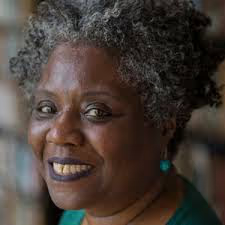
Dr. Noliwe Rooks, chair of Africana Studies at Brown University, discusses her book Cutting School, which traces how privatization and segregation have shaped American public education from Reconstruction to the present. She introduces the concept of 'segrenomics,' the practice of profiting from racial segregation in schools.
transcript
Speaker 1 It became clear at every decade that I looked at from 1877 at the end of the Reconstruction period up through 2015, which then was the present that I was that I was writing in, that there had never been a deep disruption of segregation as a fundamental and key feature of education for certain folks and as a money making and business and marketing opportunity for a whole other group of people.
Speaker 2 Hello, and welcome to episode one twenty seven of our podcast at the Human Restoration Project. My name is Nick Covington. This episode is brought to you by our supporters, three of whom are Timothy Fox, Corinne Greenblatt, and Kyle Prince. Thank you so much for your ongoing support. You can find out more about our work at humanrestorationproject.org. Because it so well researched and presented, Cutting School The Segronomics of American Education is a frustrating read. To tell the story of privatization, segregation, and the end of public education requires a massive cast. In her book, Doctor. Noliwe Rooks, my guest today, runs a precise thread from Reconstruction, Nelson Rockefeller, and Brown v Board, through to Milton Friedman, every president in my lifetime, Teach for America, KIPP Charter Schools, Mark Zuckerberg, and more. Segronomics has the kind of power that will be viewed with suspicion in states most impacted by it, are cracking down on theoretical frameworks that attempt to provide structural and systemic explanations. An interdisciplinary scholar, Noliwe Rooks is the chair of and a professor in Africana Studies at Brown University, and the founding director of the Segronomics Lab at the school. Her work explores how race and gender both impact and are impacted by popular culture, social history, and political life in The United States. She works on the cultural and racial implications of beauty, fashion, and adornment, race, capitalism and education, and the urban politics of food and cannabis production. Doctor Noliwe Rooks, thank you so much for joining me today. Thank you so much for having me. Well, let's dive right into it. Let's just start with that title, particularly the subtitle there, Cutting School, The Sagranomics of American Education. So in the book and elsewhere, you coined the term Sagranomics to describe the phenomenon that you support in excruciating detail throughout the book. So for listeners who haven't yet read the book, who might be curious, would you describe Sagranomics and its relation in particular to what you call our apartheid education system? And how are those ideas related?
Speaker 1 Thanks so much for that, for reading the book, taking the time to sort of pull out what's key about it. And I hope as we, have more conversation, we can connect some of these ideas to what we see unfolding here in our present. At its most basic kind of form, segranomics is just a mashup of segregation and economics. And part of how, I arrived at it was really thinking about, how consistent a thread, how consistent a narrative, the the wealth making opportunities for big businesses, for philanthropists, really work for for segregated unequal education. The question that I initially started with is really given all of our pronouncements, around, wanting to have equal education in the country, given the lip service that we give the rhetoric that's very much a part of education as public education as a kind of foundational piece of, who we take ourselves to be in The United States. It situates us against most of the rest of the world where having public education readily available to everyone, not having to come out of your pocket to be educated, It just doesn't happen elsewhere. And yet there was this thread of this consistent kind of under education of certain groups of folks in The United States. And a difficulty with those groups having access to quality education is a shorthand really just for the kind of education that wealthy kids and white kids regularly enjoy. Not perfect, but it provides services and certain kinds of classes and certain kinds of infrastructure. And when I started to write the book, at least initially, I was looking for a space where this dream of equal education encompassed indigenous people, black people, poor white people, rural people. It it wasn't happening in 2006, 2007. When I first started to do the research, I could see clearly. You know, there are these intractable kinds of problems and issues around education that break down around status and class and ethnicity and race regularly. But I thought that that was really speaking about what was happening in our contemporary moment. I didn't know enough about the history of education. I knew the the myth of it. I knew the language around it. I knew we common schools and citizenship and the way that we become a melting pot, and it's this edgy the promise of education, you know, to give you, the opportunity to make the world better for you and generations who come after you if you apply yourself. Go to college. Get the the information that you need and get a job. I thought that the lack of those things being true really had to do with the twentieth century kind of phenomenon, that there was some moment that I'd be able to identify where something else was was going on. And so I kept backing up farther and farther and farther in history. At least initially, I was kind of like, you know, let's go. You know? But, certainly, after right after Brown v. Bored 1954, I can probably find it. Not so much. Okay. Well, let's just go right back to a little bit before Brown v. Boy, yeah, not so much. Okay. Well, let's come a little bit forward and then see what's happening during Nixon's administration. And let's see if that's where there were some moments before what I understood is the forces of my present, began to tear apart, opportunity and all of the pretty words and pretty rhetoric and make make unavailable to large swaths of the country. And what I kept backing up into was that from the earliest moments that I could identify, in ways that were just not talked about in literature that I could find, The public education, when it was first taxpayer supported compulsory education, is a phenomenon that really kind of enters The US following the civil war during a period, called reconstruction. And while in other parts of the of the country, there were you know, you could go to school. There was public education in some places. The the where I live, I live in Providence Providence, Boston area. You know, there was a big horse man who was one of the fathers of this thing called the common school who was a student here at here at Brown. And, you know, it it you could find little moments where that was working. However, from, those earliest moments, though, where the expansion of multiracial democracy spread into this idea that all children, poor children, black children, the children of slaves, that the state, had a responsibility to collect taxes and make education possible for them. That should be a a triumphant kind of moment, a triumphant kind of story where we are, a as a nation, really living, I think, the ideals that we have and the rhetoric that we express in the constitution and elsewhere about who we are. And yet as I researched that moment, what became clear was the same forces that I was identifying in the twenty first century. The, philanthropists and businesses and corporations crafted an education specifically for poor white people that looked nothing like the the education that was for poor black people. Poor black people, newly freed black people were, supposed to be tray trained in the trades. They were supposed to be taught vocational kinds of skills. There was none of the let your mind soar. Become an artist. Become a it was, can you make bricks? Let's teach you how to farm with technical specificity. And that and this kind of education depended on segregation. It depended on having black people and poor people and indigenous people live in areas of the country or in places where it was just them. And then the prescriptions for what you do and what you teach them and how you pay for it were very similar, but something different entirely was happening for wealthy people and white people. And so that's a really long way of coming around to say it became clear at every decade that I looked at from 1877 at the end of the Reconstruction period up through 2015, which then was the present that I was that I was writing in, that there had never been a deep disruption of segregation as a fundamental and key feature of education for certain folks and as a money making and business and marketing opportunity for a whole other group of people. And that was something that I hadn't seen before. I hadn't seen anybody talk about. I didn't I didn't think about segregation as part of a business plan, as an, educational ideology that it you know, these business plans for companies, which at the time, you know, was things like teach for America and the rise of charter schools. And I hadn't thought about how much money they were making and how dependent they were on poverty and the segregation of of racial and, economic poverty of people who were poor and or black or indigenous, they had to be those things in order for them to make money, in order for these businesses to make money. They were failed business plans in the absence of segregation. So I honestly just started to wonder, is it that the reason that we have this intractable problem, this thing that we keep saying we're trying to solve? We keep coming up with with ways to deal with, you know, how racially specific educational achievement is, and educational access. But is part of the reason it's so hard to solve is there's simply too much money to be made in having people be segregated and offering to educate them outside of the public education system that many people pay a lot of money in taxes to keep going. There is not only, I think, the
Speaker 2 there is the economic incentive, but I also too think that there's the ideological incentives that are in place for the kinds of solutions that we look for in order to live up to that promise that you're speaking of. You know, it's curious to kind of think of, in my head, you know, I had imagined the the research for the book proceeding in the opposite direction, say, at reconstruction and and pulling it through. It was so much more interesting to think of where you were looking for sort of like the genesis of that of that issue and kept going back to the time where, you know, we were supposed to have lived up to these promises as a nation. And then going back and back and further back and back even further and kind of finding those stories along the way and telling it in that chronological order. So it really is there are those ideological incentives that just prevent us from addressing that solid issue of of segregation in the first place. There are the ideological incentives to want to provide those private solutions to those bigger sociological problems that don't address the sociological problems, but then ultimately make somebody a massive amount of private wealth, perhaps in the short term until they can get on to the next thing. And I wonder, so much of what I had read in this book as a supporter of public education, but also someone who lives in that tension, you know, understanding that that public system has not served all students particularly well, be it for ableist reasons or for explicitly or implicitly racial reasons. And of course, there's issues, you know, across the board in the systems and structures today, pedagogically, all of it. And it all comes down to, right, kind of living in that tension of having failed to live up to that promise for all kids. So I I really do I kind of wonder then if there is if there is room to talk about the the intervening space, and kind of where you've seen since the book has come out the three years of having lived in a global pandemic that similarly exploited those cracks within American socioeconomics. I recall reading an article in early twenty twenty that read something the headline read something to the extent of the pandemic didn't break America, it revealed what was already broken. In in a lot of ways, I think this book plays that same role. So how have you seen the similar phenomenon at work since the book came out, you know, back in 2017? What would you include in cutting schools two point o, cutting schools revisited if you were given the opportunity?
Speaker 1 Well, okay. There's two things. One, just the COVID responses. And two, if cutting school two point o was coming out in the, like, say, six months from now, Florida. Florida the entire state of Florida. I have a I have a chapter in the book about Florida that I would expand aggressively, based on what's happened. For the first part, though, about COVID, I think one of the interesting phenomena that came up, for me watching this, having researched so many periods of time where all of a sudden you have, wealthy white parents, or wealthy white people or high status white people, all of a sudden profess great and deep concern about the education and lives of poor black and brown kids. There's moments when this happened. It it happened during the civil war. You know, happened during Brown v. Boer. Episodically, have philanthropists who every so often have jumped up to say, you know, we really care about this. And when I was at Princeton and I left in 2012, so a few years before that, I was taken by the fact that I had so many very privileged, very wealthy students who all of a sudden wanted to talk to me about how bad the public education system was for poor kids and how how they needed to change it, and we need to and one thing so given that lens, given that one of the things that I haven't I didn't pull out and make it a narrative, but it was information that I had. When groups of wealthy white people discover poor people or poor kids of color and say, I want to fix education for you. You need to run. This is what I know. You need to go in the other direction hard. You need to fight back hard. You need to look for what's broken because the ways that all of a sudden we had people saying, put them back in school. Get rid of get you know, they're going crazy. People are committing suicide. The the pathos that was elicited by journalists and scholars and academic and just some shysters who just wanted, you know, attention, quite frankly. But the amount and the depth of the the pesos would lead you to believe there was an educational movement afoot that was not that far removed from the language that you heard when I first started writing the book for for Kipp and, ed reform people, where ed reform people would consistently say they were overwhelmingly white, overwhelmingly wealthy, and most of them, at least the ones I met at Princeton, would tell you they had not grown up about with any going to these schools, knowing anything about these neighborhoods, nothing. They didn't they knew nothing, but all of a sudden, they wanted to come and fix it. All of a sudden, you have mainstream press, people who are telling stories. I went and befriended a poor black child during the pandemic because I was so heartbroken offering no systemic solutions other than open the school because I think it should be open. And at the same time, oh, look how I'm getting all of this financial compensation from different kinds of groups and think tanks for saying this with rarely, if ever, talking to any teachers, parents, or caregivers who disagreed with what they were saying. So in that moment, it was hard for me to separate. And if I were doing the book again, I would do a deep dive here. I'm teaching a class on on racism and education. And I literally, in the first week, will be doing a deep dive into how these narratives of black, despair, pathos, blah blah, and this kind of caping, like my students call it caping and, like, how Superman capes for things, like how you decide you're gonna put on your cape and come in and we're gonna save it, how the racial dynamics of that that had nothing to do with systemically fixing what was broken in anybody's home, community, or school, but was just about getting the ideological payoff that they were going for. And what that allowed for and, again, what I would talk about, what that allowed for was completely overlooking what communities were doing successfully to educate those kids. You never the only stories you saw were the kid has started harming himself, and I don't mean to make light of that. I do not. The pandemic was hard for all of us. The isolation, the misinformation, not knowing who you could trust. People are getting sick. People are dying if there was a panic. But these same people are sort of like, there's a panic, but let's not focus on that. Let's focus on the fact that these children need school. But then in communities, you had some, places like Los Angeles that is very well organized, both unions. They're they're they're people of color who are from those communities in positions of authority all throughout the educational system in Los Angeles. They're doing a pitch battle right now with with billionaires trying to take over stuff, but they're all over. And what they were doing with their kids, early on, I was saying this should be a model with the everybody should be the first thing they did was, like, we're gonna figure out how to make sure everybody gets fed regularly. That's not going away. It's not a conversation. We're not even waiting for the federal government. We will make sure we understand we can't pandemic or no, we cannot have, people hungry. They were creative in how they went about educating kids. One of the things that they did out there was they made a partnership with public education, the with the public access, channels. And what they were saying is, we keep hearing, you know, that not everybody has Internet. Not everybody does. People of color and poor people tend to use their phones for Internet access. And you can't really, very well be be successfully take a class on your phone. It's one, it's expensive, but there's just all kinds of functionality that's not there for you. And it's it's, like, upwards of 60% in some communities, 70% who don't have so they're like, this is not going to be some sort of Waterloo for us. We're gonna partner with public access because all these kids have TVs in their home or 90% of these same kids who don't and they and they had this sort of rotation for what they were teaching at what time on public access. You could call in and ask questions. You could, you know, watch your teacher or a teacher teaching the subject that, you know, was supposed to be, you know, a part of the curriculum. Sometimes they had students come into the to the studio, so it felt more like a classroom. It wasn't a silver bullet, but it was an attempt to create community, maintain community, and teach in the midst of it. I don't think it's any kind of, surprise then that Los Angeles, on these NAEP scores, which these same, you shouldn't have closed schools, people are running around going, oh my god. See, we've lost learning. Right? And we've also lost bodies and jobs. And, like, we've lost a lot of things. But the scores, test scores, standardized test scores went up in Los Angeles County. They didn't stay the same. They went up. They gained ground. And in the midst of all of this concern and pathos and what this predominantly people of color led district did for their poor and of color students didn't become a model for the country. Nobody mentions it. Nobody knows it, really, for the most part. Or it's, when you hear people talk about it, they'll say, well, there were some anomalies, some outlying phenomena in places like Los Angeles. But for the most part, let's go back to, you know, what I wanna talk about. We we have no interest in what works when educating we as a the big we, a royal we, have no interest in what works. Learning from what works, trying what works, asking people who are successful, how do you educate the least of these? No interest. But we will give billions, millions to billions for anyone who is like, hey, I've got a brand new idea. Let's use computers to educate kids, which, you know, one of the things that, of course, with the pandemic showed us is all of these people who were kind of like, let's use technology. Let's rethink education. Let's and use computers to do it. You know, were were staggeringly silent about the failure of virtual education in the face of what was going on. And one would think I mean, I I I I write about beginning of virtual education, the amount of money, how legislatures are all into it. Capitalists are, you know, corporate kind of people who are like, technology and business will fix everything. They're constantly like, let's rethink schools. Let's rethink how we do public education in the pandemic. I remember Cuomo, who, like many people, you know, I I he was mandatory listening to was living in New York State at the time, so he was my governor at the time. But people all over the country were like, Cuomo's coming on to tell us what's happening. You know? We were listening. And my university, I was teaching at Cornell, and I first started hearing from some of the higher administration. And then Cuomo in his, what, bedside chat, whatever they were, fire his fireside chats, his version of fireside chat, started bringing up. We're getting together with educational leaders in business to talk about how we can turn this into a benefit to reimagine education, to do a wholesale, to to turn our frown into a smile by, you know, taking this moment and educate everyone using computers. The people that they that they were pulling together to engage in this conversation were not, the kids who most needed to be saved by what was going on. They were not the kids that were making learning pods and hiring their own teachers and which which was also happening where I live and elsewhere. You know, people were just hiring a teacher. They had their six kids. The teacher came in and taught their six kids to keep them up to speed. But none of that had to do with how they wanted to revision education all of a sudden. So, certainly, certainly, if I were doing the book now, that would be another thread that gets pulled through about how, the failure of of public education,
Speaker 2 in these very particular ways. And I'm so glad you brought up those NAEP scores. That was gonna be kind of the second data point on there. But one of the other things that was interesting about pandemic education is that when polled, the parents who most wanted not in person options for their children were families from those communities that had been historically underserved, communities of color, you know, because they knew that the impact of the health system was gonna fall disproportionately on them, kinda saw it as a reprieve from the structural racism of the system to want to provide other options.
Speaker 1 What it revealed as well is how little those parents trusted those institutions to keep their children safe. Mhmm. I mean, really, when you would when when someone would bother to really ask you know? Because it turned on a dime, like, the whole kind of discourse. Like, if you you do a whole language, whatever. If I did this kind of thing where I was doing quantitative work, I would, you know, get some some data points, and let's see how many times because the discourse that, that turned from this is all terrible for all of us to you. You people are completely you people being the not wealthy now are completely unreasonable. Mhmm. You don't care about your kids. You're you're being led astray by outside influences, and you're just wrong thinking, get out the way, and let us lead you. Like, how we went from, oh my god. This is so terrible, what is happening to your children, to you people are clearly I have no kind of care or concern for your children by this same kind of group. And it happened so subtly. I'm not I look at so I was listening for it because I was like, oh, here's what happens. When a bunch of white people who have come from outside these communities who have never had any relationship with them, there's lots of folks who have, in history, lots of folks who have had some kind of productive relationship with the least of these, who have, you know, started institutions, organizations, joined in with, groups, organizations. So it's it's not just the fact of whiteness that's the problem. It's the the white people who discover poverty, right at the moment when they have a book that they wanna write or a grant that they're trying to get funded or a TV show that they're trying to be an expert and get on, that's the that's the dysfunction that ends up, harming and widening and disrespecting educational communities, I think, the most. See, now you just got me riled up. That was my goal the whole time. So
Speaker 2 what is fascinating, I don't not that I wanna belabor this point, but the fascinating part is, right, like looking at the communities who wanted non in person options and then looking at the places when the when the Napes bomb dropped, right, and this learning loss thing was supposed to, you know, have fallen on all of our heads, the places that should have confirmed those narratives the most, like you said in Los Angeles, were the places that thrived because they had other creative options that tried to serve their community. Right. Other than just saying, just reopen the schools and everything will be fine. Well, other people said, well, let's let's work to take inventory of our community resources. How can we best serve the kids in there? How can we, you know, work to meet their needs in different ways that also works to keep them safe? To try to balance those two needs rather than, again, to to your point, ignore the threat, push them back into a burning building, and say everything is okay when it isn't. Yes. And then be like, oh my god. You're you're exacerbating a problem because now
Speaker 1 enrollments are down Mhmm. In all of those school systems, which means you're getting less federal and state money per child. Right? Because enrollments in many places in LA, they've come back, but in many places have not come fully back. Some places, they're 70 to 90% of what they were pre pre pandemic. I've seen I've seen figures that I have not run down the source, and so I can't say that they're real, but that, up to a million students had or have disappeared from public education who were. And so they've gone to charter schools, which while people call them public schools, they still blah blah blah. And they've gone to private school and homeschooling. Homeschooling for black people in particular has shot through the roof with this. Like, people are just kinda like, why go back? It's a failed system in in regard to to my child. So what you're what you're finding is the pandemic broke things open, and the ideologies behind it that truly want to defund, want to move those public dollars into, private hands have really risen to the fore. You know, what you see going on all over the country, in the mid led by the Midwest and and parts of the South is a complete dismantle on on the heels of. So the the the panic started with the COVID. Like, that was the the initial COVID. Oh my god. What are we gonna do? It transitioned into, we're not doing a good job with the least of these. We really have got to rethink and redo and re. And then it has gone into public education is such a failure. We now they're teaching about transgender people and being something called woke. I don't even know. Like, what is I don't even think people use that term anymore. The students, it's one of those things where they look at me like a little crazy. Like, I say things because I hear them, and they're kind of like, we said that six months ago. No one's saying that anymore. But now it's a it's a whole, don't have woke, and let's have parents have power, which literally started with the closed schools. That that language about parental rights, parents needing to organize, parents needing to come to the fore, started as an an anecdote to what was happening, during during COVID and funded by by a whole bunch of big, groups that have long wanted to I know I sound a little, like, conspiratorial here. However, it is literally the case that many of these parents for fair education and, you know, other groups that you're seeing in the South in the Midwest are funded by a handful of billionaires who have long been clear that what they would like to have happen is public education go away, and the the the money, just kind of follow students wherever they wanna take it. They want a business model for it. Mhmm. You now have COVID led to enough of a fracture or break, enough of a panic that these these forces that were already you know, Betsy DeVos has been funding vouchers and privatized privatization of of public education for decades, like, before she was ever the secretary of education for the Trump administration. But now in that breach and with the narrative that we saw, we're seeing that that, a march across the country for this kind of dismantling that is far more concerning, I think, than any of us would have thought when Biden came in office. I think many of us who work on education and inequality the pry you know, wanna fight privatization and who don't think unions are the devil. They're certainly they got a lot of power, and they got some issues that could be addressed. Mhmm. But I don't think we think they're the devil, certainly not the rank and file members. Those of us, you know, we really thought there was gonna be a a federal kind of change, and there has been some. They they have done some things about, you know, we're gonna cut the amount of money in this charter school fund, and, you know, we're gonna you know, they they've done some things. But it it has not been wholesale. And between that and what you are we're in this moment where politicians literally no longer care at all what their constituents want. So one of the things that was protecting public education previously is pretty much legislatures would do what their constituents wanted. And anytime you bring privatization vouchers, to a vote, it goes down resoundingly. If you give people on whatever predominantly white communities, predominantly black communities, rural communities, urban like, suburban communities, whenever across the the country, when you let people vote on if they would like to privatize education in those particular ways, resounding defeats, not even close. So now what we're watching, though, on the heels of all of this that has sort of softened up, I don't know, resolve, And then something, I don't know what, seems to have taught legislatures that they just don't really have to care about what their, constituents want. Legislature after legislature working with governors who are like minded are making possible the privatization of education in places like Texas, Ohio. Iowa. Yeah. Michigan. Michigan is is, they're still well, actually, Michigan just went down, but they keep trying.
Speaker 2 But it's unsinkable rubber ducks.
Speaker 1 Yeah. I mean, they keep coming back. You You're but you're watching them make progress. You're watching these forces make progress that they never made before COVID. And I think that there's a there's a, there's a connection there that we have not or I have not seen, anyone actually kind of tease out why is it all of a sudden. And and, of course, the insurrection. You know? Like, there was that sedition sedition and COVID really, really softened up the the ground both for, you know, politicians, I think, not in the absence of there being real consequences for many of the sitting members of legislatures in congress, state legislatures and and federal government really suffering much, so far. As a result, I really think that these these it's emboldened them. So they're just kind of like, this is what we wanna do. If you can actually wage war on the United States government and not be held to account, how bad is it gonna be if I'm raiding some education funds? And, you know, working with the legislature over the objections, and the desire of our the people who elect us is does democracy actually matter anymore? And I think that that is the the really frightening thing that we may be staring down. I've I've given the work that I've done, I've been clear for a very long time that at least in relation to voting and education, that democracy for black people and poor people does not matter. I mean, the the the democracy that the powerful wield is not the same kind of democracy, and I really think we would do well to to really like the people's democracy, grassroots democracy versus, the democracy that the powerful, the lobbyists. You know, poor people don't have lobbyists. Rich people go get some lobbyists to go get their what they want to get pushed through. Who who is doing that work for poor people? What we're seeing in the app is a in the attacks on democracy at the level of voting, and the attacks on the federal government at the level of bodies and blood, at the capital mean that people feel emboldened to enact these changes, I believe, in ways that we haven't seen before. And so what we're watching I mean, you study this. Have you ever seen them make this these kinds of inroads?
Speaker 2 I don't I was just about to add that I'm headed down to the Iowa state capital today where I'm at because the the state senate is voting on their voucher bill, you know, in the the new vouchers of ESAs and whatnot and all of that language. That is it's gonna pass. No? It it's gonna pass in the senate. As I as far as as far as I'd I know, the house is sort of the stickier issue. They tried to pass almost the same bill last year and couldn't get it through the house. They even extended the legislative session by two weeks. It went two weeks overdue as they tried to rally these votes and eventually it failed because it ultimately if you look at the the polling data around this issue, when they polled Iowa voters last June when the session ended, vouchers failed. And that's why, you know, they failed in the in the house last year. They're trying to speed run it right now. They just introduced this bill last week. We were down at the capitol last, I think, Tuesday for the public hearing, and it's already up for a senate vote today. Went through all the committees last week. Senate vote today and, you know, probably through through the house versions and whatnot, reconciliation if it needs to be. But it's house file, you know, senate bill number one. It is at the top of their agenda to do this. And I can't help but think about, right, that caping rhetoric because that's what it's all couched in, providing these parents choice to get out of these failing schools. And what I've been pushing back against through all of this is that is imported rhetoric. Yes. Right? Iowa had the highest high school graduation rate in the country in 2019, 2020, you know, pandemic messes everything up. But we're still, like, in that top tier of high school graduation rates. If you look at the Iowa state quarter, we have a schoolhouse on our quarter. We've never had a provision for, you know, vouchers. We've only have, I think, four charter schools in the entire state. So any, you know, success that schools have had, the education has had in Iowa is on the backs of, you know, the 94% of students that attend our great public schools. Mhmm. And now what you're hearing is this weird nationalized rhetoric around America's public schools have failed its kids. Right? Trying to put this national lens on, what, 16,000 public school districts throughout the entire country. They're all the they're all the same, and they've all failed because of, you know, x y and z. But when you start to point out, you know, hey, this high school has a ninety eight percent graduation rate. This one over here, all of the great Iowa schools, somehow that that fail that language of failure It Yeah. Doesn't Yeah. Yeah. It's it's not rooted in any kind of Iowa reality, but it's what gets reinforced by national media attention, by social media, etcetera. And the the big irony I felt when we went to the public hearing last week was, right now, the governor's provision is for these ESAs to be deposited for families who have their kids attend nonpublic schools. Right? Which in Iowa, primarily private education is parochial education. Right? So it's, you know, private Christian, Catholic, various denominations of of private religious instruction. And they are the ones the the parents who already have their kids enrolled in a private education were the ones at that public hearing saying, here's how I value my religious education so much and here's why I think you should support it. Yes. They were not overwhelmingly parents in Des Moines urban schools. You know, I think, gosh, we haven't even talked about like that the coded language of the failing public schools are predominantly urban schools and urban schools are predominantly, you know, black or or non white schools. They weren't those parents because they see the value in their communities that those have. They're predominantly the white parents who already send their kids to religious instruction but want state money to do that. So that was one of the eye opening things that I when I wrote the book that I just didn't know about. You know, I'd heard about vouchers.
Speaker 1 And, you know, on their surface yeah. I I was in Princeton, New Jersey Jersey at the time, paying god. I mean, I think our tax I don't know what our tax bill our tax bill was was more than my first car. And for a variety of reasons, my husband and I ended up having to put son in private school, which we just couldn't afford. We we weren't wealthy people, and we lived in a really, really high tax, and it's expensive in Princeton. And so for there was a moment where I was like, I like this voucher idea. Right? I mean Mhmm. I can I I can't afford this, and the and the schools are failing my kid? They really were, but that has to do with, like, the ways that that schools can just treat, black children and and black boys, and that is a whole bunch of other stuff. It's a different podcast episode, but it's related. Yeah. It is. You know? And so I was sort of like, yes. I want vouchers. That could be good. Blah blah blah blah blah. And so when I started researching, the beginnings of the voucher movement, that comes out of the sixties, it's all wrapped up in this. You know? I we need to schools, again, Midwest. You know? It's like we need to have these things for these poor kids, and the schools are failing. And if we take the vouchers and, you know, the civil rights people were were front and center, people who came out of black power, civil rights were kind of like, yes. Let's move this money from here to here. And this this Polly Williams is the they call her the mother of of vouchers, at one point because she or Nat Polly Williams because she, you know, was really she was in there swinging. Like, okay. We're gonna take these schools, and we're gonna educate black people, and we're gonna get this money from here. And it didn't take long. And the whole thing was, you know, it's going to actually benefit the least of these, the black and brown and poor kids, move this money around. It didn't take very long before she fell from favor because once she saw that what was happening is white parents, mostly their kids were in some kind of private school if it was religious or or otherwise, were very interested in these vouchers, were the ones who came rushing forward, initially to make sure that their kids got in there. And something like 70 to 80% of parents who were getting vouchers were these middle class parents whose kids already went to some kind of private school. But the fact of it and here here here's the thing about what you're saying in in this kind of moment, I think, this political moment that we're in as well. The fact of that, the unassailable fact of that, not not it's no one's, you know, personal opinion that you're trying to shove down someone's throat. Obviously, white, wealthy, or middle class parents are the ones who got the vouchers in the first voucher program, who who benefited their kids. Other kids did not. The schools didn't get better. That has been played out over and over and over again across the country in DC. And any place they try to to have some kind of voucher program, you you see the least of these do not, in fact, benefit, and yet it doesn't matter. That fact doesn't matter. The fact of that failure doesn't matter. You still hear so that was in the the late nineteen sixties, early seventies that the first whole, you know, district wide voucher thing is being tried. It failed. We've had multiple failures up to this point. And now today, as you're saying in Iowa and and, again, Ohio and some other places, Texas, they just decided to get rid of tax you know, now we're not even going to use property taxes to pay for things, and we're gonna, voucherize everything. It doesn't matter that it doesn't work. And that's you know, I think that that is the increasing frustration that I have is sort of we're we're post fact. Because what so many of us as reasonable people believe is, let me make a good fit. Let me show you not why I would prefer something else, but why how you just, you know, you just don't know. You know, you're probably a lovely person who has everyone's best interest at heart, and you actually believe that this is the way to, better, make bring about these societal changes that that you're saying that you want. Let me just explain to you with facts, figures, numbers. It does that's not what happens. Think of something else. Come up with something else to get you but this is what it doesn't matter. And now we have the these, people with the power to push things through who don't care that it doesn't matter and are, banding together. So, I I mean, really, be between the chunk of the Midwest where you're where you're watching I think they beat it back in Kansas, and now I can't remember. But That's ironic. I think they I think they did because because the the white rural parents were all like, what the heck? Yeah. I mean, I think that's how it
Speaker 2 Same here. Yeah. Yeah. That they've been the bullwhip because
Speaker 1 these rural communities don't have private schools to send their kids to. Yeah. So you're like, how does this school choice benefit me? I think it they beat it back, but it may have come back again. I can't it's just hard to keep straight. But you're gonna have this whole section of the Midwest, it looks like, that arguably may be the first to fall, right Mhmm. In that way. And because what's happening in Florida is a whole other thing. I mean, what's happening in Florida and Texas, I don't know that that's gonna survive any kind of court challenges, and they're gonna be a lot of court challenges. I mean, what's happening in Florida, I don't know that the governor there cares about the court challenges, but I'm not and, actually, one thing there that they did recently, I'm not gonna remember exactly what it was, the, was it the gerrymandering? Something. The the court said that was illegal, and the governor was like, you know, that's okay. We're still gonna do it. So, like, what were you like? Well, let's let's connect. You you had mentioned sedition insurrection
Speaker 2 is now in the DNA of a portion of that party. So there's there's there's the extent to which there's just two competing nations right now. Right? There's one that's in active sedition to the rule of law and to
Speaker 1 the values of, the other nation as a whole. But the problem with this education issue or the the issue that I try to to raise as much as possible is a surprising number of Democrats actually are not opposed to some of these these privatization, efforts. And a surprising number of US presidents have, Democrat and Republican, have made possible what we're seeing. There's something about rich people who, across party lines, who now you you're not really having a whole lot of democrats out in front on the on the the voucher issue. Like, you're not you're not looking at democrat I mean, this is why Michigan is a hard sell right now. Just the whole the it's straight up and down the line. They're they're democrats now for the first time since whenever. So it's kinda hard to see where they're gonna go, where the the privatization forces are gonna go. But if you start to look at what individual democratic leaders have said, they're not opposed to this. And I think that's one of the frightening things because it's not an easy republican democrat. Although democrats are certainly much more organized and much more about pushing it through and and draconian in in their lack of care for what it's gonna mean to people who are gonna be harmed by these policies. You don't generally find you find Democrats who say, we're clueless. We didn't know. But you don't find them kind of going, I don't care that you're hurt. Let let's keep it moving. Yeah. There's definitely, like, a certain type of political extremism
Speaker 2 in one party right now seems to be predominant. Yeah. Yeah. Even though, of course, you know, both parties are, like, complicit in this march. I mean, in the book Agreed. You know, Barack Obama's race to the top. You write about Cory Booker. So, I mean, any democratic would be presidential hopeful over the last twenty years has in some form kind of embraced, you know, the voucherized, charterized thing. And There's the money and that's money behind it. That's There's money behind it. Reason. My first comments on this were kind of like living in that tension. I hear so much, you know, from from black parent advocates of choice, you know, who who may have at one point called it, as you had mentioned, like the civil rights issue of our time Mhmm. Sort of idea. Mhmm. That's what I just I live so much in that tension of that history of public education as the maintenance of white supremacy and providing families this way out. And you had mentioned Annette Polly Williams in there too, and eventually her kind of repudiation, her backtracking on the promotion of vouchers as that program because the disproportionate benefits for that. What do you see going forward as the successes or the hopes? It's it's how do we find hope in dark times here where, again, you you call the Midwest sort of as the first one to go. You got Florida, Texas, Arizona, all around the country. The very notion of the the public education and of the idea of that anything should be public in the first place is under this really vicious
Speaker 1 Attack. Yeah. But, again So I'm not sure I've seen in my lifetime. Not like this. Like, this Yeah. This is this these are different forces together. But even in that darkness, what I'm always my my, and here's what the students do say, my ministry, my soapbox. This isn't actually something they say. So the thing that I I tend to to focus on is, could we get on what's working? You know? Can can we, at any point, ever talk about the figures, the places, the the districts that are working. Like, I I mentioned LA. What how and LA has also been fighting off the the their school board, but they still have democratically elected school boards, which in majority of color, majority poor districts are like a dinosaur. But they are fighting a a ferocious fight to protect public education, and they're organizing in ways that I think, they don't agree with everything each other all the time, but they are organizing around particular issues in ways that I really think we have to do a better job at those of us who value public education, figuring out how do you take those lessons of what works in your community. Now, I mean, one thing is, so much of this work has this kind of national kind of thing. So you're like, okay. What are people doing? But, you know, they're they're different flavors to two different places, and one thing is not gonna work everywhere. You you we need a way to talk about what large goals are while also joining with people in your particular community to fight to keep that one teacher from getting fired, that that one principal from going, that one school make sure that they have adequate infrastructure. Like, it has to be both in, I think, in ways that right now we're kind of like, we're going all in on electing one candidate, and that's not that's not gonna get it done. So I think LA has real lessons in in that regard. One of the the educate I mean, I I'm mostly focused on, students of color, poor students, students of color, and for in in urban areas. Like, if I'm if I'm completely clear about what most of my research, looks at and what LeBron James has been doing with his, I promise schools in Akron. But the the results that that district or that school is getting, where he partnered with the public school system, partnered with, unions, the all of the staff are unionized teachers. The students who they take are the students who are lowest performing. You get recommended by teachers all over, not because they're cherry picking, but because the teachers can see you need some basic kind of interventions. Go over here. They have the small classes. They have the curriculum that, again, done by, seasoned teachers who who have been teaching this population for some time, poor kids of color with different kinds of social, hurdles that they have to overcome. Mhmm. That's who they teach. They're not surprised by you're coming in and you haven't eaten or, you know, your clothes that look like you slept in them or like, they're not freaked out by that because this is who they usually teach. And every year, they add some other piece to the to the curriculum. So most recently, the thing that caught my eye was they have, like, a 20%, homeless population as many, urban school districts have. Homeless not necessarily being completely unhoused, but maybe no stable address or couch surfing, staying with different family members. About 20% makes makes educational, consistency very difficult. Almost completely unaddressed in national kinds of conversations about this. But, he built housing for temporary housing for students and their families, because he said the students could not thrive if they were worried about where they're gonna where they're gonna lay their head. But these are all recommended by people on the ground. It's just he has a foundation that can fill in the gaps, to make these things possible. They started adult literacy classes because so many of the parents of these students were realizing the ways that they had been undereducated and more to the point that they couldn't help their kids with homework or even really understand what's going on, and it made them feel bad. It made them feel inadequate. It was leading to different kinds of problems. Like, let's have let's have adult literacy classes. The students score I don't even believe that you just do everything by test scores, but let's at least be consistent because those test scores, given who the the population is and what are going through the roof, that's something that works. Now I don't know that you all of these billionaires that are constantly wanting to, like, you know, spend all this money, let's give Newark a $100,000,000. What if you gave Newark a $100,000,000 to pilot this? Pilot something like this that is a more robust, more relevant, form of what we're seeing a lot of expansion around community schools around the country. People are like, let's just have community schools. That means so many different things in so many different places and a lot of a lot of places. It really just means we're gonna give you some money so you can have an art teacher and a social worker and a nurse, but most everything else is gonna stay the same. And we're no longer gonna be going for integration. You just walk to your school with your social worker, and you're if they're not, like, wholesale institutions that are really drawing on the wisdom of parents and teachers and whatever about what what is most needed and then being about the business of doing that. Because, again, it's not one size fits all. What works in Akron, in that school district, in that community, there may be some pieces of what the James Foundation has partnered to do that makes sense elsewhere. But I I don't know that you can just pick that up and say, let's put it down in the middle of Des Moines, and it's gonna work exactly the same. It might, might not. But that that idea of just start with what works and why and get away from only thinking that we're losing, only thinking that we're on our heels, only thinking that there's one way to do this. There's so many examples in history. And, again, I know the ones from black and brown people best of we know how to educate children. We we know how to educate them. We just don't do those things. We do other things. We test them. We put them in uniforms. We tell them to do well or we'll kick you out. We I mean, we do all kinds of things that have nothing to do with you doing better in life. So I if for for people who are, wondering what to do of of, you know, feeling frustrated, I'm happy to join with whoever that is to let's do it. This is what works in education because it's the first step. People can't get organized if they don't have information, and we need communities to organize because we're at a, almost hand to hand combat stage of the fight for public education. School board meeting by school board meeting, city council meeting by city council meeting. It's it's so much more localized. I think the the successful strategy to protect public education has got to be so much more localized than what we're thinking right now, where we're like, let's just get that state person, that one person in, or that one congressperson in. It's not gonna do it. But we first need to know what is working because even that I I spend a lot of time doing this, and and I have some things that I can but I've spent a lot of time doing this. Most people are not just wanna get their kids educated. Like, they just wanna get their kids through high school. They don't wanna become a scholar of education in America. So I think we could make information a little more accessible.
Speaker 2 Well, thank you so much for joining me today. Thank you for having me. Thank you so much for joining us today. Stick around after the episode for a trailer for our biweekly edgy futurism learning series running this spring and summer of twenty three. Visit humanrestorationproject.org/learning for more information.
Speaker 3 Introducing our Edufuturism learning series, a pay what you want biweekly live web series featuring interactive lessons on emerging content in progressive education. Aimed at k 12 and higher ed audiences, including teachers and curriculum coaches, all sessions are interactive and feature activities reflect on your own practice and share through coaching, mentoring, and professional development. Our goal is to connect educators, academics, designers, authors, and more together to build a better, brighter future. For the first half of twenty twenty three, we're announcing Design for Change Learning from Video Games, how we can look at video games for a new perspective on classroom education, using AI without losing ourselves, ethics and application, practical and philosophical uses for AI within schools, Breaking bubbles, navigating social media and online extremism, counteracting the harmful effects of social media while recognizing its benefits. And fighting back against the future, solar punk, social justice, and speculative fiction, using fiction to reimagine what our future could be. Register live and see recordings of all of our interactive sessions at humanrestorationproject.org/learning. See you there.
resources
- Cutting School: Privatization, Segregation, and the End of Public Education · Dr. Noliwe Rooks (book) Core text tracing segrenomics from Reconstruction through modern privatization efforts. link →
- Dr. Noliwe Rooks at Brown University · Brown University (person) Faculty page for Rooks, chair of Africana Studies and director of the Segrenomics Lab. link →
- Dr. Noliwe Rooks' Website · Dr. Noliwe Rooks (website) Author's own site with information on her research, books, and public work. link →
- Segrenomics Lab · Brown University (organization) Research lab founded by Rooks studying the economics of racial segregation in education.
- Teach for America · Teach for America (organization) Named in the episode as part of the privatization landscape Rooks critically examines.
- KIPP Charter Schools · KIPP Foundation (organization) Cited by Rooks as an example within the segrenomics framework of privatized schooling.