

galton's composite portraits
Reviewed November 2026
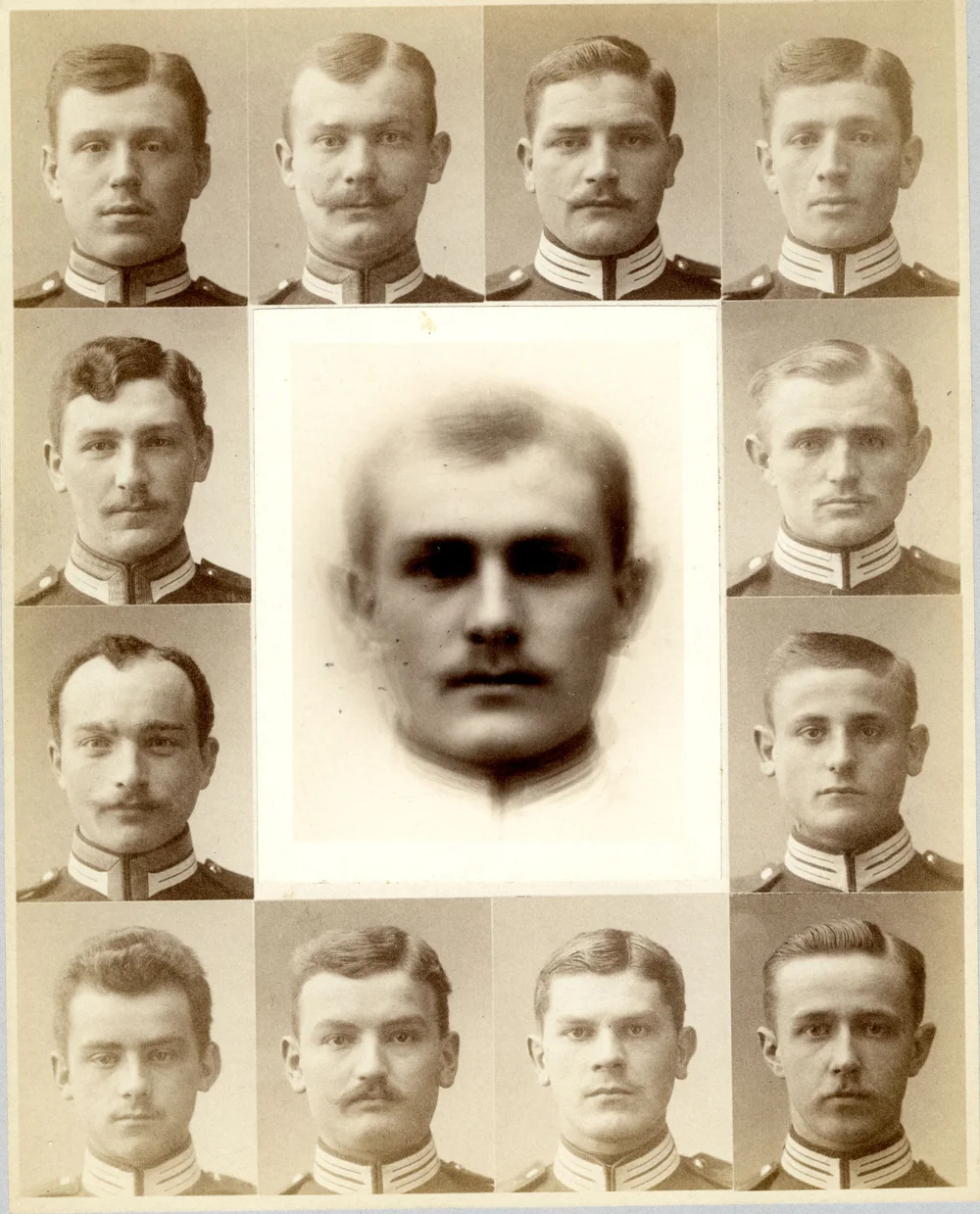
In the late 1800s the British scientist Francis Galton, a cousin of Charles Darwin, exposed one photographic plate to many faces in turn, each for a fraction of the time. The result was a blurred composite he believed showed a group's true "type." He made composites of families, of soldiers, and of men convicted of crimes, hoping to find the face of a criminal. Galton also coined the word "eugenics," and he saw these pictures as part of that project.
His criminal composites didn't show what he expected; he noted that the averaged faces looked more ordinary than the men in them. The idea survived anyway. In 2016 a paper claimed a neural network could spot criminals from ID photos, and critics traced it straight back to Galton. Image generators that produce the most typical face for a prompt rest on the same averaging. This is the hardest of these activities, and it belongs in the handbook's ethics section.
in class
try with students
Go slowly and give students time to react to the images. By the end they should know where this idea came from and be able to spot it in technology they use.
-
look at the composites 5 min
Show the composites of three sisters, then a composite beside the portraits it was made from. Ask what an averaged face shows and what it erases.
-
what galton was after 7 min
Show the criminal composites and the measurement photographs. Explain that Galton hoped to read character from faces and that this work fed eugenics. Ask who gets to decide what a "type" looks like, and who gets measured.
-
faces and machines today 8 min
Share the 2016 criminality paper and ask where else students see faces being read by machines: phone unlocks, proctoring software, filters, image generators. Close on the three reflection questions.
slide overview
-
On screen The title beside Galton's composite portraits of three sisters.
Say or ask Explain how a composite is made: many faces exposed onto one plate, each for a moment.
-
On screen One click: a composite face surrounded by the portraits it was built from, beside a page of individual portraits.
Say or ask Ask what the composite keeps and what disappears. Is anyone in the room "average"?
-
On screen A second click: Galton's plate of composite portraits, including convicted criminals, and the title page of Inquiries into Human Faculty (1883).
Say or ask Name what Galton was after: a face that would reveal a criminal, and a science of breeding "better" people.
-
On screen A third click: photographs of heads and faces being measured with calipers and instruments, including a child.
Say or ask Measurement like this was used to sort and rank people. Ask what it means to be on the receiving end of it.
-
On screen The three reflection questions.
Say or ask Discuss them together, ending on where this idea shows up in technology now.
takeaways
An average is a choice about whose faces go in, and it erases everyone in it. Claims that software can read character, criminality, or worth from a face repeat Galton's idea with more computing power, and they fall hardest on the people least able to argue with the result.
Students don't need to know how facial analysis works to ask the questions this activity raises: who decided what the categories are, whose faces trained it, and who gets measured.