

shannon's letter guessing game
Reviewed November 2026
In 1951 the mathematician Claude Shannon ran a simple experiment. He showed people a sentence one letter at a time, hid the next letter, and counted how many guesses it took them to get it. Some letters took a handful of tries. Most took one.
The game makes a good first lesson on language models because students feel the prediction happen in their own heads. By the end of the sentence they are guessing with near certainty, and they never had to think about cows. A model trained on billions of sentences is doing the same kind of guessing at a much larger scale.
in class
try with students
Run it with the whole class and the slides on the projector. Students do the guessing themselves, so they don't need devices or AI.
-
guess the sentence 8 min
Tell the class the hidden sentence is ordinary English, letters only. Take guesses for the first letter and tally each wrong one until someone gets it, then click to turn it over. Keep going letter by letter, writing the count under each tile.
-
read the numbers 5 min
Show the sentence as guess counts only. Ask where the big numbers are and why the last word took one guess per letter. Most classes notice that the first letter of each word is the hard one, and that guessing got easier as more of the sentence showed.
-
guess a language you don't speak 4 min
Read the intercepted lines in an invented language and ask for the next word. Most students pick the same word without knowing what any of the words mean. Ask them how they knew.
-
connect it to AI 3 min
Show the slide on how a model learns these patterns from large amounts of text. Then discuss the three reflection questions together.
slide overview
-
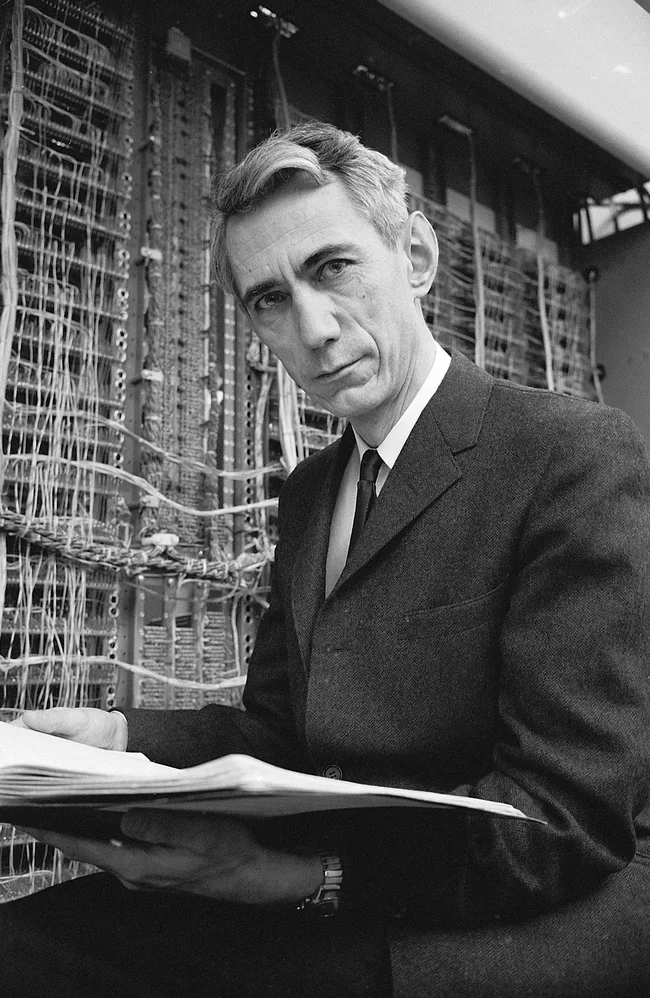
On screen Shannon's photo and a face-down board of thirteen tiles in four words.
Say or ask Explain the rules: an ordinary English sentence, letters only, and we count how many guesses each letter takes.
-
On screen Each click turns over the next letter: T, H, E, then C, O, W, G, O, E, S, and M, O, O.
Say or ask Click only once someone guesses the letter. Expect lots of guesses for the first letter of each word and very few after it.
-
On screen The finished sentence, "the cow goes moo," with three questions about the patterns.
Say or ask Ask when the puzzle was hardest and when the class could be nearly certain of the rest.
-
On screen The same sentence written as guess counts (7 2 1, 4 1 1, 8 1 1 1, 1 1 1), with a small AI character.
Say or ask Ask the class to imagine something that only ever saw the numbers. What would it notice? Why is "moo" all ones?
-
On screen A ring that counts up to 75%: about three quarters of written English is predictable, a finding repeated in other languages and even in dolphin whistles.
Say or ask Let the number land, then ask what that means for anything that writes by predicting.
-
On screen Five intercepted lines in an invented language, then "Zumi saki lum ___" and a chart of predicted next words: kesh 70%, vesh 30%.
Say or ask Did anyone need to understand the sentence to finish it? This is the move a language model makes.
-
On screen "The cow goes moo" feeding into the kinds of text a model trains on, which feed a learned representation of language, context, and world knowledge.
Say or ask The model learns patterns from text people wrote. It has never heard a cow.
-
On screen Three reflection questions: what's interesting here, what it makes you think about, and why we're talking about it.
Say or ask Discuss them as a class, or give each small group one question to answer and share.
takeaways
Predicting the next letter or word does not require understanding, and a lot of language can be predicted. That is enough to explain why a chatbot sounds fluent, and also why fluency is a poor signal of whether it is right.
Students who played the game have a concrete picture to come back to when a model writes something confident and wrong: it guessed well, the way they guessed "moo."