

harry beck's tube map
Reviewed November 2026
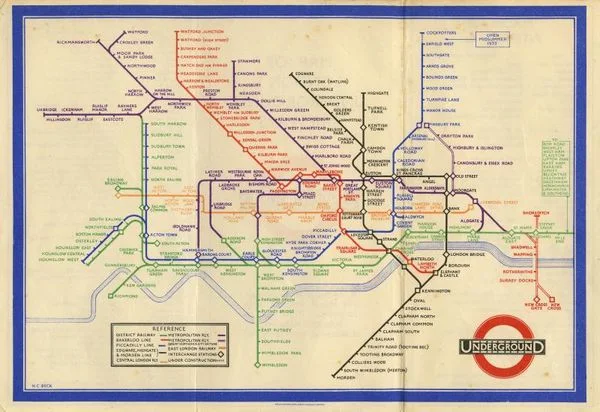
Early maps of the London Underground drew the lines over the city's streets, which made the busy center a tangle. In 1933 Harry Beck, an engineering draftsman, threw the geography out. His diagram used straight lines, a few fixed angles, and even spacing between stations, so riders could see at a glance which line to take and where to change. Nearly every transit map in the world now follows his idea.
Beck's map is a lie that works, as long as you use it for what it's for. It's excellent for planning a train trip and misleading for walking, since stations that are a few minutes apart on foot can look far apart. Any summary works this way, including one written by AI: it keeps some things and drops others, and someone decided which.
in class
try with students
Run it with the slides on the projector, then let students compare the two maps before you say anything about Beck.
-
compare the maps 6 min
Show the 1908 map, then click to bring in Beck's. Ask what changed, what each map is good for, and what each one gets wrong.
-
what beck changed 4 min
Ask what Beck kept (the order of stations, which lines connect) and what he gave up (distance, direction, the river's real shape). Who would be misled by his map?
-
compare a summary 5 min optional · AI use
Give students a short text and a one-paragraph summary of it. With a chatbot, have it write the summary; without one, use a summary a student or the teacher wrote. What did the summary keep, and what did it flatten? Close on the three reflection questions.
slide overview
-
On screen The 1908 Underground map, drawn over the streets.
Say or ask Ask how easy it would be to plan a trip with this map.
-
On screen One click brings in Beck's 1933 diagram beside it.
Say or ask Ask what changed and why riders preferred it. Then ask what it would get wrong for someone on foot.
-
On screen The three reflection questions.
Say or ask Discuss them together, ending on what else in their lives works like this map.
takeaways
Every useful simplification is built for a purpose, and it misleads anyone who uses it for a different one. A language model's output is a compression of what it was trained on, and an AI summary of a reading is a compression of the reading. The question to ask of both is what was kept, what was dropped, and who decided.