

In 1919, Vaughan MacCaughey, the Superintendent of Public Instruction for the Territory of Hawai‘i, wrote a letter to Sophie Judd Cooke about the small school she had opened in Honolulu in 1918. He wrote that he “heartily and fully” endorsed its “educational creed.” Then he added:
One of the dangers to our democracy is the lock-step and effacement of individuality in the public system… . It is my hope, next fall, to arrange to have some of our better teachers visit Hanahau‘oli School, one by one, and to catch something of its spirit.
Hanahau‘oli means “joyous work” in Hawaiian. Sophie and her husband George Cooke opened it in 1918 with 16 children between the ages of 6 and 11 (their own six plus the children of friends), after Sophie worked out the idea with Gudrun Thorne-Thomsen of the Francis W. Parker School in Chicago. The school’s own history describes it as an experiment in John Dewey’s “controversial new philosophy of education,” and Dewey and his wife came to visit a few years after it opened. Hanahau‘oli is now more than a century old. It has survived decades of turbulence as a “progressive” school, and it’s still establishing what it means to be one in 2026.
Rituals and Meaning Making
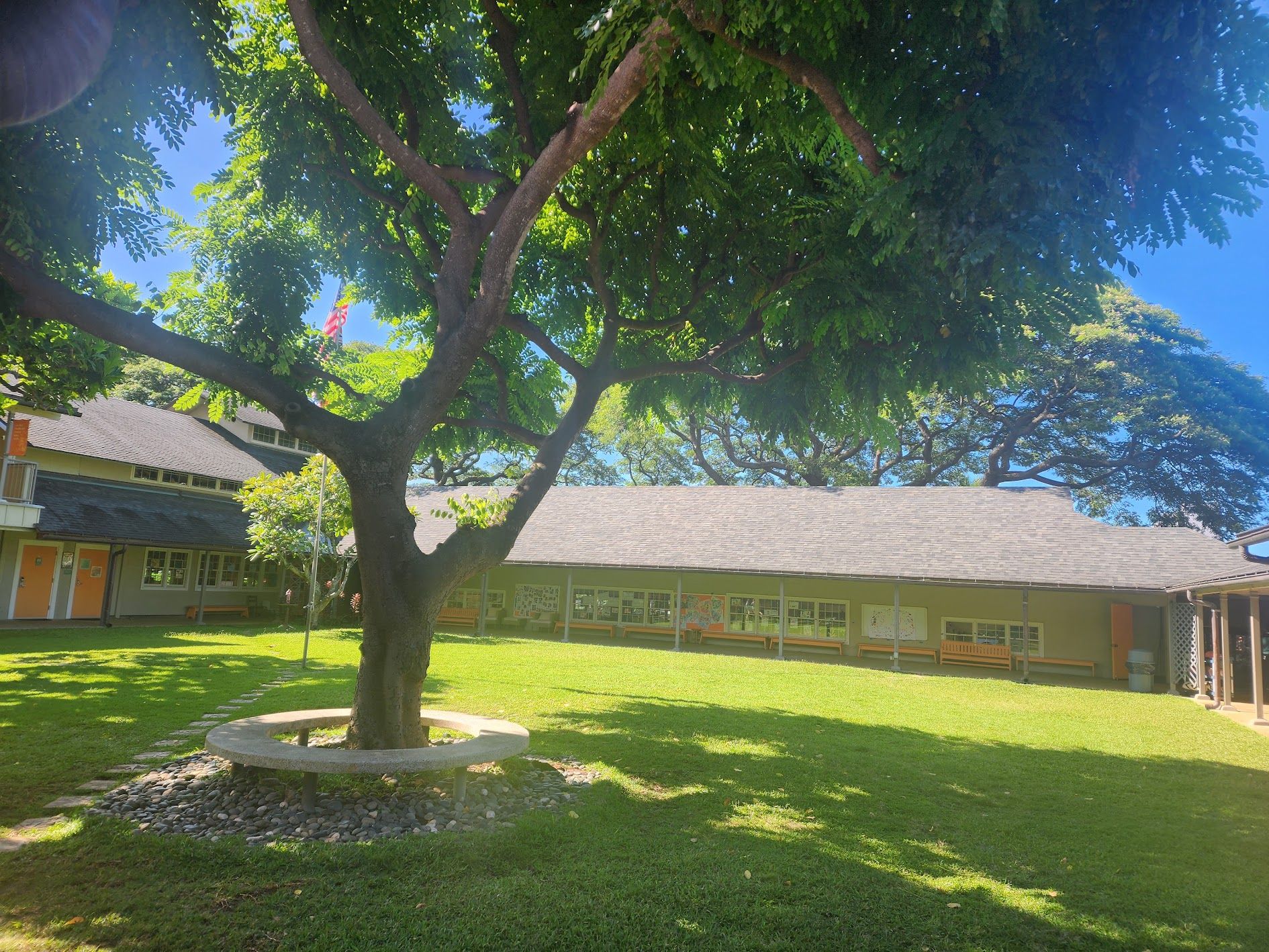
Single file, 1st through 6th grade students filtered quietly across the courtyard, crisscrossing into a circle. The school day starts outside, with a flag raising, the Pledge of Allegiance, a song from the school’s early days, and a Hawaiian chant (which was practiced earlier by upper-elementary students). Then, a student shouted across the circle: “Does anyone have any announcements!?” and students ran over one by one to announce a club meeting and an upcoming theatrical performance, or to pitch their candidacy for student body president (where a huge focus was on improving pick-up and drop-off procedures).
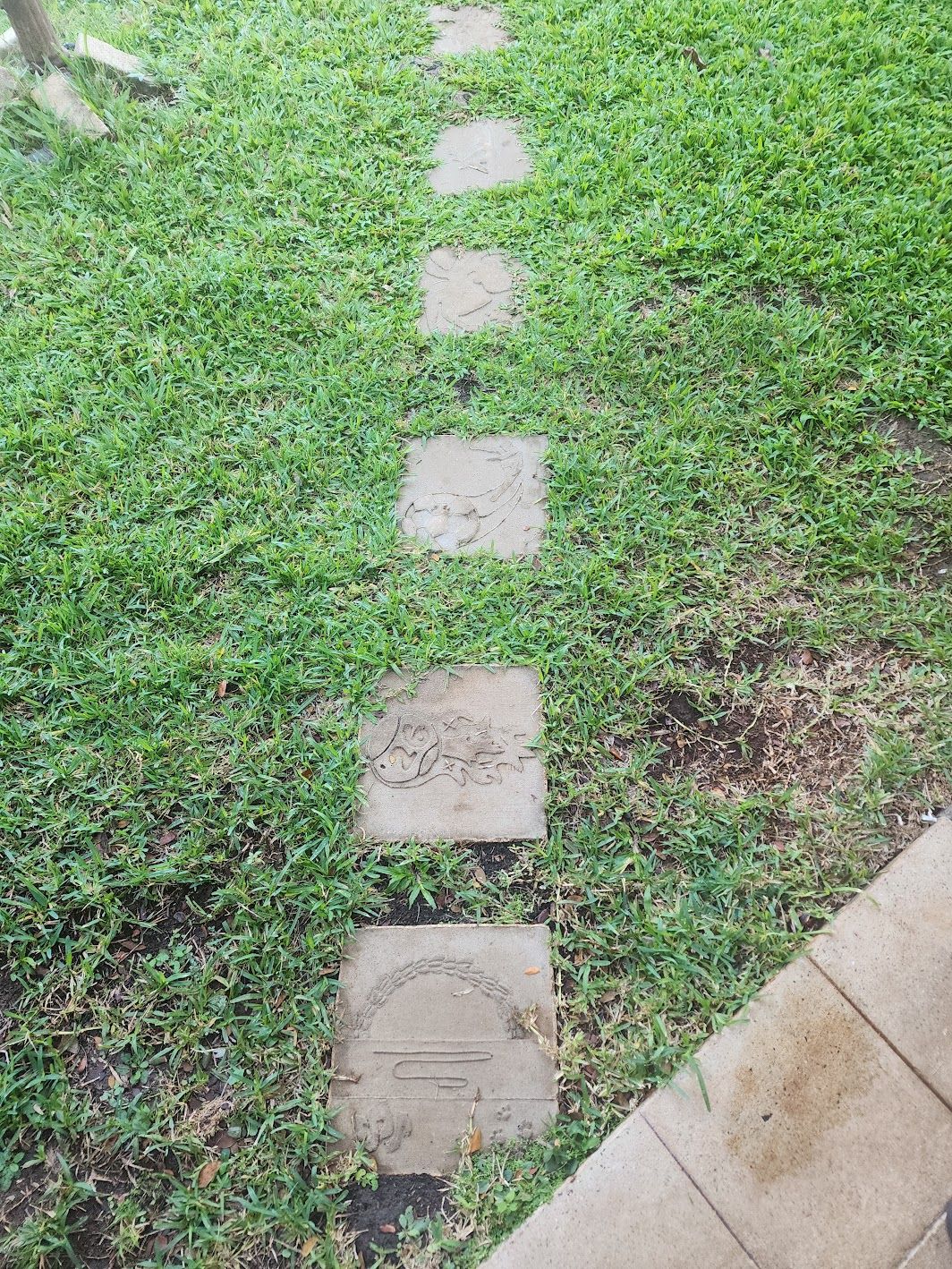
At their feet are stepping stones that dot the entire campus. Sixth graders have made them for graduation since 1926. Each has a unique design that represents its creator, and now, generations’ worth of Hanahau‘oli graduates have their time memorialized.
As the students start their class day, we’re ushered into the school library, which looks sort of like a treehouse, where multiple book lofts and small, narrow spaces are packed to the brim with children’s books. Some of the books have Post-it notes with special picks by the librarian, while others have notes on problematic elements in the story, and why it may still be worth checking out (e.g., Little House on the Prairie).
Within nearly all of these books’ front covers are taped inserts, a sheet of paper or a notecard, that have a paragraph dedicated to a student. Some are written in the student’s honor and others are the student celebrating the book itself, but all of them mark a birthday. At Hanahau‘oli, students can choose to celebrate their birthday with a “birthday book,” which essentially claims the book with a label saying it’s one of their favorites. Like the stepping stones, this practice dates back decades. The librarian told us that a copy of A Series of Unfortunate Events I’d picked up was recently checked out by a student, and his dad recognized the birthday book label as belonging to one of his friends from 3rd grade, when he attended.
When we looked out into the courtyard again, many students were practicing for that Friday’s performance. Nearly every Friday, students perform for each other, and this week the 6th graders were gearing up for a Greek play about democracy.
I’ve recently been re-reading Schooling as a Ritual Performance by Peter McLaren, which documents working-class Azorean and Italian youth at a middle school in Toronto. McLaren documents how nearly every facet of their schooling (bell-to-bell, teacher-centric classes; being controlled on how to sit properly, when to move around the room, or when to go to the bathroom; being graded on performance and placed in competition with your peers; or just broadly being in rigid, confined structures) is a form of ritual performance, or a repetitious structure, which symbolizes a push toward an individualistic, corporate, and controlling culture. As in, a space meant to output a very singular definition of success and “prepare students for the real world.” In the book, McLaren documents how many of these students invent their own systems and “rituals of resistance” to combat this: being the “class clown,” refusing to sit “properly,” or just muttering Portuguese slang under their breath.
Although the two are essentially polar opposite spaces, I couldn’t help but compare the rituals at Hanahau‘oli with those documented in McLaren’s work. And by extension, I started to wonder: what if the average school across the world looked like this? What if every school valued young people participating in democratic processes, treated them like human beings, and made them feel connected to a space and a community?
Instead of being funneled into a single, linear path that nearly always involves over-policing and a reductionist mindset of learning, young people would have the building blocks to lead a more cooperative society that cares for one another, values the democratic process, and accepts each other’s differences. The intentionality of these rituals at Hanahau‘oli is worth examining and implementing: every single day has 20–30 minutes of this flagpole community meeting, and there’s another session of at least 30 minutes on Fridays with the student performance. There is absolutely no rush to “get to the academic” part of school. In fact, the school leaders would be confused by the idea that somehow this circle isn’t academic, or that academics should run on a clock anyway (after all, students are learning all the time!).
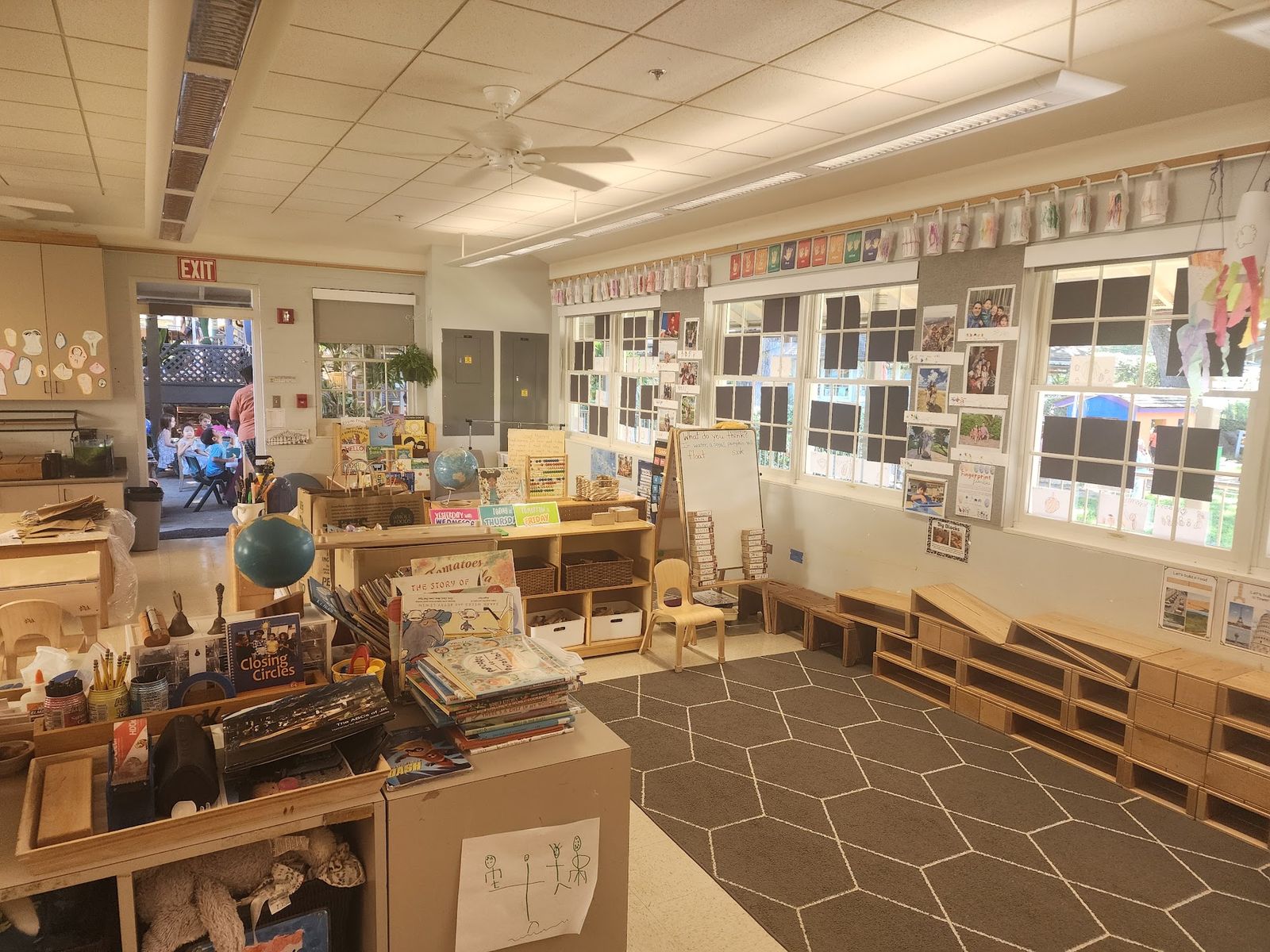
These rituals and systems extend into the classroom as well. All classes are co-taught by multiple teachers with no lead educator. Each classroom is set up with multiple spaces for children to learn, such as play mats, tables, desks, open spaces, and semi-walled-off learning areas. After we left the library, we explored multiple classrooms and saw a group of volunteers, all former full-time Hanahau‘oli teachers, helping small groups of junior-K/K students with arts and crafts projects to get ready for Halloween. They described the school as a “magical space” as they taught their “grandstudents,” as in, their former students’ grandchildren. One sat outside with groups of kids leading a hands-on “pumpkin-making” activity, while another worked in small groups across the classroom doing photorealism painting practice.
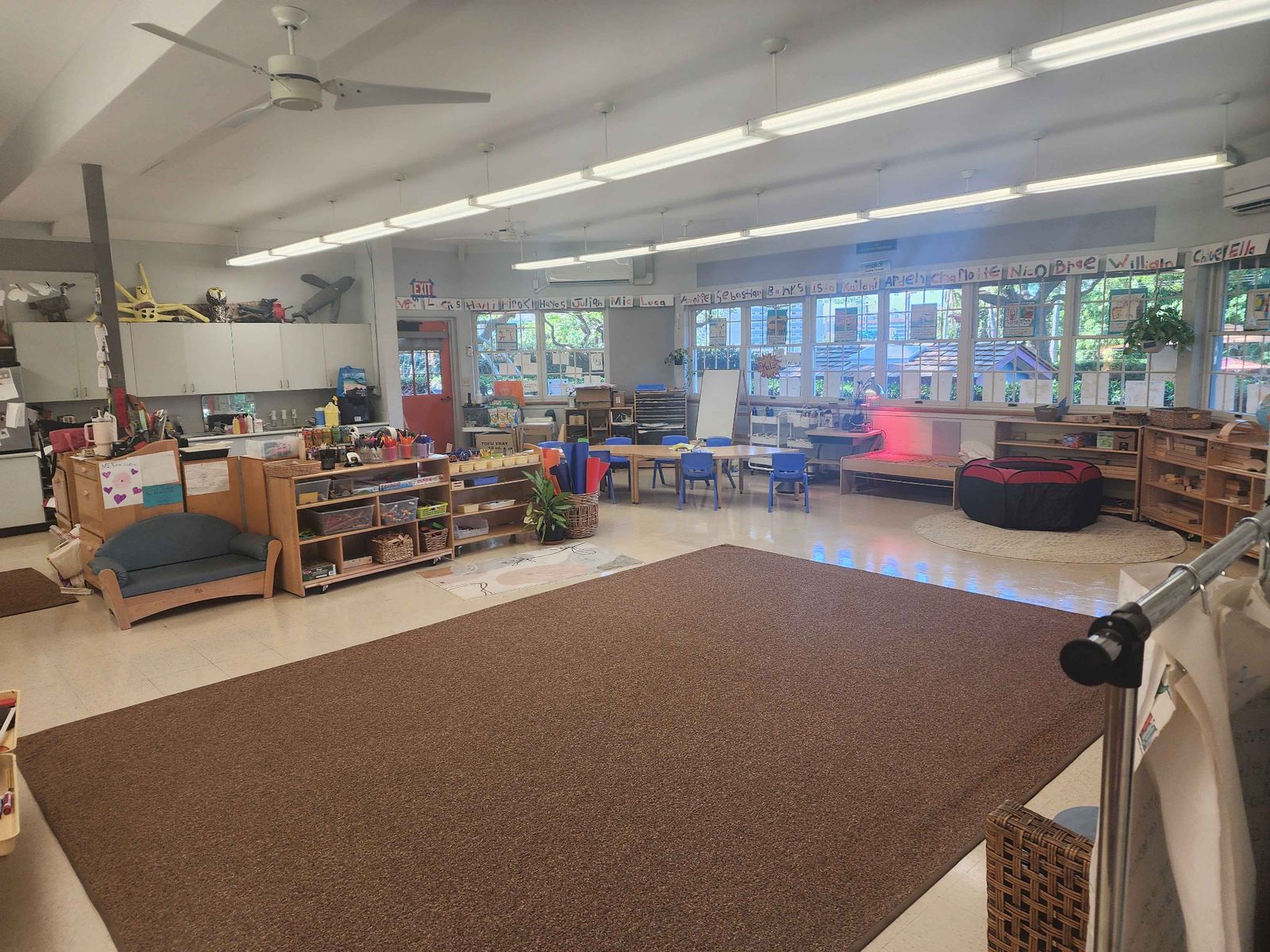
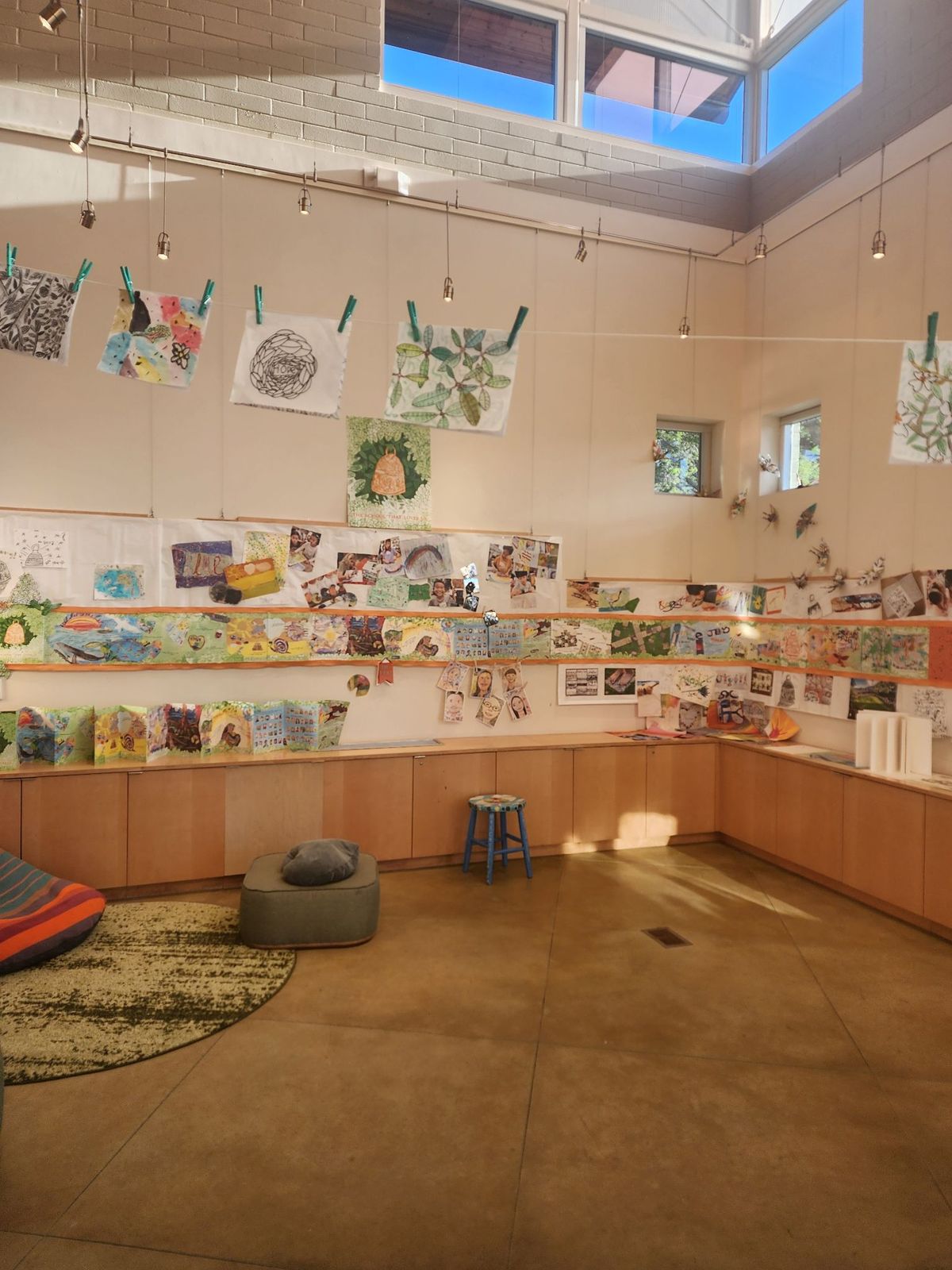
The classrooms are relatively similar to Montessori spaces, featuring a lot of manipulatives and “homey” touches like reading nooks and “mini-sized” furniture. A comment Cassie and I continuously made is that everything felt “lived in.” There was an obviously intentional effort to avoid the “sleek, industrial, engineered” look that many newer schools opt for. The furniture was all either custom-made, antique, or found, scattered around with warm fabrics and decorations galore. There were student projects, artwork, books, or toys on practically every wall and shelf. It’s noticeable that students are doing stuff at Hanahau‘oli because there is student work literally everywhere, much of it still in progress. It’s clean, but there’s no obsession with organization.
Another practice similar to Montessori is that nearly all of the classrooms are multi-age. Students are either “entering” or “exiting” a classroom band (e.g., first/second grade), which means they have the same teachers multiple years in a row and the content rotates (spirals) so they aren’t taught the same material twice. This allows each student to have a role: in classroom settings the “enterers” or “exiters” may be tasked with leading discussion or helping each other out. There’s additional multi-age learning at recess (with older students helping “keep the peace”), through design-challenge thinking partners and reading buddies, and in the jobs students have at lunch.
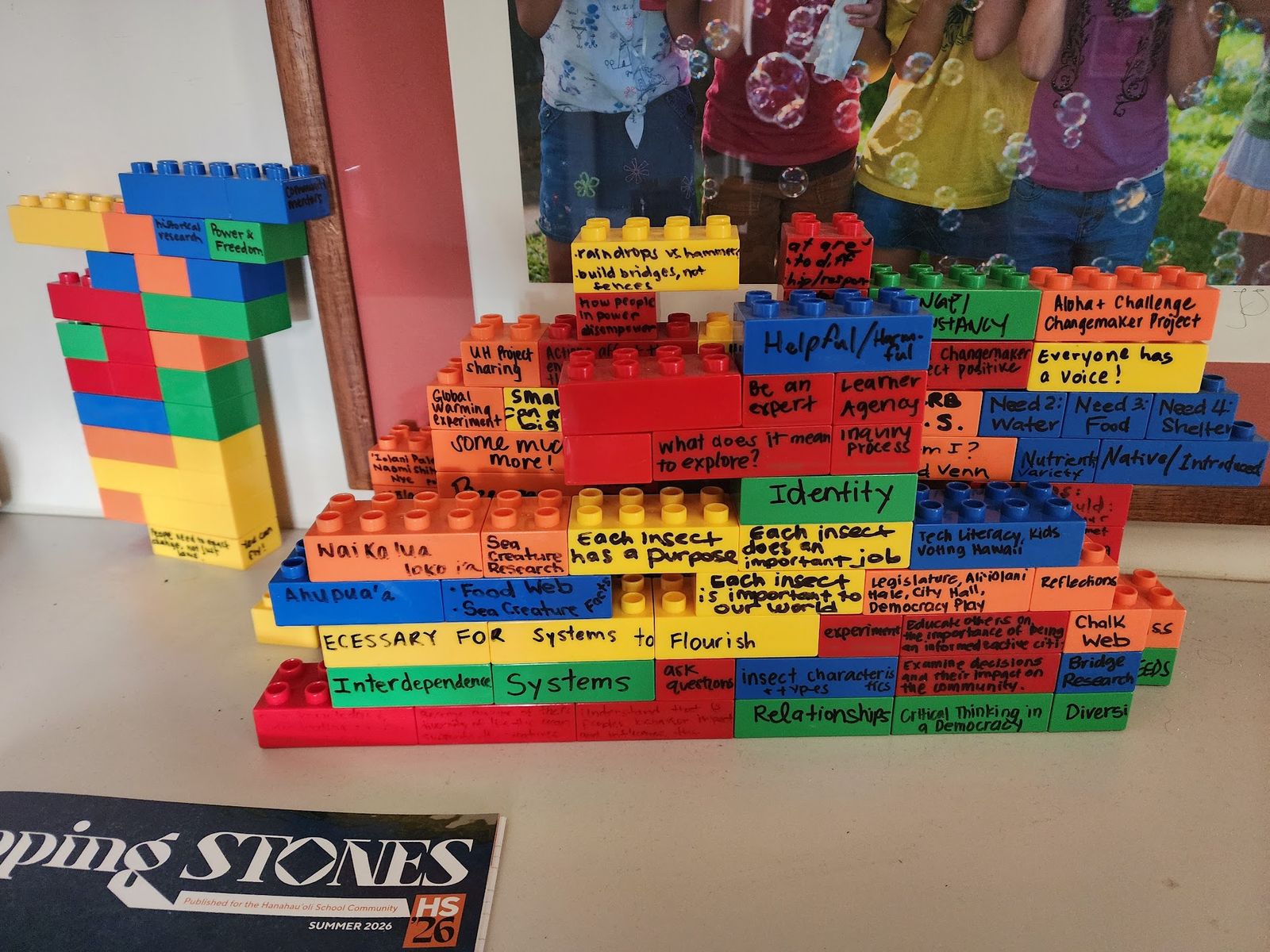
When we left the junior-K/K space, we saw a group of 4th/5th graders discussing a video they’d watched about desegregation and the Little Rock Nine, where they spoke about what it must have felt like to be singled out and bullied. They got into pairs and started working through a text to reflect on after the video. Then, we saw a multi-age music class practicing xylophones and two small choir groups singing songs they’d written to perform later. An art class was sharing designs they made and pressed through ʻohe kāpala, the Hawaiian practice of printing geometric designs with carved bamboo stamps on kapa, or bark cloth (and now textiles, fabrics, and the like). Another class was engaged in learning Hawaiian (ʻŌlelo Hawaiʻi) through storytelling and recitation, while another was learning Mandarin. The 6th-grade class (which serves as the capstone and is not multi-age) was watching CNN 10, a ten-minute news show for students, and having a fishbowl discussion on a reading.
Each space has a sign on the outside that shows the class’s interdisciplinary driving question or topic, such as how to sustain our democracy or why the Earth is shaped the way it is. These units last roughly a quarter and drive much of the discussion across all the subjects. Each teaching team sets its own schedule around the elective offerings and posts it somewhere in the room. We gathered that there’s a lot of time spent working hands-on, taking walks around campus, or playing. The restroom pass system is just signing out at the door, and students move around freely.
The students are comfortable, and they’re happy to be there. Kids and adults both get a lot of freedom and joy, and they use it to take on rigorous topics and talk them through. There are no grades; instead, students complete portfolios that encapsulate their work. At student-led conferences, they talk with their teacher and family members about how they see themselves as mathematicians, historians, and the like throughout their work – and their strengths and challenges. Family members are treated as their children’s first teachers, so Hanahau‘oli prioritizes these conversations over traditional grades. This has resulted in students showcasing learning at a much higher standard than most middle or even high schools we’ve been to.
As we wrapped up our self-guided tour, one student, who couldn’t have been older than a 3rd grader, was standing outside his art class and said hi to Cassie and me, then asked to shake our hands. He asked where we were from, we made some small talk, and eventually we asked him why he was hanging out outside of class. He calmly explained that he had been annoying some of his classmates, so his teacher told him to step out, walk off his energy for a bit, and come back when he’d calmed down. He said he needed that time and was feeling a lot better, and then he went back in. Although it was a random (and pretty funny) interaction, it really made us think: if every kid were treated with this level of respect, instead of being reprimanded or sent to the office, how would that change how people treat themselves and others? This level of mutual respect pays dividends, since we really didn’t see any students disengaged or acting out whatsoever.
Every single student seemed incredibly at ease and ready to learn that day. And I think this is just a reflection of setting up the proper systems and rituals so that every child feels welcomed, cared for, and part of a family.
Living in the In-Between
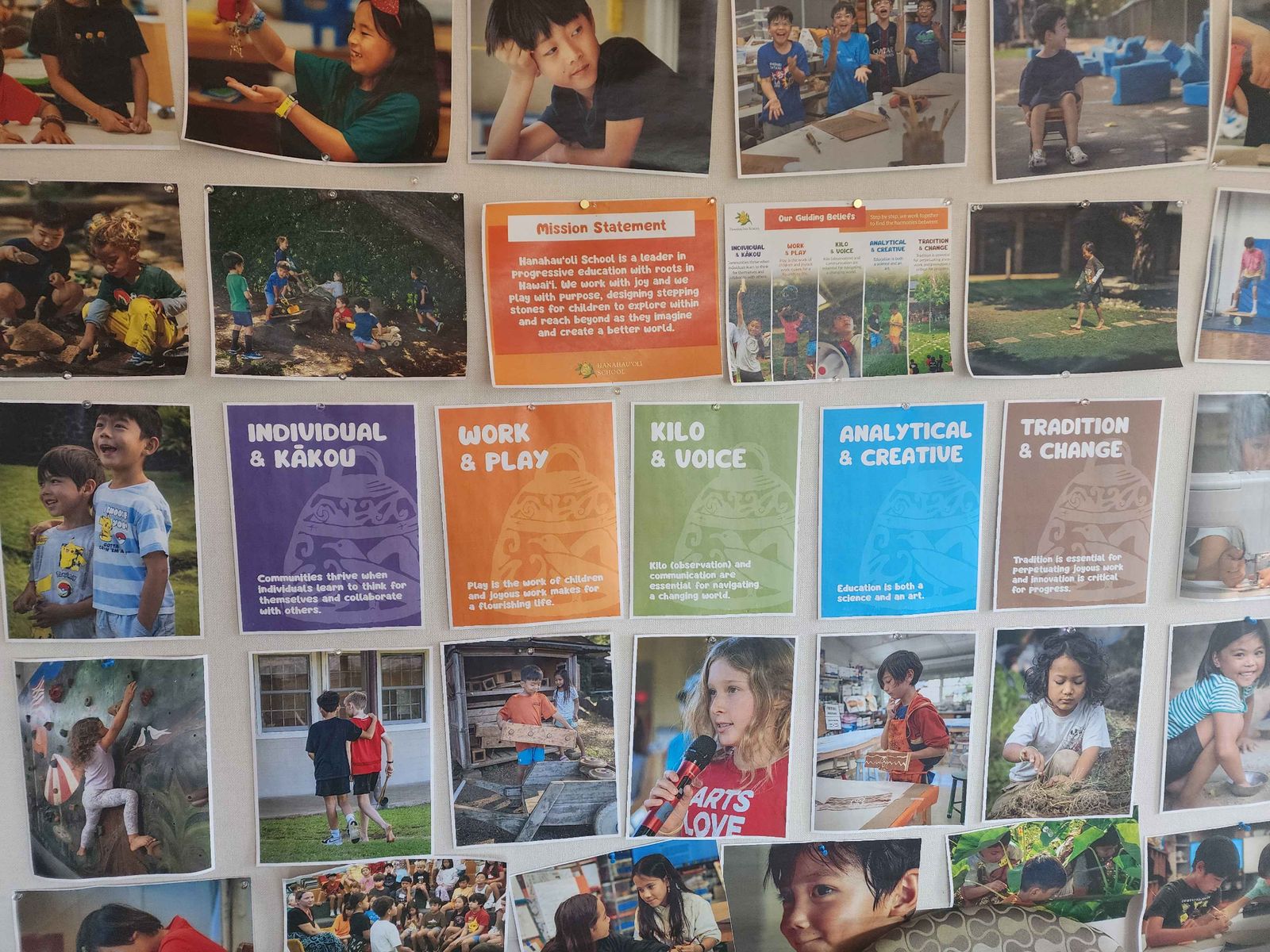
The school’s mission statement hangs on a wall covered in student photos:
Hanahau‘oli School is a leader in progressive education with roots in Hawai‘i. We work with joy and we play with purpose, designing stepping stones for children to explore within and reach beyond as they imagine and create a better world.
Next to it are five guiding beliefs, each written as a pair:
- Individual & Kākou (“We” “All of Us”). “Communities thrive when individuals learn to think for themselves and collaborate with others.”
- Work & Play. “Play is the work of children and joyous work makes for a flourishing life.”
- Kilo (“Observe” “Watch Closely”) & Voice. “Kilo and communication are essential for navigating a changing world.”
- Analytical & Creative. “Education is both a science and an art.”
- Tradition & Change. “Tradition is essential for perpetuating joyous work and innovation is critical for progress.”
The school calls this living in the “in-between space,” or designing in the gray. Its curriculum starts from place, from Indigenous Hawaiian culture and its relationship to the land, and it spirals back to the same big ideas as children get older. Kids learn digital multiliteracies (citing sources, ethical use of digital resources, the whats and hows of social media, AI use) in the library, and there’s a “physical world lab” where students learn to create and manipulate in a hands-on, industrial setting. Despite what the public might assume, progressive schools like this one have no aversion to technology or “innovation.” There’s just extreme intentionality with how these ideas are implemented. Older students at Hanahau‘oli receive laptops, but cell phones are not used on campus. We didn’t see a single student on any digital device the entire time we were there, because there was no reason at the time to do so.
Seeing the school design for the “in-between” made us consider what lessons we could take back with us to Michigan, and more broadly to the schools we work with across the globe. Hanahau‘oli is a private school, and despite the progressive education roots of the islands, most children in Hawai‘i will never attend a school like it, which is true across the United States as well. If we were to name the three “ingredients for success” we saw that are possible in typical schools, but that require us to truly invest and be intentional in our work, they would be:
- Shifting to an interdisciplinary learning model where students see a blend of subjects (not just the typical “core 4”) to answer challenging questions in the real world.
- Treating young people (and their families) as human beings, honoring their agency and knowledge, and showing them love and respect.
- Moving away from traditional forms of one-and-done assessment, and recognizing that learning is on a continuum. Hanahau‘oli has no grades, pacing guides, or curriculum packages. Educators meet together and make plans based on the needs of their students.
I think the world would be a different place if every kid had this experience.
For what it’s worth, the most common critique we hear is that the above simply isn’t possible in public schools. And although it isn’t as mainstream as we’d like, we do think it is possible. There are students, families, educators, school leaders, and communities who want to change school but are overwhelmed by the scope of changing the system. But to channel the great David Graeber, the anthropologist and author: “The ultimate, hidden truth of the world is that it is something that we make, and could just as easily make differently.”
In Muskegon, Michigan, we’ve been trying to build some of this inside public schools with the Third Coast Learning Collaborative (TCLC), our federally funded project with Orchard View and Reeths-Puffer Schools. TCLC is a “school within a school” that features interdisciplinary classes and a portfolio-based grading model, where nearly every cohort has a flexible schedule to build hands-on experiences throughout the day. Young people and educators are encouraged to experiment with unit design that matters to Muskegon and the “real world,” and to embrace challenging topics. We’re prioritizing planning time and financial resources to make that happen.
I’d bet anything that if you took one of the amazing, resourceful educators we’ve worked with in this project and plopped them into a school like Hanahau‘oli, after a few weeks of immersion and learning about the school’s systems, they would thrive. And I think that’s true of thousands upon thousands of educators: the systems we’ve created are not allowing us to embrace a truly human-centered system with compounding effects on building a brighter world. We already see pockets of this day-to-day, many of the practices we observed at home…just supported by a robust infrastructure of human-centered rituals, systems, and other intentional designs.
We’re certainly a few steps removed from the century-long project at Hanahau‘oli. But it gives us hope to see a successful, ambitious, and human-centered school that shows this work is possible and sustainable. The usual critiques (“Progressive education only works on paper,” “Progressive education isn’t rigorous,” “Without pacing guides and a set curriculum, kids will fall behind”) don’t really hold up when there’s an awesome school right here that’s been doing it for over a hundred years. So why can’t that work for all of us?