

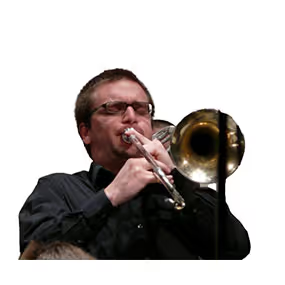
Music educator and doctoral student Burton Hable joins the podcast to explore constructionism, a pedagogy largely attributed to Seymour Papert. Hable argues that makerspaces can expand music education by engaging students in creating, performing, responding, and connecting. The conversation questions narrow definitions of musical literacy and what it means to be a musician.
transcript
Speaker 1 Man, wouldn't it be cool if your first year experience in band, instead of being the one night that you get to try all of the instruments and then pick, if you had, like this is a logistical nightmare, but it's it's still just fascinating. If if you had, you know, six weeks on flute and then six weeks on clarinet, this is all an arbitrary amount of time. Right? But then and then at the end of the year, after you've developed these, there's a ton of musical skills that apply across everything. Right? And then you've got some very specific stuff sprinkled in on top, and then you get to make an informed decision about, hey. I wanna play, you know, trombone. That was the one I liked the most. I think that in terms of skill development as it currently exists from beginner to the end of their high school career, that you wouldn't see a dip. You know? If anything, it would stay the same. I would be willing to bet that you would see that that second and third year of band for them would be far above where it used to be because they have a different, but probably stronger foundation as they get into it.
Speaker 2 Hello and welcome to episode one zero nine of our podcast at the Human Restoration Project. My name is Nick Covington and I'm a social studies teacher from Ankeny, Iowa. Before we get started, I wanted to let you know that this is brought to you by our supporters, three of whom are Efraim Hussein, Jennifer Mann, and Marie Becker. Thank you all for your ongoing support. You can learn more about the Human Restoration Project on our website, humanrestorationproject.org, or find us on Twitter, Instagram, or Facebook. I am joined today by Burton Hobbly. Burton Hobbly is a music educator currently living in Central Virginia. He is a doctoral student in Boston University's music education program, and his research interests lie in how people construct music knowledge in the context of a makerspace. He also serves as the operations and building manager for the Charlottesville band. Prior to moving to Virginia in the summer of twenty eighteen, he taught instrumental music in Iowa for eight years. I've also known Burton for twenty years now as we were high school classmates and played trombone in the same high school band together. Both of us later came back to teach in the same district that we graduated from. In so many ways, Burton and I share a similar journey in arriving at progressive education, and I'm grateful to call him a friend and a learning partner for these many years. As the title mentions, this episode focuses on the niche pedagogy of constructionism, largely attributed to one man, Seymour Papert, who published his first book, Mindstorms, Children, Computers, and Powerful Ideas, back in 1980. It's both fascinating and frustrating that despite four decades of research supporting the powerful impact on cognition and the opportunity for collaboration inherent in these ideas, the philosophy and framework of constructionism and similarly similarly modeled makerspaces are still only deployed in limited pockets on the fringes of the standard model of school. This conversation gets at the same central premise as so many others on this podcast, That is our limited imagination about what works in schools as they are currently structured, and what works to do what within music education in particular. What does it mean to be musically literate, to be a musician? Burton Hobbley imagines the role of makerspaces supported by constructionist pedagogy in music ed as a way to expand and enrich the standard model for students, with the goal of creating a broader collaborative experience for students to engage with all aspects, creating, performing, responding, and connecting to what it means to be musical. Enjoy.
Speaker 1 Burton, how you doing? I'm well, Nick. How are you?
Speaker 2 I am doing great. So it's awesome to get to talk to you. So why don't we just start with you? You know, tell us about yourself, your experiences and interests in education. What values do you center in your work with students and schools as a music educator?
Speaker 1 Yeah. You touched on on some of them already. I taught middle school and high school band in Iowa for for eight years and then moved to Virginia when my wife took a position at the University of Virginia as a professor of mechanical and aerospace engineering. I have a bachelor of music ed from Iowa State, a master of music ed from Vandercook College of Music in Chicago, Illinois. And, like you said, I'm I'm finishing up my doctorate of musical arts. I guess I don't get to be a PhD. DMA in music education from Boston University. When we I always say we because it was a a team of teachers, but when when I was teaching in Ankeny, that we had a team of six teachers that delivered instruction for band sixth through twelfth grade. And the really cool thing was our schedule was built so that none of us were rehearsing at the same time. So all six of us could be in every rehearsal every day, either pushing in to to help, what was going on in the everyday rehearsal or to pull students out for some individualized or small group instruction. As a as a music educator, I really strive to help students know how to understand and communicate emotion through the music that they're listening to or that they're they're making. And really, like, I think that the best way to do that is to try and approach them using music that that they enjoy and then using that as a gateway to to try and help them broaden their musical horizons, whether it's more into, I guess, the traditional canon of, like, what we would do in band or or into other other things beyond what they're they're interested in. And one of the ways that we did that in Ankeny was we had this this ensemble project where at the end of the year, things are winding down. There's no other concerts or performances that we're getting ready for. What what are we gonna do with our students? And we let them divide themselves up into, like, groups of two to six people, and then they picked whatever music they were gonna play. The only thing that we did as teachers was, hey. I'll help you transpose that for your instrument. Maybe tell you, like, oh, we might wanna tweak that a little bit to to make it a little bit more approachable. But beyond that, they were choosing the music. They were rehearsing the music. And then that last week that we had together, they were performing it for each other. And so we had all kinds of Disney medleys. My last year in Ankeny, there was a whole bunch of panic at the disco. It was it was some really cool cool stuff. And it's here, celebrate everything that you know how to do, but then do it in a way that's not teacher prescribed or kinda in the traditional vein of how we do things.
Speaker 2 And to have such an authentic audience for that performance as well, which is, you know, for for each other, you know, as in the form of this celebration. I mean, I I can't imagine a better, a better audience than than kind of outside of that traditional, I don't know, like a concert band environment. Here's one where you kinda you get to flex those muscles a little bit. You know? Yeah. Exactly. A lot of the conversations that we've had for
Speaker 1 years now, going way back, have revolved around this guy, Seymour Papert. Am I pronouncing his name right, by the way? No. And it took me it took me, like, two years to figure out Okay. Find somebody to pronounce it for me. It's Papert.
Speaker 2 Papert. Okay. Yeah. Yeah. So I I just kinda think of paper and then paper. Yeah. Right. Papert. Seymour Papert. Well, that's great. That's see, I'm learning things too. And I I'm not sure if if you had actually, like, exposed me to his ideas in of constructionism in particular. And so I think it bears in mind that constructivism, which, you know, is kind of a a popular or ubiquitous idea inside of progressive education, maybe, I don't know, trace back to, like, John Dewey. Right? But constructionism Mhmm. As a as a separate idea that's sort of related, I suppose. So I don't know. Give us the update here. Who was Papert? What's going on in constructionism? And what's your interest in exploring that idea in your own work?
Speaker 1 I'm gonna work kinda backwards with what you were you were saying there because it'll get us into it in the same way that I got into it. I am really interested in in makerspaces and not just because I think that they could be a nontraditional avenue for students to get into music education that aren't in band, orchestra, or choir, or just because, like, I find them fascinating on on my own. And for listeners that aren't familiar with what a makerspace is and its and its broadest idea, it's a place that has tools and technologies for people to make things. And kind of the most common things that you'll see are three d printers, laser cutting. There might be some woodworking or metalworking, some textile work maybe, or circuitry. Definitely some some kind of computer programming maybe. There's just lots of different things for you to make really whatever you you are interested in. And the theory of learning that kind of backs that up is this Papert's theory of constructionism. And constructionism Papert was a student of Piaget's. So, like, the constructivist theory that we construct our own knowledge, that there's not, like, one truth out there waiting to be discovered, but that that we kind of construct knowledge through our experiences of the world. That Piaget, after developing his stage theory of learning that he was interested in what that looks like in practice. And Papert was a mathematician that then, hey. Like, help me figure out some of the specifics about how we develop math knowledge. So Papert, after working with Piaget, began to develop this theory that that process of constructing knowledge best happens when I have a tangible artifact that represents that knowledge. And it could be something that I create in the physical world. It could be something that I create digitally. Papert called it an object to think with. That's something I can tangibly manipulate that represents my knowledge. This preceded makerspaces, but it absolutely aligns with the work that's that's happening in them because you're making something. And that making represents your learning about how to use different tools or an example of a project that I've seen out of a out of a makerspace is is I I wanted to make my own weather balloon. Well, there's a whole lot of physics knowledge that has to go into that. There's a whole lot of, some of the basic science of of weather and being able to take measurements and use those measurements to make predictions. I there's a whole bunch of knowledge that then gets represented in this artifact that you create in the makerspace. And so Papert, this was in the early nineteen eighties that he had a a group at at MIT known as the Epistemology and Learning Group, and they developed a programming language called Logo. And it was meant to be this easier way of programming, and we would use it to program things like they had these at first, they were digital, and then they became physical turtles. And you could use these turtles to draw things first on the computer screen and then later, like, in in real life, and they were used to to teach students geometry, either through the act of programming the turtle or through helping them, well, hey. Can you you make the turtle draw this? Make make the turtle do this design. So they published several different papers and then later later books on here's the different things that we were doing with programming. Here's the different things that kids were were learning by constructing these artifacts, the drawings that the turtles were producing, or the programs that they were writing to help the turtles produce that. As this has evolved, it has become stuff that we see in, definitely, in makerspaces, but but a whole lot in project based learning, whether or not you're thinking about the specifics of them your students constructing an artifact. But the the mere fact that we're producing something that is a representation of our knowledge finds its roots deep in in Papert's constructionism.
Speaker 2 It's so interesting how constructionism kind of is this huge sphere that, you know, then we find kind of the applications of that in the physical makerspaces or in the computer spaces that he had originally written about, one kind of takeaway from my understanding of that constructionist way of thinking too is that you're representing your knowledge in the physical space actually then influences your cognitive models too. So it works to both, you know, put your cognitive model into reality. And then in the creation or in the construction of it, that too then influences, your cognition. And so it just kind of is this, I don't know, this this dialogue or this, like, dialectic between you and, like, the physical or the, you know, the linguistic world if you're working with, say, a programming language or, that three d printer. Now so we already kinda talked about makerspaces, which I think, have been something that have popped up. I don't wanna call those things a fad necessarily, although I think they kind of contend toward faddishness, which, you know, I think all trends in education can tend towards faddishness, where you might just have a three d printer in a particular space, but there's not really a pedagogy, you know, aligned with, like, how to use this or, like, how do we function in this space together? So it can kind of be half implemented. But I wanna know then, like, you're talking about this kind of makerspace pedagogy in music. So how how do you construct those constructionist models? Like, what how how in the world, right, what exists out there in the world already that you're fine that you can connect to? What is new that you're innovating on or or having to know, you what hurdles are you having to overcome to get to the place that you want to be with this idea?
Speaker 1 There exist already some constructionist and can definitely constructivist, but then also constructionist educators and scholars in music. One example is I'm gonna forget his first name. His last name is Shively. He his dissertation was on developing a constructionist framework for teaching beginning band, and he unpacked a whole bunch of different constructivist and constructionist literatures to to say because there's a lot of different ways that people have applied Piaget's theories and Papert's theories and Vygotsky's sociocultural theories and picking the pieces that how would this work best in a beginning band? Right? And I've been told that when he would go out to rehearsals, you know, come and come and do an honor band or come work with with my group, one of the first questions that he would do when he'd get up on the podium would ask, well, how do you think we should start? What what do you think we we should do? And that has connotations of of discovery based learning, and Papert would agree that that constructionism has pieces of discovery based learning, but but similar to the way many progressive educators argue in favor of, it's it's not just, well, let's let's just see what happens kind of a thing. That that that there's an intentionality along along with it. For for Shively, it was helping students discover how to interact with their instrument rather than in a prescribed way. Like, how how does your trumpet work? How does your trombone work for you to make the different different sounds? And you're discovering is a as a means of here's my goal. I want to produce this on my instrument. How can I construct the ability to be able to do that? And there's there's some direct instruction that's that's that's necessary, how to put the instrument together and not hurt yourself. Right? Like, how to do do some very basic tone production kinds of things. But then beyond that, there's so much that students can discover. There's other scholars like Ruth Dubrow, from Boston University did a did a similar thing in middle school chorus. And then, like, Jackie Wiggins is, like, the, epitome of a construct constructivist approach to music education. She wrote a book called Teaching for Musical Understanding, and she she talks at great length about how do we develop a constructivist or constructionist mindset towards towards teaching music, and then how do we explore it? And you could make the argument that the artifact that that you're producing in a in a band, orchestra, or choir, rehearsal, or performance is a musical artifact that is a representation of of your understanding of music. But I'm more interested in being able to do that outside of those those paradigms. We know that the most recent research tells us, like, about 20% of a high school population takes band, orchestra, or choir at some point in their four years in high school. There's so many students then that music is certainly a part of their lives that they're just not involved in it in some way, formally in in their in their high school process. And so how can we reach those other 80% of of of students? And and I think that makerspaces is makerspaces are one way we could. And the way that I've seen that is you could call it a makerspace high school here, in Albemarle County that they, originally started as as a way for seniors to kinda do a a capstone project. They would they would attend this makerspace school once every other day, and the other day they're at their comprehensive high school taking taking their traditional courses. And one of these capstone projects that emerged was a student said, you know, I am self taught on guitar. I would love to make my own. And his his first attempt at it was to make an acoustical guitar and and realized that there that was a whole lot more complicated than he was gonna be able to accomplish in his in his senior year. And so he transitioned to making electric guitars and electric basses, and there's so much that he learned in woodworking and in in some science fields in terms of the getting the different components onto the guitar and wired the correct way and and used the correct way. But there's so much about music that he learned too because it was, this isn't sounding the way I want it to. What do I need to tweak to get that sound that I want? And then, obviously, once you've made it, well, you have to perform with it. Right? And and so here, this this student had this several artifacts of his music learning and his science learning, and and that's a big piece of of the makerspace learning is this it's cross curricular. It it engages lots of different disciplines. And essentially, the sky is the limit with with the students' imagination and what they wanna make. I think I covered everything there that you were trying to ask me.
Speaker 2 I think so. And and I think what the appeal of of less so just a makerspace generally, but the the kind of the pedagogy behind it, right, is that it makes that learning self evident, and and you just see that iteration. And I think I've seen this student or future students who had been part of that same kind of laboratory in constructing these instruments. It really is it's absolutely incredible, right, to just kinda see how, I guess, the spectrum of skills that students are required to enter into. You mentioned the woodworking part, but there's also the the electrical wiring. And then, of course, again, with the the musicality of the instrument too, just to say, like, you know, do all the frets on the guitar work? Is it getting the right timber that you want? You know, the pickup placement has a lot to do with it as well. So there's the the interplay and the lenses that students have to use as they're approaching that work and then the performance piece too. So nobody in that schooling context is gonna leave wondering what that student had learned in that class. Right? Like, you could walk out of so many classes that I've experienced and probably, you know, you and I have even taught over the years being like, wow. Did I learn anything, or did my kids learn anything, or, you know, did I actually give them the the range of opportunity to be able to express the things that they've learned in there? But with such a concrete, you know, base for performance and construction and creation, it removes all that down and just makes that thing self evident. So so I kinda wonder because I can think back to my own, band instruction, and and I can think probably about, a lot of musical instruction can look like the kind of rote instruction that we might see I don't know. You know, I I don't wanna paint with too broad of a brush, but, like, memorizing math facts or memorizing, scales kind of has an equivalent thing. So, you know, I could leave a math class per se, having, memorized my times tables, but I my ability to apply those or to create or to understand anything outside of that concrete knowledge is very limited. In the same way, maybe when I think about those musical scales, it might be the case that I could play a c scale, but, like, I can't I I might not be able to, transfer that into some other context of either my playing or my listening or kind of other of the the literacies that you need to have, to be musical, right, to have a musical competency. So on the spectrum from that kind of rote memorization of scales, which we've had a lot of conversation about this, but to your, like, ideal or what we imagine this, this constructionist or this even constructivist method of music education looks like. Right? Where are we starting from? How do we get to that ideal? Map that course for us here. What are the hurdles getting in between your vision for for what this looks like?
Speaker 1 I I don't know that I have a a perfect pathway from from from one to the other, but Oh, come on. Easy answers. Come on. Exactly. I and and I don't know that that my opinions about music education are are necessarily inside the norm of of what you might find amongst most high school music educators, well, any any music educator. But you brought up the idea of of music literacy, and I would venture to guess that the vast majority of people in The United States, in Western cultures for music ed, would say that literacy is being able to read notated music. And I wouldn't disagree that that is a musical literacy, but I don't think that it is necessarily the be all end all. Now, I'm not necessarily advocating that we should do away with teaching students to learn how to read musical notation in in any shape or form. But it doesn't have to be that that only way. So, like, my experience growing up in music, which was probably similar to yours, was at some point in an elementary general music class, we started learning the staff and where the music staff and where where notes appear on it. Every good boy deserves fudge or or something to that effect. And and and rhythms as as well, and that transferred to recorder and then later to some choice of a band instrument. And that's a that's a fairly normal path as I understand it for most students. It might end up on a on a string instrument in an orchestra or somewhere in a in a choir. But like I said before, like, we're missing out on a lot of of other students that are outside of that path. And so I'm not advocating for a replacement of the traditional path, but rather supplements too. And in some places, it's already happening. There are are music technology classes that depending on the way the classroom is set up, you could argue that they're a music makerspace. At this particular MakerSpice high school that I was talking about before, there's a music studio. There's a there's a place for students to record and produce, and they do their own music, their own music videos. There's instruments there, some of them designed by students, that that they that they can play to produce. And there there's also, I mean, national standards for music technology. Like, let's take you through learning how to use digital audio workstations and record in your own music and mix different loops and and recordings and and things like that. There's also avenues where we're trying to provide learning opportunities in music for specific cultures. There is a big movement in Iowa that was starting before I moved, and I'm fairly certain it's still continuing for mariachi music and and having mariachi ensembles as part of the the curriculum. I one of my electives at Boston, you and I talked a lot about this, was a rock band pedagogy class. And it can be called rock band. It can be called modern band. There's lots of different avenues for it. But, like, learning piano, bass, guitar, drums, or or even computer, like building through through loops and sampling, but producing the music that you listen to on the on the radio all the time. The final for that course was a a performance in the in Boston's Memorial Union. I got to play some bass on get by with a little help from my friends. It was quite quite the learning and and performing experience. Very nice. But but again for music, I I want us to have more options for more students. The students that we're not reaching with band, orchestra and choir. And I think that the ways to do that are gonna let them explore using the music that they are interested in. And how can we help you create or recreate music like that? Because band, orchestra, and choir, at least the way that we're teaching them right now, don't really offer opportunities for that to happen.
Speaker 2 They certainly don't. And that, I see that in my own students now. You know, there there are students that I've I've had come through my courses who have talked about the music that they're creating, whether it be, like, loops or samples or, you know, rap and hip hop and those kinds of things. I find it really interesting that the students those students who are usually involved in actively pursuing music in high school as as kind of a a career for themselves or something or or wanting to get into that are not the same kind of students that I see who are the maybe the most involved in, like, the concert bands, marching bands, and jazz bands and stuff, who aren't just creating music on the side. And I don't know if that's a function of structure or a function of time or if they would, if they could. But, yeah, it doesn't seem like those are groups of kids who who overlap a whole lot. And and I would really hate it if kids who went through, like, a a band program then, you know, didn't ever take up music in the future or absent that kind of structure or the opportunity to perform in a structured way. So the yeah. There just has to be more ways for for tiny humans to discover sort of the the joy of that the the the inner joy of that musical world. And and this is a conversation we've had off off air a lot, which is just about how, like, we kinda think of discovery learning as sort of being a a nonrigorous or a much lampoon sort of idea. But when you start to play pentatonic scales or those kinds of things for kids, they feel a certain way about it. Right? You have an emotional attachment to the way the timber of a certain instrument, right, or the way that the dynamics of a piece work. I mean, can feel those things before you have a musical language to describe them. So are the makerspaces the way that you feel, are the ways to to reach that, or is it more through, I don't know, like, grabbing those kids and sitting down with them and saying, like, you gotta learn, you know, your, you gotta learn your majors and minors and your your modes and everything else. I don't know. I'm not trying to get you to to play into a false dichotomy here, but I I'm seeing the dichotomy. Right? Like, seeing kids who drop out of music or kids who pick it up and then never let it go, and it goes on to influence the rest of their life.
Speaker 1 Yeah. And I I don't know that, again, that a makerspace is a be all end all, but if we take that broad definition of a makerspace that it's a place where the tools and technologies exist for you to make things, And if we create opportunities for students to make music, and not even necessarily make music, the putting aside the baggage of discussing national standards for a second. And just the national standards of for music are the same for national standards in arts education, that we create, that we perform, present, or just depending on the field of art. Right? Like produce, whatever, that we respond to art around us. Right? And if if we're creating opportunities for students to do those things with music, they're creating music, they're performing or producing music, they're responding to music around them. I guess you could say a makerspace, if it's providing the opportunities to do that, are the answer, but it it is a way of giving students opportunities to interact with music that aren't choosing, hopefully, aren't choosing to interact with it in the ways that we're already providing. A perfect example is and and shout out to our our mutual friend, Tom Hines, at at Centennial High School in Ankeny. Tom has has worked, to get some grant money going to develop a, essentially, a music studio in his media center. There's a there's a room off off to the side there where there's a couple IMAX, some recording equipment, piano, guitar, bass, drums, and he had even found a random trombone at some point that I had nothing to to do with that. But but then the kids can sign up at any time to go into the media center and and and make some music, and it's is it a music maker space? You could argue, yeah. I mean, there's there's not a set curriculum for it, and there doesn't need to be. Kids can come in and and make and explore music. It's it's a really neat idea that Tom had.
Speaker 2 And I love the idea too of sort of having, like a like a neutral ground for those kids who aren't in the structured band activities for whatever reason, you know, whether it's time constraints or financial constraints or, you know, they didn't get into it in fifth grade, you know, and so then they missed the window for it or something. Whatever. Right? But I love the idea of maybe, like, it's a collaboration space for those students who have the extracurricular interest but don't have, you know, the musical background. And then the kids who have the formal education in there but, right, don't have the don't have the ability to to collaborate or don't have the tools, you know, at home to collaborate other than, you know, writing trombone music and playing it in their bedroom. I I think the more that we can kind of get those spaces and and tear down not tear down. That seems awfully violent. But maybe, like, deconstruct those silos and just really get kids into into the work of, making music together. And, yeah, that that involves collaboration, creation. There's a performance. There's the recording and and editing component, and then, of course, you know, the performance. Like, I I have always loved, students who have who have been those those musical creators. Right? Be be they the the editors or the the rap artists, r and b loopers and stuff. They are always very willing to, like, share with me, like, their Spotify or their SoundCloud and everything else, and I and I love to participate in that. And I feel like I don't get the same, you know, thing through the students who are more in those structured programs because they only happen at certain times. So I don't know. Maybe maybe I'm just projecting a little bit of my myself in that. But it'd be a fascinating thing to be able to bring those groups together and give them a structured time during the day that that they could collaborate and create those projects.
Speaker 1 I wanna jump on on something you said there. If that's alright, you you you keep mentioning collaboration, and it's a huge piece of constructionism. It's a huge piece of of makerspaces. One of the things that that Papert was fascinated by, were Brazilian samba schools. And take what you you think of schools and throw it out the window what that word is used because it was communities of people that are preparing for Carnival. Right? There would be our community is gonna have this part of a performance in that celebration. Right? This point in time, like, our our neighborhood is gonna put on a performance from this time to this time, and so we're gonna get together and practice together for this performance. Well, there are people in there that are just such a huge range of of ages and skill levels, and there's small children participating. There's grandparents participating in the full range. And people are learning from one another. It's very Vygotsky and sociocultural and the more knowledgeable other, the scaffolding of of everybody around it. And constructionism is a is a huge piece of that or takes a huge piece of that that we're gonna be learning from the people around us interacting in these in these makerspaces. And some of it, if it's a more I don't wanna use the traditional word traditional, but it's it's what's coming out out of my brain right now. Makerspace where where I'm I am trying to design this thing for the three d printer, and I'm not quite sure how to use the software while the kid's sitting next to me that, yeah, absolutely. Like, let me show you how to how to help you do that. Or in a music maker space like you're talking about, you know, hey. Like, you wanna learn how to play bass? Like, let's come in and learn bass by doing it, not by not necessarily by, now learn your 12 major scales. Okay. Now you can come in and and play that that Exactly. Collaboration is a huge, huge, huge part of it.
Speaker 2 It's such an interesting thing, isn't it, when when you compare the Samba School model with, again, what I think about my suburban high school. You know? Let's let's maybe that's a universal kind of experience, I don't know, for Americans to have. But it is kind of bewildering that we just put all the fifth graders and we say, this is a fifth grade band, and you don't play next to anybody else who's younger or older. And it really lends itself to the only people that you're the only person really that that then that you are allowed to learn from is then the one adult who is conducting and managing and doing the impossible work that I can only assume band instructors do. But quite frankly, maybe our structures make that work more difficult because there aren't the more knowledgeable others or there aren't more, you know, mature peers because we've isolated, fifth graders from sixth graders and sixth graders from seventh graders and seventh graders from their high school counterparts and never do they ever interact. And even when those, when those bands put on performances, and you're you're aware of this, how how do they perform them? They perform as a seventh grade band and as an eighth grade band and then as a, you know, nine, tenth, or however your high school's combined band. Right? It it is such a fascinating thing to think of what music education can even look like if the the inter, not just interdisciplinary, right, but kind of that if the grade levels were allowed to intermingle
Speaker 1 to support each other in in that. And, yeah, that's that's just an interesting kind of observation in that. There's there's so many tangents that we could take off of that because, I mean, I I know people, myself included, that worked to manufacture experiences that were in Ankeny, we called them vertical. Right? Like, we're gonna make sure that those sixth grade students are getting to interact with the high school students. Now was it as much pie in the sky as you were describing? Like, no. Absolutely not. But working to to make those opportunities, man, wouldn't it be cool if your first year experience in band, instead of being the one night that you get to try all of the instruments and then pick if you had, like this is a logistical nightmare, but it's it's still just fascinating. If you if you had, you know, six weeks on flute and then six weeks on clarinet, this is all an arbitrary amount of time. Right? But then and then at the end of the year, after you've developed these, there's a ton of musical skills that apply across everything. Right? And then you've got some very specific stuff sprinkled in on top, and then you get to make an informed decision about, hey. I wanna play, you know, trombone. That was the one I liked the most. I think that in terms of skill development as it currently exists from beginner to the end of their high school career, that you wouldn't see a dip. You know? If anything, it would stay the same. I would be willing to bet that you would see that that second and third year of band for them would be far above where it used to be because they have a different but probably stronger foundation as they get into it. Where do you think that that strength in the foundation comes from? Just kind of seeing the seeing how they fit into the whole or kind of seeing the breadth of of musical expression that's out there? Like Yeah. And and then two that it's that idea of transfer of learning. Right? Like, a flute player, it I mean, are they reading different music? Yes. But it's not as different as you might think. I mean, there's transposition and and things like that. But I get to take those skills and apply it on this new instrument in the vast majority of woodwind instruments. Well, if I add a finger, add a button going down, the sound gets lower. Like, there's concepts that will work across all of the instruments. Right? And the valve pattern on brass instruments is the same on all it right? And so there's just this this new wealth of knowledge that you can take from what you learned on this instrument to this instrument, which I think creates a stronger foundation there. And I'm I'm a perfect example. I started on trumpet in fifth grade. Our tenth grade year, our tenth grade band was a little short on trombones, and so I said, yeah. Okay. I'll do it. And there's so much that I was able to transfer even though it was going from treble clef to bass clef and valves to a slide. And but there's so much that's similar that all of a sudden I mean, yes, was five years older as well, but but picking up a trombone was not nearly as difficult because of that foundation of knowledge.
Speaker 2 God, that's fascinating. Yeah. And I, again, I think about my own musical experiences and, right, if I tried to pick up a woodwind now, I would be lost in the woods. I it'd be just as likely for me to do open heart surgery on a whim as it would be to play a clarinet the first time. But with brass instruments, like, I could probably figure out, a brass instrument in fifteen minutes or so. Maybe not play anything super competently, but, right, the the basic mechanics of it are are so different between those instruments. And, really, I I think maybe, like, percussionists probably get the most broad range of transferability. You know, you've got musical notes on malleted instruments, and you've also got, you know, rhythmic patterns on various drums and things. So so they might get the the the broadest depth of transfer there. The fascinating way, just to kinda unpack the way that bands in school work. You know, we we talk about reimagining what, like, a classroom education looks like or reimagining what that band room education looks like. You you mentioned logistical nightmare. Yes. I'm sure. At the same time, right, is it is it worth this and is totally hypothetical. You don't have to say yes or no. Right? Would it be worth at least, like, launching those experiments? If only to then see literally what's the worst that could happen. Kids are more interested in playing music for the rest of their lives or or, you know, like, I think so much of the again, let's call it standard experience of of band perhaps is more of those are those legacy projects, those prestige building things, you know, playing at solos and performing at Allstate band, you know, winning awards for your school and and kind of about acquiring those things. But, yeah, I wonder if it would be worth it at some point to to reevaluate the conveyor belt of music education that we apply everywhere else and we say, you know, is is detrimental to the long term curiosity and and things of the rest of school if that applies to band too. But so I wonder then as it maybe if we start to wrap up here, thinking of constructionism or constructivism as it as it's applied to music construction in particular, like, who who are you reading? Who is who are leaders that you are looking up to? Who are motivating you? What media can listeners as learners of this who wanna seek that out more? What can they connect with?
Speaker 1 Because I'm in my doctoral program, the vast majority of the stuff I'm gonna recommend is on the scholarly side and and probably less so on the fun experimental side. But to start on the fun experimental side, there is a program called Little Kids Rock, and it has although it says Little Kids in the name, it's it's modern band. It's rock band. It's a it's a curriculum for exposing kids to learning how to play piano, bass, guitar, drums, and they're they are doing some fascinating work. That was that rock band class that I took at BU was was built out of out of some of those things, but there's a whole lot of really, really neat stuff going on there. And then even if you, as an individual listener, or you, Nick Covington, are are interested in messing around with, like, loops and things like that, there's a free web based service called soundtrap.com. And you can it's it's like if you've ever used GarageBand or Audacity or things like that, but they have this built in loop library. And some of the loops, you have to pay for if you you know? But there's there's tons of free stuff in there that you can create with as well. And they just recently or at least I discovered recently, a feature where you can type in an artist that you like, you know, Doja Cat. Right? And here are loops that we think sound like Doja Cat. How cool that, like, students can start by recreating and then move to creating from from the things that are in there.
Speaker 2 Or even begin to analyze what characterizes an artist's sound. You know? What makes this sound like a particular artist? Right? Is it instrumentation? Is it a a production quality or, you know, something that that's in post? Or is it, you know, something about the artist themselves? So oh, yeah. That's a that's a fantastic idea.
Speaker 1 Yeah. And then in terms of some of the more the more scholarly stuff there, I mentioned it was Joseph Shively was the constructivist beginning band thing. Jackie Wiggins is the teaching for musical understanding. In terms of of makerspaces, the the thing that really got me into it was was twofold. One, I did a long term sub job out here for a teacher at the Sigma Lab, like the Greek letter sigma, and it's a makerspace at Charlottesville High School. They have a a fairly structured, like, engineering curriculum that the students go through towards, a capstone project where you're designing some of your your own stuff. But you can you can look up the the Sigma Lab at Charlottesville High School and the stuff that's going on there. It's just absolutely fascinating. Erica Halverson is a professor of curriculum and instruction at the University of Wisconsin Madison, and she and a few other different scholars did research on learning in makerspaces. They have several different articles about, like, learning in the making and tying it. Erica is a a theater artist, and and a lot of a lot of the stuff then is situated in arts learning and and how how can the arts connect to what's going on. She just recently published a book entitled How the Arts Can Save Education, Transforming Teaching, Learning, and and Instruction. And there's just just some fascinating things in there. Yes. About makerspaces or how makerspaces relate to to art education, but then too, what the rest of education can learn from the way that that arts education happens. There's some neat stuff happening at the MIT Media Lab. It's kind of the modern evolution of of Papert's group that was there working in the eighties. The gentleman leading it, his name is Mitch Resnick, and his his group of researchers is called the lifelong kindergarten group, and it's it's it's all about play and how we learn from play. And we continue to develop experiences like, why isn't my senior year of high school more like my kindergarten class? There's similar stuff happening at Harvard. Harvard's group that's of the equivalent is called Project Zero, and they've published some more research on STEAM integration with makerspaces. So not only science, technology, engineering, manufacturing, but arts and how are we seeing the arts play out in makerspaces. And then they also are doing a lot of things about identity, the identity of a maker, and the democratization of makerspaces. Let's make sure that we're not doing things that are limiting it to stereotypes that we might have of of certain students.
Speaker 2 Just on the note of research, though, when we think of, like, research based practices, they tend to be, again, typical practices. You know? When you kinda think of an idea like constructionism being sort of a new thing, Papert wrote his first book in, what, 1980? And we're talking about computers, you know, like a like an Apple two or something like that. I mean, e maybe even prior to that that I just don't have an awareness of. So it's a pedagogy now that's, older than we are. You know? It's it's 40 years old plus. To say that, it's not like a research backed practice, you might just have to work a little bit harder to to connect those fears. But, you know, the fact that MIT and Harvard and things are pursuing it as well, I think, probably give it a little bit of more legitimacy too. But well, cool. Burton, how can people find you, connect with, you know, you and your work? Where can we find you?
Speaker 1 Absolutely. I have a a blog at burtonhobbley.com. It's burtonhable.com, and then it's burtonhobbley on Twitter and on on Facebook. I've been publishing a lot about my work at BU, my interest in makerspace, makerspaces. And there's stuff if you really wanna go digging. There's stuff about the work that we were doing in Ankeny with that vertical teaching in band, some of my thoughts about Nick no. Just kidding. But some some of my thoughts about, as I've developed as a progressive educator because of the work that Nick has done, that, that is that is definitely in there. And I would love to have conversations. I'm sure that you have in some way, like, outed me to my music education community as a as an outsider now. God. I hope so.
Speaker 2 That was my goal. I was trying to pin you to the wall and make you make you take a hard stance, and you wiggle that at it every time. You're a slippery guy. But Yeah. No. It's it's been awesome to talk to you. I mean, as always. And and I think we've managed to capture here in in nearly an hour in our recorded time just a fraction of, you know, the kinds of conversations that we've had in the last ten years as we've both been on kind of our own journey through education and pedagogy and and practice and and trying to navigate the tension in all of those things. So it's always awesome to, you know, check-in on on where you're at in in your journey as well. So thanks for taking some time this afternoon.
Speaker 1 No. Thank you for having me. This has been fun.
resources
- Mindstorms: Children, Computers, and Powerful Ideas · Seymour Papert (book) Foundational 1980 text on constructionism; available open access online. link →
- Burton Hable (person) Music educator and doctoral student researching constructionism and makerspaces in music education. link →
- Charlottesville Band (organization) Community music organization where Burton Hable serves as Operations and Building Manager.
- Boston University Music Education Program (organization) Doctoral program where Burton Hable researches music knowledge construction in makerspace contexts.