
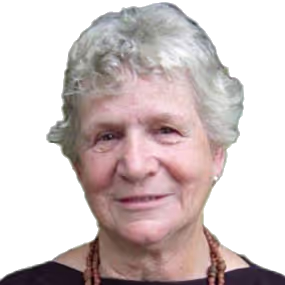
Deborah Meier, founder of Central Park East and Mission Hill School, joins the podcast to discuss building coalitions of schools, educators, families, and communities. The conversation focuses on protecting progressive public education and creating schools that strengthen democracy.
transcript
Speaker 1 Hello, and welcome to episode 112 of our podcast. My name is Chris McNutt, and I'm part of the progressive education nonprofit human restoration project. Before we start this podcast, I want to address the recent events in Uvalde, Texas. Yet again, an American public space and yet again a school has had a massacre. In the wake of the shooting, we once again hear about ludicrous substitutions for obvious gun reform and repeat the same cyclical process which has dominated our American discourse for decades. Essentially, every media personality and organization has made statements offering support for what the vast majority of Americans want, which is common sense gun reform. In spite of this, Republican politicians have turned their attention, yet again, to farcical ideas like arming teachers as opposed to addressing the obvious specific issue of guns in The United States. In conjunction with a well funded propagandistic gun lobby, it's a personal fear, as I'm sure it is for you as well, that this will be spoken about for a few weeks, It'll make their rounds on social media, then it'll become a distant memory like Sandy Hook, those before it, and those in between, or perhaps even those in the future. This podcast, which was taped and somewhat framed around the events in Buffalo just two weeks ago, calls upon educators to organize and fight for schools. And, of course, gun control is a major part of that ongoing fight. And we would encourage our podcast listeners to sign up for the nationwide March for Our Lives rally on 06/11/2022. No change can happen unless people band together and use their collective voice. We also encourage you to donate to the movement at marchforourlives.com, everytown.org, momsdemandaction.org, sandyhookpromise.org, and any other organization working in tandem to demand change. We just can't let cynicism and apathy destroy our collective voice. We have to use it. Today's guest is Deborah Meyer, who really needs no introduction for advocates of progressive education. Meyer is the founder of the modern small schools movement that aims to reorganize larger schools into smaller democratic ones. She was founder and director of Central Park East, a Dewey inspired progressive school in East Harlem, New York City. She also opened Central Park East two, River East, and the Central Park East Secondary School in the same neighborhood. This led her to establish a network of similar schools in New York City and eventually founding Mission Hill School in Boston. Meyer is an advocate of Democratic Progressive Public Schools who has served on the National Board for Professional Teaching Standards, National Academy of Education, The Nation, Dissent, and more. She is the recipient of the MacArthur Fellowship as well as the author of multiple books including the recently coauthored These Schools Belong to You and Me Why We Can't Afford to Abandon Our Public Schools. Meyer is a huge inspiration to us at Human Restoration Project and we frequently draw upon her work in our materials and advocacy. In this podcast, Myer and I talk about building a coalition of schools, educators, families, and community members to build and protect a progressive public education, discussing the importance of building a public education system that strengthens and models a democracy. Let's start off just by talking a little bit about what is going on, in terms of what's what's happening at schools throughout the country, in terms of progressive education at large, and also just public schools and the concept of equity. These things that are vitally important, and they're increasingly under attack by conservatives. And to an extent, I would argue by liberal politicians as well in terms of the defense not being as strong as it could be. Given your experience in various ways from Central Park East to all the different various schools you started and boards you've served on, what should we be doing? What what can we do in order to support these schools? Oh,
Speaker 2 I was hoping you could answer that question. I I could tell you one little development. They have decided to close the school that I started in Boston. It was part of a pilot school initiative that the union proposed in the nineteen nineties. And then at one point, there was some 30 plus of pilot schools that had were union schools with, but they were sort of exempt from a great many of the rules of both that's not part of the contract. On the other hand, they also insisted there some rules had remained like, you know, there had to be a process for we couldn't just fire people. You know? Teachers had a a voice in making decisions. And so it was a it was, I thought, on the whole in the right direction. I'm trying to solve the problem that I face about a certain amount of autonomy on the local level that involves all the adults and, ideally, even students and some of the other equity issues because very often, the the autonomy can play against equity and just as choice can play against equity. So how to have some choice some systems of both choice and autonomy for local actors, for local school that it's a real community that makes decisions about self governing. At the same time, there are some unworked out problems about that idea. It can run-in conflict with other values. And that's in a sense, it's the dilemma we're facing about democracy is that we've never really thought too deeply about it. What we mean left about it? And that it depends, my new phrase. It it depends upon the time, circumstances, the nature of the community, the issues facing that community, and it won't always look the same. I think we'd like to think that we can solve problems by having a model. You know, there's just a single answer to things and not conflicting answers. If you do this, there's a price to be paid over here, which is, do you want to pay, so to speak, if you make a choice? I I wonder then,
Speaker 1 in terms of our obsession with having simple solutions to problems, how do we spread the practice that you're setting up at these different schools and setting up almost a coalition of sorts between traditional public schools and the small schools that you've branched off to. As in, how do we convince educators and students that these schools are worth fighting for as opposed to the schools that might currently be attending, if that makes sense? Yes. Yes. So if having a little faith in what I think is a basic democratic idea that self
Speaker 2 governance, if it means that whoever the selves are, they need to play a role in deciding how they're gonna be governed. And if we want to teach young people about democracy and I think maybe it starts there in asking ourselves more seriously what the point of schools are and what's the point of democracy is. If democracy is really important, then where are we supposed to play with it, learn about it? It would be like starting a baseball team, but the one thing you don't do is ever play baseball. And you certainly wouldn't assume that going to a soccer game would necessarily help you play baseball. So we have created schools that in no way are not only are not democratic, but they are a model of authoritarianism. Even most good school, there's no place where young people see adults living, even the adults in their lives that they look and think, what does it mean to become a full citizen, an adult, an 18 year old? There's no place they can see are playing the democratic roles in the community they're living. Not in their workplace, most of the time, not in the city they live in, not in the nation they live in. So I that's why I've often started with adults That the issue of student voice is very important, but I don't think you can convince teachers that it's important when they don't have a voice. This can only pass on values that they understand themselves. So sometimes I think, well, we are I'm trying to think of is there a law we could pass? My pretend law was that every community then we have to define community. That every community has to create a definition of democracy that they will try in their school, and they will document. And that they have whatever model they produce, they can get together and change. But they have to defend the grounds that it increases the voice of all the parties, all the constituents. They have a greater voice and say in their institution, their lives, and so forth. So that we begin to in demand that that be a community project
Speaker 1 to try to imagine how the community might be more democratic, including its schools. Right. Yeah. The the ability to be able to to model that process and and teach students by by doing it, I think is often enacted as like something like project based learning or students working hands on in something. But I think the larger grander concept of teaching things like responsibility, purposeful actions, empathy, or democracy is often lost because of how the school itself functions. For example, you can integrate project based learning into a seven period day where students are just told what to do. But integrating something like democracy or responsibility is going to take a lot more reform or a lot more reimagining of what a school looks like and how it feels and what capabilities students have during the day. And I know that you've you've written about a lot, your critiques of education and children's personal liberty. What they're able to do during the day, what a traditional school day looks like in terms of sitting at your desk and and not really having the freedom to even move around, let alone voice your opinion on something. I'm curious then how we toe that line between promoting progressive education while simultaneously ensuring that public education is still is still vital, recognizing that we still need to defend public education in spite of those flaws. How do we both reimagine but still defend the concept of public ed? That's how we need to keep public education
Speaker 2 because underlying the idea of self governance is that we we are responsible. It's not just a personal self governance. It's self governance of the institution of the nation, and that means that the purpose of schooling is not entirely your success, the individual. It's not a private it's paid for by public funds because it's supposed to have a public purpose. If we say, as we often do, that it's worth dying for democracy, then one important public purpose must be to teach people to value and understand it and play a part in it. And how can they possibly learn when there is simply no institution in America who considers that their responsibility? You know, if you wanna be a cook, you go to a cooking school. But if you wanna learn about democracy, what do you do? It's at best a course taught undemocratically by an adult in high school. And then occasionally, when something doesn't matter much at all, you let the kids vote on it. So you are teaching a definition of democracy, which is really quite scary. That it's only good for things you don't care too much about and that don't have a serious consequences, then it's okay to vote on it. If it is really something of importance, then you need to have some other system. Other thing is that we function, which is the hope of democracy, that you don't function by fear alone, and that schools are arranged for each level to fear the other, which supposed to be afraid of. And so what do you mean by the word respect when we say you don't respect me? We mean you act as though you're not afraid of me. And that's when policemen use that or teachers use it or the principal uses it to a teacher, you're not being respectful.
Speaker 1 What she really means is you're not acting as though you're afraid of me. Yeah. I think that's a really powerful statement to make and I think that it connects really well to what we're seeing on the national political scale in terms of this post truth society. We're seeing a growth in authoritarianism. The election in 2024 will likely be unprecedented as many things are. And social justice movements, equity movements, even simple just LGBT rights in schools are being censored and attacked
Speaker 2 and put down. What teachers can teach about? You can't teach about reality. You have to teach, you know, our version of history. Someone's and that and you should be afraid because if you don't do that, you might lose your job. Yeah. And it's it's scary. Right? Like, it's it's terrifying. You know, as I was mentioning earlier, they are planning to close Mission Hill School and the process, of course, has nothing to do with the school people making decisions. And it's just too long to explain what's going on there. But years ago, there was a man named Seymour Saris, and he wrote a book shortly before he died called the inevitable failure of school reform. He wrote that book, and I was reading it about the time I was starting one of the new schools. And we would talk about, is there anything I can do now that will prevent them from destroying this school in the long run? Because they did it with the high school in New York. Soon as now there, they did it right after I left. They just sent the principal in to replace me who and they have the legal right to do that, and they his message was to change the school, make it a traditional high school for select kids. Every the opposite of everything we it stood for. Now in the case of Mission Hill, I was so pleased because I left there in about two thousand three or four, maybe. You know, it survived a long time. It's this this would be its twenty fifth year. So I thought somehow they were safe, that it wasn't something that they were doing because they finally got rid of me. But apparently, it's not. And I don't know around the country how many other progressive schools have I mean, first of all, I'd like someone to investigate what's happened to schools that were known for being public schools that were known for being very progressive and whether it's had an effect on the private progressive schools also. I went to a private progressive school in New York as a child, and I have the impression that they have actually, in some ways, stayed true to their progressive tradition. But the progressive tradition that was seen to me was did not it did informally, but it didn't formally give parents and teachers a voice in the governance of the school. I mean, you redo it, I don't think he talks about the adult culture that children learn by osmosis. There's more about how to give children democratic rights than the adults in the school in progressive education. How to make the classroom more democratic, not how to make the school more democratic.
Speaker 1 I I think that that builds well into what we do about the fact that so many different schools are under attack, both public institutions and progressive schools at large. In my opinion, that would look like teachers as activists. We know that typically top down reform movements don't work, especially not on a national or state level because of how many different times progressive schools have come under attack by politicians. I think that the really the only way forward are teachers banding together,
Speaker 2 demanding more, and doing a more grassroots style. So how can we get the unions to be that? Are we there is or are we trying to is there a way to reform the union so that they are the advocates for it? Not collective bargaining entirely seen as something that's done to teachers, but that the, bargaining is close to the pace, you know, that more is left. Now I think they did some of that in Rochester under Adam Erbansky, left more things on the school level rather than on the metropolitan level. He was one of the few leading people in the union in the AFT who agreed with me about democracy. No. No. The best of them did verbally, but you know what I mean. Adam fought for trying to figure out a way which a union can be a supporter for her local democracy so that teachers felt less afraid and more like full citizens of the school. Yeah. I mean, the idea that that the school might be a democratic site which now they might beat exceptions in terms of depending on the age of the students and so forth. You know, I don't think infants should have the same democratic say as 12 year olds who might and or 18 year olds. There's a certain arbitrary arbitrariness about when you are considered old enough to be self governing, but and when it comes to schools, nobody is old enough to be self governing, even the principal.
Speaker 1 It's scary to think that I wonder myself, like, how much is it really going to take for activists, union members, teachers, etcetera to band together and make that change given what we're seeing every day in terms of censoring public education through like divisive concepts. But even, like, sadly, what we saw yesterday in Buffalo, where you have an 18 year old young person who was radicalized. I I can only question, like, what classroom experiences that they have leading up until that point. Not saying that it's the teacher's fault, but there's certainly a systemic failure there that
Speaker 2 makes me wonder like how how bad will it get before we start to change course. Yes. So that is a dilemma. And sometimes maybe it has to get a little better for for people to have hope. That's very important is to think about what lesson the school does teach. And one of them is the resentment that the people in the lower tracks in schools must develop over the years towards educated elite. I mean, twelve years in an institution that only thinks you're smart if you're a certain type of person with a certain kind of smarts and to have spent all those years being put down by the faculty, other students, for being the dumb kids. And I think some of the resentment that we sometimes annoys us because it doesn't seem to be in their own self interest. Poorer and lower class and working class people feel towards the educated elite has been built consciously over twelve years in school. For example, when my daughter first school in New York City that they went to after we left Chicago, and they were put in a top track class, all three of my children, on the basis of nothing other than that I went in and I was white. No one knew what it was but with my children were placed in the top tracks. And then the top tracks were responsible for they had some self governance, so to speak, and including governance over the other tracks. They were the hall guards, and they were they had the authority roles as young people. I she was in third grade, fourth grade. Anyway, we had fifth grade, actually. We had went and talked with some of the teachers about the fact that she did not want to be enforcing rules against other students who had no say in them. I insisted they should not let should not make her play that role.
Speaker 3 Conference to Restore Humanity is an invitation for k 12 and college educators to engage in a human centered system reboot, centering the needs of students and educators toward a praxis of social justice. The traditional conference format doesn't work for everyone. It's costly to attend, environmentally unfriendly, and it doesn't allow everyone to engage or have a voice in the learning community. Our conference is designed around the accessibility and sustainability of virtual learning, while engaging participants in a classroom environment that models the same progressive pedagogy we value with students. Instead of long Zoom presentations with a brief Q and A, keynotes are flipped, and attendees will have the opportunity for extended conversation with our speakers, Doctor. Henry Giroux, the founding theorist of critical pedagogy. Doctor. Denisha Jones, educator, activist, and co editor of Black Lives Matter at School. And the Circle Keepers from Harvest Collegiate High School in New York City, a student collective focused on social And instead of back to back online workshops, we are offering asynchronous learning tracks. You can engage with the content and the community at any time on topics like anti carceral pedagogy, disrupting linguistic discrimination, designing for neurodivergence, promoting childism in the classroom, and supporting feedback over grades. The conference to restore humanity runs July 25 through the twenty eighth. And as of recording, early bird tickets are still available. It's $150 for four days with discounts available for individuals from historically marginalized communities, as well as group rates. Plus, we'll award certificates for teacher training and continuing education credits. See our website humanrestorationproject.org for more information. And let's restore humanity together.
Speaker 1 Yeah. That that hidden curriculum. Like those things that you're you're you're internalizing over time that you could grow up within that system and never never make that that recollection. Never piece together the fact that in many ways, the school the way the school is structured because it's so competitive And underlyingly, in many systemic ways racist and classist, etcetera, you could go through twelve years of schooling and never recognize all those different ways in which school can be harmful because of the way it's set up. That kind of morphs our society at large. Right? To create a better society, you have to look at those systemic structures in school and make that change. And the language.
Speaker 2 I mean, you know, I was thinking that it wasn't until very recently that it occurred to me that the word respect has this other powerful meaning because that was a word I often used. We need to respect each other. Mutual respect is a and I didn't realize that actually by another definition, there can't be mutual respect. I mean, we're both afraid of each other. Is that what or maybe that that is one way. We're both afraid of each other in which case we can never collaborate out of our mutual self respect. It's interesting how, you know, the the word respect, and it wasn't until I saw it played in this on television, this was the police that I realized the help. Eerie when the police is saying to someone, sit down, then lie down, put your face down, and then saying, you have learned to respect me. And watching the two, this person being totally disrespected in the most extreme form was that the word respect was the word the policeman went back to. Where did he learn that? He did not respect me. That was what teachers say to kids all the time. Yeah. It has that that carceral effect, which
Speaker 1 is yeah. I mean, And I and I I do wanna steer the conversation towards something that you you said earlier, which is how do we inspire then hope? Like we have all these terrible things going on. And you see an exodus of teachers from the teaching profession, especially in public schools who are being regulated and they were already really not paid well. And they work very long hours and many of them are just saying, hey, I'm just gonna go do something else. How do we keep educators there? Like how do we retain educators? How do we build schools that attract educators? How do we inspire hope that there is a future in this that that teachers will desire change?
Speaker 2 You know, the fact is when I think about my entering the profession, which was completely unexpected on my part, And it was in a period in which there was a lot of social interest in schools in the sixties. When I started to in the sixties, even though part of me thought of especially elementary school teaching as something a smart person, a well educated person doesn't do. On the other hand, I was also excited by it because there was this conversation and we were struggling with ideas. When I came to New York, there was something called the workshop center in open education at City College and a woman named Lillian Weber. And it wasn't just teaching. I was joining a community of people who were exploring the same thing I was. And we don't I don't know where that is anymore. When the coalition went out of existence, it was a real loss for me because at least once a year, we all got together and shared with her part of some larger force. The union isn't playing that role these days, and I don't you know, there are groups like yours. How do we tie them in some way together so they begin to think not just a local player, but they could tackle some of the issues that are more systemic?
Speaker 1 Yeah. Yeah. Almost like a a nationwide
Speaker 2 union, like a collective. I don't know the answer to that, but I think it's your that's partly because the answer probably comes out of the experiences and what are the shared experiences that teachers are having and parents too. Because the other thing is they've always managed they whoever they are, they've managed to keep parents and teachers from trusting each other. Parents have often and when I came to New York was when we had the big struggle between parents and teachers over who was gonna run the schools. So the notion of and especially if you add race to that, which was, of course, part of the New York issue, It divides teachers from parents, black parents from white parents, black teachers from white teachers, so that it becomes almost seems impossible. But we did have it a few times. We've had it a few times. So what was it that enabled us for a while to think we all belonged in the same movement?
Speaker 1 That shared meaning making and and shared experience to to do better. I mean, there's an argument that probably could be made that in times where, like, all hope seems lost and things are as bad as they possibly can be, you would hopefully have a small collective of educators who
Speaker 2 want to change that because they believe in a future where that's not the case. History suggests the opposite though. So the very worst is not a good time for hope. I remember, you know, as a socialist most of my life realizing I know, know, doing some projects in which we realized it was usually as things began to get better. So we need some victories behind us, and that's we've not had very many.
Speaker 1 What do you think will be next? What inspires you to potentially shift things forward, or do you think that it will just keep going downhill?
Speaker 2 No. I I think since I think there's something about the human species, it isn't comfortable in the society we've created. I think people will keep trying, in some way, keep being an there will be opposition not by all the people, but by some people. Sometimes that opposition will have victory and that will encourage other people to join it. You know, what I sometimes get annoyed by more some of my left wing friends who who don't want us to have any victory because they think it will you know, that if the democrats win, then we'll be satisfied with democrats. I I think we have to convince also our own side to realize how important even half victories are just to sense that your that your work can lead to something that you've been told it can't do. Breaking that barrier in small ways helps build the belief that you can change something even bigger.
Speaker 1 I'm curious what words of advice you would offer classroom teachers who are struggling, are trying to achieve those small victories. I know that you have always been a fan of of the idea of creative noncompliance. I'm curious what that looks like in an environment today. What what advice would you offer teachers who are trying to do better and trying to band together and they're just looking for what they can do next? Well, get together with other teachers like you and try to play with that idea. I think that's the first step.
Speaker 2 That people had to have find even five other people who they learn from and who learn from them, who then become 10 other people. You need a support group so you're not trying to do this all on your own. And I used to say to teachers when I did some teacher education that when you go to a new school, see who your allies might be if they come after you. See among parents and teachers And see if you can build some kind of in Philadelphia, there was a group called the Teachers Learning Center. It kept something going there. Didn't win, but they kept something going there that was really very impressive over many years. It didn't end up leading where they hoped, but it it kept those people in the field too. It kept them teaching and learning and they taught, thinking about their relationship with their students because they had some trustworthy allies where they could play these ideas out with, where they could make mistakes, where they could discuss when they're feeling defeated and so forth. And so they also knew would be at their side if the system went after them. I think people over in New York thought I had more power than I did, and they didn't they let me get by with some things. They didn't want because they thought the union and Shanker and Sandy Feldman, who were my friends, would go would come to my aid, which I doubt. I mean, we were friends, but they weren't going to put the union movement behind me just because the system went after me. And there were a number of situations like that where people were mistakenly intimidated by me. You know, most people go into teaching right after they finish college, and they had been in a system of authoritarianism all their lives, the public world. They have a committee that I didn't I came into teaching in my thirties. I was active in community organizing and the socialist movement, the civil rights movement. So I was already thought of myself as having some power collective power. I thought and also I wasn't the sole breadwinner. My family could survive if I was kicked if I they did fire me. So I and I think we've I often forget that for people who are the sole breadwinner, the idea of being fired is far more dangerous than it was to me. So the worst thing they could do to me was fire me. Yeah. Building that coalition. Right? That gets done to, like, Jonathan Kozol's work.
Speaker 1 Being able to recognize that you have other people behind you that in the event that you were fired or at least would come under fire for something that there's enough people in your court that you could bounce back. Find other jobs for you. You know, I always thought if I did get fired, the union would hire me.
Speaker 2 No. I yeah. I totally get that. Where do we break into that? Now it's to some extent, the student organization, people who are activist, student radicals probably don't generally go into teaching. The people going to teaching are the people who are good good students, respectful
Speaker 1 students. Yeah. That's a that's a good point. I know that you I know that you've spoken about that many times of the folks that you tended to want to hire were folks who didn't do well in school or who didn't like school that much. I mean, I I was truant multiple times in high school because I never wanted to be there. So the the folks that tend to maybe not have the best school experience, but then go to school to to potentially wanna improve that tend to be the folks who are more comfortable with making things more uncomfortable for for those that would make school not so great. Kind of a strange way to word that, but I think you know what I'm saying. And and in some way, if people like that are, I think, by their natures,
Speaker 2 slightly intimidating to the people with power. Maybe just because it's unusual for the you know, they're not used to people acting as though they had power. If you act like you have power and there's someone behind you, some people believe it even though you may not.
Speaker 1 Deborah, thank you so much for for joining us and talking about all these things. There's so many different snippets of things you said that I think are very powerful just about keeping keeping hope alive. There is a lot of power and even very small groups of people making a difference. And in order for us to see that difference happen, it's it's gonna require those small groups of people banding together and organizing
Speaker 2 because there isn't there isn't one person who's miraculously gonna come out of nowhere and fix everything. There's not a solution in another political party. When I started teaching, which wasn't supposed to be I I wasn't assuming I would remain a teacher. It was some thing I was just doing. And my children were young, and I could do as a substitute this a daze I felt like it and may bring in a little money. And then I the school across the street had a morning kindergarten job open, and it was that morning kindergarten job that changed my life because I it restored hope to those children who I was told had no language and all these things that we claimed about low income black children. They it was clear to me that wasn't true. These kids had all the potential for being a powerful people in society. It wasn't a failure of the human species. It was what we had created. Any case, so it made a big difference. I looked at those kids with hope they could be a force for change. And it was it was a time in my life when I think it was in between. You know, maybe hope is a silly thing because maybe the species by its nature. And if all the people who are most oppressed are lose language and so forth, and then to realize these kids had as much language as I ever had. It was a different language in some cases, but they were related to each other. They had the power that language gives us.
Speaker 1 The ability to see the growth and change in advocacy from students is really I mean, that's what's kept me in the classroom as long as I did was when we talk about things that you don't like divisive concepts in class as a social science teacher originally. The students were the ones that gave me that hope because I saw them connecting the dots together and they themselves grew older and now many of them are involved in trying to make a change. That's how I feel about the schools that I think they're destroyed.
Speaker 2 That at least we had twenty years of graduates, and they're out somewhere. And in fact, we were we're we're in the process of trying to make a movie interviewing graduates from Central Park East Secondary School who are now in their forties. One thing these young people now have that we didn't have was social media. So they created their own websites
Speaker 1 and let me into their websites, and I realized they're out there doing things. Yeah. To me that that that is the power in the the modern ages movement towards connecting teachers together. Mean, our organization is based off that idea that there were all these fantastic movements of progressive education that existed for decades, arguably over a century. Now we have the ability to connect online and connect those different forces together underneath one banner where we can all learn and grow from each other without having to share a physical space. There's so much power in being able to connect with other educators online who are going through the same issues in their own context. But it's just at a click away, and it's a lot easier to find people. Yeah. And that is helpful, but it hasn't
Speaker 2 produced what we I guess the other side can also figure that out.
Speaker 1 It's it's escalation
Speaker 2 on both sides. But I think it's true that, you know, the what's interesting about these Hedger Park East networks is they are both personal networks as well as I mean, you know, partly, they help each other get jobs, all the things that Bill Boys networks would do for each other. And when I moved to another city, they would find another old CP or there. They would, you know, get together and discuss where to live and where you could send your kids to school and so forth. So they were both a personal support system and and probably more of a personal support system than than a social system. So individually, they may have been political, but they were not collectively. Most of what they were collectively was a network of allies, which is important, but they didn't turn a political vehicle.
Speaker 1 Thank you again for listening to Human Projects podcast. I hope that this conversation leaves you inspired and right to push the progressive envelope of education. You can learn more about progressive education, support our cause, and stay tuned to this podcast and other updates on our website at humanrestorationproject.org.
resources
- These Schools Belong to You and Me: Why We Can't Afford to Abandon our Public Schools · Deborah Meier (book) Co-authored argument for protecting and strengthening democratic public schools. link →
- The Power of Their Ideas: Lessons for America from a Small School in Harlem · Deborah Meier (book) Draws on Central Park East to show what small, progressive public schools can achieve. link →
- Deborah Meier's Website · Deborah Meier (website) Meier's own site with writing and resources on democratic progressive education. link →
- Deborah Meier (person) MacArthur Fellow, founder of Central Park East and Mission Hill School, progressive education leader.
- National Board for Professional Teaching Standards (organization) Standards body Meier served on; relevant to teachers pursuing board certification.