

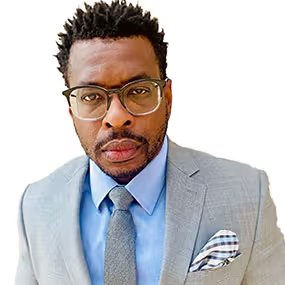
Dr. Sheldon Eakins, founder of the Leading Equity Center and Director of Special Education in Idaho, joins the podcast to discuss recognizing and pushing back against tokenistic DEIJ practices in schools. He draws on experience across elementary, middle, high school, and administrative roles to help educators move from performative gestures toward systemic change.
transcript
Speaker 1 Hello, and welcome to episode 115 of our podcast. My name is Chris McNutt, and I'm part of the progressive education nonprofit human restoration project. Before we get started, I want to let you know that this is brought to you by our supporters, three of whom are Corinne Greenblatt, Dina Lowe, and Abigail French. Thank you for your ongoing support. You can learn more about the Human Restoration Project on our website, humanrestorationproject.org, or find us on Twitter, Instagram, or Facebook. As a heads up, our inaugural virtual conference is from July 25 to 07/28/2022. If you're interested in exploring a human centered progressive pedagogy, giving you the tools to change systems in your classroom, then this is for you. We've invited doctor Henry Giroux, the founding theorist of critical pedagogy, doctor Denisha Jones, the co editor of Black Lives Matter at School, and the Harvest Collegiate Circle Keepers, a student transformative justice organization. All to talk about building a better system and reimagining the classroom. Plus, there's five fantastic learning tracks to guide your learning and build a sustainable future. Tickets are still on sale. Visit humanrestorationproject.org/conference to learn more. Today, we're joined by doctor Sheldon Akins. Doctor Akins is an educator who has taught in elementary, middle, and high school settings as well as an administrator. Currently, he is the director of special education at a school in Idaho. In 2018, doctor Akins founded the leading equity center, professional development service, podcast, and resource hub for spreading cultural awareness, promoting equitable practice, and inspiring change to disrupt inequities in schools. Each week, doctor Akins hosts a podcast and livestream that tackles a disruptive concept from recruiting diverse applicant pools to examining critical childhood studies to being vulnerable with students. We highly recommend his work and would encourage you to check out Leading Equity on your favorite podcast player and visit leadingequitycenter.com.
Speaker 2 It's interesting because I never thought I would become a podcaster, content creator, any of those things. I moved to Idaho about six years ago and it definitely was a culture shock, definitely was a change of pace than what I was used to. And what I found was I had a lot of students that were coming up to me and telling me students of color specifically that were coming up to me and telling me all these different things about, you know, their experiences in classroom, in the hallways from their peers, teachers, principals, you know, those kind of things. And I'm like, I don't know how to help them. Like, I I I feel bad, you know, they're coming to me, they see another person of color, and so they were confiding in me. And and and it's like sometimes it was venting, sometimes it was like, okay, let's take some steps, let's do something about this. But I didn't have the terminology or the knowledge behind what was happening to them. And so I just got my PhD maybe a couple years before, so I'm used to doing research and interviewing. So I was used to researching articles. So I started just pulling up articles and Googling and Google Scholar, pulling up stuff, you know, on microaggressions, implicit bias, culture responsiveness because I didn't really know much about these things. I didn't really have to pay much attention from my previous teaching experience and so that's how I started this show. And that's the goal is for me to provide the tools and resources necessary for educators to ensure equity at their school. And and that's that's my goal is ultimately helping teachers which will ultimately impact our students and their families.
Speaker 1 The topics of your podcasts range everywhere from, I would say, like, very basic, like, equality versus equity to, like, more modern culture war issues, like critical race theory, divisive concepts bills, ongoing forms of of censorship, both of educators and young people. And I'm curious just about your thoughts about the landscape today of professional development, teacher training, and teachers just having to teach in an environment that feels way more surveilled and controlled
Speaker 2 than it ever has before. I mean, gotta look at the data as well. I mean, we got a lot of teachers leaving, unfortunately, because we folks that want to do this work that are just now kinda I think George Floyd was kind of a turning point for a lot of people because you had George Floyd coupled with COVID nineteen. So everybody's at home, sheltered in place. So a lot of people that never had experiences with such as police brutality or issues like that, issues with races, that wasn't just part of their background, but you see this all over social media. And so you had a lot of people that are like, oh, shoot. These things are happening. And and then with COVID, it's like on the education side, it's like, man, we got a lot of kids that are dealing with trauma at home, that are dealing with, you know, loo losing loved ones to COVID or afraid that they're gonna bring it home because they have vulnerable populations in the house. They have all these things happening all at one time. And so as a result, you got a lot of people there. And then and then, I forgot, you had How to Be Antiracist comes comes out. You got White Fragility book as well that's out. And so with all of these things happening and the way the media is kinda like shifts our eyes and our place, you know, where we pay our attention to, I think that that was why a lot of people started to get on board with the equity work. But then, of course, as a result, you got the pushback on the other side where people are like, oh, woah, woah, woah, woah, this not I I don't want my child learning about this or this is reverse racism or this is that and you're teaching our kids to hate America and you're indoctrinating, you know, all these words, buzzwords coming out. And it's funny because with the whole critical race theory, when that started coming out last was that last summer or so, I I I remember I wasn't as familiar with critical race theory. I was familiar with culturally responsive teaching and which was to me is the official CRT if you will, but that's a whole another conversation. But it's with I had started doing research and thinking about what the work that I do and the trainings that I do, what is how does that relate to what critical race theory is? And to me, it's just I always relate it to the to the Candyman. You know, if you ever watched that movie, Candyman, you say it five times and and then Candyman shows up and he does his thing. And I think that that is kind of the the the pushback that we get is, we'll just say that this critical race theory just so terrible and as a result, this is what's happening in your classrooms, this is what your teachers are teaching, which teachers don't teach critical race theory. It's it's it's on a whole another level. But again, if I'm not an educator, if I don't have an education background, if I don't know these things and I'm hearing this on my favorite news station, and this is the stuff that they're telling me, oh, I should be afraid. That I should be afraid so then maybe I am starting to be afraid. And and I think a lot of this is just a way to deflect and to uphold white supremacy, to uphold the status quo, the way things have always been. Why are we talking about change? Why are we talking about this? This is ways to device our our country and all that. It's just just negative stuff. Reality is I just think it's just bottom bottom line is just a way to try to uphold white supremacy.
Speaker 1 It's so much more transparent than it used to be, which I think is in some ways a good thing. At least it's easier to identify if someone is doing something. That's something that you don't want in public ed. I think about the growth of places like like PragerU, for example, or other online right wing, stations, professional development networks even. I mean, PragerU is now developing educational packets, they give out to schools on counteracting CRT, which translates to counteracting talking about race. It's just it's like basic basic stuff that they interpret this as. And in your own practice and doing PD, but also hosting your podcast, if there isn't a silver lining of more folks, like, tuning into this work as a result of just more media coverage?
Speaker 2 It's an interesting question because yeah. I I I honestly, I lost contracts, especially I had a few groups I was working with in Texas and I lost some of those contracts because, know, there's this fear that he's a critical race theory and he's teaching this stuff. I'm like, no, equity is not critical race theory. But the problem is, again, here's now equity used to be the umbrella and underneath equity, you used to have social emotional learning. You have all these different areas, restorative practices, trauma informed care, all these things kind of fit underneath equity. But then critical race theory is starting to become the the new umbrella for a lot of right wing people and then they just throw everything in their buzz words in there as, oh, yeah. These these are I've I remember seeing last summer a a meme, was it No. It was like a image that had all these different terms and they took it down rather quickly because they got a lot of pushback on that. But it was just like all the words you could think of equity, privilege, close responsiveness, all these diff inclusive, just social most like things that are just to me basic stuff. And the thing I I never really understood is like, okay, we're okay with saying differentiated instruction. That never gets attacked. No one ever questions differentiated instruction. But if I say an equitable approach to me, they're very similar. Right? Because differentiation is just saying, okay, this child learns this way, this child will benefit from this type of instruction, this child benefit, you know, IEPs and all that kind of stuff. That's okay. But if I say equity, it's just triggering and it's a problem. So sometimes I feel like, are we just really spending too much time on semantics and and that's and that is that taking away from, again, supporting our students who have different needs? I think we can all agree that our kids all don't learn the same way. I mean, we as adults, we learn differently and and the same thing applies to our students. And so if I have a student that prefers to be more auditory, if I have a student that's more visual, these type of things, I wanted them I I don't know a teacher that says I want my kids to fail. I I assume that all teachers want their kids to be successful. So what are those approaches that we need to take in order for them to be exist to be successful? And then again, that's where all these buzzwords really kinda muddy the water and takes away from the experience of a student.
Speaker 1 Yeah. That makes me think of I subjected myself to reading James Lindsay's book. I forget who it's written with. It's called it's it's something like the guide that counter woke craft,
Speaker 2 which is a a book that Where do you even find these actual books? Where do you find it?
Speaker 1 Had a Kindle Unlimited. Like, it came with my Kindle that I bought, and I popped up. It's the top selling book in education. James Lindsay is one of probably the most, like, alt right educational speakers. He he says terrible things both about equity, but also just, like, general public education. But the book is referenced by a lot of different organizations that are pushing for school choice, a lot of different organizations that are involved in the the c anti CRT movement. And it just flat out says, like, these are the words that you should be looking for, kinda similar to that image that you just described. Or I found this kinda funny. It'll say things like, if they say words that you don't understand or that sound made up or that just sound left wing, like, do that's it's in the book that you should come in and they give you advice for basically to troll it, to come in and say things that intentionally make the argument sound either absurd or just to frustrate the person who's saying it with no debate over the policy or the implications of the policy, but more so just the concept of it being left wing. That's what I'm saying. It's the language. It that's where we're at. I mean, again,
Speaker 2 a lot of us can agree we want our kids to be successful in it. And again, that we can agree that our kids learn differently, But the approach to to help them out in their individual needs, again, is really just to me, it comes down to a bunch of semantics. And because I remember I did a I did a doctor King speech this past January at a in a school or for in Iowa actually. And, you know, I do I did a little q and a at the end and, like, the questions I was getting was like, yeah, you you're this is like scripted from Fox News. Like, this is is like the idea of like equity is taken away from one person to give to other people. I'm like, but you're making it no. That's first of all, that's not what equity is. It's just again, ensuring individual needs are being met. But when you think about resources, you make it seem like they're I only have $5. I only have this much resources and so I'm gonna take this away from one person. By the way, who may not even have needed it, but I'm gonna take this away from somebody and give it to someone else. But we had to think of it from a larger scheme as far as resources being plentiful. I have access to Chromebooks. I have access to whatever, you know, these devices or these instructional aids. And so I'm gonna provide these instructional aids to the students that need this help who have an IEP that says these are the supports that they will benefit from. Yet, again, when we start saying certain words, it's a issue. Long as we don't say those words and do the same task, then it's fine. But you you say those words is is such a triggering moment for a lot of people. How do you recommend that educators navigate those waters?
Speaker 1 So one suggestion would be, I guess, try to stay out of the political terminology. Obviously, you wouldn't write in your syllabus. Like, I I think that everyone kinda has an unwritten rule that they're not going to put some of these things in their syllabus even if they might talk about them in the class because they know what the ramifications might be. Not because they're trying to be, like, sneaky about it, but because they care about the kids in the room and they're just they're just doing their jobs. It's what you do. How do educators talk about these things and act on these things when they know that there's this almost looming threat
Speaker 2 of someone willing to call them out? From my experience, the the main thing I whatever advice I would give to teachers that are wanting to do equity work, but they're in districts or they're in schools or situations where, again, these words are are deterring them or their confidence or they're they're wanting to do this stuff, but they just feel like if I say the wrong thing, then it's gonna you know, I could lose my job or I can get disciplined or whatever it is. I think just simple things such as providing real life situations and helping the students just to critically think. I think one of the challenges is teachers, we tend to wanna have this level of control and so we wanna really engage in dialogue in in these conversation, give our take and give our point of view, and I think that sometimes is where things get a little challenging. My my advice is always to say, just if it's just let the students talk. Let them like let them share what how they view. Okay. You just talked about maybe gentrification. I'm a social studies background as well. So it's like, okay, we're talking about gentrification. The Starbucks wants to be buy this building that historically has been in a black neighborhood, they wanna take this this building and here's how much this cost. Students, what are your thoughts? And allow them to dialogue in that. You don't have to necessarily be the the the main person speaking on it, but just listening to your students and hearing what they think. And if a student asks you a question, you know, what is your take teacher? Say, you know what, I think I have my definitely have my points or my thoughts regarding this, but you know what, I'm really enjoying learning from you. I prefer to hear what you have to say. And and so you'd put it back there on them. That way you're not saying anything, you're you're not putting yourself in a position where you could again, potentially lose your job or any of those kind of things, just again, allowing students to talk about it. And honestly, if you can always tell people if you can find a school where your administrator supports you, where you you've you can engage these conversations, we can subtly instill this information to our students and help them again critically think. We're not indoctrinating, just allowing them to think for themselves. I have little kids. I have a 12 year old and a nine year old and I say, here's the situation, what are your thoughts? You're a smart child, you're a smart individual, I love to get your point of view. What what are what are your thoughts on this situation? And then allow allow them to engage in that conversation as opposed to you just trying to facilitate everything and be the main one speaking. Yeah. I I think that's a good way too to just navigate the the concept of divisive concepts
Speaker 1 as well as the laws themselves. It's interesting to note that almost all of those laws to my knowledge, as long as students are the ones that bring up the concepts, it's perfectly fine to talk about them. And those concepts that are important for students to understand are going to naturally come up whenever you talk about pretty much any current event or issue in someone's community. And as a instructor, you don't have to provide your opinion. You can just complicate scenarios with facts. And over time, that I mean, it's kinda like your opinion, but the exact same time, the facts are on your side. That that knowledge is there. For for years, we talked about speaking of gentrification, that that exact concept, I I taught in the community as the second highest opioid overdose rate, in the country. And and inevitably, it would come up at some point during our social studies class. And the kids would just talk about things. And as soon as someone said something that was like, that's a little problematic, we just, you know, pull up, like, a a graph or a diagram and talk about that, not in an aggressive tone, not because I was upset, just like, hey. Like, what about this? And I I was always surprised by students who maybe had more, I guess, like, right wing leanings or libertarian, whatever it might be, were super okay with coming around to that and having those discussions because it wasn't propaganda. It's just learning about stuff. In the exact same way too for students that form more, like, form a little more left wing that maybe had some not appropriate things to say about other people. Well, that's why you had to have classroom norms. You you you had to set up those classroom norms, you know, this is how we're gonna engage in conversations.
Speaker 2 You might have a student that has a difference of opinion than you have, but we're gonna be respectful. Okay? We're gonna allow each person the space to be able to share their thoughts, to share how they feel, and again, it might, know, defer from what you believe in which, but it's okay. I I don't enter like, when I personally do trainings for people, I tell them, I say, look, we're here together for an hour, we're here for ninety minutes or half day, whatever it is. Right? We're here for this time. I don't expect to change your hearts and minds within this time frame. My goal here is to bring you some awareness, try to provide some perspectives that you may not have considered. You can digest that however you wanna digest it, but there's still you can I encourage you to further do education on on this topic and and learn more going forward? But if we don't set those ground rules from the beginning, like, if we just jump right into dialogue, we jump right into these conversations, we jump right into these trainings without providing some, you know, just some basic protocols about respect, about being in a brave space, about allowing voices to be heard, and differences of opinions is totally fine. And I think if we don't do that, that's where we get a lot of challenges. So I always try to make sure that I spend at least five minutes to just kinda go through some some simple stuff. Alright. Now let's talk and here's what I think and here's some research that supports what I think. But if you have something different, let's talk about it. I love to know where you're coming from.
Speaker 3 Conference to Restore Humanity is an invitation for k 12 and college educators to engage in a human centered system reboot, centering the needs of students and educators toward a praxis of social justice. The traditional conference format doesn't work for everyone. It's costly to attend, environmentally unfriendly, and it doesn't allow everyone to engage or have a voice in the learning community. Our conference is designed around the accessibility and sustainability of virtual learning while engaging participants in a classroom environment that models the same progressive pedagogy we value with students. Instead of long Zoom presentations with a brief q and a, keynotes are flipped And attendees will have the opportunity for extended conversation with our speakers, doctor Henry Giroux, the founding theorist of critical pedagogy, doctor Denisha Jones, educator, activist, and co editor of Black Lives Matter at School, and the Circle Keepers from Harvest Collegiate High School in New York City, a student collective focused on social justice. And instead of back to back online workshops, we are offering asynchronous learning tracks. You can engage with content and the community at any time on topics like anti carceral pedagogy, disrupting linguistic discrimination, designing for neurodivergence, promoting childism in the classroom, and supporting feedback over grades. The conference to restore humanity runs July 25 through the twenty eighth. And as of recording, early bird tickets are still available. It's $150 for four days with discounts available for individuals from historically marginalized communities, as well as group rates. Plus, we'll award certificates for teacher training and continuing education credits. See our website humanrestorationproject.org for more information, and let's restore humanity together.
Speaker 1 Circling back to what we were talking about earlier, these things have always been in indicators of, like, strong teaching. You could go to a teacher workshop a decade or two ago and get similar vibes from a discussion based pedagogical activity. Things have changed, though, a lot in the last couple of years and there but in multiple ways. You talk about this topic called performative wokeness. I think that that would be an interesting kind of thing to talk about here for a second. Do you just wanna describe about what that is?
Speaker 2 Performative wokeness, and I don't have the definition in front of me, so I'm just gonna paraphrase, and you'll get different. You know, you you hear performer wokeness, you hear performative equity, these type of these type of terms. Again, to me again semantics. However, in a general sense, it's the idea of saying, you know, I support this, I support that. I'll put a Black Lives Matter flag up in my classroom, but that's as far as it goes. So I won't speak up against police brutality, I I won't address it, I'll just put, you know, a rainbow flag and say this is a safe space for LGBTQ plus, but I'm not again, I'm not going to speak up. So it's more of, look at me, I'm I'm supportive, I'm an ally, I'm disarmed that, but then there's no actual work behind it. People that don't have these personal identities tend to like, those are the ones that usually are the ones with the performer wokeness because it's like, oh, it doesn't personally impact memes, but this is what's on the media right now. I turned my TV on and Roe versus Wade is happening right now. So I'm gonna be all about abortions, pro abortion or whatever it is. So I'm being about it and then news cameras go off, we shift to something else that's happening in our country and now I'm jumping on that. But abortion still is gonna be an issue six months from now or a year two years from now. But if the media is not highlighting it and then I'm not highlighting it. So sometimes people just kinda jump on the bandwagon and say, oh, yeah. I'm all about this or I'm all about that, but not really wanting to do any work behind it. I used to be, you know, very supportive of the word allyship for example, and I've kinda shifted my thought and so instead of being an ally, I I say I'm a disruptor because to me, an ally can be a safe word. I've heard people say, well, you know, disrupting just kinda seems a little bit more combative versus, you know, ally just seems nicer, seems safer, and I'm like, that's the problem. If you're telling me that allyship just seems nicer, seems safer, protects me, I can be an ally versus saying I'm a disruptor, that's gonna bring a different connotation towards it. But okay, but if you want change, if you really want if you recognize that our systems that we have in place historically, the way our educational system is set up wasn't set up for everybody. And and if you can recognize that and that two hundred years later, these things are still in place, these are what we're doing still and we want to make some changes, yeah, you're gonna have to be a little bit more vocal and and you're gonna have to push back. But if you're saying, well, I don't really wanna push back because, you know, you know, I don't wanna call anybody out or I don't wanna do this, I don't wanna do that, then that's where that performative piece comes in. It kinda comes down to leveraging power and privilege and taking those those mitigated risks
Speaker 1 Because there's there's no denying that it's going to take risk to change these things. And there is always that element of you probably are going to have an office meeting with a principal at some point or another if you're doing this kind of work. And I have a strong feeling that if you were doing this kind of work a lot and depending on the school you're at, you're gonna have a lot of administrator meetings. But if you navigate that in the way that you were talking about before and you present in the facts, run the classroom how classrooms are run, you have that pedagogy behind you, chances are you can at least defend yourself. Or if it it still leads to more problems, well, you could do some of it. You go to the media. You could you could talk to people about it. You could really put up a like, it's like a shit store for people trying to to mess with you. What are some of the things that go beyond performative wokeness in the classroom? What are things that you you would encourage educators to explicitly do with their students to actually fight for change beyond just the the putting up the flag or the sticker or whatever?
Speaker 2 I I have, you know, I've come across, you know, most of us are familiar with culturally responsive, culturally relevant, culturally sustaining. A lot of us are familiar at least with the terminology there. But before all of that, there is multicultural education by doctor James a Banks and he talks about some approaches that we can take when it comes to learning about again, I'm a history person, so I'm I'm gonna talk from a historical standpoint, but just kinda telling multiple sides of the story. Right? We we talk about Lewis and Clark Expedition, for example. We celebrate expansion of The United States, but how did that impact our indigenous communities? Right? We forced them on well, not we, but they were forced on reservations, their land was taken and we're excited because we purchased land that wasn't even for sale and and but but again, we we tell the story one way. Now Lewis and Clark, we celebrate those type of things and and then Sacajawea is off sometimes, you know, I've I remember my child my daughter had a, you know, they did a whole lesson on this and they said the key players within the Louisiana Purchase, Lewis and Clark and Napoleon. And I'm like, okay, these are the key players? That's that's it? And so so my daughter's she's she's very militant. I ain't gonna lie. I mean, she knows her dad and she listens to the stuff that I say and we we have conversations. And I said, so she came to me about it and she's like, daddy, I don't feel right about this because they're saying key players, but it doesn't say anything about Sacagawea. And and I said, okay, we'll talk to your teacher about that. Let her know how you feel. And so she communicated with her teacher and basically the responses she got from her teacher was, well, yeah, they're the key players and I have a whole lesson dedicated to Sacagawea. I'm like, okay, so we're gonna do this by the way or contribution type of approach, but let's keep it real. Had it not been Sacajawea was very very influential. I mean, those those gentlemen were not would not have been able to communicate with the the indigenous communities that they they met and that they encountered. They would not have been able to map the land without her support, without her help. It would have been a different situation. And to be honest, I mean, the whole Lewis and Clark expedition was really a reconnaissance mission. It was just scoping out the land and finding ways. What are the weak points? How can we take over this land? That's legit what it was, but again, we're not supposed to say that. We're not supposed to talk about the terrible things that The United States, a lot of people within The United States have done to get to where The United States is now. So I just say, try to teach lessons that provides a holistic approach as opposed to teaching in a European dominant perspective. But we really need to well, how did this impact other people? I'll give you another example. Right? We talk about the the stock market, you know, what was the crash and the great depression. But who was really impacted the most when it comes to stock market? Right? Because a lot of people of color didn't own stocks and that wasn't part of our experience. We were already in a great depression and arguably, you could say we're still trying to get ourselves out of that. But it's highlighted from a European perspective. So as a result, oh, this is a big moment, a pivotal moment within our country, but you had groups of colored who have who are already in these situations historically from before, I don't know, nineteen thirties, all all before that. And because it impacted a lot of people that didn't because it impacted a lot of people of European descent, now it's staple within our social studies. It's part of our, you know, standards and all that stuff. But again, how were other people of color already being impacted prior to and still today? We have to teach the whole story. But again, with this whole book banning and with all the censorship these days, they don't want us to share that information. It's not like we're telling lies, we're not making up stories, It's just they literally don't want us to tell the entire story. It's like if you have two kids that that get into a fight and you only talk to one of those kids and say, what happened? And they say, oh, Johnny hit me and I didn't do anything. And then you just, okay. Alright. So I'm just gonna punish Johnny because you told me the story. Thanks for letting me know and keeping me making me aware of that. But you don't question the other person, you know, the other party involved in this situation. You're only getting one side of the story.
Speaker 1 Gotta get the whole thing. Yeah. It's also just like inherently more interesting to get all sides of the story. I remember covering we'd always open up with, like, the colonial era, and we would tell the story of Squanto. And just thinking about the question, like, how did Squanto know English? And the fact that the typical curriculum skips over the entire story of, like, Squanto was a slave. He was in Europe. He learned how to speak the language, which is why when he came back, he did he wasn't with his with his village. Like, it was, like, the whole reason why he even met up with these people. That's the the origin of the story. Or covering I remember covering it was it was super dark, but the Philippines American war, which is a war that I think that if you asked most Americans, like, what is that? They wouldn't have any clue that that even occurred. And talking about that with kids and saying, like, you know, why do you think it is that this is a war we don't typically talk about? Well, it's because it was the war that was the most explicitly an aggression by The United States. There was no even, I guess, fake reason for going. We just got a whit and took it over and caused a a genocide.
Speaker 2 Hawaii. We don't talk about Hawaii. We we we say, you know, we got 50 states, but how did how did we acquire Hawaii? Like, that was taken from you know, again, we celebrate these things and, you know, that's just kinda again, that is kinda how they want us to continue to teach history. But it's nice that America is, you know, 50 states, but some of those again, the land that was acquired was was, you know, taken and and and dominated and and conquered and all these different things, but we just don't wanna have those kind of conversations with, oh, there's such an ugly history behind The United States. But they'll love to highlight slavery, they love to highlight our our indigenous folks and conquistadors and all these. Like, we'll we'll talk about when we conquered you, but we won't we don't feel right talking about all of the different thing oh, we'll talk about your oppression, but we don't wanna talk about yeah. But what is our role within that oppression and and why folks were being oppressed and those type of things? We we don't wanna have that kind of conversation. Interesting too that kids are very receptive
Speaker 1 to these conversations. We we would have conversations all the time about, like, is this, like, unpatriotic to talk about these things? Like, is it okay to critique the country that you live in? Like, does this mean that we're any less proud to be Americans or that, like, we should revolt against, like, the entire government or whatever it might be. And kids would always share things like, you know, I'm just really appreciative that we're learning about these things. I had no idea. I feel like I'm more knowledgeable. At a very surface level, these concepts are incredibly basic. You learn about your history. You learn about everything that happened, and then you try to do better knowing that information today.
Speaker 2 But with that But repeat. It
Speaker 1 Right? Yep. This is a a core concept in history. And I think too, it it kind of branches out to to, like, in English now we're seeing, like, self censorship. There might not be explicit censorship of what books you pick, but I might intentionally not pick certain books knowing that there might be a debate around me picking oh my goodness. I was just thinking of it. The the book where the girl's friend is shot.
Speaker 2 Oh,
Speaker 1 hate u give. The hate u give. Thank you. Yeah. That's that was a big one. I remember when that first came out, like, I feel like everyone was teaching that book. Like, it was commonplace, and you saw it everywhere. And then over time, they're slowly slipping away from that syllabus because that book was covered by Fox News. It was covered by, the anti c or he folks, and people are afraid. They don't they don't wanna bring that. But what's wrong with the book? That's the reality. That happens.
Speaker 2 I don't know if it's because it's written by a black woman or or or again, we don't want folks to feel bad. I don't it's crazy how some of the books that are being banned and censored and all that stuff has real life concepts like these it's a historic, you know, it's a it's a fictional book. However, it's not like it's unlikely for something like this to happen, it happens. We literally have seen every now and then, I'll see a list of all the unarmed black people that were were killed at the hands of the police. Doesn't mean that I hate police or any of those kind things, I just I don't like police brutality, I don't you know, my father is in law enforcement, so it's not that I have anything against police officers. Just we have police brutality, it's always been a thing and it's continued historically has happened and then we we see stuff happen on camera and still we see a lot of police officers get acquitted for for their actions and things like that. So it it's just a matter of trying to keep the status quo, keeping things the same. We don't want change, we don't we wanted to keep it the way it's always been and and I think that that's really a problem. So I like when students are like, thank you for sharing this information because I didn't know. This is not something a conversation that we have at home or this wasn't a conversation that I've had in my community. So I'm glad to be able to learn from a different perspective. I think too there's a way to extend that beyond
Speaker 1 just curricular. There's the curriculum element of ensuring that people understand factual information and they understand all sides of the story. Then there's also all of those other things that happen in school, which are also very much racist, target marginalized communities, etcetera. I I think about things like how grades rank and file students, tracking policies, discipline policies, all these things that even before all of these conversations, like, including now, they aren't necessarily as spoken about because it's something that is well, that most people do without, like, a second thought. Like, there there's an irony to me in failing students for not passing an assignment I have on social justice. The the disconnect there of you just basically told this kid that now they are worse off than someone else, and it could have lasting implications for them. That's just the way that we've always done things, at least in the mainstream. In terms of your work and and equity and and leading equity and the advice that you're spreading to teachers, beyond just changing up curriculum for someone who's not a history teacher, an English teacher, humanities, that kind of stuff, what do they do now?
Speaker 2 You know, so it's it's people would tell me, well, you know, you humanities classes are really easy. Liberal arts are really easy to do social justice and equity, that kind of thing, but I'm a math teacher. So what, you know, all I got is formulas and equations. I say, yeah, you can use those formulas and equations to create word problems. Problem is, we often just lean on and and I including myself, I used to be the same way. We we we get our textbooks, textbooks gives us, you know, here's the lesson plan, here's the worksheets, here's here's the assignments, here's the assessments or whatever, and we just lean on that, we rely on that, but we know that a lot of those textbooks that we have adopted into our schools and our classrooms and things like that aren't as diverse when it comes to teaching content. So if I am a math teacher and I'm like, okay, wanna do more than just put a flag up or I wanna do more than have, you know, highlight inventors of color or highlight this mathematicians of color, which I I went to school, I don't think I remember learning anything about mathematics of color. But our Egyptian history, when you think about pyramids, when we think about like a lot of stuff, there's there's angles. There's so much there that you could bring into your classroom. If you're a geometry teacher, just teaching about like Egyptian what do you call them? You know, pyramids and things, sphinx and all that stuff that's out there, like that's science, that's math, there's there's equations there. But rather than I say this with a caveat, rather than just saying, okay, we're gonna teach the lessons and we'll just do one lesson this month on Egyptian culture or Egyptian mathematics or whatever, but it needs to be embedded within the the the curriculum. K? So sometimes we just have to go a little bit beyond on what our textbook gives us, but really doing a little bit of extra work to create a better experience, especially when you have and it really doesn't it matters, but I I go back and forth with this because people will say, well, that's great if you got a classroom full of black or brown kids, but we only have white students in our classroom. So but I'm like, it benefits your white students as well when you teach them again multiple perspectives. So just embedding in equitable instructional practices, think, is really important. You can do that in math, you can do it in science, but if you just say, okay, this is a science class, we're just gonna do one one special lesson or even one unit on inventors of color or or one on contributions from people of color, whatever it is, you're still teaching from one side, you know, European perspective and then you're adding in or doing a special lesson here and there. But it again, it needs to be all encompassing as part of your curriculum, something that we do every day. Yeah. It's otherwise, it's very tokenistic.
Speaker 1 That that that concept too. Very tokenistic. And also just like the idea of, like, if it makes me cringe, but the idea of saying, like, you know, I don't I don't have any black students, so I'm not gonna teach these things. That kinda gives away the game of exactly how you think about it. I get but people tell me that.
Speaker 2 They tell me that all oh, I live in Idaho, man. So, like, I'll get people say, well, you know, I think culture responsiveness yeah. That's really cool, but it doesn't apply here. And I'm like, what do mean it doesn't apply? So your white students don't have any culture? Like, what does that even mean? Like, there is like, you got folks from Europe Europe, you know, there's Italy, you got England, you got all of Russia, you got all these different countries. But what happens over time is a lot of those students don't necessarily know all their origin or they, you know, I think I have some Irish in my family. Well, what do you speak Gaelic? Do you know anything about, like, the Irish culture, the food, those kind of things? That's culture. But we say, oh, we can't be culturally responsive because we don't have a student of color. But culturally responsiveness does not limit you just to race. There is so much that happens within the things that we do, the things that we like, our traditions at home, the holidays that we celebrate. But again, if we think that, oh, well, might, so I don't have much culture. No. You have culture. We do things. A lot of the stuff we celebrate, the Christian holidays, a lot of those type of things that we do is culturally based. So it you're doing your kids your white students a disservice if you say, well, I only have one or two blacks, you know, students of color. Yeah. So does that mean that they don't matter because it wasn't enough? I think everybody can benefit from learning
Speaker 1 a whole story as opposed to just part of a story. Right. I think it's also a good way to defend it and explain it to students and parents in terms of there's there's always been this talk recently of, like, the the twenty first century skills or soft skills, whatever it might be. And a key part of that is empathy and caring about other people and these ideas. And even in a hypothetical world where for some reason every student at your school is white, you still would want to know these things so that when, by when you in like, when you come across someone who is not white, you understand like, you understand things. So that way you're not saying things like, hey. Everyone in my class is white, so therefore they don't need to learn it. Because you would recognize that's not I feel like it's hyper problematic just to state that. Yeah. It just makes you a more complete person, and it it shouldn't be something that needs to be debated. So I realize we're we're running close to time here. Explain where folks can learn more about you. What should they do next? Where can they go to see a leading equity, etcetera, and then any anything else you wanna add to the the end. Sure. Sure.
Speaker 2 You know, if if you listen to this conversation, you're like, okay, Sheldon. And then, you know, you give me kinda like some sound bites, a couple tips here and there, and you want to learn more, you can definitely go to leadingequitycenter.com. I have a new book coming out in about three weeks. It's called Leading Equity becoming an advocate for all students. And this book is kinda broken down into 10 different steps that we can take towards towards being an equity minded educator. I provide, you know, talking points, you know, because people always come to me and say, okay, I get the what, you know, okay, these are some I get what a microaggression is, I get what implicit bias discrimination, all these things, but I don't know how to approach my teacher or my colleague or my principal about these things. So I have talking points in there. Here's the examples. This is what was said to me. This is how I responded. Here's some ways to create some classroom norms. Here's some ways to talk about race or or community things that are happening in our community, the things that are happening on a national scale. These are some ways to have some dialogue in your classroom. Here's some lesson plan templates. Here's some journal prompts for you as you're working on your journey. So all of that is built into the book. So again, if you're trying to learn more, you can definitely grab that book. The podcast as well, I have two shows these days, man. I don't know what I'm doing. But why I have two shows, but I have Leading Equity podcast, and then I have a livestream every Thursday called the art of advocacy, which comes out at 06:30 eastern every Thursday. So between all of that, the contents there available. A lot of stuff is free. Some of the stuff is paid as, you know, that's how I keep the lights on. But for the most part, I would say 80% of the content that I have out is free. I don't wanna be one of those people that just preaches preaches preaches about, you know, this is wrong or, you know, the world needs to change or education needs to change. I like to give you steps like, okay, here's how we can change. These are some of the things that are that we could look at and here's how we can approach it as opposed to just saying, do better as an educator, be an equity minded, No. It needs to be a little bit more because I recognize that there's I mean, I was there four years ago. I didn't know anything. I just knew I was having experience. I didn't know what it was called. But now I wanna be able to help people who are just starting on their journey and and give them those steps to help them. I'm not a checklist person, so I don't believe that you can, okay, do these 10 things and you'll be officially equity certified because I don't find myself as a certified person. I feel like it's a journey. I'm still on a journey. I just try to stay a chapter ahead of everybody, but I'm constantly reading, I'm constantly trying to learn as much as I can so I can be better. The reality is there's gonna be experiences that my friends are having, my colleagues are having, students are having that I will never experience. But because I'll never experience, does that mean that I should not care? Does that mean that I should not pay any attention to it? Or can I, like you've mentioned earlier, try to develop an empathetic lens and try to understand where someone's coming from and if there's something I can do to support them, if I have some level of privilege that could benefit them and I can utilize my voice or my professionalism or my position as an educator or a leader, whatever I'm whatever role I have, if I can utilize that to support people even if things don't personally impact me, those are the steps that I need to take?
Speaker 1 Thank you again for listening to Human Restoration Projects podcast. I hope this conversation leaves you inspired and ready to push of education. You can learn more about progressive education, support our cause, and stay tuned to this podcast and other updates on our website at humanrestorationproject.org.
resources
- Leading Equity Center · Dr. Sheldon Eakins (organization) Professional development hub for cultural awareness and equitable practice in schools. link →
- Sheldon Eakins' Website · Dr. Sheldon Eakins (website) Personal site for Dr. Eakins with additional resources and contact information. link →
- Leading Equity: Becoming an Advocate for All Students · Sheldon Eakins (book) Practical guide for K-12 educators on building equitable schools and advocating for all students. link →
- Dr. Sheldon Eakins (person) K-12 educator, administrator, and Director of Special Education with expertise in equity and cultural awareness.