

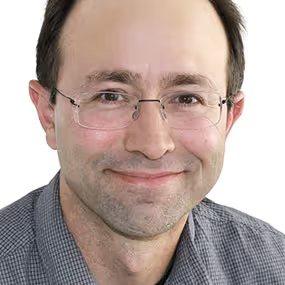
Nick Sousanis, Eisner-winning comics author and associate professor at San Francisco State University, discusses his book Unflattening, a doctoral dissertation written entirely in comics form. The conversation explores how visual thinking and graphic novels can deepen sensemaking in teaching and learning.
transcript
Speaker 1 Hello, and welcome to episode one seventeen of the Human Restoration Project podcast. My name is Nick Covington, and I'm the creative director here at the Human Restoration Project. I was introduced to Nick Suzanis' work through a Twitter connection, so shout out to Andrew Jay. As I wanted to spend more time over the summer with what are broadly called graphic novels. Probably like many listeners, I had read comic books as they appeared in pop culture over the years, like the Dark Tower adaptation, The Walking Dead, even classic graphic novels, I suppose, like Alan Moore's Watchman, V for Vendetta, and From Hell. As a history major, I'd also read the first book of Maus in college, but other than that, I never really knew where to go from there. Now, just in June 2022, I had a friend recommend Marjan Satrapi's Persepolis, a graphic memoir of her childhood before, during, and after the Iranian revolution. I borrowed it from the library, read it in a single setting, and was hooked. So I immediately put a call out on Twitter on where to go from there and got dozens of suggestions. I've spent the rest of my summer catching up on a number of graphic memoirs, including the March trilogy, The Best We Could Do, and Fun Home. Then came Nick Susannis' Unflattening. Nick Susannis is an Eisner winning comics author and an associate professor of humanities and liberal studies at San Francisco State University, where he runs a comic studies program. He received his doctorate in education at Teachers College Columbia University in 2014, where he wrote and drew his dissertation entirely in comic form. Titled Unflattening, it argues for the importance of visual thinking in teaching and learning and was published by Harvard University Press in 2015. Unflattening received the 2016 American Publishers Award for Professional and Scholarly Excellence, the Prose Award in Humanities, the Linde Ward Prize for best graphic novel of 2015, and was nominated for an Eisner Award for best scholarly slash academic work. To date, Unflattening has been translated into French, Korean, Portuguese, Serbian, Polish, Italian, and Chinese. There's an irony here that we are going to attempt to discuss these very visually linked ideas in an audio podcast, but I will also provide links to the excerpts of Unflattening that are available on Nick's website. So Nick, thank you for speaking with me today.
Speaker 2 Yeah. So I'm Nick Sousanis and I I run a comics program at San Francisco State. And as pointed out, I I wrote I wrote and drew my dissertation entirely in comics form and then it was it was sub subsequently published as Unflattening, which I guess is a graphic novel though it's not a novel in any sort of way. So these words are all a little complicated. But I'll say, I I was a comics maker as a kid, and I read comics. I'm I'm certainly certainly somebody who could attest to the the learning to read strengths of comics. Like I I read very early and I think reading comics definitely helped that and I see it in my own in my daughter who's was a very early reader and I read comics to her. So I was really into comics as a kid and then I made my own superhero comics through junior high and high school. But when I got to undergrad, undergrad comics is not a thing to do. Like it's not like, if you wanna do intellectual things, but it didn't exist, number one. And even if it did, I wouldn't have thought about it as an intellectual thing. And I wanted to do those kinds of things. So I studied mathematics and I was I was always making comments in the background. And it's not till quite a bit later, you know, I was still reading them and still sort of making them, but never not much finished for a long time. But I was in Detroit from rural Michigan, but I was in Detroit for about a decade. And I ran an arts arts and cultural magazine and wrote about art. And I got invited to be in an art show around the two thousand four presidential election, I only had a couple days to do it. And so I was like, oh, make a comic. So I made this short essay, comic as essay. And then right after the election, there was a second show. So there's like, oh, yeah. I got four days to do it again. So I made a second one, and those those two pieces really, like, set the tone for my return to comics in a quite different way than I had as a as a kid. And and shortly after that, we put on an exhibition of art and games. And a buddy of mine said, why don't you do the essay as a comic book? So I was like, okay. So I did this long form comic on the history of games, philosophy of games, how games work. It was really involved study of games. And and having finished that, it really it really set the stage for what I could do. And I at the time, I was teaching at the university and I was teaching I had a master's in interdisciplinary studies in math and art. And I taught a public speaking class at the university, which I really loved. And I taught a little bit of writing, but mostly through the public speaking class. And I thought, you know, being an adjunct is not not a really sustainable career, but I love being in education. I'm a child of a of a physics teacher and tennis coach, and and my mom is a is a naturalist environmental studies teacher. So I've been I I'm the child of educators, and I I do and done all these educational things. I was a tennis pro, so I I made my living teaching tennis Mhmm. For most of my most of my young adult to middle adult life. So I was seeing all the stuff I was doing is educational, but but not in the sort of traditional sense. So I decided I might as well get my doctorate because I like doing these things. And the and the comics that I was making, I saw them sort of come together and bring the stuff that I'd love to do with the stuff I cared about educationally. And that that all could all come together. So I I I sort of stumbled into Columbia Teachers College education program. A friend back home knew somebody there, and they said they are interested in people doing curious things. And I was like, I'm doing curious things. So I I showed some potential advisors the kind of comments I did, and they seemed intrigued. And I applied and I got in. So so I came I mean, this is a question I get a lot. Like, did you have a lot of trouble getting your dissertation approved? You know? Because and and the truth is I I didn't know it was a big deal. I I had no idea. I just thought because of things that you've mentioned, like Miles and Persepolis had already been out. I kinda thought that the the argument for comics as as intellectual and educational had been long ones. Scott McCloud's understanding comics had been out a long time at that point. But it's not really till I got into it that I realized that that there was still there was still a lot of barriers to break down. So my work I I knew I was gonna do comics for my work, but I didn't know that the comics were gonna argue for themselves. That became that became more apparent as I got into it and and realized that that I had to I had to champion, at least I felt I had to champion that that comics belonged here and that comics could should just be one of the many options people could do to do their thinking.
Speaker 1 Would you mind unpacking a little bit more of like, you just said letting the comics speak for themselves when you were talking about that. What do you mean by that? Like, you're expecting to have a lot more pushback or
Speaker 2 I get this question a lot that people expected that I had a a big fight to make my to make the work happen. Right. And and I don't know if because I hit the right time in history, because I was a older student, or because I was just too naive to know that it was a big deal. I was just doing it. I was like, this is what I wanna do, and I'm gonna do it. And I had a bunch of very senior professors, so didn't have much to lose. They didn't have much knowledge necessarily of what I was doing, but they didn't you know, they were intrigued and supportive in in those ways. So, I mean, I think a lot of times you see projects like this in the past where where you would do the thing, but then you'd have to write a text thing to explain why you did the thing. Mhmm. And that was really important to me that I didn't do that. That that that's I mean, I I don't think I said this before, but I think that comics speak for themselves. Like, this is a legitimate form of scholarship, and it's a legitimate form of meaning making. And in fact, there's things I can do with comics that I can't do purely text. So so very much, you know, my work is an argument for itself and things sort of like it. Right? That that it doesn't need that other layer of explainer. Now, obviously, comics are a little bit you know, if I was doing performative dance, that might take you know, comics still have words in them. They can still have notes. They can still have these things that we recognize. So in some ways, they're they're not that big a leap to make from from what you might have thought of as scholarship before, But but they still are. People are still either intimidated or dismissive of pictures. And can do a lot. They're really complicated. It's a lot harder. If I was writing my dissertation, it would have been a lot faster. I
Speaker 1 bet. Yeah. Especially if anybody has read Unflattening or if you check out the excerpts, yeah, I think you'll see that that is self evident. It really is something to say the pictures by themselves, the images, the visual by themselves, maybe requires some of the context to help provide it some context. But then the words by themselves need the visuals perhaps to imply the deeper meaning. And so it really is just the marriage of both of those factors, and especially in the way that you that you use them to literally think out of the box. I think a lot of us, when we think of comic books or graphic novels, think of the squares on the page. And I think you you've kind of really opened up that just to use it as a visual space, like you said, for meaning making and to do your thinking on the page. And, you know, you write a lot in Unflattening too, just about like that physical process, the connection of the the the physicality of the pen and the paper and constructing the meaning as you go through that.
Speaker 2 Yeah. I mean, think you said it really well. You know, constructing meaning on the page or this space to explore is we're sort of accustomed to thinking as being this thing you put your hand under your chin and you sit still for a But but thinking when we move, thinking when we're on the run, thinking when we're making marks, I work solo. Right? I make solo, but I had this partner in my drawing. But, you know, the the the drawings pushed me to think in ways and ask questions that I wouldn't have asked in other ways. It doesn't mean it it's not necessarily better. Right? I mean, I think it's better, but but it's different. It's different. It pushed me to ask questions and go directions. I just would not have gone if I was purely writing. So they'd be, you know, if I'd written this thing, you know, started at time zero and and you can watch two timelines here, and I just just stuck to the writing one or just stuck to the comics one and you saw that they would diverge quite a bit. Wouldn't just be an illustrated version of my written one. And it is interesting, just as a side note, how, right, text as
Speaker 1 a mode of thinking is really valued both in society, but particularly like in academia. And so it is interesting to see a work like Unflattening just challenging that norm. You know, why why would we not be able to submit a, you know, a YouTube video? Or, like, let's imagine a director at a at a film school, right, trying to submit a piece of writing. It's just interesting to see how multimodal, multimedium thinking, you know, as legitimate form of academic expression as much as it is self or self expression.
Speaker 2 We're complex creatures. We we express ourselves in many forms and we learn in many forms. So why not use more of it? Why not use more of it? And I mean, and it's challenging, right? It's hard to a lot of our formats were created because they fit in something that we could manage.
Speaker 1 It's it's harder to deal with pictures in a lot of ways, but I think we can handle it. So there have been a handful of ideas that have been conceptual game changers for me as an educator in terms of shifting my perspective or adding a new lens of looking at a problem or thinking about the world. One of those would be Seymour Papert's constructionism, that notion that we're in dialogue with the objects we create. So whether they're physical or digital, Papert was a big proponent of coding in schools for for instance, that those outer physical models influence and help us construct our inner mental ones. So we're constantly in dialogue with those spaces. And you even spend a chapter in your book, we just talked about actually, connecting that physical act of drawing with the notion of construction. And you say in there, we draw not to transcribe ideas from our heads, but to generate them in search of greater understanding. And I think to this pile of conceptual game changers, you know, this list that I have in my head, the notion of unflattening seems to have that power for me as well. So to get to the thesis of that book, what do you mean by unflattening? What are the core concepts at play in that work, and how can our listeners get involved in doing that for themselves and unflattening their own thinking?
Speaker 2 Part of what I mean by it is is that answer is unique to everyone. And and and one of the biggest I'm not sure how I'll answer this question, but I often people make typos when they refer to the book and I get unflattering a lot, you know, which which is funny and I don't mind it that much, but unflattened is the one I dislike the most because unflattened implies a finished thing. Right? It implies something that's done. And and I'll get questions like, do you feel like you're unflattened? I'm like, no. Of course not. I'm you know, like, this is the idea is that it's something that's always ongoing in the same way that our vision is. You know, your eyes are moving around, both of them are moving around and like picking up spots and what we do. That's how our senses work. We're always sort of adjusting how we experience the world. And so that that that is sort of the core of what I meant by it. It's like always coming from multiple vantage points and and changing how you, you know, changing how you understand your own experience or or how you make meaning. So that so that's definitely part of it. You know, it it it became a way to fit all these ideas I had about interdisciplinarity, about justifying my own sort of curious background of math and art and and tennis, know, like this physical part in this, you know, sort of abstract mental part and the whatever arc, you know, like like they weren't you know, those are all supposed to be boxes that don't fit that are separate. Right? And I was trying to say that they're they're just parts of being human. So some part of unflattening is, you know, is the simple come from two eyes or more. Some part of it is to come from different modes, and and a big part is that it's never done. It's never done. And there's things, you know, I mean, I I like the thing I made, but there's plenty of things I do differently. There's plenty of things that I've moved on from. And I I think, you know, when I talk to teachers, a question that sort of and I don't wanna say this disparagingly, but it but it bothers me is is I like your book, and what do you think I should do in my classroom? And, like, what do I know about you? Like, that's not I'm not there. Right? Like, if I was there and we can, you know, we could talk about it and I we could come up with ideas, but but part of the goal is is that you can do it. You know, you can get there on your own two feet and and sort of that that idea that you can ask your own questions and you can find your own answers. And and they won't be you know, they might not be the best answer you got until till the next year when you get a better one or whatever, but but you can figure it out. And you can ask, you know, I'm I it's one thing to be inspired by things or have conversation about it, but I'm not capable of telling other people what to do.
Speaker 1 A partner idea in that too. You've got the the a lovely illustration, and I and again, if we could show the illustration, think people would catch on to the idea pretty quickly. But this idea that is a theme in the book is this notion of rhizomatic thinking, which, you know, I don't know if that's a if if that's an original kind of like lens of looking at things. I had never encountered that concept before, but of course mapped out visually in the way that it is on the page is very striking. I didn't know if you could help us understand what's going on with that lens of rhizomatic thinking or how that differs from the sort of linear kind of thinking that you critique earlier on in the book? You know, how do we help support that version of rhizomatic thinking?
Speaker 2 Yeah. I mean, I didn't I mean, imagery is all me, and putting those pieces together is me, but it's certainly not. I mean, that, you know, Deleuze and Qatari, I'm referencing, and and lots of other people. Right. I'm not the originator of such things, and and I don't know that I can speak for any of them. I mean, I used it a lot to say, like like, text is a great thing. This is I I was I think in my early years talking about this, it it often sounded like I was anti text, and that's not it at all. But it but there are it it as with everything, everything has its own limitations. Text has its limitations in in its sort of linear form, and you try to I mean, you can put only so many parentheticals in your thing before it's a little annoying. Right? Like, images allow parentheticals in that sort of branching that that a rhizome does. So rhizome is something unlike a tree which has a trunk and then it splits off into the roots. Everything is sort of interconnected. So grass is like that. Aspen is like that. And the banyan tree which is what I used in in one of those pages Mhmm. Is like that. Where where everything is sort of all connected and you cut one part of it, you're still you're still there. You're still there. There's still other ways to get around. Whereas you cut the trunk of a tree and and that's gone. Right? And writing is a lot like that. You cut you you break the chain of writing and it falls apart. You break the chain of an image, there's other ways to connect around it. So I I don't know how to say that as risomatic thinking so much. I think that's a little beyond my ability to speak to it, but I think images work in that way and comics work in both ways. That was this one of the thing the things I thought was so so amazing about it is that, like, we do think sequentially. Right? Like, I know I I had to get my kid to preschool and I gotta run back and I gotta talk to you and then I've got something after that. Like, there's a very linear sequence of things that is gonna happen to me today or I'm gonna do today. But at the same time, you know, our conversation is gonna make me think about what I was doing in Detroit in 2004. And I'm thinking about ideas that, you know, that I might need to do in my class now that something you've said are in my new work. So my thoughts are are are all at once and simultaneous and going in lots of directions even while I'm marching sequentially through time. So I think the comics pages is cool because it can really it can handle that sequence, but it can also allow you all the sort of unusual connections that are that we make. And we make them all the time. We make leaps. We make sideways leaps. So so comics are, you know, as you said at the opening, yes, there's this marriage of word and image which is super important and allows us all these things, but it also changes what reading. You know, reading, you know, we're used to sort of reading as left right carriage return. Right? You go and the typewriter thing goes back. I guess maybe people don't know what a carriage is anymore. But but the carriage return, it comes back, it comes back, it comes back. Right? But but but comics allow carriage returns if that's what you want, but it also allows you to go move upward and move right to left once Or in a just the simple thing like when do you encounter the words in a comic? You read the words and then look at the pictures? Which comes first? Which comes or do you take in the whole page and sort of view the page and then sort of make your way in and out? So the whole, you know, the whole hierarchy of reading is sort of cut up a little bit in comics and allows for these different possibilities which to me is one of them. Know, like I I make I really thrive on trying to push what reading flow looks like and and more even more so in my new work. Mhmm. Because it's I mean, just got intrigued about that. Like how can I how can I take you on a little journey each time you encounter the page and and make that journey feel a little bit like the idea what I'm talking about? You know, so so each each each page moves in a way that that is supposed to feel something like I'm talking about. And that so that adds another layer of of, you know, I'm able to convey another layer of meaning even while the pictures are saying something and the images are saying something. There's just a lot coming together. So yeah, comments aren't simple. And and you might think they are. I mean, I think that's the sort of dismissive part. You're like, oh, I can read that quickly. I can look at but and they can be. Right? But so can books. Right? Like you can make whatever for dummies or any of those things exist. You can have light reading and you can have not light reading. And you can have light comics and not it's but if you want, you can put so many layers. I mean, that's really where to come back to what I'm flattening meant. The word came to me when I was, you know, some of the early classes. I had a class with my advisor Ruth Vins, who was in English education. And we had to shadow a researcher for the semester, like find another researcher you're interested in and read a bunch of their works and do you know, analyze and do stuff with it. And I picked Alan Moore, which is not really an educational researcher, I was already quite versed in his work. But I read everything and I tried to think about, well, know, how is he and his collaborators using the page to make meaning and and try to understand that aspect of it. And and so as I did it, what I what I just coming back to the point here, is is that I was thinking about how much information a piece of comic book page could contain. Mhmm. That made it that made it go far beyond the capacity of what a flat sheet of paper seemed like it could do. So somehow I could I could layer information and interconnect information to make something that was really not flat. Like a flat piece of paper does does this much. A comic book page with all of its images interacting, its composition interacting, its words and pictures interacting, all of a sudden this thing was really expansive. It came out in dimensions. The first time I wrote unflattening as a word, it was in is was thinking about how comics could present information in really less than flat way. Mhmm. Which also you know, has the connotations of like not boring and all that too. But I meant that less than just the sort of pure density that you could get on it. It takes a lot of time to do that, but yeah.
Speaker 1 Now this might be kind of a related follow-up to some of that. I just wanted to mostly point this out to listeners as well. And I had shared the page with you, and I had this revelation. And this was really the thing where I where this kind of came to me as as, okay, this is something special. This has gotta be a way, a new way of thinking about things. But perhaps we can unpack this here as well. But on page 81 now, you you followed up with that rhizomatic thinking with this wonderful collage of shapes representing the perspectives as text boxes and visuals. Your eye kind of follows diagonally across the page toward its conclusion. A human figure stands on these swirling waves, geometric shapes, the knotted strands representing the intertwining of thought, and the text box is read, and you reference Root Bernstein, found that scientists versed in the arts possess a distinct advantage in making discoveries. So equipped, they are able to see from other sides, play, make connections, and look at problems in expansive ways. Finally, the bottom text of the page reads, to prepare good thinkers, we need to cultivate good seers or seers. And it struck me that this was probably more than just a play on words. Could you help us understand the meaning and power behind behind that statement?
Speaker 2 Yeah. I don't talk about this one enough. You know, I mean, this is on the surface level, and that's what, Rube Bernstein's study discovered. It you know, is that scientists first in the art. So, you know, the the this goes back to CP Snow's what is CP Snow's where I quoted in here at least once, the two cultures. CP Snow is the two cultures, which is sort of the humanities and the sciences that that they really shouldn't be separate. And so, I mean, you know, this is on its basic level sort of an interdisciplinary thing that the examples I have here and in other places are people that were versed in arts could could look at a crystal in a different way or look at DNA in a different way and see things that that maybe people with more data had trouble seeing. And and some of these stories have some issues with them, so we won't go into the specifics, because I think they've been challenged over the years. But but the concept, I think, is clear enough. But I think, you know and and some of it's also certainly an argument just for me being who I am. Right? Like, that I'm interested in arts and mathematics, and I don't think that's so weird. But I think I think it's really true. I I mean, clearly, you need to have lots of expertise in something to make big discoveries. But I think when your expertise gets really narrow, it can be really hard to make the connections that make big jumps. You can be really, you know, you you can be really cut off from seeing all these other kinds of ways of thinking. So I I think very clearly, I mean, look, you know, obviously, we might talk about the blind project too. So let's say it carefully that, you know, we we are visual creatures. Like, that's how we've come to be. And we're, you know, we we we engage with the world with our senses. And if, you know, if visual is not part of our senses, we're still engaging with our world through a variety of senses. And to pretend we're not, to pretend that we're we're creatures that sit and think, it narrows us. I think it really narrows us. So I think cultivating, you know, as I said here, the cultivating good seers, our ability to see, our ability to make connections with visuals, which, you know, I think in in my current thinking, would expand I would try to find other words to use besides purely visual here. But I am talking about comics, so I I it's okay, I think, to stay in that. The more versed we are in the sort of in the visual arts or other arts, I think the more able we are to think in whatever form we're doing. Whether it's mathematics, whether it's the sciences, whether it's whatever, we've got those very basic human skills. And I think the truth really, you know, even deeper is about movement. Right? Like, we're creatures that we're animals. Right? Animals move. That's what they do. Like, that's what makes them animals. And I've been reading Maxine Sheets Johnstone as part of my part of my new work, thinking about her work, which is all about movement as sort of as our first way of thinking, as our first you know, and that's that is like, what did things do at the beginning? They moved. Did they say, I want this? Maybe, but they moved to it. Right? They moved to the thing. They moved to the light. They moved to the smell. They moved away from something scary. When you're a baby, you move to the you move to the smells that you want. You know, you recoil from something that hurts. Like, that's that's kind of so so how do we how do we cultivate the sort of core level of our senses? You know, again, to come back to the visual, how do we cultivate that so that you can bring that to bear? And I don't think it's, you know, I I don't think it's that some people are artistic and some people aren't. I don't think that's it at all. I think we, by nature of the kind of species we are, are sort of oriented around visual things or our other senses that are very strong, you know, if if the visual is not. So how do we say that those things matter? And they they would have mattered to all of us for our survival thirty thousand years ago, but how do we not sort of let them die? I don't know if that's too strong a word, but Yeah. But how do we keep them fresh and keep them important? And you you know, if you wanna apply this to schools, it's pretty simple. Right? Like, what's the first programs to get cut? Your art art music gets cut first. Maybe gym class gets cut first. I don't know. It's fifty fifty. Right? Like, those get cut. Even my my daughter happens to go she got into a a public charter school here that's a more art space, and we liked it, and she'd gotten in their lottery. And and it's a good school. They do things that are a little bit more artsy, but on their, like, test weeks or or or conference weeks, the classes that get cut those weeks, they're art classes. Mhmm. It's like, we didn't have art and music this week because we had this thing. Like, those are the things that get cut. They only got once a week to begin with, and it's the school that's got arts in the name. So, you know and I'm not disparaging any of the other things, but I think, you know, we learn to make connections when you're studying painting or or thinking about you learn to do things that are good for you just as a human, but they're also good for you in the sort of productive way that we seem to need to think about things. Like, they they help you. And and I think that's what the point of their study was, the Ruth Bernstein study, is that scientists with these kind of trainings could really do make leaps that, you know and so I don't know. It's a sort of long answer to to an impossible problem. Right? But I think these things are important, and they shouldn't be an afterthought. It shouldn't be it shouldn't be like, well, and and also I guess this would be one other thing I I speak about myself. So when I when I studied mathematics, you know, I would tell people, oh, what do you do? I said, oh, I'm in math classes and stuff, and they'd say, you're so so smart. Right? You're so smart. It's sort of annoying because it's not nice. I don't know. I'm not a big fan of people telling you you're smart. But then if you make art, they say, oh, you're so talented. Right? And so there's this wall. Right? There's this big wall between those two things. And in my case, I think I was a really talented mathematician. I was really clever at figuring things out. How smart or not? I I don't know. But I was talented. Like I could do stuff. I could do stuff. And in my art, like, I mean I'm pretty skilled, but there's people that are way more skilled. I watch students that like crank out things. I mean I'm stubborn, so I I make things work eventually. But I think I think making my art has made me so much smarter because I can think in ways that I couldn't otherwise. So, you know, I say this a lot now, that I think this this barrier between smart and talented has been really really unhealthy, And it's and it affects both. Right? Like you get science people think, oh, I don't draw, and you get you get art people who are like terrified of mathematics. Right? And that's there's reasons for that, and maybe, you know, I'm not saying people are all the same. Right? Some people are more comfortable with things, but their upbringing makes a difference. The teachers they have make like, there's a lot of things that make a difference. So I mean, for me, one of the most fun things I have is working with drawers, working with adults like non drawers, self described non drawers. Because then I can, you know, I can help them rediscover things, and they're so excited like, and they do amazing things. Because they all can, right? They gotta navigate the world, which means they know, you know, if I have people make marks in a quick exercise, like, you make a smooth curve. Like, we all know what that means. We all know what that means. You don't need to be a trained char to know that that's something comfortable or calm or and we know a jagged line. We know the kind of line your your face like starts to squinch up when you make a jagged line. Right? Like you don't need art training to know that. Mhmm. You just need to have a body. So how do we bring that back in? I think we need to cultivate it, and I don't think that means cultivating it in a way that says let's train everyone to be a professional artist. That means let's give everyone these experiences and see what they do with them, see how they can apply them to their own experience. And to me, you know, this is an argument for comics now. Like comics because some people make comics where they draw these really beautiful illustrative things, and some people make comics where that's really not part of it. They're stick figures or they're almost pictureless because they allow all these different range of of skills. I think comics is a really nice bridge for that. And and ultimately, you know, people tend to tell stories or or some kinds of they're communicating with them, so I think it's a way they can latch on to that's maybe a little less than an abstract art, which I'm not remotely disparaging here. I'm only saying that I can you know, people can find their way in before they've got skills. Then they can find their ways out and do all kinds of things. So long answer again. You ask me a short question, I give you a long answer. What you're speaking to is like, from an educational
Speaker 1 systems lens, has to be like a paradigm shift in the way that we view expertise or success in those ventures. Right? The the reason why people would say, apply some value towards not not just mathematical thinking, but like the process of maybe answering math problems, or however we tend to view those particular things, or art as being viewed in a particular way instead of being viewed in that interdisciplinary way to see how they can complement each other and how they can support and strengthen each other instead of being, you know, non overlapping magisteria where someone specializes early in math and they don't touch those other domains and not seeing how those things can reinforce each other. And what struck out to me to bring it back to that word seer is is less about like a sighted person, as as being someone who has foresight or insight into into those issues. To to prepare good thinkers, we need to cultivate good seers. Again, brings it to like how do we so much of our school, our education system is not geared around training kids to be insightful, it's to find correct answers to questions that we already know the answers to, or to, you know, do those things instead of come up with clever, creative, interdisciplinary ways of thinking. And maybe it's a lapse in the research on my part, but not realizing it, your own personal emphasis on interdisciplinary studies really becomes obvious now in that work, how you so literally bring those strands together. Like, that's it's it's a the visual metaphor metaphor of your whole work is those strands coming together, seeing those different perspectives. In contrast to earlier in the work where you show people on the on the conveyor belt, all in line, you know, being molded in these particular ways, you know. So there is paradigm shift in unflattening, perhaps, school structures and systems to help support insightful ways of making connections instead of putting people down a particular path towards math or towards English or towards any of these other things. So to bring things around, you had mentioned the blind accessibility part of that, and that struck out to me, not just because it's the first part of your website, so it's the first thing that you see when you get on there, and immediately that concept just just jumped out to me. But at Human Restoration Project, we're designing this interdisciplinary curriculum for our partners in Poland right now. And even though each lesson has primarily an interdisciplinary lens, we're including disciplinary extensions. So that way, you might teach an interdisciplinary lesson in a particular context, but then go into a disciplinary context, say in math or science or social studies or language arts or physical education. And as one of the art extensions for a lesson called From Empathy to Action, I included some directions to using the link to your blind accessible comics as a resource, redesign or remix existing art pieces to improve accessibility to art and culture for a range of impairments and disabilities. To really think, have people think about the access to either physical art spaces or visual art spaces, etcetera, in different ways. And as an example, on your website, you've linked to a completely transcribed box for box version of Watchmen that is intended for screen readers, and it is awesome. I never knew such a thing existed. So I didn't know if you could discuss how how did you arrive at that work? What is the the motivation or the inspiration to to make comics in particular more accessible? And what progress has been made in that area? It's only first on my website because I don't blog much these days.
Speaker 2 But but it's been a big thing we've been working on for a while. So I didn't say this in my sort of secret origin part, but but a big part of of why I made comics was I love them, obviously, but but it was that all the sort of big ideas that I like to wrestle with, I felt like I I really liked what went on in academia in the sort of thinking way, but I really didn't like how exclusive it tended to feel, you know, like you had to have the specialized language to to be in it. And I didn't think it was that people weren't smart enough. It was that they just didn't have that vocabulary. You know, I mean, it's hard. If you don't have the vocabulary, you can't you can't be part of the conversation. So I thought comics allowed me to sort of transcend that and and make complicated things accessible and bring people in. And my particular way of doing it is I never really tell you what I'm doing, like I don't it's all metaphor, I'd strip out like, you know, you think this is a book about education and I agree with you. But the word school or education or teaching, they don't appear at all. The word interdisciplinary, it doesn't appear. None of those terms that that you would use are in here. So people interpret it in all kinds of ways which is occasionally scary but mostly that's what I wanted. So just to summarize that, my goal in making comics of my work was to make it accessible. And I think it's been quite successful in that except it's left out one audience in which it's completely inaccessible like not even a little bit accessible. And I certainly and my work is even worse in that it's all about the visual too. So not only is it difficult to translate, it's also because there's no story either, right? There's no simple way to summarize it. It's also all about visual metaphors which I know are metaphors and I know that, you know, that they're but they're drawn so then they become more concrete. So it's a it's a tricky thing. So I I was aware of much of this when I was doing it but you can only figure out so many things at once. Right? You can't be you can't master it all. So so it's on my mind and I would periodically there was a there was a comic for blind readers called shape reader. It's a tactile thing. It's on listed it's on my list of resources that came out, I think while I was still in the dissertation thing. And I would collect these things. Originally, that's part of my the education part of my website started as a wiki for my classes and then I just put it on my site because it just grew so much and it's too many things to maintain. And then it got big enough that it was sort of its own page like there's there was a of things. And when I got hired here at San Francisco State, happened to get hired at the same time as another professor, Ting, who's in she's in special education but working with blind access. That's her that's her field. And we just got to talking that first, like, first week. We were in orientation about comics and and making them accessible, and her then boyfriend, now husband was doing some research on on special education in comics. So she had, you know, she had some interest in it. So we just kept talking and anytime I would see some project like about adapting comics for blind blind readers, I would send it over to her and say, hey, does this sound does this sound like somebody who's actually consulted the blind community or does this sound like somebody thought this was a good idea and doesn't know what they're doing? Most of them have been the latter. But so anyway, things few years passed and then I have a student who defended her master's thesis as a comic. And so the library had some questions like how can we make sure this is accessible? Some people saw that as an opportunity to get really worried and I thought this was, wow, that's awesome. Like, you know, this is an opportunity to think about how we could do it better. How can we make this better? And we met with the library people and that's how I left that conversation. Like, you can do the minimum, right? You can describe the page, you know, say what the text is and do a best, you know, sort of summary of the page. Or maybe you can do better things. And that student did a really thorough job of doing the description. But I talked to Ting about this and then we applied for some internal grant to have like a small project. And so we we teamed up also with the Longmore Institute for for disability on campus. So the three of three of us, Emily Ting and myself, started working on this. And we had this first thing that was just we got Scott McLeod. I knew Scott, and Scott's dad was blind. He's a rocket he's a rocket scientist. And then Scott's daughter, who's a filmmaker, his older daughter, developed the same she got the same gene that that causes this blindness. And so we got the two of them, a couple blind accessibility people. And the week before I said, let's should we just see if the public wants to come? Know, this is going to be sort of this small internal thing. And I put it out on Twitter and like 800 people signed up a few days later. So it was it was a great conversation but it prompted us to hold a second thing. We had a symposium that summer with a similar amount of people but it was an all day. We had a panel on tactile comics, a panel on audio, a panel on new media, and then one about depictions of blinded comics. And that was a big thing and then we thought the next step should be to put some of this into practice. So a design competition to make accessible comics and each team has to include at least one blind low vision member. And that we launched late spring of this year sometime and the submissions have come in so we're about to judge them to see which ones we we got some funding to to fund the projects and then we'll exhibit them when they're finished. So we have proposals for the projects now and then so to me, you know, like I I believe in comics as accessible form but but obviously it leaves out people and I'm not gonna stop making comics because of that. But how can we, you know, I think about my pages and they're so difficult. Mhmm. They're so difficult to do. And that's the strength of them, right? The strength, to me, the strength of them is that they're the way I use the visual does all these things. How can you make that, you know, it's one thing to say, alright, Batman punches the Joker and he jumps down and the Joker doesn't get up. Right? Like that's pretty simple but how do you get the feeling of like this black mass crosses the page and it's in this wide panel and this whatever. How do you do that? It's really hard. And there's all kinds, you know, there's tactile approaches, there's haptic approaches, there's Even any, even even two, you know, descriptive ones could be dramatically different. Yeah. Somebody might choose to really focus on all the little details and somebody else might do it and say, they just wanna know what happened, right? And anyway, so that's, it's sort of an accidental thing. I just was curious about it and thought I should be better at it from my own work and my own teaching and then teaming up with these other professors at my university, just kind of snowballed on us. So now I I mean, I'd like to see the industry, you know, you can't if you're interested in Spider Man and you are blind, you've gotta have a friend who's willing to read it to you and tell you what happened. There's no there's nothing. There's no screen reader. I mean maybe there are some things, but the Marvel Comics doesn't do this. PC Comics doesn't do this. And they it's hard, right? It is a hard thing like book publishers have whole teams that are devoted to this and they don't, you know, they just gotta read the book. Maybe they get good voice actors and stuff but Yeah. At the end of the day, there's not a lot of extra stuff they gotta do. Maybe they do a fancy one where they put sounds and stuff in. But comics is a whole it's a whole other level and it yeah, don't know. I don't have a lot of expertise in this at all, right? Like I mean the stuff I collect on my website, it's there for people to look at and for to learn from. But I think it's it's important and it's you know, I I don't know where we'll get to. I'd like to see the industry change. I'd I'd love to see some accessible versions of my own work. I I realize that's gonna be extremely difficult. I mean just trans I know you said something about words and pictures at the beginning and you know, it's one thing to translate the words, but particularly like I don't write dialogue, right? So the words in my my comics are often very particular like like I use the word lightning, like to make lighter, and you know English speakers often spell it wrong. They butcher that word, right? Mhmm. But I was making a pun with lightning and the act of lightning, so that's confusing enough to native English speakers because they spell it wrong all the time. But then when it got translated, and I only caught it in like the third translation because then I started looking up some words because I don't speak any of the languages translated into. They translated the word incorrect. Understandably they got the word wrong. They got the word wrong. And so I realized that all I mean it's like translating poetry because the words are so specific to how they interplay with the image. They're not it's not enough to get the word a correct synonym for the word. It's gotta be the word that connotes the same meaning as the word you use. So it's a challenge, right? It's a real challenge. And accessible comics is a bigger challenge than than translation.
Speaker 1 And I think too, just providing the space for collaboration and and innovation in there, to highlight the scope of the problem, and then get smart, creative people to bring to bear their ideas on it, you know? And no solution is gonna be perfect right out the gate, but then just have folks iterating on that, and at least trying to improve the experience for people and make that stuff accessible. I mean, it's with any issue with accessibility. I mean, even one of the things that I think about a corollary perhaps in the Twitter alt text, you know, as anybody has to share resources now, kind of thinking, you know, how do I, how would a screen reader read this image, or how do I get the right meaning across in this thing, you know. Hopefully, it just helps prompt more people to think about how they can make their, you know, those intellectual spaces more accessible for, not just for, you know, visually impaired folks, but also for people with other disabilities or issues with accessibility too.
Speaker 2 Since since we first had these conversations about the project, I've done the alt text for for all my posts, and it it's work. Right? Like it's you know, I'm like, oh, this is cool. I just wanna share it. And then I'm like, oh, shoot. I gotta but I I always do it now. Yeah. I mean and I signed up for alt text reminders so that three or four times in the last year and a half that I forgot and I get this note that says you forgot and then delete it. But I I haven't I I don't see a lot of it yet. And maybe in at least not in comics, maybe in in other spaces. NASA just rocked it last week with their I I their descriptions are amazing. Yeah. With the James Webb images they Oh,
Speaker 1 yeah. You you gotta get the the James Webb the you gotta get the intern or whoever the social media person to
Speaker 2 Yeah. To do the transcribe unflattening for you. Yeah. Well, I'd love to see it. I mean, I love the, you know and I'll just say one more thing about the project. We had that first first or second symposium, I can't remember. I kind of thought I would walk away from it saying, oh, I know what I wanna do with my work. Like, here's how I'll make it accessible. Mhmm. But what I left with is like, no, there's a lot of way. Like there's, you know, there's people in this community already. They know this like like one size fits all is is not the right because there's people who are born blind at birth. There's people who are blind much later in life, and then and they may want different things. There's people who are comfortable with tactile. There's people who don't do any of it. Mhmm. So there is no, like, I'm gonna just make this thing, and it's gonna work for everyone because it's it's more complicated than that. So it's a big issue, but, you know, we
Speaker 1 got smart people. We can do things. Yeah. And do I understand right that I think I saw videos of the symposium on YouTube. Is that correct? It's all up. Yeah. Everything we've done is so through my website, there's links to it. It's on the education tab of my site. Just wrapping up here, what's what's kind of your next big project? What are you working on? How can listeners learn more about you and your work? Where can they find you in online spaces?
Speaker 2 Well, I've been very slowly working on the follow-up to Unflattening, which which is I don't know that you can have a sequel to a philosophical comic book that was a dissertation, but I think if you did, it's this. But it it pushes on you know, some of the stuff we've talked some of the things that that when I give talks about my work or I teach about it, about drawing as a kind of thinking in the body, and especially having small children as as you know as well, watching them learn through their bodies. Right? They learn I mean, they also learn through words, but they're they're learning through how, know, how big their shoulders are when they're weaving through chairs or something. Right? So so this one, it's it took me a long time to sort of I I knew what I wanted to do pretty early on, but it it took me it took me a while to figure out the thing that made it my work and not just sort of an academic look at these things. And the goal of it is to really look back at what we are, what made us what we are, what we are both in growing, but as a species and as a and then look at what thinking is from that perspective. And then in the sort of metaphorical way that I do things, think about the implications of that on education, which, again, I won't offer any answers or tell you what I'm talking about. But but I'll know. So it's it it and it's it's right now, it's it's technically titled nostos, n o s t o s, which is the Greek word for return, the delight in return. My editor actually suggested it, and this is sort of what the Odyssey and other things are nostalgia comes from the same same root. And it's not about nostalgia, but but this delight in return. And and I think there is delight in sort of reminding how you, you know, you made marks or you sang or you moved your body when you were three or five. And so so I I'm not a 100% sure that I'll stay the title at the end, but the idea will be there the whole time. That that how do we remind of what it's like to be that even as we're not that. And that doesn't mean you forget how to tie your shoes and things like that. It means how do you keep that that that that way of being in the world alive. And again, that doesn't sound maybe that different than how I talked about unflattening, but but it it it's it it goes farther. And it uses the odyssey as sort of a framing metaphor. Doesn't really have anything to do with it, but it but it uses it. And I've been drawing five years. I've drawn about I've I've got three chapters in five years. So it's I've had very small children in a pandemic, so I I my time to work is it's it's hard. It's a much harder book research wise. I I spent two years drawing what a not yet born baby and the first year or so of their lives would be like, which drawing babies is I I probably drew several 100 pictures of babies, and that's hard. And and just under you know, I had to under I had to teach myself all these fields that I don't know. I mean, I had children, but I don't know, you know, all the things about pendulum walking, like how you learn it. Like, I might have witnessed it, but I don't I now do. Right? I now know I now know how your lungs switch on when you're born. I I'll forget it soon, but but I spend a lot of time learning those things. So it's a lot of fun to teach myself all this stuff, but it's it's each page has has dozens to possibly 100 sources to like wrestle with before I can draw anything. Mhmm. And then I gotta I gotta wrestle with all the visual sources. So very slowly, I am I am making my way through it, but I'm thrilled with it. And I often show my sketches and my sketches and working things if you happen to follow me on Twitter, often late at night. So I you stay up late at night. You can see it. And I I I hashtag them with no dose and unflattening too so that I can keep track of them when I need them for my remembering what I did in the last in ten years after I'm done. And then my website, occasionally I post bits of it. That's a more permanent record of it. So somehow I feel like I don't share it on my website as much as as things like Twitter. Because people see it or they don't, and I don't care.
Speaker 1 No. That's awesome. Well, Nick, honestly, it's a delight. I mean, your work is wonderful. I'd encourage all the listeners to check out both your Twitter handle, website. I'll reference those things, as well as your work in Unflattening. Just incredible perspective changing, a consciousness raising work. If there's still some time in the summer for listeners to get that and read it before school starts, It could really just help kind of blend those perspectives and bring that interdisciplinary mindset to to the work ahead of all of us in the fall. Nick, thanks Yeah. For
Speaker 2 Let me can I have one thing? Yeah. Of course. The the education part of my website, I have all my drawn syllabi and everything I do in my classes including all the activities, my my opening exercise. So I documented not all of it because I can't keep up with it, but I've documented a lot of what I do and it's there for people to to use. So I I just I throw that out there to say, I just wanna see what it looks like in my classroom. It's all there and people are free to it's there. I put it out publicly so you can have it.
Speaker 1 Yeah. That's it. Yeah. I've I've seen those syllabi and they are they're incredible. So yes, definitely check It's those
Speaker 2 fun and it's an interesting thing like, you know, I get students to do things like Sketch Note, that is to sort of draw notes and and but I think when I do it myself, that impresses not impresses in a in a like, well, it's impressive, but like it makes it clear that this is important from the first thing. It's it's a better way for me to see what the class is gonna be and for them to see and then for them to find their own way. So I'd like to do even more of that kind of drawing my classwork. But anyway, it's all there for people to have. Well Nick, thank you very much. Yeah. Thanks so much.
resources
- Unflattening · Nick Sousanis (book) Doctoral dissertation in comic form arguing for visual thinking in teaching and learning. link →
- On Graphic Scholarship: A Conversation with Nick Sousanis · The Comics Grid (article) Interview exploring Sousanis' approach to comics as a scholarly and educational medium. link →
- Nick Sousanis (person) Eisner-winning author and associate professor running a Comics Studies program at SF State. link →
- Persepolis · Marjane Satrapi (book) Graphic memoir of childhood before, during, and after the Iranian Revolution; readable in one sitting.
- Maus · Art Spiegelman (book) Foundational graphic novel frequently assigned in history and humanities courses.
- March Trilogy · John Lewis and Andrew Aydin (book) Graphic memoir trilogy recommended in the episode for classroom use in history or civics.