
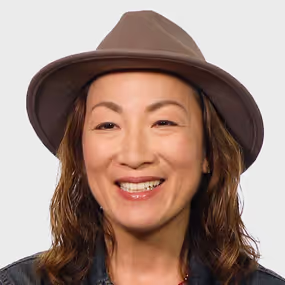
Emi Takemura, co-founder of FutureEdu Tokyo and Learn by Creation, discusses building experiential and project-based learning in Japan, inspired by High Tech High. The conversation covers hands-on curriculum design, differences between Japanese and US education, and how experiential learning relates to the job market.
transcript
Speaker 1 Hello, and welcome to episode 91 of our podcast at Human Restoration Project. My name is Chris McNutt, and I'm a high school digital media instructor from Ohio. Before we get started, I wanted to let you know that this is brought to you by our supporters, three of whom are Brandon Peters, Aaron Dowd, and Tegan Morton. Thank you for your ongoing support. You can learn more about the Human Restoration Project on our website, humanrestorationproject.org, or find us on Twitter, Instagram, or Facebook. Today, we're speaking with Emi Takamura. Emi is the co founder and representative director of Future EDU Tokyo, which seeks to reimagine education in Japan based on project based learning and experiential education inspired by Hai Tekai. She is also the representative director of Lorembi Creation, which provides professional development, conferencing, and networking for inspiring hands on learning in Japan. Emmy is a veteran entrepreneur who co founded Pietix, a mobile event platform and engages in many events on social entrepreneurship and startup funding. She's worked at a senior level in various financial firms and has been an advocate for female leadership, ethical investing, and reimagining education. Our conversation dives into what it means to develop a hands on learning curriculum, how Japan and The US relate and differ, and how all of this should or shouldn't relate to the job market.
Speaker 2 Hi. My name is Emmy Takemura. I am a representative director of FutureEDU and the Learn by Creation. They are kind of similar to nonprofit organizations in The US system, but essentially, we're in with both organizations, we're trying to advance the dialogue of about the future of education by involving, multiple stakeholders, from schools to teachers to administrators administrators to to governments to parents and, people in a community. But, prior to starting or embarking on my education journey, I was actually entrepreneur and, in the tech space for quite many years. I started out my own startup, event platform in 2010, and prior to that, I used to work for large corporations like Amazon and Disney and McKinsey working on the Internet and technology space. So I'm a little unusual for somebody who's trying to really focus 100% of energy in restoring or advancing our education, but with our kind of Asian technology where you can't really ignore how to look at our future. By embracing technology, I I feel like I have a something to contribute at this juncture in our society.
Speaker 3 Of course. And your backstory is fascinating. I was reading all these different q and a's about you before, we get started. I wanna talk about your experience in entrepreneurship because I know that you specifically focus on social entrepreneurship and how that led you to thinking differently about education.
Speaker 2 So I started out my own company with other cofounders in 2010. And as you might know, in 2011, we had a really major earthquake that hit Japan, which caused, even today, you know, 40,000 people to be displaced and living in, you know, outside of their own hometowns and every and things like that. So the earthquake sort of really kind of changed everything in a way, like the way a lot of people look at the future of our society, that it's not as stable as we we thought it's it could be like. So at that time, there's a lot of people who wanted to do something to help change our society. Even today also, there's a lot of grace of social good projects happening around Japan. So I felt that maybe Japan was coming to the turning point where, you know, more people wanted to, not just think and imagine, but actually do and create impact. And it certainly happened to a large degree compared to, like, pre earthquake. But, I used to run a social entrepreneurship program for young people, who wanted to actually make these ideas into more scalable concepts and adventures. And it was a really great program and partnership with a US organization called, at that time, Unreasonable Labs. And we had this five day intensive boot camp courses where, you know, anybody with a great idea with a prototype or with some working prototypes could come in and work with the mentors and with our, with our program staff to really polish and hone their their product and service concepts and make them into a scalable idea and be able to pitch to investors and so forth. And I felt that, you know, I wish I I was part of that program before I was starting my own company. I mean, it was that it was really a good program, but I had such a hard time attracting talent. We ran two, cohorts, and the first cohort, we did okay attracting talent with the word-of-mouth. So we actually got ended up getting, like, cream of the crops of social entrepreneurs in Japan, and many of them doing wonderfully, receiving rewards and investments and so forth. But when it came to the second cohort, we actually ramped up our marketing effort, and I went around seven cities around Japan to recruit and talk about the benefit of social entrepreneurship. And quite a few people came and listened to our conversation, but very few people applied. And that was kind of like my wake up call in terms of, okay, there are people who are, you know, acting on their issues in hand, but so many people are just sitting on the ideas and not being able to realize what they think should be changed into their own realities. And that's when it hit to me really hard that our education system is really creating a smart people but not be able to act on their beliefs.
Speaker 3 It seems very likely that although our students are being very well trained in, like, guess, like, liberal arts, they understand the basis of English, math, etcetera, they don't necessarily have the proper tools to navigate what is often referred to as the the real world or the connection to the community or learning through, you know, hands on understanding.
Speaker 2 Yes. Because I think it's really the iterative cycle of doing something with your idea. Right? Either creating something or talking to someone and persuade and do something together or, you know, showcasing your work to the public. Whatever it is, I think we our education sort of neglected the last mile of delivering whatever students have created to the real audience. So we kinda grew up without knowing the joy and also kind of scary part of of doing that. Right? Like, you're sort of when you're showing casing your work to public, it's it's a little scary, but it's rewarding at the same time. But if you never experience that, it it's incredibly hard to kind of jump over the hurdle and actually do things for many Japanese people, especially the the society itself is is relatively compliant compared to probably that of The US. So, our sort of system reinforces this concept of, you know, people just being more compliant rather than acting on something
Speaker 3 on their own beliefs. That's so interesting because, like, a common critique of the American education system is that it makes everyone hyper compliant. So it it's interesting that you say that. And I I think too that there's something to be said about, when you make learning more meaningful and you make it more engaging with the community, you're also going to pull in the students who hypothetically never really wanted to learn those, I guess, traditional academics to begin with, people that just weren't engaged with school. When you bring in meaningful, problems and then have students create meaningful solutions, that's gonna engage way more people because it actually makes sense. I mean, the most common question people ask is why do I have learn this? Why does it matter? Who cares? Some will do it anyway, but some will just decide, hey, this doesn't matter to me, so I'm just not gonna participate. You know, you're doing this work with learn by creation with future EDU. What are the goals that you have to build schools that are that are more unique and more hands on that that fit the needs of the moment? So in Japan, this may be quite unique to Japanese society, but
Speaker 2 as a background information, we do have increasing number of students who are not emotionally capable to go to school. Like, we have about 180 almost close to 180,000 kids in primary school and middle school, for many reasons. A part of it is bullying, part of it is a psychological, part of it is family issues, but for many reasons, they they are just to the point they're pushed to the point where, they don't feel capable or they don't feel confident to attend school. So that's one evidence where our education has sort of, like, marginalized certain types of kids not to be able to exercise their right to be educated. Right? So that's one big problem. But another side of the problem is we also don't support kids who have their own interest. Because our education program is very much standard space, it's probably much more, strict than common core in The US, that, you know, every unit, or every subject and every unit has sort of very rigid sequence that you're supposed to be kind of following. And, technically, the teachers can actually opt out and be more free. And, you know, if you they wanna introduce hands on learning and make it more meaningful for students, they can do so. But because they'd never done it or that their the school culture never really allowed that to happen, and they're afraid that maybe parents and other teachers may might criticize of them doing something different from the what they had done in the past. It's very difficult to come out of the mold for an individual teacher to introduce hands on learning. So although there is a need from multiple sides of the students that they wanna have more engaging and meaningful learning experiences at the school, and some teachers want to make it happen. Our sort of system or the culture of the school makes it very difficult to kinda bridge over to the the next phase of the learning pedagogy. So that's where I feel that people like us who are, you know, mutual nonprofit oriented organizations to come into play and really kind of, you know, let multiple stakeholders to discuss what we wanna really see happen, including hands on and, you know, project based learning or more, you know, safe environment for kids to feel that the school they belong to the schools. And, you know, all these important ideas, I think a lot of people have them individually, but they were afraid to kinda surface these ideas. So we're trying to kinda create more common platform or the avenue for people to gather and exchange these ideas and think about how to, move forward collectively.
Speaker 3 What you're describing sounds exactly like, the series, like, problems that we have here. Like, the the common core is very malleable and pretty open ended, but states have their own individual standards, which tend to be a little bit more exact. However, the vast majority of teachers are in situations where they could deviate from the norm and do something different. It's just not either the culture of the building or something, like, something is making them feel like they can't accomplish the tasks that are at hand. And usually, the number one thing that comes up is standardized testing. Now the perception I have of Japan, this could be entirely wrong, is that standardized testing is a pretty big deal more so than in The United States. What is the current situation?
Speaker 2 Yeah. So Japanese schools are actually seat time based grading system. So, they do have tests, but also, attendance and other factors matter for grading. So high stakes test is not so much for the school grades itself. Of course, it affects, but it that's not 100%. But where it plays a big role is the school admission to higher institutions, like from junior high to high school and high school to college. And because in our generation, you know, I'm I'm a parent and, you know, in our sort of current parent of k 12 school kids generation because we are sort of, like, ingrained to think that, the better high school, the better college, better junior high, better high school, and we have this sort of like normalized curve of scores, like scoring each school even when it's public school for a high school. So in if you're living in a small town and there's only two high school, everybody knows which high school is a better school. So parents who are interested in education of their parent children, they go, you know, they go out of their ways to make sure kids are focused on these, like, memory skills of, you know, cognitive ability and not so much on other stuff. And that's where kind of I see a lot of big problems, throughout Japan, because the parents mean well, but the result doesn't really kind of, necessarily show the success of the students because the focus is overly on cognitive ability at the expense of developing a child as a whole person.
Speaker 3 It reminds me of, I went on a tour of Chicago schools a couple years ago, and I toured all of these quote, unquote elite schools. And they were aimed to be progressive, so, like Montessori's, hands on learning environments. And k through five was hyper progressive, but, I mean, traditionally, it always has been, pretty progressive play based learning. But what was interesting is in Chicago, it sounds kinda the same. High schools typically had admissions policies, and you needed to take a pretty intense test to get into the most elite high schools. So as soon as students got into seventh and eighth grade right before they were shifting to high school, it was no longer a progressive school. They might have said that they were Montessori, but they were just doing worksheets and prepping for that test the entire time. Because, again, there's that faux perception that in order to be elite, this is the way you have to learn. So how do we then utilize, these conversations, protocols, ideas to shift the framing of learning away from traditional test based rote learning into something that's hands on experiential and community centric?
Speaker 2 It's it's a very difficult question, but I think in Japan, the, the biggest issue is really the college admission, and the positive sign is that it's there's still a long way to go, but there is a a growing number of students who are taking nontraditional admission route to get into college. So these kind of nontraditional route allows them to showcase what they have done in terms of, like, research projects or more kind of hands on or experiential learning, as part of the application as opposed to just taking a test. So I think we just need to really kind of shift the portfolio of college admission options and, hopefully, we transition, like, a bulk of bigger chunk of the student's body into these kind of more portfolio, based assessments or alternative assessments.
Speaker 3 I I would imagine too that as we build more portfolio based, assessment, the issue we're running into is that students are getting to college. They're going for two, four, six, eight years, and then they're graduating, but they're not doing much with the degrees that they're earning to begin with because they spent the entire time basically prepping for the next test. So they they graduate, and then it's it feels purposeless.
Speaker 2 And That's a acute problem in Japan because because, like I said, every school or every faculty at every college has this, like, number, against I it's a very arbitrary number, and they're it it's it's not really necessarily accurate. But because it's so easy to digest, a lot of people look at those those numbers and say, oh, for this college, this department has, you know, score 60 versus 47. Therefore, you know, if I if I'm accepted to two fact two departments, one is forty seven and one is 60. Although I'm more interested in literature, which has 47 score, I would still have to go to this other one, like, with the family pressure because it's supposed to be the better school. So, like, a lot of the people's decisions are not true to what kids or students really want to do because the numbers seem to overtake and dictate a lot of the decision important decision makings for the families and children. That sounds incredibly similar to The US News and World Report,
Speaker 3 which is probably one of the most corrupt things when it comes to higher education. I I see that all the time, like, with students they're applying to college, they go entirely based off of, like, this school's ranked number one in anesthesiology or something really random without understanding that, like, that whole number is generated by how many people that you deny or some, like, really bizarre algorithm that has nothing to do with the quality of instruction
Speaker 2 or the type of instruction. Yeah. So it really calls for critical thinking on the part of students and teachers and family to really
Speaker 3 kinda question those numbers. Right? And it it also implies too that perhaps high school should be shifting toward if we're building community centric project based learning that students might not need to go to college at all, that they can learn the skills that they need without or very little, post secondary options.
Speaker 2 Yeah, sure. I mean, I think probably The US colleges are ahead than Japanese colleges, but I think the whole notion of, you know, going to college for four consecutive years to complete a degree that they can't deviate from what they had originally thought at the age of 17 or 18. That, I think, needs to be kind of transitioned to a newer concept because the the world is is so rapidly moving, and especially when kids kids' exposure to real world and during high school years is so limited. It's I think it's it's quite natural for kids to change what they want to do with lives after, you know, first year of college or maybe during a gap year. And I think we need to kind of give students more options to design their own higher education as opposed to entrenching them into this two year or four year package program that they can't get out of at a very high price tag. So let's then kind of shift into imagining what that process looks like using your organizations as kind of the example.
Speaker 3 And I think first, it might be useful to just get the perspective of what's going on in Japan in terms of what students are experiencing day to day. I know that the hours are longer, than US schools. It looks a little bit different. Could you briefly describe just like a traditional Japanese school day? Yeah. So Japanese school typically
Speaker 2 has six to seven period a day and, five days a week plus some public schools are have Saturday twice twice a month, usually in the morning. And after those six or seven periods, which is usually from 08:30 or so till 03:30, and after middle school starting middle school, a lot of kids get become engaged into what we call club activities, and that is one of the positives and disadvantages of Japanese education is that that the school takes a lot more responsibilities than just academics. So I I guess the original purpose is really the human whole child development, but kids are allowed to choose, you know, whatever club that they wanna belong to, you know, which running or basketball, theater, whatever. And they're supposed to to to pursue that oftentimes, for three years during middle school and three years during high school. And during that time, they cannot change even if there's interest shift. And so it it takes up their days become very monotonous very quickly because, the the curriculum is is completely fixed, for the most part. There are some selections, but for the most part, it's fixed. And then and the club is fixed. Once you choose, you can't get out of it. So kids have very little time to think for themselves or why they're learning what they're learning, why they're doing this homework. They have very little time to questions
Speaker 3 about their lives. And do they run into the same issue? Is that that's relatively similar to what happens here. There's not the locking in of clubs, but there is an issue of students over scheduling themselves to get ahead all the time. The students that are quote unquote a students, the ones that wanna get in the top ranked universities will schedule themselves till nine or 10PM at night every single day because they wanna build up their resume. Is that the same there? Yes. It's it's very similar. So
Speaker 2 I don't know. May maybe that's a positive of high stake test, but because the the club activities, things like that don't count for, like, the most traditional type of college testing. But they instead, like, kids go to, like, cram schools, which is, you know, which is a school purely the whole purpose is to test prep kids for SAT type of things. So so although the you don't have to do service learning and volunteer and all of these things to beef up your resume, you still the kids are still busy because they're focused on academics. And these club activities, can be quite, harmful to some kids because they do take up so much of their time regardless of their interest. So with that being said,
Speaker 3 let's talk about future EDU. Let's talk about the work that's being done to counteract that narrative and what we can do to do things better because there are a lot of really, really, really cool things going on. A brief side note, no matter who I talk to, no matter where they're at in the world, everyone kinda has the exact same thing going on. There's these systems that are in place that are hyper traditional. There are a few pockets that are working to change those things, and there's change on the horizon. Some have succeeded, some have failed, but there is movement over time. What is future EDU doing?
Speaker 2 So we started out more as a volunteer organization five years ago to really start up a conversation dialogue among multiple stakeholders that they used to never talk before. So we use I should say by we use, but but we started out by screening film called Most Likely to Succeed in Japan in 2016. And the first time we started, there's only English subtitle, which is a really high hurdle in Japan. But without much promotion, we still got, like, sixty, seventy people to show up from all walks of life. Some are school teachers, some are, you know, corporate executives, some are parents. And we had a really inspiring conversation about what's going well at our schools and, you know, what could be better and and so forth. So I was really inspired to take this kind of conversation more broadly across Japan. So I sort of became ambassador of the film in Japan, and I work with Ted Dinger Smith and and others to bring the Japanese subtitle version to Japan. And to a big credit to Ted. He was so kind to make that happen. And so since then, I've been really promoting or encouraging any any change makers in Japan who wants to see change in education to use the film as a tool to kind of start up conversation. And, fortunately, I don't have exact number, but 46 out of 47 prefectures in Japan has now hosted a screening plus the conversation or workshop dialogue about future of education. And increasingly, more and more schools are trying to use that type of media as a way to train teachers. So initial like, at the beginning, it was community based film screening, and increasingly, it's becoming now a school's k 12 school and colleges. So I was really inspired by that sort of progression as well as, you know, all these voices that I was I was collecting because we do survey with all the change makers who host screenings. And that sort of, like, evolved into the conversation about what else we can do to kind of help everyone make a small first steps. And that's why we started this, event series called learn by creation, and creation meaning, like, create any new learning. So we try to gather, you know, people again from all walks of life to come together, And we do have some seminars and panel discussions, but we also have workshops and we have hackathon and multiple activities. So any anybody at at a different level of mindset, you know, whether you're still really skeptical and you just wanna find out the evidence about, you know, hands on learning, experiential learning, they can come and learn about it from, you know, people who are practicing. Or if they are, you know, ready, but they don't know how, they can join the workshop. If they really wanna hone their craft, they can join a teacher training program. So we kind of created different options where anybody can participate and have a meaningful conversation in, like, a fun and safe environment. And it's it's been quite remarkable how, you know, people are feeling empowered to find other people to work with, because my whole interest is to create innovators around Japan who can kind of act and be in charge or, you know, facilitate conversation around progressing, or advancing our education because, you know, central control model, it doesn't work for education, I don't think. So we need to just empower everybody at a different regions in Japan who live in different circumstances and different culture. They think their own feet, and they feel empowered with their, you know, colleagues across Japan to to work together and do something
Speaker 3 to improve and take our first steps. So Yeah. Empowering communities is is such a huge step, and most likely, the succeed is a very effective film that's showcasing what hands on Lauren could do. We've we've interviewed Ted Dinner Smith. I've personally been to High-tech High now four times, I think, in the last, like, five years. Yeah. I keep heading out there, I it's really cool to go when classes are in session, you see students working, but I'm always taken aback by kind of a a more natural look at what's going on. The film makes the implication that, like, all they do every single day is all this crazy stuff, and it's always so wild. But it feels a lot different on the ground, and I I actually found that very calming. Like, kids still goof off. They still talk to each other. They still run around and be weird. And there's there's a natural flow to learning that does not look like kids sitting in rows and just listening to someone talk. The vast majority of it is very natural human behavior of kids. Some kids are working on some stuff. Some of them are talking to each other. Some of them are watching some random television show. But over time, the teacher is guiding them and helping them to get there. As you're, you know, working with these different school leaders, these different innovators, etcetera, what, if any, changes have you seen in the classroom as a result of showcasing this film and speaking with them? Sure.
Speaker 2 Yeah. So some schools, have kind of created this, like, innovation team. And, for a lower it's you I see more happening at private school than public school, unfortunately, at this moment. But for example, for, like, a seventh grade curriculum, they, the teachers work together to create, these cross curricular or or interdisciplinary project based learning. And they were able to use their existing unit by working collectively to do a somewhat long term project and able to do an exhibition which received a really good feedback. So now they're even more in part to do it for the grade eight and things like that. So that's kind of more successful organized examples, but there are also other schools where teacher, like a public school teacher, have found their units to be kinda combined, like, for example, English and social studies and things like that. And just for one class, but they experimented with, like, hands on learning with a theme of convenience store, which is very common in Japan, and a lot of kids are really interested in going there. So, like, they try to have a project around, like, convenience store and and the world. And I went to see their exhibitions, and it was quite quite fascinating. Or another science teacher, created a project to create instrument, and it was a unit on the sound, but kids kind of came up with their own materials to create their own instrument, and and the teacher, weaved in the concept of the sound in in that instrument, and in the end, they had a concert. And it was great because the teacher himself is a former musician or, you know, an amateur musician, so he it's it was his interest as well. So he was really excited to make that project happen, and, you know, it was interesting for students as well. And I think when those two could be combined, I think it can become really a powerful project.
Speaker 3 And there's there's two things that you bring up that that instantly come to mind on the the power of this. One is when you display this work publicly and invite in the community, not only is it more authentic and meaningful, but it proves to the community why this style of education works. Typically, throughout the school year, there are some skeptical voices of, like, well, why are they not reading this book or whatever it might be? And then when they see the final part, they're like, wow. This is really cool, and I haven't seen anything like this before. It's incredibly powerful. The second thing is is that and speaking of monotony, it's less monotonous for the teacher. I couldn't imagine teaching a class where every single year I do the exact same thing. That would be so boring. Whereas if you do these projects, it's very much driven by what the current learners want to do and what their interests are. So as a result, you can pull in your own interest, their interest, and every year looks a lot different than the previous year. So it's like you're always teaching different classes, and it's exciting and fun, which is what learning should be at the end of the day. I think Japanese
Speaker 2 teachers are so dedicated, and they think about kids, sometimes they forget about their own learning. And I think it's very important that they feel growth and they feel that they're learning from teaching experiences as opposed to,
Speaker 3 you know, like you said, like, teaching the same material year over year. It allows you to to center the student voice that you're learning from the students. I've done, like, video game projects. I've done, like, theatrical performances, like, sorts of random stuff that I have some experience, and I learned a lot from the project. But honestly, the kids are the ones that taught me a lot of the stuff that was going on. And that that feels good to have that that intertwining of ideas.
Speaker 2 The challenge is is for teachers to really let go of the fear of not knowing everything, especially in the Japanese cultural cons context that, you know, elderly is supposed to be respected, but they're supposed to know everything in this kind of traditional Japanese culture. So I think there is a very high expectations that the teacher put on themselves that they have to know all the answers. Therefore, it's a little too scary to kind of step out of that sort of guidelines and and do the projects that they are passionate about, but they may not have all the answers. For teachers that are listening into this that maybe feel intimidated to try out more hands on experiential learning or reaching out to the community,
Speaker 3 what suggestions would you have for them to initiate or start that process? I think
Speaker 2 one of the more power empowering things that you can start is to have a really kind of candid, meaningful dialogue with people who are not in your profession. So if it's a parent, with the teachers, or if it's teachers with administrator, or teachers in other subject areas. Because oftentimes, at least in Japan, at high school, teachers in English departments don't seem to talk a lot with teachers in the science department or, you know, social studies. And I I've seen times and times again when people's kind of eyes light up and, they get so excited about, all the great ideas that they have when they start having this candid meeting for conversation. But oftentimes, they feel they're not allowed to have these kind of talks. And I I think I mean, film is one way, but it doesn't have to be the film. But I think if you can organize a casual gathering, hopefully, a routine basis just to kind of imagine and talk about, you know, what is it like to have this or that or, you know, what kind of kids would you like to develop it? How would you like to see kids be succeeding in ten, twenty, thirty years from now? You know, if we if we gather in a really serious manner, I think from the beginning, there is always attention, but if we can somehow organize a casual conversation in a relatively sort of safe environment for people to really talk their ideas out and find a commonality and find, like, maybe a low hanging fruit projects that they can maybe start out and try. It could be something very simple, like, you know, having a circle time conversation at the beginning of each day for students to express their interest and maybe over time those interests can become a seed for project ideas. Because I I'm a big proponent of social emotional learning, and I think unless kids feel safe and free to speak their own interest to, teachers and peers. I I think even if there is a choice in voice, it's very difficult for students to express that during the project time. So we can step back and kind of start from there as well because it doesn't take a lot of time, and, we can make it into routine practice and evolve from there as well.
Speaker 1 Thank you again for listening to Human Restoration Projects podcast. I hope this conversation leaves you inspired and ready to push the progressive envelope of education. You can learn more about progressive education, support our cause, and stay tuned to this podcast and other updates on our website at humanrestorationproject.org.
resources
- FutureEdu Tokyo · Emi Takemura (organization) Japan-based organization reimagining education through project-based and experiential learning. link →
- Learn by Creation · Emi Takemura (organization) Provides professional development, conferencing, and networking for hands-on learning in Japan.
- High Tech High (organization) US school network that inspired FutureEdu Tokyo's project-based and experiential learning approach.
- Emi Takemura (person) Co-founder of FutureEdu Tokyo and Peatix; advocate for female leadership and experiential education in Japan.
- Peatix · Emi Takemura (tool) Mobile event platform co-founded by Takemura; used for social entrepreneurship and community events.