

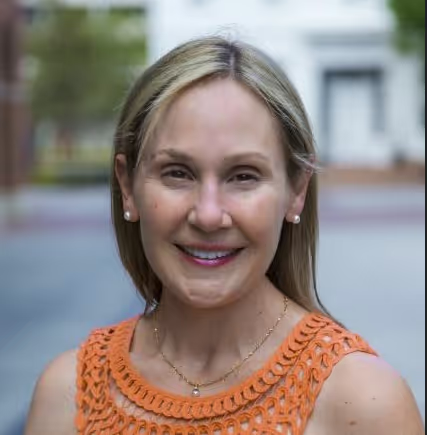
Researchers Anna Saavedra and Morgan Polikoff share findings from their February 2024 report 'Searching for Common Ground.' The report surveys American attitudes toward controversial school topics, finding broad support for public schools alongside sharp partisan divides on issues like LGBTQ identities and racial inequality.
transcript
Speaker 1 2022 was a system reboot. 2023 broke the doom loop. This year is all about turning vision into reality. Conference to Restore Humanity twenty twenty four is an invitation for k 12 and college educators to build your joyful reimagined classroom. Our conference is designed around the accessibility and sustainability of virtual learning while engaging participants in an environment that models the same progressive pedagogy we value with students. Instead of long Zoom presentations with a brief q and a, our flipped keynotes let the learning community listen and learn on their own time, then engage in a one hour Q and A with our speakers. Doctor. Mary Helen Immordino Yang makes the neurobiological case for progressive education rooted in her groundbreaking work in affective neuroscience. Doctor Carla Shalaby demonstrates the power of education as the practice of freedom, honoring young people's rights to full human being. Doctor Sousan Jabber elevates the voices of Arab and Muslim students as an advocate for global equity and justice. And Orchard View School's Innovative Learning Center showcases healthy, sustainable community learning spaces for teenagers and adult learners alike. Beyond our flipped keynotes, participants will be invited to join week long learning journeys. Join Trevor Elio on a journey to learn interdisciplinary inquiry based methods to equip students as knowledge producers, communicating with zines, podcasts, and more, and understand the ripple effects of modern imperialism with a focus on Palestinian resilience and classroom tools for fostering global solidarity in our second workshop led by Abir Ramadan Shanawi. Also featuring virtual school tours so you can see progressive practice in action at the NOVA Lab, Olin Tangie STEM Academy, Community Lab School, and more. The mission of reshaping education systems, of turning vision into reality is vital for a sustainable and just future. Conference to Restore Humanity runs July 22 through the twenty fifth. And as of recording, early bird tickets are still available. It's a $150 for four days with discounts available, group rates, and parity pricing. Plus, we'll award certificates for teacher training and continuing education credits. See our website, humanrestorationproject.org, for more information, and let's restore humanity together. Hello, and welcome to episode one forty eight of the Human Restoration Project podcast. My name is Nick Covington. Before we get started, I wanted to let you know that this episode is brought to you by our supporters, three of whom are John O'Brien, Timothy Fox, and Leah Kelly. You can learn more about Human Restoration Project on our website, humanrestorationproject.org, and connect with us everywhere on social media. There aren't more contentious topics in modern education than those related to LGBTQ gender and sexuality, race, and sex education. When you include the push in many states to implement and expand so called school choice programs and laws framed around the post twenty twenty parents' rights movement, you quickly realize this suite of issues almost entirely dominates education journalism and discourse. But how much do we actually know about what Americans and which Americans believe about these issues, about the purpose of education itself? And how can we use this understanding to improve public conversations and policymaking around potentially contentious topics. My guests today are the lead authors of just such a report based on extensive surveys completed in the fall of twenty twenty three and whose results were publicly released in February of this year. Hi. I'm Morgan Polikoff. I'm a professor of education at the USC Rosters School of Education.
Speaker 3 Hi. I'm Anna Saavedra. I'm a research scientist at the Dornsife School of Arts and Letters with NUSC.
Speaker 1 Well, thank you so much both for your work and for joining me today to dive into these results. My pleasure. Happy to be here. So for the listeners, the report, Searching for Common Ground, Widespread Support for Public Schools, But Substantial Partisan Divides About Teaching Contested Topics is available online and you can find a link in the show notes if you'd like to pull it up and follow along. Now, Anna and Morgan, let's just talk a bit about the methodology before you get into the results because both of your research interests and expertise lies in conducting and making sense of this kind of survey research. Could you explain how you conducted the survey, why this work is important for informing and guiding education policy making and discourse?
Speaker 3 My research center at USC, the Center for Economic and Social Research, has been serving the same households over time, now about 13,000 since 2014. So this is called a longitudinal sample, where you repeatedly survey the same households over time. The survey sample is nationally representative, meaning that we have a sample that we're drawing data from. It's not the entire United States, but we can draw conclusions about how the how The U US population would respond similarly to similar questions. For our particular survey that we're gonna share that talk about the results of, we surveyed 4,000 adults from households representative of The United States. Half of them have a k 12 child living in the household and half don't. We are going to talk about results overall across the 4,000 adults. We also broke down our results for our report focusing on differences in partisanship. So for our sample, 40% are democrat or leaning democrat. It was 34% republican or leaning republican and 27% other political affiliations, so independents or libertarians or Green Party or others. There are many other ways to look at the data, but that's the way that we focus on in the report that you referenced.
Speaker 1 Let's go ahead and talk about the elements that you asked about in the survey based on the demographics that you talked about and the the results or I guess not the results, but the the responses that you were looking for. What were those elements that you asked about in the survey? And how and why did your team decide on these topics at this point in time?
Speaker 3 We asked about purposes of education, so we asked adults. You know? We listed 12 different pot potential purposes of education. We asked them to tell us how important they thought each of the 12 purposes of education are. We also asked some questions designed to understand adults' beliefs about public education compared to private education, some of the under underlying beliefs behind school choice. Then we asked we wanted to learn an adult's views about the appropriateness of teaching topics related to LGBTQ race and sex ed education in elementary and high school classrooms, and we wanted to understand what do adults think is the appropriate role of parents regarding what their children are learning in school.
Speaker 2 And we settled on these questions. So we had we had done a similar study just a little over a year ago in in fall of twenty twenty two and asked some similar topics. So we asked about curriculum related topics, for instance, related to LGBT and race issues and and other curriculum topics. But we really wanted to go much deeper this time, so we we asked many more scenarios and more detailed scenarios. And then I think just generally, we're a a team that pays a lot of attention to what's going on in the education policy space right now. And, you know, clearly, choice is a major issue right now in a in a lot of red states. And then these issues related to views of on the purposes of education, we thought, were just highly salient to this topic of, you know, what people want schools to be doing. Right? And and we know that there's a sense that people's views on the purposes of education, both K-twelve and frankly higher ed, are sort of changing right now, that there's some inflection post COVID. And so that was how we came up with the broad buckets for this survey.
Speaker 1 That's that's excellent insight there. I think thinking about the collection of those results then, when you got the results back and you began the analysis that eventually becomes this report, what results or patterns emerged that surprised or shocked you? Were there any results that seemed counterintuitive to any narratives or challenging to those narratives? And what ones perhaps confirmed any theses that you may have had about how those pieces would come together in the long run?
Speaker 2 Sure. Yeah. I mean, there's tons of findings in the report, and there's also tons of findings that we didn't report and are planning to roll out and continue to analyze, know, cut the data in different ways. But let me just say some of the a couple of the things that stood out to me that were surprising. So one was in terms of views on school choice. Right? People tend to think of school choice as a as a Republican issue. It's happening primarily in Republican states that are passing vouchers and ESA bills. And we asked a question where we asked people, you know, how they think money should be spent, whether giving, school choice opportunities to low income families or whether improving local public schools. And overwhelmingly, both Republicans and Democrats expressed support for using that money to improve local public schools. And I would say I was surprised at the strength of that support because there's a a lot of public opinion data on school choice. I think people people want to think that school choice is a particularly partisan issue, but and and I think it is in terms of partisan elites and policymakers. But in terms of what actual people think about improving schools, people really want to improve their local public schools. That is a very popular position, and I was surprised at the level of partisan agreement on that. We also found a lot of partisan agreement on most of the purposes of education that we asked about. So for instance, the number one, you know, top issue for both Democrats and Republicans was basically teaching kids the basics, reading, writing, and math. And but across essentially every every purpose that we asked about really except for one, there was pretty good partisan agreement. The one issue where we really did see, a pretty big partisan agreement separating Republicans and Democrats was on teaching children the importance of embracing differences, where Democrats were much more supportive of that as a purpose of education than Republicans were. But those are two things that to me really stuck out as pretty surprising. And I don't know if you want if there was anything that you wanna say in terms of things that were surprising or
Speaker 3 or things that maybe confirmed what we already learned last year. I agree that the most surprising but also optimistic result is that shared support for public schools. And it's a common starting point. Right? We did find a lot of areas of disagreement or difference between Democrats and Republicans in terms of the content that they think children should be learning at elementary and high school in terms of, you know, these issues of race, LGBT, and and sex ed, but that common ground and support for public schools is a great place to start from. One thing that I found really useful was we asked questions designed to understand a little bit more about where these differences might be coming from. So we found, for example, Morgan gave the example of, you know, two third three quarters of Democrats thinks that a very important purpose of education is teaching students to embrace difference difference compared to one third of Republicans. But we also found, for example, that there's a much greater proportion of Republicans who are worried that their children learning about racial inequality is gonna make them feel guilty. That's really not a major concern among Democrats. We found some other sort of explanations that seemed helpful, like much greater percentages of Republicans are worried that learning about being gay or being trans will actually, like, make students be gay or trans, whereas that is a much lesser concern among Democrats. We found several others of these differences, but I do think that understanding these differences in conjunction with having this great support for public education is like a way forward. You know? We all have support for public schools. Let's learn about each other's differences, and maybe we can come to some sort of consensus. You know, another thing that we've that I found pretty sort of helpful and a little bit well, concerning also is that when there's disagreement between adults and what kids should be learning in school, there's also disagreement on how to reconcile that disagreement, and that's sort of like, you know, we need to figure out some process here. I thought that those results kind of together are saying, look. We support public schools. We have some differences. Let's try and understand those differences and come to some sort of processes that we can all agree on to come to some kind of consensus.
Speaker 1 Well, I'll point it to the three things that I pulled out of there too that just stood out, like, in you know, with blinders on with with blinkers on here, which the first one is, like, that 39 gap, right, between the Democratic support. It's interesting because we don't generally talk like in these explicitly partisan terms about education, at least in in this context for this podcast. So it's it's kind of interesting to to bring that perspective into this. But that 39 gap in agreement on teaching children the importance of embracing differences, it was, I think, 74% of Democrats agreed compared to just over a third of Republicans, something like 35 there. Such a striking difference, while at the same time, you know, you pointed out that on that item about money should go to public schools to improve them, I was really shocked again at how high that bipartisan consensus really was, you know. 63 or 67% of Republicans agreed with that where, you know, Morgan was just talking about that has largely been a Republican driven issue in these state legislatures, Republican dominated states passing these school choice bills. It kind of seems a little bit counterintuitive that those things would kind of be the case. While at the same time then, I think to dive into the more contentious topics, perhaps we can start to look at that. Now, you performed a similar survey in 2022. Were there things that you asked that were different then or were there any notable similarities and differences that you found between each of these year's results, I suppose, before we dive into the the contentious topics?
Speaker 2 Yeah. So the general approach was the same between the two years where we asked about people's views on con well, in 2022, asked about controversial topics, so everything was about topics. And this time, we asked about scenarios because some of the scenarios aren't specifically topics that you would cover in a curriculum, so that's one small difference. But we asked about it separately for elementary and secondary because we know that people have very different views on these issues, whether you're talking about young children or older children, and we certainly had found that in 2022. And then we asked just much more detailed scenarios this time. So last time when we asked about topics, an example of a topic might just be like gay rights. Right? So that is a very general topic. And really, we want to understand, well, where are people comfortable and not comfortable? Because the specific scenarios that come up, those are what people are talking about. Right? Whether it's, you know, trans girls on girls sports teams or whether it's a pride flag in a classroom or whether it's talking about slavery as the cause of the civil war. Right? These are very specific scenarios. And we really wanted to understand Americans' views on these very specific scenarios. So so we crafted a range of scenarios for LGBT issues, for race related issues, and for sex education issues that we thought sort of varied in terms of their difficulty, meaning that some we thought most people would agree with and some we thought most people would not agree with, so that we could really figure out for each person where on this continuum of support they will be located. So that was our sort of strategy. And actually, I think we'd ended up doing a really nice job of differentiating along this continuum of support, and highlighting also, again, how it differs for Republicans and Democrats and how it differs for elementary school and and high school.
Speaker 1 Well, let's get into some of the more specific scenarios that we've alluded to here. And I'll I'll read some more of the language of the report specifically just for the benefit of listeners who may not be following along, So I hope that's okay. And then I'll come back around here to just asking, I guess, where we go from here. But I think as I dove more into the specific topics, two of those outcomes that were again more striking to me, even if I felt like they weren't surprising, one was the partisan breakdown that was included right at the beginning of the executive summary that said agreeing LGBTQ classroom scenarios are appropriate in public high schools as opposed to, say, elementary school. So these are topics that would be broached with, like, 14 to eight year olds. You found nearly unanimous bipartisan agreement on teaching why being kind to others matters, standing up for others, an opposite sex love story, for example. But for the other 21 scenarios, on the LGBTQ scenarios front, Republican responses are underwater, below 50%, including discussing same sex marriage rights, again, in a high school setting, the teacher's same sex spouse picture on the desk, and the divide only gets worse for topics impacting transgender identities where the overall percentage of adults dips below 50% bipartisan agreement. As you had mentioned too, Anna, later in the report, you included a chart that showed 55% of Republicans agreed with the statement learning about gay people might make children gay, and 66% agreed that learning about transgender people might make children transgender. The last part here, the other one is from teaching about the racial inequality, where the subheader I think for the section reads, Republicans do not support students in elementary or high school learning about racial inequality. And the report reads, the scenario with the least support from Republicans, that's only 36 agreed with it, is the one most directly related to high school students, a math project where students studied national data on how often different races get sent to the principal's office. So I guess I'm wondering, where do we go from here? Right? How do we get past this contention and this conflict? And what way forward do you imagine that this survey illuminates for us? Because I I I get the sense that those are sort of hopeless divides here in terms of teaching about LGBTQ issues and identities and teaching about racial inequality. But what path forward does the report chart in your estimation?
Speaker 3 Well, I think that we start with this, bipartisan high strong support for public education. And we say, okay. We all want to, invest and support public schools. And then we say, wow. We have these big differences in what we think the children should be learning at both elementary and high school level, and we don't really, do a great job of arbitrating our disagreements. Like, we need to improve our processes. And this is most likely in just about every district around the country, all of which are purple to some extent, even if it's a vast majority Republican or vast majority Democrat. You know, we have disagreement within communities, and we don't seem to have great ways to reconcile the disagreement. So we need to come up with processes, and they're really some of the going back to the basics of democracy, some of the tools that we have for democracy at the national level. You know, we need to be developing those processes at the local level as well. We need to be listening to each other, understanding each other, and then using some of the tools we have, you know, at our disposal. Like, there's commitment to coming to compromise, understanding that not everyone is gonna have every one of their needs met, public panel deliberations, citizen advisory groups, provisions for dissents, you know, understanding that we're we're all in it together. Most people you know, if if you wanna stay in your community, you wanna commit to to having productive conversations with the peoples in your community. You know, there was an article, I think it was over the weekend, about a conversation last week as part of National Civic Learning Week between two of the justices about the fact that the supreme court justices is a position for life. You know, they have a lot of disagreements among them, but they also have some really, really strong norms about how they should be communicating with each other. And I think that there's there's, you know, some lessons to learn from the justices in terms of you know, we might have a lot of disagreements about some of their decisions, but maybe they have some processes we can all learn from. I think all that I would add additional emphasis to what Anna said, right, ultimately,
Speaker 2 what it comes down to curriculum is, for better or for worse, a local issue and a state issue. And I think states need to put out guidance for how these issues are to be addressed in, you know, in age appropriate ways across the continuum. I think locals need to have similar discussions about how they're going to implement these kinds of issues. And we're we're not all gonna agree. As Anna says, every district is purple. I think there, you know, there needs to be guardrails. And I frankly I'm not wild about the idea, but there also needs to be opportunities for parents who disagree with the way particular topics are going to be presented to have the opportunity to both express their disagreement. And also, if they really don't want their kid learning something, there needs to be some kind of release valve. And I don't think we want kids opting out of lots of lessons. I think that's a logistical nightmare, and I think it's bad for democracy. But I also think that, you know, for some people, there are nonnegotiable things they do or don't want their child to hear. And we, you know, we have to respect that to some extent. And so I really think it it means coming up with specific policies and strategies, models that can work in red states and blue states and purple states, and and that's really the path forward.
Speaker 1 Perhaps to build off of that too and just kind of look at look ahead a little bit further. I know it's difficult just because, obviously, I mean, you guys are researchers, not policymakers, so it's hard to ask, like, how you envision these results being used. Are there areas though that your insight can be valuable on as far as the areas of you see of greatest compromise? The the biggest levers that we have to bring people together to be able to do that. Perhaps, yes, on the agreement that our public schools are good and valuable and we need to spend money on them, but then when we get into the nitty gritty of how do we actually what do we teach in there and how do we do that? Are there areas of compromise that you see being powerful levers for for that? I don't know. What do you think? Yeah. I mean, listen, I think that there are
Speaker 2 there are clear differences across grade level here. And I think one thing that our report does very nicely is really gets into the details of what people are supportive of and opposed to at elementary and secondary. And the story is very, very different. Right? So at secondary school, I would say the general, you know, 30,000 foot takeaway is people want potentially difficult issues to be covered in secondary school. What they don't want is they don't want teachers pushing a particular ideology on children. And so that means coming at broad topics from multiple perspectives, critically analyzing data, giving students the abilities to come to their own conclusions about potentially fraud issues. And that's how I read the secondary school results. And there was a there there are lots of surveys that come to the same general conclusion. There was one, I think, from Ed Choice that came out last week that had very similar results and where they they actually directly asked a question. And the conclusion was basically people are very concerned about teachers pushing particular ideologies on children. And so I think that is we could just accept that as a finding now, right, that we found it in both of our waves of the survey. It's been found in other surveys as well. So people want secondary schools to be a a place where these issues are discussed. For elementary schools, I think broadly, people don't want elementary school kids exposed to potentially difficult topics. I think they pretty much think that lit for little kids, leave those issues at home and have the school focus on the basics. And we as educators might think, oh, that's not really reasonable or, you know, kids are gonna ask questions or things like that. But people have people do have concerns about age appropriateness. And and that certainly is true on the LGBT issues, where even on most of those issues, Democrats aren't supportive of of them being addressed. But even on the racial issues, right, like getting into complex things about the causes of racial inequality for a nine year old, I think is I think a lot of people would say, you know, that's probably a little bit young for that kind of conversation, and let's have that a few year when they're a few years older and they can engage in more complex reasoning. So I think that grade level difference is really important, and and we found that across
Speaker 3 both our surveys now. I would say building on what Morgan said, and this isn't as much from our survey as some of the other surveys that have been, out there around the same time. There have been surveys of teachers showing how hard all this disagreement has been on teachers. You know, they have fear about what they're teaching, but they also need they need support. There are resources out there that can that can show teachers and provide them with the the tools that they need to really foster open discussion in a way that is welcoming of different perspectives from the kids, not indoctrinating. It's a skill to be able to facilitate a conversation about a potentially contested topic. And so teachers need those supports, and they are out there and they exist, and that's you know, I think that's an important sort of point to take away. You know, I think the other point is just we should we should all be looking at ourselves and asking how how can we contribute more productively to the conversations going on in our own towns about what what's, you know, happening in our local because we can start by pointing fingers at others, or we can start by improving what we're doing ourselves.
Speaker 1 Have your survey and the information that it reveals just added as a as a supplement, as a complement to the other, you know, array of perspectives and data that's out there too. I think Can I actually add one can I actually add one more Of course? Yes. Yes. We've
Speaker 2 also been analyzing the data in other ways for things that haven't yet been published. And I will say that another you know, this report focuses on partisan differences between Democrats and Republicans. Another way to slice the same data is to focus on differences based on the partisan breakdown of where people live. Right? Because you live in a congressional district that has a particular breakdown. And so we've also done that, and the gaps are much smaller if you've the gaps are much smaller between, quote, unquote, red places and blue places than they are between Democrats and Republicans. And that should make some sense because even red places are still usually 30% Democrat or something like that. And so even on things like the slavery is the cause of the civil war, there might be some big gap between red places and blue places. There really is not. And on a lot of the items, these gaps look much smaller when you analyze them sort of geographically. So I think there's also a little bit of a disconnect between and, actually, I think this is true on both the left and the right between what policymakers would like to push into schools and what the actual makeup of a particular school district. If you were to poll all the parents in the school district, what they would want for their kids on average. Right? Because policymakers represent one party. Unfortunately, this is kind of the way it works these days. Policymakers represent one party rather than representing all, you know, all of the people who are in their district, whether they're blue or red. And so I think that's another important thing is that this report, emphasizes the partisan gaps between Democrats and Republicans, makes them look very large. But there are other ways of analyzing the data that in some ways I think are more reflective of the ways that we actually structure schools that point out that actually these gaps aren't quite as large, and and there are more areas of common ground.
Speaker 1 Are there any other ways that I guess, I'm kind of excited about that angle of things here. Are there other ways that you're both parsing out that the massive pile of data that you've gotten from all of these from all of these participants that you're excited to look forward to, be they by congressional district or other perspectives for future reports and releases?
Speaker 2 So I can name a couple. So one is we're currently working on finalizing a so we actually did a thing where we embedded an experimental manipulation in the survey where we gave people some information about the potential downsides of opting kids out of the lesson that you disagree with. So we gave half the people that, and we gave the other half of the people not that description. And we found that just that description of the potential downsides really substantially reduced people's intended support for opting kids out of a lesson with content they disagree with. I want to say it was like a 14% or a 16% or percentage points or 25.
Speaker 3 So it was from a 5057%
Speaker 2 support rate to a 42% support rate. And that and that effect was it was equally large for Democrats and Republicans. Right? So that so that's one finding. It that's actually in the report already, but we're gonna we're gonna turn that into an article, I think. Another breakdown that I would say that I find quite interesting and to me actually is a little bit counterintuitive is the parent non parent split. So as Anna said, about half the sample's parents and about half the sample's non parents. And I was a little bit surprised that actually on most of of the potentially controversial topics, the parents are actually less supportive than the non parents of those topics being covered in schools. That would I'm not I'm not a parent, but that was a little bit counterintuitive to me. And I think that I think there's two reactions to that. One is there's an argument out there that, oh, this is all being driven by outside agitators or something like that. I don't think that's really true. I certainly think there's some of that, but but that's not the main thing. And the other is, you know, I think parents really are thinking about what do they want to be their domain and what do they want to be the school's domain. And I think that we don't want to demonize parents. Parenting is hard. We should respect parents' opinions about what is their area and what is the school's area to the extent that we can. And so that parentnon parent split, I think, is also pretty interesting. But the great thing about the UAS is because we've been serving these people for a very long time, we have all kinds of demographics that we know everything about these people, their education levels, their incomes, you know, as I said, where they're located, and their certainly their race ethnicity. So we can do lots of these different kinds of analyses. If your readers have an eye or your readers, your listeners have an idea of particular things they're interested in, you know, we can always do we can always do more.
Speaker 3 That reminds me that we have a lot of people to to thank for this work. You know, we're represent we're representing a big team,
Speaker 1 but we also always really like to thank our our UAS respondents because, obviously, we couldn't do any of this without them. No. That's awesome. Yeah. I think just with an eye on time, is there a, a way that you imagine these results being used or a way that, you know, they're out there in the wild for the public, for policymakers, for people to look at? Is there a particular use case that you had imagined for these? And then is there just anything else that in the course of our short conversation didn't get mentioned that you would think, hey. I'd be remiss if I didn't enter
Speaker 3 this into the record. I think there's a bunch of ways that Morgan and I would like to and our team would like to move forward with all the results. You know, we expect that we'll be speaking about them to different audiences through the year and maybe in coming years. You know, I spoke to the local high school kids and teachers about these results two weeks ago and to our local principals and district staff last week, and, you know, they prompted really helpful discussions and not just between me and them, but amongst sort of amongst the principals in the town. There were 17 in that leadership meeting. There's a lot of different audiences that might respond in different sorts of ways. We hope that this will raise attention for funders, for example. You know, there's ways that funders could be interested in different parts of the report and maybe wanna learn more about different parts of our results. You know, the Hewlett Foundation funded our work last year and this year. We're very grateful for that support. Morgan and I are gonna be presenting to a big group of funders in the fall. We're we're looking forward to that. I think that there's
Speaker 2 honestly a great need and opportunity for a middle of the road. I mean, listen, I realize it's a presidential election season. It's totally crazy. It feels like everyone is like, you know, the partisanship is ruling everything. But actually, I think a lot of people are sick of that. I think that there's an opportunity for, you know, regardless of whoever wins in November, that there's an opportunity for a conversation about, you know, sensible policies that large majorities of Americans can support about what goes on in schools. And I think rather than thinking about everything as like a partisan death battle, that there is a great opportunity for funders who are interested in sort of the future of civics and democracy to support efforts to come together and find common ground on what should be happening in our public schools. And so I hope that our report can be part of those conversations and help us think about, okay, well, what is the path forward here that makes education better for for all Americans? There's a sound bite if I've ever heard one. That's what I was going for. He's so good at that. I I could kinda see the gears turning. Like, I gotta land this plane. I gotta I know. Yeah. I was like, what are the how am I gonna end the sun?
Speaker 1 We'll we'll we'll put that on your, campaign, bumper sticker later. Right? My gosh. No. I I found the report fascinating. I read every page of it. I encourage, people. I'll include links. Obviously, when we share out the full podcast in April, we'll include the link to it again. It'll still be relevant, as you said, Morgan, clear through this presidential election. And this is just a great way, I think, to help bring more light than heat. And if if that's a if that's a cliche, think it's a useful one. But the report is searching for common ground, widespread support for public schools, but substantial partisan divides about teaching contested topics with the lead authors here, Anna and Morgan. So thank you so much for joining me today. Thank you for having us.
Speaker 4 You again for listening to our podcast at Human Restoration Project. I hope this conversation leaves you inspired and ready to start making change. If you enjoyed listening, please consider leaving us a review on your favorite podcast player. Plus, find a whole host of free resources, writings, and other podcasts all for free on our website, humanrestorationproject.org. Thank you.
resources
- Searching for Common Ground (February 2024 report) · Anna Saavedra and Morgan Polikoff (article) Full survey report on American attitudes toward controversial topics in public schools. link →
- How Americans really feel about the teaching of controversial topics in schools · USC Today (article) Accessible summary of Saavedra and Polikoff's survey findings for a general audience. link →
- Anna Rosefsky Saavedra (person) Co-Director of USC CARE and Director of Research for USC EdPolicy Hub; leads the Understanding America Study.
- Morgan Polikoff (person) USC Rossier professor specializing in K-12 policy, curriculum, standards, and survey research methods.
- USC EdPolicy Hub (organization) USC research hub focused on education policy; home base for Saavedra and Polikoff's survey work.