
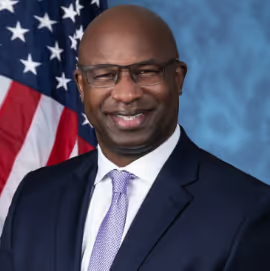
Congressman Jamaal Bowman, a former Bronx teacher, principal, and school founder, discusses his More Teaching, Less Testing Act with Chris. The legislation responds to decades of educator and family advocacy by shifting schools away from over-testing toward holistic, lifelong learning. Bowman draws on his background in the opt-out movement, restorative justice, and social-emotional learning.
transcript
Speaker 1 Hey there. You're about to tune in to our latest podcast. My name is Chris McNutt, and I'm part of progressive education nonprofit, Human Restoration Project. Before we get started, I want to let you know that this is brought to you by our supporters, three of whom are Elliot Baer, Zaynab Balbacchi, and Wendy Feyron. Thank you for your ongoing support. You can learn more about the Human Restoration Project on our website, humanrestorationproject.org, or find us on social media and YouTube. In today's discussion, we're speaking with congressman Jamal Bowman, serving New York sixteenth district since 2021. Bowman was a crisis management teacher in an elementary school in the Bronx, who eventually founded his own public school, the Cornerstone Academy for Social Action, a middle school in Eastchester in the Bronx. For years, he maintained a blog on changing school policy and standardized testing, with a focus on being deeply involved in the opt out movement to encourage families not to take standardized tests, as well as centering pedagogy on social emotional health and restorative justice. Congressman Bowman's team reached out to Human Restoration Project to talk about the More Teaching Less Testing Act, which will be linked in the show notes. Ostensibly, the policy lessens the number of standardized tests given each year in schools, limiting the number of tests, and finding other ways to gather that data, such as through a smaller but representative size. Please note that Human Restoration Project is a five zero one c three nonprofit organization, that this interview is not an endorsement of Bowman or his electoral campaign. Thank you and enjoy the show. Congressman Bowman, again, thank you so much, for taking time out of your busy schedule to join us today. And I just wanna talk to you more about the More Teaching Less Testing Act. But before we dive into it, I just wanna learn more about you and your school experience, because I was browsing through your your blogs and your Wikipedia, and I didn't know that you used to be a teacher, a school founder, you were a principal in The Bronx. Can you describe about your experiences as an educator, your perspectives on education just just broadly?
Speaker 2 Yeah. Yeah. No. Yeah. Worked in education for twenty years before, running for congress. Started my career as an elementary school teacher in the South Bronx. Did that for about five or six years before becoming a high school dean of students and guidance counselor at the high school for arts and technology, at the MLK Campus near Lincoln Center. I was there for about three or four years, and it was at that time where I really felt drawn to, you know, the idea of school leadership and really just, you know, building a school that unlocked the unlimited potential of our kids. You know? Because it was you know, I learned so much over my first eight years. You know, I I my entire career, I worked in title one schools, which are schools, either in low income communities or serve children from low income communities. And I really hate the term low income. I think a better term is historically neglected and historically marginalized communities because they are low income because of, previous policy decisions that have been made, you know, over over several decades. So, you know, starting elementary school and, you know, saw the, you know, the lack of resources and the lack of a vision for our kids. And when I started working at the high school level, I thought that that would kinda shift and change. But what I saw was this just this this culture of of, you know, not just low expectations for our kids, but a lack of vision for what our kids were capable of. You know, a lot of the, you know, neo liberal sort of language is around low expectations and really demonizing teachers in schools. But for me, it was more about a lack of vision. And so, you know, I pursued school leadership, you know, got into an amazing program, new leaders for new schools, wrote a proposal to open up my own school, and, had the opportunity to do that. And we opened in September 2009, the Cornerstone Academy for Social Action Middle School, where I served as principal for ten and a half years. And just, you know, for a point of clarification, this was a district public middle school, not a charter school. It's a very important distinction I wanna make there. And so, yeah, man, I I love, you know, education is my life. Serving children, is my life's work, and I and I'm very proud to to continue that work, here in here in congress. And it's just you know, there's so many exciting things that can happen in education if we're honest and have the right conversation, and really center equity and our humanity as part of that conversation.
Speaker 1 For sure. For sure. And it's it's awesome, honestly, is to have an educator who is a representative, because I think oftentimes there are a lot of promises offered to educators from, leaders across the country that don't necessarily ever come to fruition. I did wanna briefly talk about what that school was like. I I used to teach also in a title one school for for ten years. That was a progressive school. It was a public, school that focused on project based learning, that focused on, like, alternatives to testing, etcetera. What was your vision for the school that you founded?
Speaker 2 Yeah. It was exactly that. It was on project based learning. It was on interdisciplinary curriculum. It was on restorative justice, and it was on a holistic curriculum, that really tried to tap into the multiple intelligences. You know, was always so frustrated by our overemphasis and obsession on just math and ELA test scores. And because that was our obsession, the entire school design was around making sure our kids were ready to pass, math and ELA tests at the end of the year. And that's I I was just frustrated by this because there are so many other aspects of learning and so many other opportunities for kids to show their learning as opposed to showing it, only on a test at the end of the year that was multiple choice, you know, short response and extended response. And so, you know, we did we we try to be very creative and innovative in, you know, shifting our curriculum more towards something that was interdisciplinary and project based. And in order to do that, you know, teachers had to, you know, receive the supports they needed in order to shift from one way of delivering instruction to another. So we spent a lot of time on teacher professional development around the issue of project based learning, but also on unit development and unit design. Understanding by design was a philosophy that we, learned a lot about and use backwards planning, to align our instruction to end of the unit projects that kids would then, display, for their for their teacher and for their classmates. And so but this is, again, it's a struggle because teachers aren't trained in this way. So we really had to, like, go outside the box and really invest a lot of resources in getting teachers trained in that way. Our science class no longer was just a science class. It was a it was a STEAM class. English and social studies were no longer separate classes. They were humanities classes, and we implemented a lot of Socratic seminar, in those spaces. Math, you know, we was it a struggle to do some project based learning, with math. So there's always is. Right? But there were resources out there, again, just with the pressure of the tests and teacher training, and time and all those things. It was hard to get it there, but we did it as much as much as we could. But we had other courses like, we had a horticulture class where Oh, cool. Kids yeah. Where we brought in, you know, curriculum around climate justice and and and and agriculture and sustainable agriculture. And, you know, kids had an opportunity to, like, grow fruits and vegetables and, like, share them with the community. That's a project based course. We had, you know, a computer science course where kids were learning Python code, and and every unit was aligned to a project, that they had to present. So, you know, we implemented, project based learning as much as possible because we also know, you know, when you look at Bloom's taxonomy, top, you know, creativity is the the the pin the the pinnacle of it. And so project based learning is directly aligned to Bloom's directly directly aligned in creativity, and it's directly aligned to what kids are gonna be doing, you know, in post secondary opportunities, whether it's higher ed or or real world, work experiences.
Speaker 1 And so it makes sense to us to take that approach. That's that's so sick. It's, right right in our wheelhouse too and and and the experiences that you're talking about. Plus, not to mention, I'm I'm sure you found that, you know, kids rise to that occasion. I think part of that that neoliberal narrative that you're talking about is that it tends to be that that those who are in power that have a lot of money will send their kids to these rich, progressive, $50,000 a year schools where they do the things that you're talking about. But yet, they propose that for the kids who are, you know, historically marginalized that have been that poverty has not been eliminated for, they are subjected to the sit and get wrote memorization because that's what they need, quote unquote, like scare quotes there. So Yeah. Like, like, that that environment is just so interesting, especially as we talk about scaling that to something that could be,
Speaker 2 statewide or national, which I think yeah. Yeah. No. I would just say, I think, the project based approach is more in alignment with how kids naturally live, engage, and learn. I mean, from from them going to the park, meeting strangers that they never met before, building relationships with them, getting to know what them, getting to know them, making up games on the fly, and playing those games. That's all that's natural, you know, that's naturally how kids engage and exist within the world. That's actually naturally how how people engage and exist within the world. And so, you know, the project design, the, you know, the the curiosity that's inherent in it, the critical thinking that's inherent in it, the creativity that's inherent in it, the social and emotional intelligence that's inherent in it is really, really key because, you know, we've we've overemphasized and overfocus such as academic excellence without doing the social and emotional intelligence work. I think project based learning does that. And, you know, you know, I don't even like to call it progressive education. It's just quality education, like education education. Right? And so, you know, that's how we gotta think about it. That's how we gotta talk about it. And we gotta design our learning spaces more so in alignment with how people naturally engage with the world, particularly how kids do.
Speaker 1 Right. It's also just more in alignment with the things that many folks are advocating for, like college and career readiness, which often in practice, what people do in order to do that is have kids, you know, take a lot of tests, have them sit and get have them do more, I guess, like traditional or I would argue just boring ways of learning. But the fact of the matter is is that we do a lot of community focus groups and talk to business leaders. We talk to faith leaders, etcetera. We talk to them about what do kids need to know. Like, what are the things that you're looking for? And the things that they're looking for are things that you find in project based learning because it requires much more academic again, this this word has been used in kind of nefarious ways, but rigor. It's difficult to do projects and kids are gonna learn more. They're gonna be more worldly. They're gonna understand more about their community and they're going to act on it, which is much more than we could request on a a short paper assignment or a few multiple choice questions. 100%.
Speaker 2 It's whole brain, whole body, whole community development. Like, that's what we're talking about. Not just, you know, myopic, small aspect of cognitive development. It's a it's it lights up when you when you learn in this way, it lights up the brain and inspires the heart and the body, and it supports, everything that's healthy in living and community. So it's, you know, it's a revolutionary approach that should be happening everywhere, and it's inspiring. Like, to your point about kids, you know, rising to the occasion, kids are excited to working this way working this way. So it's not even about rising to the occasion. They they just this is this is intuitive for them, and that's that needs to be part of our design,
Speaker 1 in schools across the country. Speaking of, I think that's really good context then for back in I believe it was March earlier this year. You introduced the more teaching, less testing act as a way to move the needle on that and move towards schools that that act like this. And I think also just help the teaching profession sustain itself, in a space that can be, often very dehumanizing. Could you explain to just listeners about what is the purpose and rationale of the the bill? What are you looking to accomplish with it? Yeah. So we're testing too darn much.
Speaker 2 I mean, that's the bottom line. You know, we test kids every year in grades three through eight and then at least once in high school in the areas of ELA and math. And we say that our goal is to close the achievement gap, and to get all kids to a 100% literacy rate. And so there there are many problems with this entire, theory of change. One being, where's the research to support that more testing, leads to higher literacy rates and closing achievement gaps. That research didn't exist before the bill. It still doesn't exist now. Secondly, you know, states are using third party, vendors to create the tests who then sell them to states, and then states implement them. So you don't really have classroom teacher input and scholar input in the actual creation of the test. And there have been many cases, like court cases, that have questioned the validity and reliability of the test in terms of, giving us the data that we say we say we are seeking. So the More Teaching Less Testing Act moves away from annual standardized testing and shifts the focus back towards what I call the magic of teaching and learning in the classroom. What really drives student learning is excellent classroom instruction connected to consistent formative assessment. Now formative assessment comes in the form of everything from exit tickets at the end of a class to question and answers, the question and answer process during class, during lessons, giving kids immediate feedback, and then guiding them to to the next lesson and making sure parents are engaged in understanding, you know, what's happening in the classroom spaces and are up to date consistently as to how their kids are doing instead of waiting till the end of the year for for the one exam. And so more teaching. Let's focus more on teaching and learning and curriculum design and curriculum development and instruction and really supporting kids with their social, emotional, and cognitive needs. That's the key. And and the data that the that the state claims it needs in terms of just being forward facing and and letting the state know or the country know how our kids in grade four or seven are doing, doesn't you don't need to test every year to get that data. You can choose which the bill proposes to test, you know, maybe fourth grade and seventh grade instead of every year or take some form of sample in fourth grade or seventh grade or some form of sample in grades three through eight. That gives you the data you need so the so the state can know, okay. We have some challenges here, some gaps here. Let's go in with some resources to help support what needs to be done in those spaces. This entire system that we have in place now was connected to no child left behind, was all about targeting teachers, demonizing teachers, demonizing teachers' unions, labeling them as failing teachers, labeling schools as failing schools so that the schools can then close and be reopened as charter schools. This was all about a neoliberal charter school movement and agenda towards, you know, really getting rid of public education in our in our country as we know it. And they and they've made a big dent. But, public schools are still standing and parents by and large continue to support their public schools.
Speaker 1 Right. It it requires fighting back because even if even if they don't necessarily get turned into a charter right away, they also just lose their autonomy. Like what we're seeing in Houston, for example, where you have, you know, basically a charter school leader operating a school like this militaristic authoritarian style, charter at a school that's not even actually doing poorly on standardized tests, ironically enough,
Speaker 2 which makes it especially interesting. Yeah. The Houston the Houston situation is really crazy, because, you know, what there was one school that so called performed poorly one time, and now the state is coming in and taking over the whole school district. And that was apparently part of state law. Like, if one school does poorly once the state can take over. So now we have a full state takeover of the Houston school district in a state where they're looking to ban books in a in a in a city where they're they're they're turning libraries into detention centers. This is this is almost like a textbook example of the school, the prison pipeline. And so and and this neocolonial so called free market education ideology is seeping into our schools and is hurting the most vulnerable people, which are children and particularly children from, challenging circumstances.
Speaker 1 Yeah. Yeah. I I have a couple questions about the logistics of the bill. Before we dive into that, I think it might be worth noting on how do you how do you work to change the narrative that school the the role of schools is to bring people out of poverty. So it's like for some context for that, the way that a lot of time the standardized tests and more traditional forms of education have been weaponized is this myth that if you get kids to pass all the tests, they go to college, then you will eliminate poverty. Whereas most folks have recognized like that's not how it works. You have to actually use policy to get rid of poverty. And arguably, if you use policy to get rid of poverty, everyone's test scores will go up because they tend to just measure your ZIP code as opposed to actually measuring some kind of school quality, whatever that might mean. How do you actually, like, change hearts and minds to recognize why these changes even need to occur, broadly?
Speaker 2 My experience, people, the majority of people intuitively know the truth and have been hesitant to push back on the propaganda that's been out there around testing and charter schools and, you know, college and and this being a pathway to ending poverty. Intuitively, people know that there's something of else afoot here. Right? And so that's a good place to start because when we then when people then begin to speak out about that intuitive truth, what you see is is is a galvanizing of community standing up and saying, hell yeah. Like, I I I felt this. I knew this. And what's exciting is you have the research that has been aligned to the intuitive truth that communities have felt, and now we have a movement pushing back against the overuse and misuse of standardized testing and the lies we tell ourself about education and kids and community. You know, America has this horrible problem. We we we use propaganda, to move from one generation to the next, without really holding ourselves accountable in terms of what has happened historically. So you can't learn about redlining. Right? And then and then, accept the propaganda that, well, if, you know, if our kids do great on these tests, we'll get out of poverty. That's not how it works. You can't learn about mass incarceration and a target in a certain communities and and and and believe the propaganda. You can't learn about, gun trafficking and and and the and the trafficking of crack cocaine and opioids into communities and then believe the propaganda. Like, the the the reality the propaganda doesn't doesn't meet the facts on the ground. And even that idea that, you know, good test scores, you know, you know, go to college, go to college, you get out of poverty. Even that idea is is rooted in this, again, neocolonial ranking and sorting, you know, you know, winners and losers ideology. And so Right. Yeah. Some might, you know, get to that point. Right? Some might get out of poverty because of a quality education. Right? But they also might be in tremendous debt because there's been no conversation about or no policy around how darn expensive higher education is. Right? And so, you know, you you have the expenses of higher education. You have, underemployment and unemployment. You have capitalism and and and market market based, economics as it relates to housing and childcare and transportation and all these things. So, you know, you're feeding them one lie without even giving them the the the the real education education they they need to deal with the, you know, the the blood sport of capitalism in America. And so, you know, again, people intuitively know the truth.
Speaker 1 It's just important to, you know, stand up and speak that truth and connect that truth to what research and data and and and reality tells us. And the fact of the matter is is that once you establish this, you can show them the results. I'm sure you found when you were a school leader that when you do, like, some kind of expo night, exposition of learning, some kind of event where people come in and see what kids do, it will blow their minds. When you take away testing component and you just focus on cool student projects where you get them out in the community and they get to, like, report out on what they did, There was never a time, even even at times where I thought the project was a little, as the kids would say, was a little sus. It was like, man, I don't know if that's really that great. The the the parents were shocked because it was the first time that their kid has been able to express themselves in a meaningful way and actually was able to make an impact in the real world because the fact of the matter is is that those tests never go anywhere nor do we ever actually use that data for anything. I would struggle to find a teacher who actually is adjusting like, oh, I'm going to teach you this slight this activity is slightly different and that's going to make a one point difference on test, because we don't have the data quickly anyway. So I did want to go back to the, you know, the pragmatics of the implementing these changes because you had said before that a huge barrier to implementing this is that teachers do need professional development. It's not like we can just kind of strip away all of these kind of faux accountability measures, but then also expect that schools just inherently get better right away. There's there's a PD component there, a a support component. Does the more teaching less testing act account for that in any way? Not so much.
Speaker 2 This is step one, towards other, more transformational, more comprehensive legislation, that we're going to be working on and introducing as an office. You know, we are two or three years, behind in terms of the need to reauthorize ESSA, the every student every student succeeds act, which is the next generation of race to the top, which was next generation of no child left behind. Right? And so during that reauthorization, you know, god willing, we're able to do it, you know, next cycle. That is the moment where, okay, now it's time to reimagine education in America. Because right now, what we are doing is not just harmful to kids. It's harmful to families, communities, and larger society. I mean, in New York City right now and many places, they're not even trying to roll back from the over testing even though the research is clear that we need to. They're actually doing more testing. You know? They're doing these things called interim assessments where we assess kids every six to eight weeks, so called in alignment with the test at the end of the year, so that we can get the data, see where the gaps are, teach to the gaps, right, and, to get kids ready for the end of the year test. So now as opposed to just the one test at the end of the year, they have three or four or some cases five interim assessments during the year that lead up to this. So this is just this is just education malpractice. And so, you know, when when it's time to reauthorize ESSA, that's an opportunity to reimagine education in our country from a legislative perspective. But in terms of the the national mass education movement that's needed, podcasts like yours and other ways to get out there and push back on what's happening in our schools is is essential. And and I was involved in something called the opt out movement in New York State, which then became a national movement where parents just say, you know what? I'm refusing to allow my kid to take the test, this year. And that started happening in the hundreds of thousands of parents across New York State, and they were forced to to change their approach, to change, curriculum, to change standards, to engage parents more. And and it and it literally broke the education system that, you know, governor Cuomo was trying to push at that time. It's gonna we we need that kind of resistance as well everywhere, because this this is not we can't wait for us here in Washington as policymakers to do the right thing or even statewide policymakers to do the right thing. Everyone is biased. Everyone has an agenda, and their bias agenda right now is about is is continuing to push the charter narrative, right, and continuing to push continuing to attack and demonize teachers. But now it's about attacking, LGBTQ students, trans students, black history and culture, banning books. Like, this is what's happening. And we need so we need a major pushback against all of that, so that we could get to where we need to go sooner rather than later. We need to do this right now, man. And so it's not just, you know, it's moving congress in the right direction, but we need outside forces,
Speaker 1 to help grow this education movement across the country. Yeah. I mean, at the end of the day, it's it's gonna be grassroots. No offense to you and your position, but I just I I think about the
Speaker 2 ability for congress to pass any that. Here. Yeah. Report what we're trying to do here. I mean, members of congress, we're very comfortable. Right? We we're chilling. We're not doing much. Not me, but others. We have to be forced. Right? And so we need the people on the outside to force us to do what's right on the inside.
Speaker 1 Do you anticipate, just briefly from, like, the national politics angle, that Republicans actually might be more likely to pass a bill like this considering that it is technically less federal control. Because I mean, you're getting rid of like their whole thing and I'm not saying we should do this, but their whole thing is like we should abolish the National Department of Education. Well, a big part of that is, I mean, arguably the testing industry and how that works. Is there any movement to be had there?
Speaker 2 I think there is, but not at the present moment with this current iteration of the Republican Party. The the MAGA influences are strongly entrenched. It's very everything is very partisan right now as it relates to education. They're more focused on the culture wars than they really are on teaching and learning. And so because of where we are at this moment, no. I do not I do not see that happening. And this is why next year's election is so critical, not just of the president and not just, you know, regarding the senate seats that we need to win back. And and we need to win back and and grow, but also in the house. We have to take Democrats have to take back control of the house. Now, again, the Democratic party isn't perfect either. You know, the Democratic party has been complicit in a lot of the, you know, charter movement stuff that we see across the country. But we have to take back control of the education and labor committee so that we could bring some, at the very least, baseline common sense, back to the education conversation as it relates to k to 12 schools. I also think if we if we take back the house and grow the senate, we will reauthorize ESSA, which gives us a chance to to deal with some of these bills accordingly. And there are some Republicans, not the rank not the not the chair right now who would be ranking member if we took it back, Virginia Fox. But, there are some Republicans who are open to having conversations about this piece, the testing piece, but also about career and technical education. I think those two pieces provide an opportunity for bipartisan support, And I'm gonna do everything in my power to push for this,
Speaker 1 God willing, we take back control of the house next year. That that's incredible. And I I appreciate you sharing all of this, congressman Bowman, and joining us here on our our brief little podcast talk about making a change. And I I appreciate your message surrounding, that grassroots action, having teachers, you know, fight for what's right so we don't become,
Speaker 2 subjected to the endless culture war, but also we can actually improve how schools function. So I I appreciate being here. That's right. I appreciate you, man. Thanks for having me. We need a collective vision for education, and it's gonna take a grassroots coalition and get us there. So so thank you so much for doing your work and for having me.
Speaker 1 Hey. Thanks again for listening in on the podcast. As a reminder, can find our podcast on pretty much any place that you listen in. That could be Spotify, Apple Podcasts, etcetera. Also, be sure to check out our donation drive at humanrestorationproject.org/support, where you can find some cool donor gifts, as well as tribute to this ongoing work to restore humanity to education. As a reminder, we are a nonprofit organization, and your donation is tax deductible. Thank you.
resources
- More Teaching, Less Testing Act Bill Summary · Congressman Jamaal Bowman (article) Official one-page summary of the proposed federal legislation targeting over-testing in schools. link →
- Congressman Jamaal Bowman (person) Former Bronx teacher, principal, school founder, and EdD; advocate for opt-out and restorative justice.
- Cornerstone Academy for Social Action (organization) Public middle school in Eastchester founded by Bowman; model for social-emotional and community-centered education.
- Opt-Out Movement (organization) Educator and family advocacy effort encouraging students to refuse standardized tests; referenced throughout the episode.