

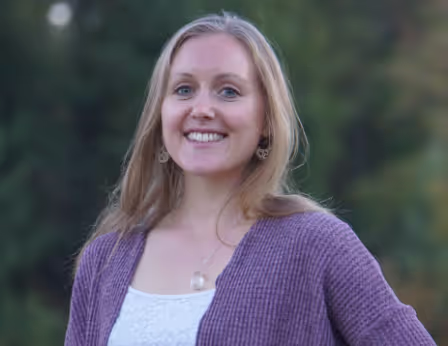
Dr. Emma McMain, postdoctoral researcher at Washington State University's College of Education, examines social and emotional learning as a tool for systemic change rather than a classroom add-on. She connects SEL to racism, sexism, and neoliberalism, and explores how culture-war attacks on schools shape its implementation.
transcript
Speaker 1 Alright, everyone. Hello, and welcome to our latest episode of our podcast. My name is Chris McNutt, and I'm part of the progressive education nonprofit, Human Restoration Project. Before we get started, I want to let you know that this is brought to you by our supporters, three of whom are Daniel Kearney, Julia Valenti, and Leah Kelly. Thank you for your ongoing support. You can learn more about the Human Restoration Project on our website, humanrestorationproject.org, or find us on social media and YouTube. Today, we are joined by doctor Emma McMain. Emma works in the College of Education at Washington State University as a post doctoral teacher and researcher, focusing on assessment for pre service elementary teachers, cultural considerations in education, and social emotional learning, aka SEL. Her work aims to promote social and ecological justice, seeing education as an important site of social transformation. Her recent works include Drawing the Line, Teachers Effectively and Discursively Question About What Counts as appropriate behavior in schools, which dissects the power dynamics of classrooms in determining what is then, that kinda scare quotes, appropriate behavior. And as well, the problem tree of SEL, a sociopolitical literature review, which contextualizes what SEL actually means in a classroom setting from a variety of perspectives and in history. So we reached out and wanna talk more about this idea of SEL as systemic change versus SEL as an add on. So thinking about SEL in the lens of racism, sexism, neoliberalism and more, especially then considering the the culture war attacks on schools and how SEL is being framed. But before we dive into that, Emma, thank you for joining us on this discussion. Yeah. Thank you for having me. I'm excited to dive into it. Alright. Well, let's let's just jump right into that that last point, which is social emotional learning. I mean, SEL has been defined in in many different ways. Some conservative lawmakers see it as, like, socialist or part of critical race theory. Some of it see as, like, this app this optional, tag on. So, like, I I think about doing yoga during standardized testing. It's like a way for us to get through the issues that may be presented by the education system itself. So could you provide or, you know, it could also be a a systemic overhaul. It could be a good thing as well. So could you provide an overview on what SEL is and and, like, why this is the case? Why are we all interpreting it in different ways?
Speaker 2 Yeah. I'll I two of my favorite philosophers always say, like, start in the middle because I'm like, I don't know where to start. So I'll start in the middle. Because like you say, SEL is such a broad term that I feel like we have to treat it with nuance, right, like, in the midst of these culture wars. And we have a lot of really conservative communities considering SEL as, like, a Trojan horse for critical race theory or the newest variant of the CRT virus and just, like, bringing it under really brutal attack. And then I think in response to that, there can be this kind of panacea discourse of, like, SEL is amazing and this, like, long awaited recognition of sociality and emotionality in schools. Like, huzzah. Like, we did it. And so I always think like, wait. Let's back up a second. This isn't really a sided issue. It's a layered issue. So I think one of those layers, which is kind of like a paradoxical layer, is that SEL is kinda new, but it's also really not new. Like you mentioned, the historical piece, I'll do just kind of a quick, like, deep dive into how if we look at, like, the early nineteen hundreds, progressive education and the nineteen twenties, there was, like, mental hygiene was a big push. Like, how do we help students be good citizens and be emotionally healthy or hygienic? And then in the nineteen forties, there's this thing called life change curriculum, then character education. Like, SEL has been going on since public schools were a thing. So it's kind of interesting to think about it as, like, this new thing. But then at the same time, I think part of what has kinda, like, made SEL be so prolific, like, since the two thousands, like, early two thousands, is how it's making its way into learning standards and curricula and, like, being seen as even a formal accountability measure under ESSA, the every student Succeeds Act. Like, SEL is being treated as, like, a legitimate part of schools. So to me, I think it's important to, like, recognize that, like, new but not new and how even the backlash isn't new. There's always been groups saying, like, this is parent's job, not teacher's job. Why are we doing this in schools? This is, like, stepping on family's toes. And so I think sometimes it's easy to be, like, for SEL or anti SEL, but there's actually, like, some really important points in a lot of these layers. So, I I mean, I could keep going on. I think one of the big things to me that I always try to kinda separate is that there's a distinction that needs to be made between recognizing and valuing being social and being emotional and formally teaching or training that. Like, to me, those things are often collapsed, but it's, like, a really different thing to say we value you as a social and emotional person versus, like, we are now going to, like, shape you into a certain group's definition of socially and emotionally competent. So that's why I kind of find myself, like, not easily on either side, but kinda like in the mangle of it all. I could keep going, but I'll pause there. No. No. It As
Speaker 1 you're as you're talking about the the mandated nature of it, I can't help but notice the connection to, like, PBIS, positive behavior incentive systems, because they tend to go hand in hand. PBIS tends to be promoting good behavior. Again, like in scare quotes there because of how that could be framed and and what lens we're viewing that through. But there are things that seem to be more and more, I guess, mainstream. Most teachers are familiar with these terms. I'm I'm sure that many teachers have familiarity with implementing programs into their classroom that might be SEL programs. They do it like an advisory period or home home curriculum, or find themselves inserting standards into a lesson plan about like valuing other people. I always find them very silly because, like, shouldn't you be doing that anyway? Do we really need to have that as a standard? But that is conceptually something people are doing. So with with that kinda said, what does it even mean to, like, to be talk like, why are we talking about this? Like, for someone who's just like, who cares that that it's being interpreted different ways, what's the what's the gist of that?
Speaker 2 Yeah. Because, I mean, you mentioned like, one thing I also always wanna call out when I think about the history is that, like, the examples I mentioned, like, progressive education, character education, mental hygiene, these are all things that have been done within, like, the colonial school system. So I do always wanna recognize, like, let's look at feminist theories. Let's look at indigenous ways of being who have been, like, implicitly valuing sociality and emotionality since time immemorial. So it's also feels like kind of a I don't know if ironic is the right word. A really problematic erasure to suggest that, like, okay. Now this is a formalized thing in public schools. Now we can talk about it. So like you say, I think it's problematic to say that if someone is skeptical about a certain program or about wanting to, like, teach it to the tee that they don't value sociality and emotionality. Like, that's something that concerns me. And then at the same time, like, it I sometimes get excited at, like, so much attention and, like, money and momentum is behind this recognition of, like, social emotional learning. So there was something else. Oh, I was gonna share. This is kind of an extreme example from educator and scholar named Cleo Sterns, who I say all over the place. I love Cleo Sterns. And she's done a lot of, like, hands on work observing elementary school classrooms that are unfolding, like, very scripted programs of SEL. Like, disclaimer, not all SEL programs are scripted. But she's looked at ones like Second Step. And the example is a first grade classroom that's going through the Second Step lesson. Like, this is our 30 SEL block. And the prompt is for the teacher to ask the students, like, when is this recent time that you felt sad? And so a child raises his hand and he says, well, last night, I was really, really cold. This is like the middle of the winter in New England. I was so cold and there's no heat in my house and my blanket has holes in it. And I was shaking and I couldn't sleep. I was so sad. And so the teacher who to be fair, like Cleo Sterns really believes as an empathetic person is also feeling very much like she has to be maintain fidelity to this script. So the teacher goes, thanks for sharing. Now what do we do when we feel sad? We belly breathe. Sure. So it's just like this moment. Like, it's it's like funny in a horrific way. Right? Yeah. So it's like what happens when, okay, we did our SEL, but like, here's this stark example of actually needing to look at the cause of why someone would legitimately feel something negative. And, like, what happens when the onus of responsibility is on kids to deep breathe through oppression and through misogyny or racism or whatever it may be. It's like, okay. If we if we emphasize, like, these programs more than, like, the meaning behind them, like, we're really doing a disservice at the end of the day. And I think a lot of SEL researchers would totally agree with that. But that is an example of like, here's what can happen, when we aren't careful. Yeah. That that branded
Speaker 1 component of it, I think, just tends to lean into that because that's how education products tend to work generally. You take what is a probably pretty good idea on its baseline and then brand it and commodify it so that everyone can do it in the exact same way. Because if I start interpreting it, then I'm gonna eliminate that brand. It's no longer gonna be exactly how they're saying it's going to work. And not nearly as an extreme as an example, but my my experience with SEL programs has even more so just been that they're just not exciting. Like, they're just boring. Kids don't like them. Like, we're gonna do our our team building activity, and you're gonna stack a deck of playing cards. And then whenever we share something, you're gonna take one out, like that kind of stuff. And it just feels illegitimate to the point where kids no longer see the value in doing the SEL activities. So whereas we value these ideas of reflective thinking, even like things like meditation, things like that, kids just see that as kumbaya, silly, things that, you know, like, guys like me with a man bun do at the coffee shop. Like, don't see it as legitimate practice. And therefore, it has a counterintuitive effect of lessening the impact of SEL.
Speaker 2 Right. It becomes so cheesy sometimes. And, this is where, like, I'm anticipating the pushback of people being like, yeah. That's SEL done wrong. But I think there's there's a limit to the conversation of reform. Like, well, we just need to do it better. Like, at a certain point. It's like something paradigmatically is, like, a little bit problematic maybe when it is just, like, assuming that we can script these things.
Speaker 1 Right. Because it in addition to the systems of oppression at large, in terms of who's creating this curriculum, what do we mean when we're saying good SEL, and who are we trying to shape people into being, etcetera, there's also the fact that you had just mentioned school itself can be an oppressive space. And for for many folks, I would argue most folks, school has a lot of oppressive tendencies because of how we rank and file kids, who's dictating the curriculum, and just the general authoritarian nature of, sadly, most most schools. So as a result, SEL tries to be the panacea for the problems school itself is causing. I alluded to in the intro there. I think the classic example is like yoga or mindfulness techniques before a standardized test. The standardized test is gonna make us throw up. We don't want kids to be sick, you know, for four hours in this small dimly lit room. You know, it's it's awful. So we'll have them do some deep breathing exercises to get through it as opposed to looking at the standardized test situation itself.
Speaker 2 Yeah. And appropriate a bunch of cultures along the way. Yes. Yeah. I mean, that's a whole other topic, but yeah. Yeah. So
Speaker 1 with that said, I guess that that builds into the question of what does it mean to craft a strong SEL system? How do we navigate this whole field of different interpretations of SEL to determine what we should be aiming toward. I mean, the idea is then changing systems, would assume. Like, focusing on social justice, recognizing that the systems need to change. What is the role of SEL in that in in terms of, like, the research, the theory, the the history?
Speaker 2 Yeah. So, I mean, shameless plug for my own podcast. Like, I'm I've been working with a group of colleagues and friends on a podcast project called unboxing social emotional learning. You can find it on Spotify. It's very much in the beginning stages, but I guess my answer to that is partly it it depends. Because I think, like, one thing I love about having critical dialogue around this is that it's it's really tricky, and I feel like I need to we all need to have kind of our incoming assumptions challenged a lot. Because on the one hand, I would say, well, SEL can be a really great driver of social justice, or it can be channeled into, like, transforming our school systems. And then on the other hand, like you mentioned, can actually just be reinforcing those things. So I think one of the biggest things to me is, like, whose voices are in this curriculum? So regardless of whether it's called SEL, is it something that's built on community values? The caveat to that is, let's say, that the community values, the loudest voices are very white supremacists. Like, then maybe we have to think about who's kinda making the who's shaping this program, but how is it different depending on the context it's in or the region it's in. So, like, I'm all for kinda grassroots, like, bottom up SEL. That means also including kids' voices. What what do they think it means to be social and emotional? That's not something that they are, like, have to be trained into. We're born being social and emotional, so, like, not treating kids like their incoming ways of being in the world need to be fixed. So I I guess at the end of the day to me, whether or not it's called SEL, it's about kind of building some kind of program or approach that's flexible enough to actually, like, really change depending on the needs of the community, including, again, those who are often excluded from conversations, including children. There was oh, I was gonna say also, like, back to your point about recognizing schools as they can be a transformative force and, like, a reinforcer of systems of oppression. I think every SEL program has to reckon with that. I've had a quote going through my mind for a couple weeks from a webinar session with doctor Megan Bang, who's an amazing indigenous scientist and researcher. She's at Northwestern Northeastern University in Chicago. I think I got that right. But she was she said this, she shared a lot of stories and one of the quotes she said was, like, as an indigenous woman, it would be irrational for me to walk into a school system and immediately assume that my best interests are at heart. And that's like a really hard statement, I think, especially for really well intending teachers to sit with, teachers that want school to be a positive site and that wanna, like, build an SEL program to make kids feel at home and included and safe. But I think part of an SEL program should involve, like, the adults, the teachers reckoning with being, like, historical actors. Like, you're in a school system that is the same system that was part of the boarding school movement to remove indigenous children from their families. Like, how do we recognize that our good intentions can be part of that program? And, like, our reckoning with ourselves as historical actors in a site that's enacted harm is also, like, part of that context. So a lot of it means, like, an SEL program should involve the adults doing a lot of self reflexive work. Like, what does what does emotionality mean to me? How have I been taught to, like, cope with or handle or relate to my emotions? So it should be, like, a very self reflective thing.
Speaker 1 I feel like I'm talking in circles. Like, I don't have a how to, but Yeah. These are some of the considerations that I think Yeah. There's there's a couple of things you're you're saying I think that that that make a lot of sense to me as someone who I mean, I was in the classroom for ten years. And there's certainly a cognitive dissonance that happens daily the deeper and deeper you dive into this stuff. Because you know that the systems are built on racist, neoliberal, sexist, all the things that we listed at the beginning. It's built on these these tendencies both from a kind of contextualized view. So you it's in the communities that these they find themselves in, but also like literally, like through the sense of boarding schools. Like they are quite literally designed to do this. So that that's something that you're constantly facing while walking that tightrope against. Public schooling is also a public good. Because you could come to the conclusion of saying, well, we should just not have public schools at all because look at how terrible they are. Burn it all down. But in in my view, in reality, what that would lead to is just a bunch of charter schools. Private industry would capitalize on that. It wouldn't lead to some kind of, I don't know, positive beneficial change with the community schooling their kids. I just don't think that would happen in The United States. So with that said, the second point that you're you're diving into, which I'm thinking about what I was going to say when I was editing, there was something you just said that was that that made sense in regards to the the SEL component. Oh, talk talking with kids. I know now. So the second part of what you're saying regarding talking with kids and learning from kids and doing this grassroots well, while being sure that we're not putting all of the burden for change and labor on kids, but certainly listening to them to change things. I'll I'll never forget these stories. So HRP, we we go around to a bunch of different schools. Our PD model is built on doing focus groups with young people. So we've talked we've spoken now to, like, thousands of kids. And pretty much in every focus group conversation, a kid brings up, if they have one, the SEL program. And nine times out of 10, they always have the exact same complaint. And I think this really gets to the heart of this. They always say, every day, I'm forced to do some kind of reflection activity. And they submit it into a system. And it's like, how are you doing today? And sometimes it's like a Likert scale. Sometimes you get to actually write it out. And the kids always say, I don't like the system because if I report I'm doing bad, I have to go to the guidance counselor. So what kids do is that well, either they just don't do it, or over time, they say they're doing a lot better than they used to be doing before. And this has like a three pronged effect, because on the one hand, the school reads the data and sees, oh, the SEL program has made all the kids happier because over time, all of their scores are going up. Therefore, they reinvest in it. Or second, everybody quits using it. So then the school's like, well, SEL programs don't work, so we're not going to invest in them anymore. So now SEL just like is out the window. Or three, like kids no longer, like, trust the adults to actually go to them about SEL issues because they're afraid that if they go to an adult, it's gonna trigger what they seem to be like an overblown response. So it's like they wanna be listened to, but they also don't wanna feel like they're going through this mandated system of like, maybe they don't like that guidance counselor. Maybe they just don't like, they don't want to talk about it right now. They want other means of going about it, which in my opinion, a good SEL program would recognize that. Like, it would be much less mandated check marks, step by step process, and a little more holistic and with a bunch of different avenues in the same way that progressive education kinda does in curriculum. That's, like, the overall idea.
Speaker 2 Yeah. I mean, I'm thinking of two things. One thing, like you mentioned, that's, like, that's kind of a funny example. Like, look. It works. They're all happy now. Because I think so often, like, one of my big critiques or, like, concerns with SEL is just this huge emphasis on articulating, naming, and processing emotions, which for some kids is great. Like, yes, they wanna talk about it. It helps to talk about it. But, like, actually, this was a quote from one of the teachers I talked with for my own kind of discourse community focus group a year and a half ago. And she said, well, naming things isn't always helpful. Like, right? Like, sometimes when you name something, you actually constrict what it can be. And if you have the kid, like, circle the face that you're feeling and they circle the sad face, that kinda shrunk, like, the possibilities of what they're feeling. Like, now they are feeling a sad face. And again, it can be helpful and it can't. So like you mentioned, what if there's a variety of avenues where some of the ways of, like, responding to kids' negative emotion isn't talking about it, which is kind of hard to think about because we live in this society where if you don't talk about it, you're repressing it and, like, it needs and I think in some ways that's a pushback against times of not being able to share negative emotion. But, yeah, I think about with SEL being celebrated as, like, let's bring into awareness how kids are feeling. That also means let's subject their social and emotional and even spiritual worlds to intense surveillance. So, yeah, there's that, like, kinda like, the cognitive dissonance of we want to value this, but are we just, like, surveilling it now and deciding what's best for them based on this really vulnerable information they're sharing? The other only other thing I was gonna share is a quote from doctor Kelly Lee, who's at University of California. I was recently watching a webinar with her, and she said, it's just so ironic how often in schools we tell kids, you're a changemaker. You are agentic. You can make change. You can be who you wanna be, but you can't change anything about my classroom, or you can't change anything about our school. So
Speaker 1 those things came to mind because definitely resonate with what you're saying. I mean, yeah. I mean, it's it's definitely what the the fact of the matter is is that if you listen to kids, chances are they're going to build not only a better curriculum, and add like a better, you know, just general school system overall, but the SEL program's also probably gonna be better. They don't need to be handcrafting it, But if they give you feedback along the way and they'd say, this is what I want. This is what I'd rather see. You're gonna be able to identify the programs and procedures and all those different things that make the most sense for a group of kids. And there's gonna be multiple options. It's not just gonna be one size fits all model. Mhmm. Yeah. Just just generally. So with with that said, I think that's that's a good segue into something that we had spoken about off air, which is, is it worth it slash how do you brand something that is everything that we just said? Because we spoke for about, like, 15 there contextualizing what makes that different. And I think the the rationale is typically, well, give that an acronym or give that a framework. Right. Give that like a new thing. And we were talking about this idea of s e l s e j, social emotional health, social emotional justice, as a framing that addresses that. But I I think you're kind of, like, thinking in a different headspace about that now and, like, whether or not it's worth going down that route. Just wanna learn more about that.
Speaker 2 Yeah. This is why I value so many voices at the table because my voice is very, I always joke with friends, like, I'm very certain that I'm uncertain about everything. Like, that is the one thing I'm certain about because I do think I'm I'm terrified of acronyms, honestly. This is this is kinda weird. It's something I've been playing with, but I created a methodology for the focus group I mentioned with teachers and was kinda like building my own way of analyzing. And I've been writing an article about that and feeling a lot of pressure to name it. It's like if I'm gonna put out this methodology that I kind of curated, I have to call it something. And that's probably gonna be an acronym because it's like this long word. And so I'm calling it what am I calling it? I know the acronym. An affective feminist relate no. An let's see. What am I calling it? The acronym is AFRAD, a f r a d. Okay. Affective Feminist Relational Analysis of Discourse. And I'm like, that's perfect because it's pronounced afraid. I don't know if I'm actually gonna publish it this way. But I'm like, that's perfect because it's like, I am I'm very wary of acronyms for some of the reasons we've been talking about. I guess, for listeners for additional context. A few years ago, my committee chair at the time and I published a paper advocating for this SELSEJ, social emotional learning for social and emotional justice. And I still stand behind all the ideas behind that. But like I've been talking about with Chris, I get really wary about the branding of things. I guess a couple of the reasons I would push away from kind of an easy response of, like, let's create a program, brand it, maybe scale it up, mass produce it, is that it becomes for one, it can be seen as like a social justice flavor of SEL. Like, we have SEL SCJ that kind of acknowledges that SEL itself is not necessarily anti racist and doesn't necessarily acknowledge coloniality or whiteness. So it becomes like, well, you can do general SEL, which doesn't talk about racism, or you can do, like, the anti racist version, which scares me because it's seen as, like, maybe there's then a feminist version, then there's a it starts to segment all of these different systems of oppression as, like, optional add ons. So that's a concern I have. And another is kind of what we've been talking about with SEL itself is it becomes such a huge umbrella term that it kinda becomes emptied of meaning when it's just thrown around as an acronym. I can do anything in the name of SEL. I think we don't often think about why we're doing it or what's behind it or what it means. So, like, acronyms can kind of again, like, it kinda like the circling a sad face. It kinda shuts down, like, what something can be. But then at the same time, that's why I started this kind of by saying that I value other voices because sometimes my friends even will say to me, like, totally hear what you're saying. We have to call it something so that we can tell people what we're doing and deliver it and package it. So those are some of my qualms. I think there's a way to give something a name, use an acronym, create a grassroots, really cool program and call it something and be critical about, like, the co opting or the commercialization of that label. But I think that criticality like has to be there.
Speaker 1 Yeah. That's tricky. Yeah. That's super tricky because I I think about from like a PBL standpoint. I mean hell, PBL by itself is three. It's place based, problem based, and project based. There's probably more. I was thinking yeah. So then you have challenge based. You have there's there's a bunch of them. Like, there's, like, 20. We have a list of these somewhere that are all ostensibly the same thing. They all have, like, their own flavor. I mean, place based learning is project based learning account like accounting for place. But PBL already accounted for place, but now we're adding the additional acronym on to or I guess we're changing a letter of the acronym to make that more apparent. So what what we find is that when we travel around to different schools from a PBL context, we'll go into the school, they'll say, oh, we don't do project based learning. We do challenge based learning. And it's like, okay. Well, what is that? And then they describe project based learning Because when they were doing project based learning, they said, well, it didn't include x, y, and z, and teachers were doing this. But then we'll go back, you know, two or three years later, and they've shifted from CBL to some other framework because this framework includes this thing and teachers weren't doing that. I don't really know if this has anything to do with the with the SEL component. But Yeah. It's it's it's a it's a multilayer problem because on the one hand, you have you have to be able to define what you're doing. And I think it is worth noting that this is a different thing than it was before. But at the exact same time, it shouldn't have been a different thing than it was before.
Speaker 2 Right? Yeah. Exactly. Like, this is actually making me think of a conversation, in one of our actually recent podcasts about SEL and indigenous communities and indigenous ways of knowing and being and relating. And one of my friends, Sequoia Dan Slaton, who's a PhD student at Washington State University, and also a member of the Shoshone Bannock tribe. She is a really great advocate for, like, not all communities want to call something SEL and need to be told that they must have it. Because, like, with what you're saying, I can I can see scenarios where someone, like, comes into an indigenous community and says, you need SEL? Like, we'll create it with you. It can be based on your community values. We'll use your terminology, but, like, we want to give you SEL. And I can see so many communities being like, so we do that. We don't call it that. We actually don't agree with some of the components, but, like, I don't want the the kind of evangelical drive of SEL to be that every school has their own customized SEL if they don't resonate with that label. Or they're already doing things. Like you mentioned, progressive education already does a lot of this stuff as far as like valuing sociality and emotionality. So, yeah, another kind of with what you're saying, I worry about that fear of like, if you aren't using the label, you're not doing it kind of thing, which isn't true. So Yeah. You also get caught in the trap of like consuming the the capitalist code.
Speaker 1 Yeah. Acronym gets attached to a brand name or to a label. Shout out, I love EL education. But we've been spaces where people will say, oh, what you're doing is the EL education, crew curriculum or whatever. It's like, well, no. We're we're just talking about, like, like frameworks, concepts that have existed in academia for in this case, I think we're talking about something that's, like, a 100 years old or, like, the CASL framework even. Like, we brought CASL as a framework. Like, well, that's the crew curriculum. Yeah. But, like, we don't have to go through their catalog of branded content that you purchase in order for it to be effective. This is a a broad ranging thing that is more deeper and nuanced than that. So I I I also fear that it that the more we focus on names and acronyms without looking at the root systemic problems, the more likely we are to just try to find a consumerist or or capitalist solution to our problem, which Mhmm. Which relates it all back to, like, there's no magic potion. There's there's no one size fits all solution that's just gonna be this is gonna solve all of our SEL problems, so we're just gonna buy that thing and kids are gonna be fixed or whatever that means. Right.
Speaker 2 Yeah. Yeah. I forget. I had a thought, something. I've lost it.
Speaker 1 I might come back. No. That's good. You're good. You're fine. You're fine. This is wide ranging conversation. We're going a lot with So so let's let's then talk about, like, the solutions focused element of this. So I think we've underpinned at least a a baseline for the the theory and why it should be problematized, SEL, as a concept. Then how do as how do educators actually figure out what to do? Like, if there's all these different interpretations and there's all these critiques of how SEL was implemented, We've we've already outlined, listen to kids, and, like, ask them and figure out from kids what what's going on. Are there other spaces or, like, researchers, academics, things that we should be considering foundational to understanding SEL?
Speaker 2 Yeah. I would say one thing that I really resonated with me from talking I talked with six different elementary educators, for part of the focus group discourse community I mentioned, not just classroom teachers, but also, a paraeducator, paraeducator, SEL specialist, a special ed teacher. And one of the biggest themes on with what they were saying was we have so many options of SEL curricula. Some schools do require, like, we are doing second step. But some are like, if you wanna do character strong, if you wanna do mind up, if you wanna do ruler, like, any of it's good. And they're like, that's not helpful. There's so many resources. We have so many resources. We don't need more resources and we don't need more accountability. Like and and there was some disagreement to that. One of the teachers actually did feel like we need more, like, teachers to be held accountable for being having fidelity. I don't know what the verb is there. Maintaining fidelity to the program. But what they don't have a lot of time for is time to think critically. So I do think in itself, like that's something that teachers can advocate for and especially administrators could advocate for is instead of trying to protect this thirty minutes of SEL time or to get the money to purchase this big program, what would happen if we had more I mean, it's kind of like radical, like free play time. Let's use that thirty minutes for another recess. There's social emotional learning. That's kind of a glib way to say it. But Yeah. More time for, like, PD that is based on teachers talking with each other. What are you doing in your classroom? Like, what's working for your kids? Or what things have parents brought up? So more time for just, like, talking with other people of kinda, like, to piece together more grassroots approaches to SEO. But I also will say, like, kinda more tangibly, Dina Simmons' work is wonderful. Yeah. She do you know, like liberate Liberated Mhmm. Is her organization. Right. So she's wonderful at emphasizing, like, let's dismantle the deficit discourses around, especially like black and brown kids being framed as not having social emotional competence. Let's ditch that narrative and build with community assets, anti racist approaches. Sierra Kaler Jones, is another, like, person I would encourage any educator to learn more about. There's also another thing I'll bring up because it's kind of like a elephant in the room with this conversation is transformative SEL, which is CASEL's newest kind of social justice oriented approach to SEL, which is claims to be rooted in community based rather than individual based and acknowledging systems of oppression, acknowledging racism. So I think transformative SEL is something that's, like, worth bringing to the table in these critical conversations. I'm still dubious about some things. There's still a lot of emphasis on kids learning these skills and not always a look in the mirror at an institutional level. But transformative SEL would be like another area I would direct people to. Do you have anything to add to the list? I'm curious, like, what No. I would you advocate?
Speaker 1 I I mean, I think from from our angle, it would be taking all of those things and then looking at the foundations of a classroom. Like you had just said, like, recess is super important. But sadly, in schools across The United States, that's becoming more and more rare, even at an elementary school level. I mean, we would advocate for high high schoolers should have recess. Everyone should have recess. Kids like going outside kids like going outside when it's negative 20 degrees outside. Speaking from experience of having to walk kids outside is like, please come back in. But they they love it, that's important for them to be outside and being with their friends. But there's also other things like like, why is it that 99.9% of school has to be so competitive? Why do we have to focus on grades and ranking? And when we put kids in the groups, why is it that they focus on things like, you know, I wanna make sure my grade's protected, so I don't wanna work with so and so. And to me, that's highly problematic. The the goal of working in a group is to build on those collaborative skills, communication skills, but also just to relate to other people as human beings. So we need to find ways to move away from concepts like grades, concepts like testing as this, like, one and done style of assessment and move into a more holistic lens in that angle. Like, in the way that we're actually structuring our class on how we're giving kids feedback and just speaking with them broad. Like, if you if you had a classroom where kids work together and do, let's say, like, community service or they're making an art project and putting it up down the road and they're talking to community leaders, etcetera, that's gonna be killer SEL. Like, that's gonna be so cool. Like, they're gonna connect with with other people. They're gonna learn from people that that they may have never known before. They're gonna have to go at different age levels. They're going to have to actually speak with each other in a variety of means, participate digitally, and talk about, like, digital SEL and talking to people online. That's not to say that SEL programs can't be important. It's just that the at a systemic level, the if the classroom is the antithesis to the SEL program, it seems like we're doing something wrong.
Speaker 2 Definitely. And one other thing I was thinking about too is I'm a big advocate for, like, being social and emotional has never been exclusive to humans. And so sometimes when we think about ecological justice or climate justice, that's seen as, a separate thing. Like, that is SEL. And I've been into like common worlding pedagogies. Shout out to common worlding pedagogies of recognizing ourselves as always intricate members or members of an intricate more than human system. And that's another thing I personally wanna explore a lot more is how do kids already see themselves as, like, members of a more than human world. And like you mentioned, just going outside, being in the community, even inside, like thinking about reframing how we see our cafeteria lunches and Yeah. Seeing ourselves as animals. Like all of that can be part of SEL too. So what like big big picture SEL. Sometimes I differentiate like social and emotional learning from the, like, SEL paradigm, kind of the bigger possibilities and then the more branded possibilities.
Speaker 1 But Yeah. Yeah. Two more shout outs and then we'll do, a final question. I I would also add to the list. We'll just have those giant show notes. Love It's two for humane education, has a lot of really cool, curricular activities centered on what you were just saying. So centered on, both kicking other people, but with an explicit focus on animals and like ethics and relating with nature, etcetera. They have a lot of interesting stuff. And then Chef Anne Project, which is a way that you can actually dive into making farm to table lunches and warning where your food comes from. We did a whole deep dive on that at some point. We have a we had someone on our podcast that came and talked about journalism of food. And it's really interesting to note, it's actually cheaper to get your food farm to table in schools than it is to get it from your corporate supplier. You just have to work through a lot of different contracts, but it is cheaper in the long run. But, yeah, I I think then in terms of just moving into, like, the the cornerstone element of this conversation and and talking about LCL broadly, people now know perhaps some contextualized information on, like, why we're talking about this. They maybe have problematized it a bit. They see perhaps places they could turn to. Do you have any advice for educators that maybe just listen to this conversation that are just like, okay. What now?
Speaker 2 Yeah. I think I mean, this is the advice for so many of the problems with education. Like, get with the community, with other teachers, with other community members. Like, don't try to operate alone is always a big one. I think also, like, kind of trusting in your own practice, which again, I say with an asterisk because I've seen or and heard about some pretty atrocious classroom practices. But also a lot of really great stuff comes from teachers themselves. So I think to have some trust of, like, if you think something is really working with your classroom, like, at a social emotional level, like, believe in that even if it's not, like, showing up in the scripted program. So, like, making space for that. I always try to, like I mean, I'm pretty upfront about not being a k through 12 educator, so I never wanna assume that, like, I don't know that lived experience. But I think recognizing that there is support in numbers, Unions, this can definitely be, like, part of union efforts. So, yeah, like, have some value the grassroots, like, your own practices, value those and get together with other people.
Speaker 1 I wish I had a silver bullet, but it's kinda what I got. Yeah. I mean, at the end of the day, if the kids in the room are enjoying what's going on and they're telling you it's enjoying it on, you're collecting feedback and they're like, this is great. That that's all the real proof you need that your SEL program is working. Just a brief anecdote. But, like, I remember we had this was during the the hybrid year of COVID. So there were 10 to 15 kids in a room and then 10 to 15 kids online. And that year, we kept all the kids in the same room for a very long period of time, and then then they went period to period with the same group the entire day. So these kids were spending seven to eight hours a day with the same 15 groups of kids. And as anyone might imagine, that is either amazing or absolutely awful depending on what group of kids. High school or ninth grade. Oh, okay. Yeah. Yeah. Like, for example, like, if what if kids break up? Typically, that's not a big deal. They'll sit on opposite sides of the room. Well, not it's a pretty big deal. There's only 15 kids in the room. So I know a lot of teachers really struggled with I I I have heard ad nauseam of people saying like, thank God that's over. Like, I'm so happy that we don't have to deal with that anymore. But the exciting time, I'll tell you, from personal experience, that was my favorite year teaching. Not because of the the pandemic element, obviously, but it was my favorite year teaching because I've never felt more connected to a group of kids. I sometimes envy elementary school teachers because they get to do that. They can just have, like, this one group of kids pretty much all day every day. And as a result, you're able to develop those systemic SEL practices organically. Like, those kids, we would come in every day and play, like, random games. And we would just do it because that's what the kids like to do, and we didn't have to plan that. It was just a part of the day that this was, like, this is what kids like doing. We did that. We had in jokes. We knew each other. So there's an element here too of, like, scheduling design, classroom design, even higher level design than classroom design to look at how can we develop schools to be more SEL focused and really center community so we're not so siloed and isolated and we have more space to connect with other people and and with the world. You know, we have more outdoor classrooms, etcetera.
Speaker 2 Yeah. I love that. I think I we need those stories of a little bit of pushback from those years of COVID, I'm not like romanticizing it and denying the trauma a lot of people experienced. But Sure. There were I mean, there were some elements of, like, increased connection that I I even felt too. Like, I always joke about the black hole of black Zoom squares where, like Mhmm. Three people are talking. But that that was also the year I think I got the most affirmative feedback from students I ever have about social and emotional things of, like, thank you for making this classroom a space. Like, you've been a rock or, like, we feel safe to come to your class. And I'm, like, interesting. Like, it was just this kind of paradoxical time of, like, like, shit kinda hit the fan, but then, like, what happened from that? Like, we were we kinda, like, had the bare bones of, like, what do we actually care about this year? So I like those stories of, like, some things sometimes good things can happen when the system is rocked a lot.
Speaker 1 Thank you again for listening to our podcast at Human Restoration Project. I hope this conversation leaves you inspired and ready to start making change. If you enjoyed listening, please consider leaving us a review on your favorite podcast player. Plus, find a whole host of free resources, writings, and other podcasts all for free on our website, humanrestorationproject.org. Thank you.
resources
- Drawing the line: Teachers affectively and discursively question what counts as 'appropriate behavior' in schools · Dr. Emma McMain (article) Examines power dynamics behind classroom behavior norms and who defines appropriateness. link →
- The 'Problem Tree' of SEL: A Sociopolitical Literature Review · Dr. Emma McMain (article) Reviews SEL's historical and sociopolitical context from multiple classroom perspectives.
- Dr. Emma McMain · Washington State University College of Education (person) Postdoctoral researcher focusing on SEL, cultural considerations, and social and ecological justice. link →
- Washington State University College of Education (organization) Institution where McMain researches assessment, cultural considerations, and SEL for pre-service teachers. link →