

clever hans
Reviewed November 2026
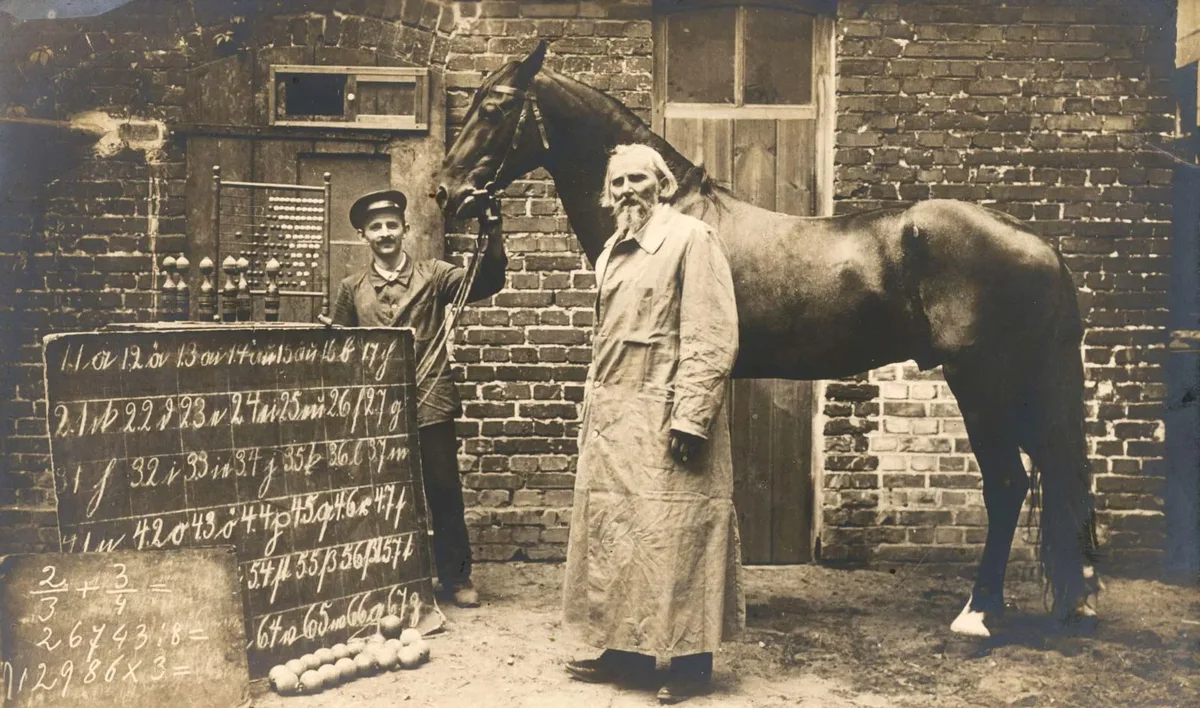
In early 1900s Berlin, a horse named Hans drew crowds by answering arithmetic questions, tapping his hoof until he reached the answer. A commission of experts watched him and found no trick. Then the psychologist Oskar Pfungst tried two changes: he asked questions the questioner didn't know the answer to, and he asked them where Hans couldn't see the questioner. Hans stopped getting them right.
Hans was reading people. Questioners tensed as he neared the right number and relaxed when he reached it, without knowing they were doing it. AI researchers still say a model has a "Clever Hans" problem when it scores well by picking up a shortcut instead of the skill being tested, like an image classifier that spots horses by the watermark that horse photos tend to carry.
in class
try with students
There are only two slides. Most of the time goes to working out how you would test whether Hans could really do math.
-
meet hans 3 min
Show the photo and the drawing of Hans being asked "what is ten and ten?" beside a number board. Ask the class whether they believe it.
-
design the test 7 min
In pairs, students design an experiment to find out whether Hans can do math or is doing something else. Collect ideas. Someone usually gets close to Pfungst's tests; if not, share them.
-
test an AI 5 min optional · AI use
Ask what the same tests look like for AI. How would you tell whether a model understands a math problem or recognizes its shape from training? With a chatbot, try a familiar word problem and then a reworded or unusual one; without one, have students predict which changes would trip a model up. Close on the three reflection questions.
slide overview
-
On screen "Horse math: Clever Hans," with a photo of Hans and his owner.
Say or ask Tell the story up to the crowds and the experts. Don't give away the answer.
-
On screen One click adds a drawing: Hans facing his questioner, who asks "Was ist zehn und zehn?" (what is ten and ten?), beside a board numbered 1 to 20.
Say or ask Ask how Hans could be getting it right. Then ask how you would test it.
-
On screen The three reflection questions.
Say or ask Share Pfungst's tests if no one has, then discuss the questions together.
takeaways
Getting the right answer isn't the same as having the skill, and the people asking the questions can supply the answer without meaning to. Benchmarks, leading prompts, and test questions that appeared in training data all give a model ways to look clever.
Pfungst's two tests carry over to AI: change the conditions the answer depends on, and see whether the performance survives.