
If you’re in the 90% of US schools who go back to school before Labor Day, welcome back! And if you took the summer to unplug, we’ve put HRP’s summer highlights here in one spot for you to catch up on and come back to.
We hope your first days are wonderful and set the trajectory for a great year ahead!
- Nick, Cassie, & Chris
Human Restoration Project
Podcasts
Restoring Humanity to “Special Education”: Global Perspectives on Inclusion w/ Dr. Sarah K Benson ↗
“Inclusion” has become a word everyone nods along to but almost no one defines it the same way, And since so much of special education has historically been about sorting and labeling kids in relation to an imaginary average. I was so curious to ask Sarah, what does genuine inclusion require of us, and of schools, and what would it mean to restore the humanity of a special education system that was built to put kids into buckets?
The Power of Critical Play w/ Dr. Mary Flanagan ↗
Even though at some point many of us stop playing games — even if we don’t stop paying attention to them — we hold onto the experiences, the feelings, and the lessons: what they taught us about ourselves, each other, and the world around us. And it’s because games play an important role in human development and tell us so much about societies and cultures at large, the relationship between play, games, and learning has always been a focus of our work. It’s also been the lifelong interest of game designer, artist, author, and researcher, Dr. Mary Flanagan.
The Myth of the Unmotivated Student w/ Dr. Erika Patall ↗
When the basic psychological needs for students are met, achievement and well-being improves, and behavioral and emotional disengagement decreases. And it’s not just for students, teachers whose needs for autonomy are supported report greater self-efficacy, job satisfaction, vitality, and less exhaustion. It seems like a no-brainer: if you want your students to do better, feel better, and be more engaged, and if you want to be less exhausted, you’ll want to hear what Dr. Erika Patall has to say about self-determination theory and agentic engagement.
HRP Summer Book Club
On Friday, July 31st, we hosted Dr. Ginie Servant-Miklos for a Q&A about her book Pedagogies of Collapse: A Hopeful Education for the End of the World As We Know It. This was the conclusion of our Pedagogies of Collapse book club, where we met biweekly to discuss the book and its implications for education. Here is the full unedited Q&A ↗. Heads up, this conversation gets heavy pretty quickly and includes explicit language. As a reminder, HRP is a nonpartisan 501(c)(3), and the views expressed by our guests are their own and do not constitute an endorsement.
Writing
How Recreation Helps People Survive Prison by Gregory Coito ↗
Recreation gives structure to empty hours. Without it, many people are left with boredom, anger, and anxiety. Research on prison life often shows that idleness increases tension. When people have nothing to do, stress rises and conflict can grow. Games and hobbies create a healthy distraction. They also sharpen skills. Card games improve memory, reading, math, and strategy. Sports improve physical health. Music and art give emotional release. Recreation can reduce violence by giving people another place to put their energy. Most importantly, recreation reminds people they are still human.
Gregory Coito was a Boston College Prison Education Program student enrolled in Jennifer Berkshire’s Journalism course at MCI-Shirley, a medium-security prison in central Massachusetts. This paper was presented as part of his final for the course and has been reprinted with the author’s permission. You can learn more about BC-PEP here ↗ and listen to Nick’s podcast conversation with Jennifer Berkshire ↗ about her participation in the program. Gregory’s piece has been formatted for this platform but is presented in the author’s original words.
Updated Progressive Education Primer
The Primer is still coming and we’ve been hard at work on it! It’s definitely proving more difficult than initially assumed, but as adrienne maree brown says, “there is always enough time for the right work.” As proof it exists, here is We Are Worldbuilders: A New Vision for Progressive Education in physical form. It’s a research-backed, illustrated introduction to progressive education, with citations throughout. You can flip through sample spreads on the website ↗ while we finish the edit.
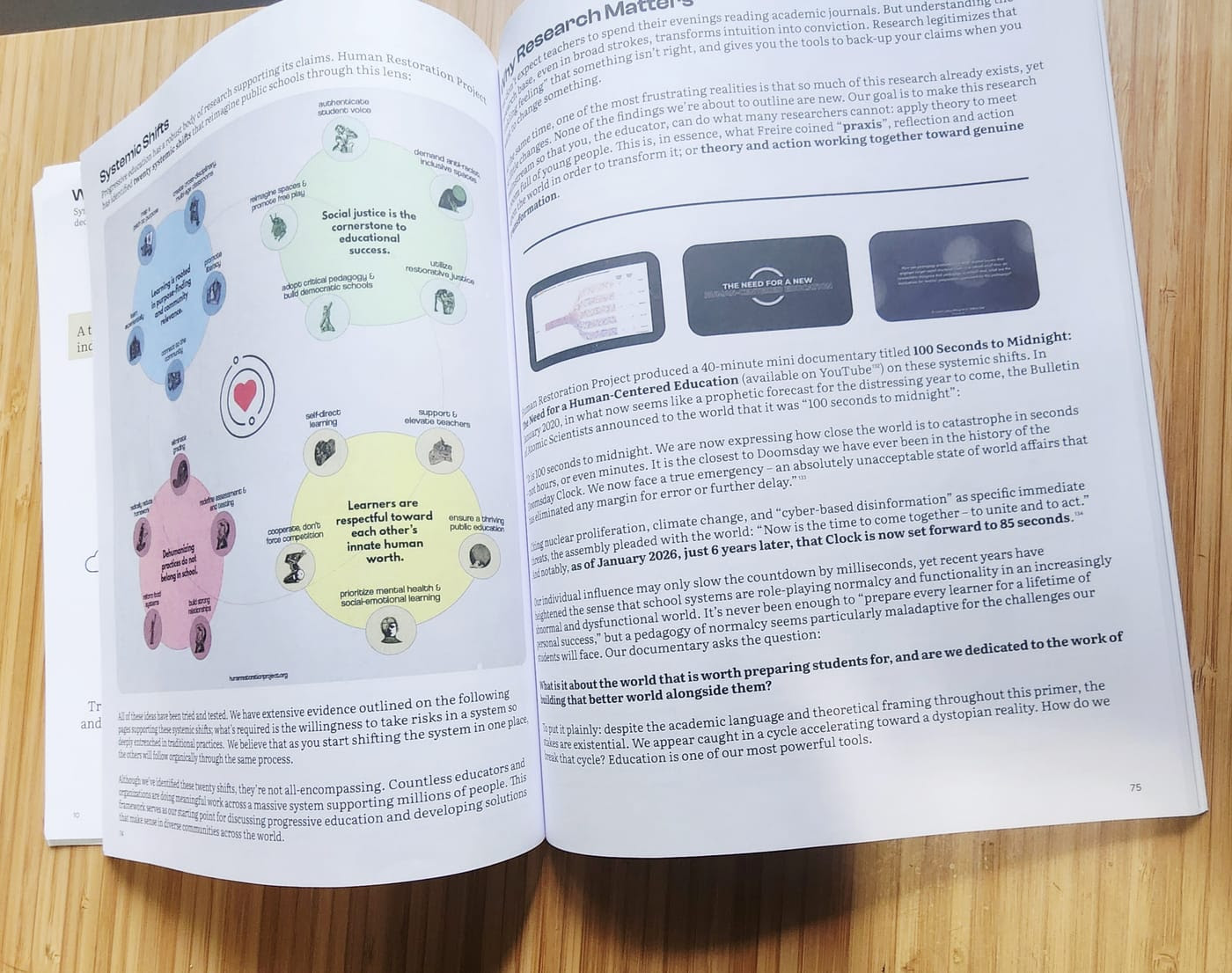
Two essays from the updated Primer have already been released on our writing page and given audio narration:
Teaching in the Wreckage of the Real by Chris McNutt — Essay ↗ · Audio ↗
We Are Worldbuilders by Nick Covington — Essay ↗ · Audio ↗
Our Work With Schools
Third Coast Learning Collaborative
In June, teams from HRP and OWL were in Muskegon, Michigan working with teachers getting ready for another year of interdisciplinary project-based teaching and learning. In its third year, Third Coast Learning Collaborative will be serving over 600 students in grades 6-8 in Muskegon middle schools. You can learn more and find a project showcase on the TCLC website ↗.
HRP Australia
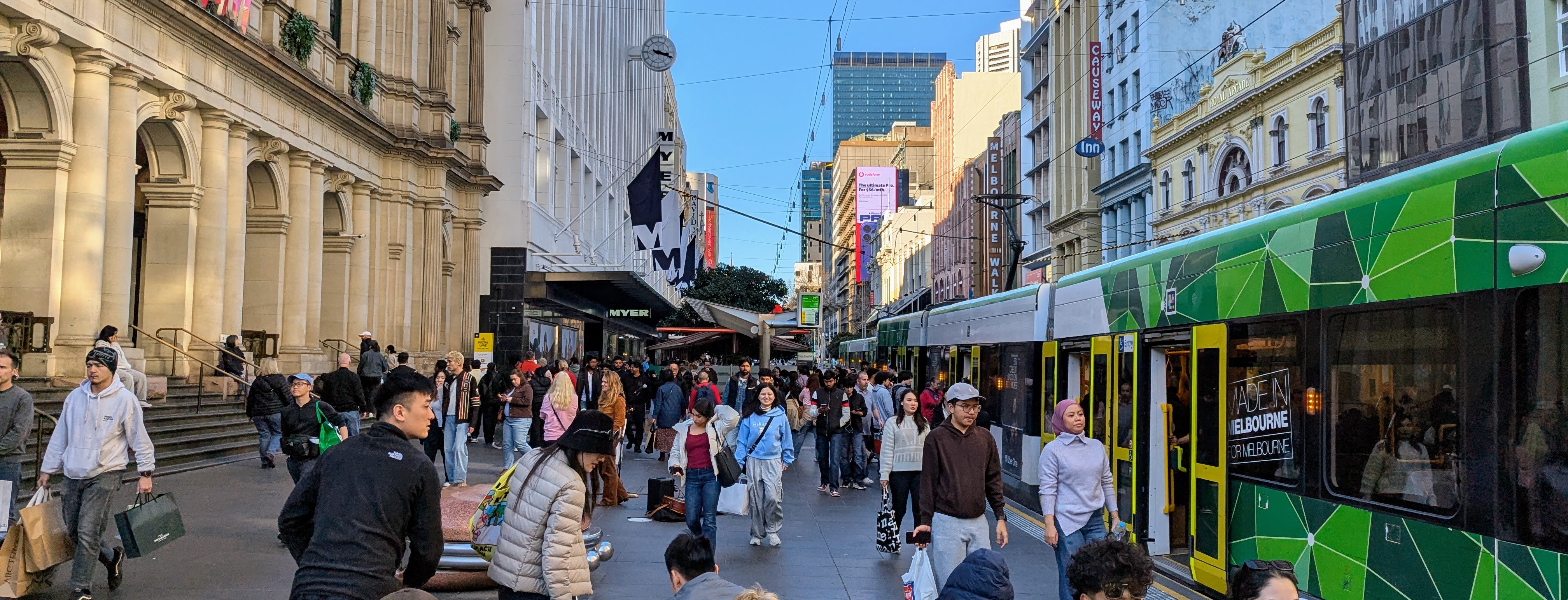
In late July, Nick flew out to Melbourne, Australia to meet up with Vaughan Cleary, director of HRP Australia. Nick and Vaughan visited half a dozen schools and learning sites and talked with every student, young person, teacher, guide, and leader they could find along the way. A takeaway that will surprise almost no one: teaching and learning can look like a lot of things, but it works best when the aim is well-being, interdependence, and human flourishing. HRP Australia ↗ partners with organisations to build places where people thrive, through Autonomy, Relationships and Competence. Look for an upcoming podcast series, HRP Down Under, spotlighting the schools, educators, researchers, and students restoring humanity to Australian education!
Student Voice & Polaris ↗
Polaris has picked up a pile of new features this summer. There are now four ways to ask a question: open text, a 1–5 scale that still asks for the why, image choices, and video. A question library gives you strong starting points by topic, and you can re-ask a question from an earlier session to watch how answers have changed. The bigger news is scale: after last spring’s playtest with 10 districts, Polaris is on track to work with around 100 districts in the coming school year.
Young people are the closest observers of school we have, and often the least consulted. When a school asks them a real question and something visibly changes because of the answer, they learn that their voice does something. Making that an ordinary, normal part of how schools run is the work we care about most. This school year, we’re excited to welcome thousands of new students and educators onto the platform. If you’d like your school to be among them, visit our website ↗.