

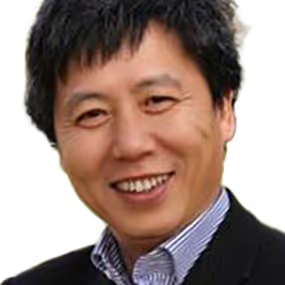
Dr. Yong Zhao, Foundation Distinguished Professor at the University of Kansas, argues that standardized testing harms students rather than helping them. He and host Chris McNutt discuss building a movement to end standardized testing and designing classrooms that tap students' innate desire to learn.
transcript
Speaker 1 Hello. Before we get started, I want to let you know that this podcast is brought to you by Human Restoration Project's fantastic patrons. All of our work, which includes free resources, materials, and this podcast, is available for free due to our Patreon supporters, three of whom are Mary Walls, Jeremiah Henderson, and Sheila N. Thank you for your ongoing support. You can learn more about the Human Restoration Project on our website humanrestorationproject.org or find us on Twitter, Instagram or Facebook. Hello, and welcome to season three episode 21 of Things Fall Apart, our podcast of the Human Reservation Project. My name is Chris, and I'm a high school digital media instructor from Ohio. In this podcast, we are joined by doctor Young Zhao, the foundation distinguished professor in the School of Education at the University of Kansas. Zhao was the presidential chair and director of the Institute for Global and Online Education at the University of Oregon and a University Distinguished Professor at Michigan State University. Further, he served as the founding director of the Confucius Institute and US China Center for Research on Educational Excellence. Not to mention, he's also the author of over 100 articles and 30 books, many focused on turning away from standardized tests and focusing on personalized learning for all children. Zhao and I will talk about building a movement that ends standardized testing in The United States and how to build classrooms that invoke a student's innate desire to learn. You recently wrote this article about PISA scores, and I know that, you know, a huge part of your career in speaking has been about the issues of standardized testing and, like, the what works may hurt approach of increasing those scores. You know, that information's out there. We talk about it all the time, and I think a lot of teachers recognize this. How do we then convince institutions as well as students and parents to actually change how they assess or change how they look at standardized tests? Well, think that's the the struggle.
Speaker 2 You know, when you and I and there are many other united people have been through the test scores, even in college admissions, you know, why, you know, college admissions use SAT scores, SAT scores ready, and the way to discriminate against disadvantaged minority kids. You know? They don't mean man in in any sense. Also, there are kind of business scores or pizza scores, any of those things that they're they're meaningless. But what I think we need to do is to just tell more of the story. You you we do see the power of public opinion. I think as teachers, you even though you're you're under the right now, the authoritarian regime of test scores in your district, but it doesn't stop you from sharing the message, sharing the article, sharing the evidence with parents, with school administrators. It's gonna take a while to move the the public opinion about it. I think we used to have a much healthier suspicion test scores. I think in over the last twenty, thirty years, we've lost that, but I think the only thing we can do is talk to people, kept talking, kept repeating. And I do see the change in the movement. I mean, over the last several years, actually, you look at, you know, ESSA, which is still have a lot of testing in it, but it's definitely a relaxed after, you know, a more much more relaxed than no child left behind, I would say. So we do see the change of this.
Speaker 1 Just keep working. Keep talking. Yeah. Like you do. You know? For sure. I mean, you see that too with ACT and SAT scores even though it's a little bit different. I mean, there's a lot of institutions that no longer accepting that. We're seeing that a a lot recently. Yeah. Make it optional. Like, 48% of US four year colleges don't use it anymore. And with that kind of being said, do you have any suggestions then for teachers to communicate this message in a way that it would actually matter? Like, as in is there a certain strategy or idea that you would offer teachers to get those ideas out there? Yeah.
Speaker 2 I I I really think, Chris, it's important to even though I don't have the book, like, my book, what what works may hurt, I think there are several messages you want want want conveyed. There's enough clear evidence to show that test scores at any age, at any scale, either SAT, SAT, PISA, state, do not predict a children's future success. Okay? So that's the first thing. So you you struggle all the time, and you try this. It does not really guarantee your kid's success. And second thing does not reflect your teacher's ability. There's not evidence to show that. You know, like, I I was treated in an article. I was done by a group of economists talking about how, you know, try even in this value added model, people are trying to push that to punish teachers. But, actually, you know, this study showed, well, that student height are related to teachers. You know, it's impossible. That's the absurdity of this. You can show this evidence. But the third point is that not only test scores don't mean much for college success, for features like this, but it's also causing damages. That's why I was exposing in the PISA and for Chinese kids and the Asian kids, and they do very well on test scores, but they are really hurt. Their confidence is low. They do not value the subject. They're not interested in school under psychological distress. So what do you want? I think those messages are worth painting. You know, they don't mean much, cause damages, and, therefore, it's not worth pursuing. There's a lot of evidence. I would create charts, create PowerPoints, share the messages to others, you know, and you always have a chance to do that.
Speaker 1 Yeah. I I think that that matters a lot too, especially when our students are so anxious and depressed and and just in general are going through a lot right now, that high stakes pressure of assessment certainly is contributing to at least some of that. I wanted to refer to your work counting what counts where you and a bunch of others talk about alternative means of measurement. I'm I'm assuming that there's probably always going to be some form of assessment with schools, at least at the national level. And you talk about, like, motivation, for example. Do you see any organizations or tests right now that are being used or spread that do alternative forms of assessment?
Speaker 2 Well, I'm very cautious of recommending any kind of assessment, honestly, because once they become once you use a one test to hold teachers accountable, you're dehumanizing teachers. You're trivializing education as a technique. So even even in that book, counting what it counts. You know, there are many other things you can measure. You could measure, like creativity, entrepreneur things, now that we can measure growth mindset, rate, motivation. It can make all kinds of things. But most of those things should really be based on, I would say, actual authentic work, a teacher observation. I'm very suspicious of anything. Actually, I'm right now examining the here's the creativity test. I think it's gonna be a horrible way to actually kill creativity. So I would really go back to a time to trust good teachers' professional judgment about his progress. I hope, actually, some organizations is developing tools to help teachers that become better judge you know, judges of the students' progress, become better reporters of that. I I know many schools with all we taxpayers give money. They give a lot of money. We gotta hold schools accountable. But a lot of times, when you hold teachers as soon as you you use any quantity that measure, told teachers that comfortable, you are gonna corrupt the process. That's what Campbell's law. Donald Campbell is down there. So I'm I'm ready. I think that that book and the main of my argument is always trying to say, okay. There are other options, but those options should not replace become, like, the new thing. It's like now I'm I'm, in I love social emotional learning. I love people doing social emotional well-being, but the social emotional learning as promoted now is very problematic. The SEL promoted now. They're putting into state standard, hold teachers accountable.
Speaker 1 That's very problematic. It's as bad as the as the common core actually. Yeah. Yeah. I mean, a lot of that seems to be tied to the financial implications. Like as an education company, I mean, could make so much money right now by just selling some like motivational curriculum
Speaker 2 to make people feel quote unquote good about themselves. Yeah. So when I mentioned that, I was more like look at look at other possibilities, not just say, oh, do more. But, you know, there's companies trying to stay on mind up, saving those mindsets. I mean, it's it's silly. Actually, I want to return the power to teachers and human beings that run a human business. You don't need all of those kind of things. Yeah. I mean, learning is very complex. So the idea of taking it down to, like, one
Speaker 1 point at any time doesn't make any sense to begin with. And one of those things that I I always struggle with personally as a teacher because it it can be slightly demotivating or or scary, which is it's a group of teachers that tend to not be very well respected in society versus this giant, like, neoliberal test taking industry with so much power and wealth. And sometimes it be can be very demotivating, for lack of a better term, to think about if that's ever actually going to change. What advice would you have for educators who are participating in this work that feel like they're kind of up against the Goliath? They don't really know what to do next. Well, I mean,
Speaker 2 Diane wrote the book, David versus Goliath. I mean, you can think about it. I I actually I this is one point I want through your podcast to reach all the teachers just to say this. You know? And there are many things we don't know whether we can change, but that's no reason for us not to try. Okay? I think we have power. We do change. We do make a difference. Giving up is not an option, especially if you if we are in this profession, giving up, blaming others. There there's nothing we can do. I think I I'm I'm more like a you know, in many ways, it's like a even Noni's hero idea to say, we have a moral purpose to drive, to change. We're the public intellectual. And once it's gonna change on and we can't take another a a great guy coming to deliver new policy and new ideas. We have to work at it. Like, I don't really believe the system itself is gonna change. You know, like, people talk about social mobility. We always recommend policy changes. Policies don't change themselves. Politicians change, and politicians have to respond to what we do. You know, like, a minute, I don't like the you know, politically, I don't like what's going on in this country. Washington DC is such a mess. But who I blame, I blame our voters. I blame our educators when I thought our voters good enough to say, we gotta fight. We gotta keep doing this then. And and I don't really have a lot of hope to say, this will change us because of me. And but I wanna tell you because we all work towards something, public opinion shifts. Public opinion changes,
Speaker 1 then that changes the politician, then it changes public policy. It relates a lot to what we're trying to promote at Human Restoration Project, which is systemic change over just a different type of strategy. There's a lot of professional development and, mean, authors, booksellers, etcetera, who are trying to just say, if you just teach this way, you'll see like 10% better classes or, you know, like what your day will be slightly better. But at its core, educators really need to be mobilizing to change entire systems. Like, for example, equitable education systems with funding or gradeless learning or, you know, things that radicalize
Speaker 2 how the actual structure of a classroom is seen. I think, you know, you you you need to re re resist your group teachers. I want teachers to resist the mechanization of teaching or trivializing teaching as engineering, a simple technical process. It's a human endeavor, but not engross all the humanity of teachers in the process. It's not teach this way, lesson this way. I I don't think we understand. A lot of the PD, I've seen, a lot of the folks waiting for teachers, the trivial as teach as a little tiny tricks. It's not a trick. You know? It's it's a wholehearted with the soul, with the body, with the heart. You actually you you feel the relationship with another human being. That's what I think is what I want I want your group teachers to think about this, you know, your restoration of humanity in the right sense. Resist the
Speaker 1 technique kind of way of doing things. Yeah. And it it's kind of the exact same thing too what's going on with students, which is the idea of teaching only for career or as some kind of financial gain or economic gain, which ignores all the complexities of human growth and probably the reason why we're seeing so many different social emotional issues in general when your entire value is tied to, you know, your finances. And kind of in the exact same vein, I know that you mentioned that you have a new book coming out surrounding self directed education. What do you then see as the role of an educator day to day within a self directed classroom? Like would it work in
Speaker 2 the standard 25 people to one room class that we see now? Well, you know, they are the the book is coming out of from ASCD. It's called teaching students to become self determined learners. I I co write this with Michael who's a really huge expert scholar in the special education. You know? So that's so and then several other books I've written that includes this one. And it's it's really first of all, we're talking about students, not student boys, not student ages. The students as human beings deserve the right to self determination as anybody, like like any human means, as teachers do. You have the right to self determination, self determination of your your goal, your outcome, your environment. So how do we help students to develop as human beings? They send us teachers. It's like autonomy. So and I would say teachers back off from looking at the teaching process as implementing the curriculum standards or transmitting the content, but rather you look at every child to say how they grow. And if children can take responsibility to grow for the learning environment, actually, you can reduce that. I'm running experiments of similar methods in China, in Australia. Think about it in China. We got a class of 60 kids, and I have convinced actually US teachers to do it and Australian teachers to do it in China. And they're doing fine. We just you you reorganize. You organize the student in very different way. And I thought but the key is to have students to to take ownership, to be responsible for their own learning, their work with you. So and they just have you have different specialties.
Speaker 1 And when you go to these schools and you propose these ideas, what do you say to those that offer pushback that say things like the students need certain types of knowledge or need that traditional style of learning in order for them to do anything. That sounds kinda gross, but, I mean First of all, I I actually
Speaker 2 I I well, I'm I I do different kind of talks. The people always ask if they ask those questions, I will give them evidence there. Oh, look at this. This is evidence one, evidence two, how it's been done, how it's been done. So I can talk about that. But more importantly, when I work with schools, I I I'm not gonna about I I my invitation on that, not imposition. I always believe that I'm gonna invite people, the ones who are willing to try to do it. Like, your organization, your podcast. You know, it's more like invitation. So I I do not try to spend so much time trying to. So I think a lot of them may wanna say, because I always believe there are teachers who are not happy with what they're doing, who want to believe what we are talking about intuitively. So everywhere I go, there's somebody who wants to try it. So that's why I work with the ones who wanted to try. But more and more people, you know, they how the social movement happens is that when a few people like it, they do it as an example or they sell alternatives,
Speaker 1 then they're follow. I I I'm thinking about teachers that might be listening to this that are maybe younger, maybe just started teaching and they love all these different ideas, but they just really don't know where to start because there isn't necessarily like a set step by step guide on what to do in order to change everything that it is that you were taught in terms of teacher education?
Speaker 2 Well, I mean, I would say that they're small. You know, I I guess, I just use you know, in in my other book, wrote this thing called, you know, the rich for greatness. The book is called the personalizable education for all children. And just a new book came out. I worked with my students. We collect a lot of examples of how teachers can get started. And there's a lot of teachers starting the out of the blue because they're tired of teaching the old way. I mean, I would've said the first thing you can say, okay. Start with one tiny project. People always say, oh, how about a passion project? You are teaching eighth grade English. You ask kids to say, okay. And that's one assignment. You can do whatever you like. You know? Then let's see how that goes. And there's other projects that I'm involved in that I always try to tell, can your kids go out and say, okay. Can they find a problem? That's worth solving. And whatever subject you are teaching, use the subject to solve a problem for the community, for others. You know, I'm I'm doing language. For example, I'm working with kids in China for learning English. Now I've got involved Australian teachers to have their students to be writing English materials for Chinese kids. You know? And I co write in recipes, co write in the history books, and then bilingually. That's kinda work you you can do it. Just start with something very small or start with the kids who really don't like your class, the kids who are disengaged. You know? Maybe start with them. Ask them what they would like to do and what chance they would like to make. And, also, the the kids who you really feel challenged, you know, put them in charge. Just put them in charge to make make them help you to do something. Kids always like to be valued and like to contribute to something. I would say, do not try to do big changes. Start with one little project, a few weeks, start with a couple of students, and you'll probably see amazing things. You know? Another thing I've done myself in my teaching, if I have to teach, let's say, this class, I would tell my students maybe one third of the content I have decided is good for you. Everybody has to learn. One third of this, you can decide on yourself but have to justify why you wanna learn it. Another third maybe have to be negotiated among your colleagues, among your friends, why you have to learn. So just make it relevant, make it authentic, and then really trust the kids can do something. You can gradually
Speaker 1 relinquish your control to them. Yeah. I I think that that brings up a lot of great points surrounding the the dangers of labeling students. And when we have grades and standardized tests and report cards and things of that nature, we tend to see students who aren't performing academically very well in that system as the quote unquote bad kids. And as a result, I think that they get less attention or at least frequent negative attention and that's not going to help anyone in this situation. I mean, know I've given students that who traditionally don't perform very well in school some, like, assignments that they want to do or a project that they want to do. And all of a sudden, they were obviously the leaders in the classroom, which I I doubt in the teachers' lounge is how they were described in the past. And that is a serious issue with, like, assigning a number to someone or assigning a a value to someone based on Well, let them shine everywhere. I mean, if I were a teacher or school principal, I always say, you know, does every student in your class in your school feel that good at something?
Speaker 2 That that I think that's a really important measure except for me.
Speaker 1 You know, feel that good at something. Yeah. I I feel like that should just be a normal thing about school. The fact that that wouldn't be a normal thing about school is shocking and worrying. That someone wouldn't feel like they're good at something. But sadly, that is the case. I have a final question for you, which is what goals do you have personally or what organizations have you seen that you feel would be great for a school to partner with or something that you're working on that could help change how education is currently working and how we're using data and everything of that measure? Well, I really honestly, I've seen many organizations.
Speaker 2 I haven't seen one that I would highly recommend, but I think it sounds like your your group may be the one. You know? Like Okay. I'll take that as an endorsement. I'll put it on our website. I I really like to see teachers taking charge because, you know, right now, we have a lot of young teachers. I really want them to become social activists, you know, advocated for just and fair education for all children. It's like a you know, it's like environmentalist. Now the youth is the big movement. Right? I think in the youth, I want the teachers to partner with students to say, how we create a new kind of community, a coalition, social movement, training, bringing humanity out of education. You know, education is a science, we know, but education is also value driven science. There's a lot of value in it. You know? So that's why when I wrote the book, what works with her is to show that it's not only so called evidence or not only churches, and it's a volume. You make a judgment about it. You know? So yeah. I I haven't read anything anyone particular, but but again, there's so many organizations. People can work together. But, you know, anybody can social organization can work.
Speaker 1 Yeah. Trust me. You're speaking to my heartstrings. I I love that idea of building a new future and kind of making others kind of step out of the way because that's what's going take. It has to be a little bit more forceful. It can't be baby steps when it comes to systemic change. It's always to have to be you can't tinker around utopia, essentially. You gotta just do it. Yeah. I mean, the line, you like, for example, teacher unions and I mean, I'm teacher unions have different functions, but a lot of them teacher unions probably needs to be focused a lot more on the moral purpose of teaching the professionalism of it too. You know? Exactly. Yeah. The idea of, like, actually changing what school is, not necessarily just protecting someone's job. There's a lot more to it than that. Exactly. Yeah. Because if you are
Speaker 2 indispensable, then you will have a indispensable. You'll be indispensable. Right? Yeah.
Speaker 1 Thank you again for listening to Things Fall Apart from the Human Restoration Project. I hope that this conversation leaves you inspired and ready to push the progressive envelope of education. Education. You can learn more about progressive education, support our cause, and stay tuned to this podcast and other updates on our website at humanrestorationproject.org.
resources
- What Works May Hurt: Side Effects in Education · Yong Zhao (book) Examines unintended harms caused by common education interventions including standardized testing. link →
- Reach for Greatness: Personalizable Education for All Children · Yong Zhao (book) Offers a framework for personalized learning that builds on each student's unique strengths. link →
- Counting What Counts: Reframing Education Outcomes · Yong Zhao (book) Challenges narrow test-based definitions of student success and proposes broader outcome measures. link →
- The Courage to Be Creative: An Interview with Dr. Yong Zhao · Yong Zhao (article) Explores how creativity and student agency are suppressed by test-driven schooling. link →
- FreshEd #79: What Works (May) Hurt w/ Dr. Yong Zhao · FreshEd Podcast (podcast) Zhao discusses side effects of popular education policies in a focused interview format. link →
- Does Studying Student Data Really Raise Test Scores? · Education Week (article) Reports on a Harvard University analysis questioning whether data-driven test prep helps students. link →