

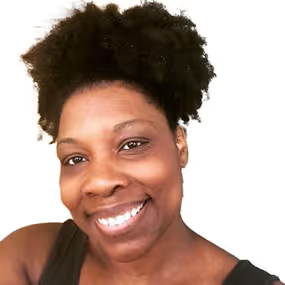
Tiersa McQueen, an unschooling parent of four, shares how unschooling philosophy can inform educators supporting students at home during isolation. She critiques traditional education and offers practical insight for both teachers and parents navigating home-based learning. The conversation bridges unschooling practice and classroom teaching.
transcript
Speaker 1 We want to let everyone know that we see you in the work that you're doing during COVID nineteen. Although we sincerely appreciate all the continued support that we receive on Patreon, we recognize that in these uneasy times that both Nick and I are privileged to work in salaried, stable positions. On our website at humanrestorationproject.org/covidnineteen, you will find a list of helpful resources and, if possible, a list of organizations that need our support during these troubled yet hopeful times. Hello, and welcome to season three episode 25 of things fall apart, our podcast of human restoration project. My name is Chris McNutt, and I'm a ninth grade digital and media instructor from Ohio. Our podcast today features Tirsa McQueen, an avid homeschooler who raises her four children in an unschooling philosophy. Tirsa and her husband both work opposing shifts to allow this to occur. Tirsa frequently posts on her Twitter and Instagram handles as mother bae, critiquing traditional education, offering support as an unschooler, and demonstrating how we can adopt unschooling among our children. I invited Tirsa to talk about this pedagogy and offer advice for educators who are now supporting their students in their home environments, as well as many who are raising their own children alongside this.
Speaker 2 And I don't want my kids to be on Twitter. That's the reason why I started, like, speaking for them. When I have an opportunity to, like, just get their voice across, try I to be make it as as authentic as possible because I don't want people to think, oh, she could just be saying that. You know? I don't think unschooling works because, you know, she's just saying what the best possible outcomes are. So that's why I ask them all the time. Like, okay. What do you think about that? And then I post it on Twitter because I think it's important for the actual unschooler voice to be the one that comes across. Not so much me as a parent. I already have my education. I was telling my kids that all the time. I already have my education still learning, but I'm, you know, I'm out in the working world, and people need to hear from you. Reason why we started this in the first place was because I just had this idea of my children as actual people. I know that sounds like a very benign it sounds very benign to me. It sounds like very a child is a person, but that's not how we are conditioned in society as parents or as educators to think of children. We don't think of children as actual human beings. We don't think of them as as people. We don't respect them. We don't give them the same respect that we give adults. So from the time that my kids were really small and just by talking with them and observing them, I started to realize, like, oh, this is an actual person with an actual point of view. Even though they're little, even though they're small, they they're just trying to figure out the world. And I started to think of them as just new humans. So I was just thinking of them as, like, if I went somewhere that I was foreign to, I was foreign to a country and I didn't know anything, I want someone to treat me with respect. I just don't know. It's not that I'm stupid. It's not that I, you know, I that I'm trying to mess this up. I just don't know. I need someone to show me how what the customs are. What's the culture? How do I do things? And I just started to think of them as that, as new humans in the world. They're not stupid. They're not dumb. They just don't know. So when I once I got that idea in my head, everything just, like, kind of filed from there. I started looking for more information that was, like, in that same train of thought, and that was, like, a direct line to unschooling. And just living our lives that way, my son, when he was about in third grade, he's 14 now, he said, I don't wanna go to school anymore. And it it was, like, a shock to me because he really was good at school. Like, he got straight a's. The teachers loved him. But the reason why he didn't go to school anymore was because he felt like he didn't have any say. He didn't have any control, and he was really, like, screaming out for that. He wanted to have some autonomy. And the straw that broke the camel camel's back for him was once one kid did something in the class, and the whole class got in trouble. And he thought that was just the biggest injustice in the whole entire world. Like, he could not get over it. So then when the next school year started so when the school year ended, I said, well, you don't have to go to school. We can try homeschooling. And he was like, fine. Great. So then for the whole summer, he was happy. And but I thought he was gonna get over it. I thought, okay. When the school year comes up again, you know, he'll forget about that, and then he'll just go back to school. Well, the school year came up, and I said, okay. Well, let's get ready for school. And he said, what are you talking about? We already decided that we were homeschooling. And I said, oh, okay. So we're really doing this. And then that was, like, the first, like, year that we said, okay. Well, I guess we're doing it then. And it was just it was just that simple. It was just like, let me just follow these kids' lead and see where see where it takes us. And the more I got into homeschooling, the more I got into unschooling, the less I heard my voice within that community. So I really started to talk about it more on Twitter because I just wanted to have people see that there are people like me out here doing it. Like, I'm a black woman. I have four children. Me and my husband both work. That's that's something that I didn't see in homeschooling community a lot, which was two working parents. And a lot of times people say, well, I don't know how I would ever make this work. I wanna be a homeschooler, but, you know, I have to work. Yeah. I work too. And my husband works too, and I don't work from home. And he doesn't work from home. We work separate shifts so that we could homeschool our kids. But I just wanted to show people that there that was an option, especially black people like me, who I feel like are usually the most different disenfranchised within the schooling community. They were the ones that feel like they have the least amount of options, and I just wanted them to know that's not true because I'm doing it. That's what started me on the whole journey. That's what started me talking about it and, like, inserting my voice into this space just because I didn't hear it. Your message highly resonates with me. I mean, the the organization is literally called the Human Restoration Project.
Speaker 1 But that idea of taking away all those labels and barriers to learning that we typically find within the education system, in your case it is probably the most obvious path to get there, is just doing it yourself and avoiding the institution altogether. Whereas educators who are listening in, for the most part, I think, are attempting to do at least some of what you're doing inside of the education system, kind of like rebelling from the inside. It's no small feat just as unschooling is no small feat. I'm sure that's a crazy demanding task to both raise four children in addition to teaching them, in addition to working. It's a lot. Conceptually, it's really interesting to note that there are a lot of misconceptions surrounding unschooling and homeschooling and what that looks like. I know recently you were talking about the convention of religious homeschooling. It's typically what people think of when they think of homeschooling, why their kids are not in school. Could you briefly talk about what it is that your students do in unschooling? Like, what is, like, their day to day? Unschooling is just a philosophy.
Speaker 2 So I'm an unschooler too. I'm an adult, but I'm unschooling. It just means that I'm a lifelong learner, self directed, and I learn things based off what I'm interested in. So what the kids do, that's what they do. They learn through their daily life activities. We, as unschoolers, believe that every single thing that they're doing has educational value. So we don't separate things into subjects. Just like right now, my daughter, she's taken up baking again. She loves baking, but she's since we've been quarantined or isolating, she's taking up baking even more. She bakes all the time. But when she bakes, I mean, we're talking about, you know, finding a recipe. We're researching and reading the recipe and then math, you know, the all of the fractions and everything that goes into baking and the science. Don't forget the, you know, the leavening agents. And so when we when we think about unschooling, baking and cooking is, like, a perfect example because, you know, it's all of the subjects in in one. And it's also, like, preparing something with your hands. It's a project and then presenting it. So that's basically what the kids do every day. They find things to do, but they're just living life. So, like, my son, he my daughter, she she likes to do just what she wants to do. So she's more of a fly by the seat of her pants. Whatever interests her that day, that's what she's gonna do. Whether it be music or, you know, I don't know, just, like, some science thing. She gets into, like, earth science. Sometimes she's into, like, turtles or animals or whatever. She's whatever she fit feels like doing that day, that's what she will research that day. My older son, he's 14. He's into engineering. Completely self directed. You know, we didn't suggest it. He just became interested in that. And he's way more structured. Like, he has a, like, a schedule that he does every single day that he made up on his own. You know? And my it goes by days of the week. So, like, on Monday, he'll do engineering for a a big chunk of the day. And on Tuesday, he studies Japanese, so he'll do that for a big chunk of the day. And then I don't know what all the schedule is for the whole week. I'm gonna be completely honest because another tenant that I follow is that their learning is none of my business. You know, I I'm I'm here and available for you, but this is your life. This is your path. This is your journey, and I'm not here to tell you what to do. I'm just here to provide you the resources to do it. So that is you know, that's the kind of the guiding force that I live by so that I can give them the trust and the, you know, freedom that they need to find their own path. But I know on Fridays, he just does, like, reading fiction books. He likes to that's like his day off is just, you know, finding a book that he likes and reading that just for fun. So those are like, my older two, those are, like, their day to day. My younger one, their day to day is most they they'll find just the most random things to do. Like, they love playing video games. One likes Minecraft. They're both nine. One likes Minecraft a lot. The other one I'm completely honest. I don't know what kind of video games he plays. He but he likes to play video games. But they also like to do things like stop motion animation. They like to get their toys out and, like, they'll borrow my phone and then do stop motion animation, and they'll show me their projects. They love doing stuff like that. I was earlier today, one of my twins asked me to play games with him. So we played connect four, and we played guess who. But that's just basically what their days look like. Their days look like living life, just what kids would do. I mean, it's I I would think that someone who's unfamiliar with unschooling would look at their day to day life as what their kids do during summer vacation. That's basically what my kids do all day every day is what kids normal school kids do during summer vacation.
Speaker 1 Yeah. That's a really interesting build into the next question I was gonna ask you, which is how educators are now seeing themselves as quote unquote homeschoolers for their own kids. I don't know if, and I could be entirely wrong, but I don't know if the majority of educators going back to raise their own children during this crisis see their philosophy of education in line with yours. I think that it's a lot more structured because that's how the classroom typically tends to be. Do you see the change from basically, people going from in the classroom to out of the classroom almost being forcibly homeschooled as the same thing as what you're doing, or is it something else entirely?
Speaker 2 I think that a lot of the benefits that homeschoolers enjoy, they are getting to enjoy during this time. Like, their kids don't have to ask to go to the bathroom. They can go to the refrigerator anytime and get a snack. And then a lot of it, they have time. They can do things at their own pace, hopefully. But it's during this time, it's a lot more intervention from outside of the home that comes in and is telling these new homeschoolers or COVID nineteen homeschoolers, I don't know what the a correct term would be, what to do. And that is a departure from what we do. We don't have someone that comes in from outside and gives us instruction or tells us these are the things that you have to do in a date on a daily basis or, you know, you have to hit these markers and read this book or do these math projects. We don't we don't have that. So I think that that's something that's different is that you have a entity from outside coming in and instructing you on what you should be doing with your kids every day. And sometimes that's still strict. You know? I've heard I read a lot of Twitter feeds where people were saying that they can't even keep up with the demands that are that's coming from the school district, and that's very different than eve even homeschoolers that would do traditional, like, school at home, they don't even have that type of restriction. I'm hoping that a lot of these parents will relax. I think that this is the perfect time to just deschool a little bit and just relax and understand that these kids aren't losing anything. If anything, they're gaining by this opportunity to not be inside of the institution of school and to, you know, follow their interest. They have an opportunity to learn based off of what they're interested in, and I really think that they need to their parents need to give them opportunities to do that because it's very important. And I think that they'll see what I hope my hope is that they'll gain some confidence in their children, and they'll gain confidence in their self
Speaker 1 that they can do this. It's interesting that you bring that up because I don't have children of my own, but part of the silver lining of this crisis has been that I've gotten to see more of my students in a sense. I know more about their home lives because the way that we've changed our classroom is pretty much what you just said. Their their, quote, unquote, assignment is doing something that they like doing and then talking about it. Because they have more time and space at home to manage these things and it's less structured, ironically, I I find them doing more, which is in line with progressive education in general, giving them time, space, the ability to self direct. Given what you see, what advice would you have for educators who now are kind of moving into your world? And in many ways, public educators are being told by their districts, hey. You need to do something for your students. You need to teach them something.
Speaker 2 What might that look like, and how would you go about structuring that? That's a very difficult question because unschooling, like I said, is is more of a mindset than it's the way that you go about your day. It's the thought process behind education. It's more of a theory than an actual practice. I don't unschool my kids. You know? It's not they're they're unschoolers, but I'm not unschooling them, if that makes any sense. The thing that I would suggest that the one thing that I would suggest to teachers as they move into this new space that trust. You're going to have to trust them. I think that you that's the that's the main that's like the cornerstone of unschooling is trust. And I understand that that is a difficult thing because that's not traditionally what you see in schools. People don't trust the students. I mean I mean, that's just the the the the school is based on a lack of trust for students. So that is the thing that we're going to have to do. And I think that that's this is a perfect opportunity to do it because they're not there. So this is an opportunity to trust them more. Give them a little bit more freedom. Give them a little bit more leeway and see what they come back with. And I'm I'm I guarantee you're gonna be surprised. And a lot of times, though, when you're in this process of, like, I I went from structured to unstructured, there's a lot of downtime. And it's because people don't know what to do. You know, they never had this freedom before. So now that they have the freedom to do all the things they wanted to do, they tend to, like, not what it looks like they're not doing anything. But that's not true. They're just they're gathering their thoughts. They're figuring it out. And that takes that time, that that, like, interim, it takes trust. It takes trust that they're gonna come back around, that they are gonna be interested in reading, that they are gonna be interested in math. They are going to be interested in all of the things that you want them to be interested in. They are going to get there. They just need that time. They need the time to breathe. They need the time to figure it out, figure out what it means to be self directed. Because that's the problem with, you know, traditional schooling is because if when you control someone, they don't know how to make decisions for themselves. And that is the part that they're learning right now is how to make a decision for themselves, how to get up in the morning and find something to do. When without anyone saying, without, you know, listening to a bell or, you know, having to catch the bus, how do you get up in the morning and and direct yourself and find things to do? This is an opportunity for them to find that intrinsic motivation that they they don't have because they go to school. So I think that that would be my main point that I would try to get across to teachers is that you're going to have to gain some trust. I don't know how to suggest that you do that or what that's gonna look like, but that's that's what you need to do. I mean, I I agree with you wholeheartedly because in in my case, one of the most frustrating things about being a teacher is that we are restricted to some form of schedule.
Speaker 1 And as a result, you know, it a lot of my students at 08:00 in the morning are not exactly stoked to be there, and I get that. And there's still this obligation like, hey. You're in this time right now. You should be doing something. Whereas now, interestingly enough, because we're not coming into the building at all, I get so many questions at around like six or 7PM, which is great because there are more questions than I would have ever gotten from my first period class had it been 08:00 in the morning. And there's a lot more of like deep inquiry questions. So I teach digital design and media, and I get a lot of questions over like, how do I Photoshop this? Or how do I make this into a book? And a lot of these like really cool questions that I wish I would see more of during the school day, But ironically, it takes a crisis for us to start rethinking about how a school schedule looks and what free time looks like and what self determination theory would look like in a public school setting. Is there anything else that you would wanna throw out as potentially things that you feel like need to be shared?
Speaker 2 I I mean, it just all comes back to trust for me. It really does. I mean, I under I I get the all of the things that the teachers are up against. I understand it. Like, I used to be a substitute teacher. I mean and I was for years, and I had my own classroom because of such a lack of teachers. So, you know, it's that's it's unfortunate, but that is one of the reasons why I knew that I could be I could let my children do this because I saw firsthand, and I taught middle school, which is a very difficult time. And I I understood that maybe if these kids just had some more sleep, they wouldn't be, you know, so upset. Maybe if they could eat right now. Like, just just basic human things. And I think that along with trust, we need to give the students a lot more grace and understanding that this isn't easy. What they're what we're asking them to do isn't easy. It's not easy for me to sit in a classroom or a lecture that I'm not interested in or at a time when I'm sleepy or I'm hungry. You know? It's not easy for me to do, and I'm a grown woman. So we're asking them to do things that adults have a hard time doing, and we're expecting them to do it perfectly. You know? So and I think that that's it's unfair. And I I think that we need to give our children a little bit more grace and to to look at them as human beings. I I know this seems very simple, and it seems obvious, but I don't think it is. I don't think that people give children that, you know, that humanity that they deserve. You know? And I understand that it's hard. I do. I I I have four children. I I mean, I have a 14 year old, a 12 year old, and two nine year olds, and they're not always nice. You know? And it's not they're not always they're cranky sometimes, and they're and they get anxious, and they get hungry, and they get frustrated, but so do I. So, you know, so I think that that's something that I think we need more of just in general in teaching and parenting just in the way that we interact with and relate to children. I think that we need more of that. And, also, I would say during this during this time, I've seen a lot of people be anxious about socialization during this time. And that's a big thing that people worry about about homeschooling. Like, they'll be like, oh, I think that it's great, but I worry about my kids being socialized. And I don't, you know, I don't even socialization as in, you know, we put our children in a classroom with full of children their same age from the same ZIP code, and we say that that that they're being socialized. I don't believe that that's socialization for just in general. But even if it was and that they're and the kids were missing out on something because they don't have that right now, I would say that you shouldn't worry about it because you're there. The adult is there. And this is an opportunity for you to talk to your children and get to know them and for them to get to know you. So, I mean, as long as you're there and you are talking to them, you're socializing. It doesn't have to be with a child that another child re interacts with. It can be with an adult. You know, my kids my son, he's 14. He goes to chess club at the library, and he always jokes that their chess club at the library is nine nine year olds and 90 year olds. Those are the people that are at chess club. And so he gets to talk with and play with elderly people when he's at chess, and he talks to them, and they talk to him. And he he becomes friends with these with these older gentlemen that play in the chess club at the library. And it allows him to, you know, get a different perspective. And and and it makes him, you know, better in the world. He recently had a job interview at the grocery store, and he was very comfortable speaking with the adult. He wasn't nervous at all because that's his life. He speaks with adults. He understands how to talk to adults. He doesn't see it as a hierarchy where he's supposed to be, you know, nervous around adults or wait for his turn to to talk. No. He just jumps right in there and starts talking just like an adult would. So I think that this is an opportunity for children who generally don't have that time that they get to speak to adults just like peers to have that with their parents. And I know that's gonna be radical for some people because they don't think of themselves on the same level as children. They think of themselves higher than children, but that's fine. You can still have that mentality, but just have a conversation with the kid. Just take some time out every single day and talk to them and let them talk to you and and then that's the same. They're still having a social interaction that they generally probably don't have because we we're we're really short on time. Especially when kids are in school, they're short on time. And people are getting parents are getting more time with their kids probably than they have since their children were toddlers. So they should take advantage of it and talk to them and get to know them and let them get to know you. And I think that that will be good in lieu of the socialization that they would have gotten in school. Sure. Especially considering,
Speaker 1 God, in middle school, there's a lot of things that can really warp how a child sees the world. I know personally, I never went to middle school. I skipped like ninety days of school or something. So it's a rough time to be a kid. If you don't mind, I'm going to sneak in a philosophical question for you because I think it caters to exactly what you're saying, which is when you go through school, school in many ways via the teachers, via the curriculum, via just the the rank and file and labeling of students reinforces the dominant culture. Do you see unschooling as part of a greater movement to almost like restructure the literal societal fabric? That's like a really, like, crazy question, but I I I see it almost like a small piece.
Speaker 2 Well, I I I don't see it as a restructuring of the culture. I mean, I I understand why that line that you can draw for to that. I get it. But for me, unschooling is just it's a it's a it's going back. You know? It's not I mean, it's restructuring, I guess, if that is a good word to use. But for me, it's just going back to basics because school is the experiment. We didn't always do school the way that we do it now. What I'm doing as an unschooler is what people did forever before school became a thing. You know? And so for me, school is the experiment. School is the restructuring of society, and unschooling is a return to nature. Unschooling is a return to what feels good, what feels natural, what comes naturally as a parent. Just guiding your child, just teaching them as that's just an extension of parenting instead of outsourcing that part of parenting to the state, to teachers. So I just feel like that unschooling is just going back to basics. That's how I feel about it. That and that's how I look at it. I just look at it like if I like, my kids learn to walk. I didn't teach them how to walk. They learned. I was just there to help them and make sure that they don't fall and hurt their head. And that's what I'm doing right now. That's what unschooling is. It's the same thing. It's just an extension of that. And it's just, you know, as they grow older, they don't they already know how to walk. So what's the next thing that they need to learn how to do? I'm gonna be there for the for them in the same way I was when they learned how to walk. I'm just gonna make sure that they don't fall and hurt themselves. That's how I that's how I view it. That's how I look at it.
resources
- Tiersa McQueen (@tiersaj) · Tiersa McQueen (person) Unschooling parent and critic of traditional education posting under @MotherBae handles. link →
- Tiersa McQueen on Instagram (mother_bae_i) · Tiersa McQueen (person) Instagram account sharing unschooling life and support for Black families who homeschool. link →
- Tiersa McQueen on YouTube · Tiersa McQueen (video) Video channel documenting unschooling practice and family learning in daily life. link →
- Girlfriends Guide to Homeschooling, Episode 91: Dual Employed Homeschooling Parents of 4, Tiersa McQueen · Angela Jordan Perry (podcast) McQueen discusses balancing dual employment and unschooling four children at home. link →