

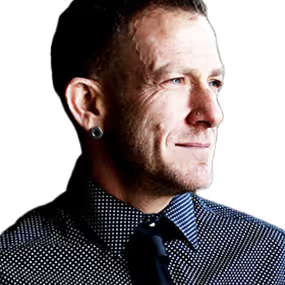
Dr. sj Miller, associate professor of teacher education at Santa Fe Community College, discusses how schools can better serve nonconforming gender identities. The conversation covers liberatory classroom practices, common professional-development mistakes, and systems-based approaches to LGBTQIA+ advocacy in schools.
transcript
Speaker 1 Hello. Before we get started, I want to let you know this podcast is brought to you by Human Restoration Project's fantastic patrons. All of our work, which includes free resources, materials, and this podcast are available for free due to our Patreon supporters, supporters, three of whom are Ray O'Brien, Nadine Lay, and Joshua Sloat. Thank you for your ongoing support. You can learn more about the Human Restoration Project on our website, humanrestorationproject.org, or find us on Twitter, Instagram, or Facebook. Hello, and welcome to season three episode 27 of Things Fall Apart, our podcast of the human restoration project. My name is Chris McNutt, and I'm a high school digital media instructor from Ohio. Today, I am joined by doctor SJ Miller, an associate professor of teacher education at Santa Fe Community College. SJ is an expert on social justice and challenges the gender and gender identity binary. For example, trans asterisk plus, gender dynamic and fluent youth, and creative youth. SJ is an award winning and well published author, including writing for the International Journal of Transgenderism, International Journal of Critical Pedagogy, and the Teachers College Record. You can view SJ's speech on gender identities and young people via TEDMED in the show podcast, we will talk about how schools can best serve nonconforming gender identities, how classrooms can be liberated for social justice, and the mistakes we make in professional development in addressing the complex topic of gender in schools.
Speaker 2 Currently, the core of my research is looking at pre k through university level issues around inequities related to social justice and specifically around gender identity. The work evolved out of my own coming to terms with my identity. Initially, I thought that I might be trans because I never felt comfortable in my own body, but then I came to realize that gender is entirely a social construct. And so if in fact I was refuting and refusing to be captured within the social construct, I realized that I wasn't trans because that is actually part of a binary now, like LGBT. Like, it is a codified, understood term. And I was like, that doesn't really speak to my truth. And I realized that I was agender, meaning the absence of gender. And, also, am a pronoun, meaning the absence of because those two go together in my head rather than be identified as z, peer, or any of the other pronouns we often see connected to being trans. And so my work then really came from that space around wanting people to self determine their gender identities, which meant not walking into a classroom or a space and presuming someone even has a gender similar to me or uses a pronoun, but creating a space through discourse tools that invites a level of communication that signifies, hey. In this space, I really wanna encourage you to be whoever you are. So the book I wrote called gen about gender identities in schools and communities talks about that process. It gives concrete tools, and it actually demonstrates models for how to welcome somebody into that conversation in what I hope is a very non confrontational way. Because what I've realized over time, and I appreciate questions that come to me because people wanna know, and those questions actually become my research rather than push back and be antagonistic. As I've actually seen a lot of people do, like, you should understand me. You need to already be here. I find that a welcoming attribute that really does become taxonomy throughout my work.
Speaker 3 It's it's really interesting how you weave through your your research, especially I was reading through, like, terms like liberatory pedagogy or I mean, just drawing upon themes critical pedagogy to welcome others into the classroom and kind of place students on the same level as the teacher. So do you then see different studies of gender identity and welcoming gender identity into the classroom as kind of one facet of just giving students more power in the classroom?
Speaker 2 Yeah. I've seen a lot of work stem from the work I've done. I think what happened was I broke through a gender identity glass ceiling in teacher education and work's been there in other fields. But that's why I called my work trans asterisk plus disciplinary. It's not about being transgender, but it means about crossing boundaries. It means about integrating what other fields are saying. Hence, the asterisk and the plus because the plus for me me means indeterminate, that which we have yet to see evolve. And so that plus is a signifier that my work is open ended. So bringing in work from social welfare, from sociology, from women's studies, from anthropology, queer studies, all of these fields have really informed my own thinking around specifically within teacher ed. And I think bringing that those various epistemologies have really helped kind of broaden the way that people bring that lens into the classroom. So if that if that makes sense.
Speaker 3 For those that are listening who are mostly k through 12 educators, what are some things that someone could do to welcome that lens into the class? One thing I really wanna encourage
Speaker 2 on Teachers College on Teachers College Press website, if you actually look for my book, you'll see there's a massive a massive appendix, and people can pull from those as examples, like placards to put up in your wall. Like, this is a space that welcomes all identities. And then I have those terms enumerated because it's not enough to say and I don't use the word this is a safe place because you can't just walk in and know a place is safe. Like, that is something that has to come from self. Right? You know, it may say safe space, but you're the one who ultimately needs to experience its safety. So safety is something that is determined from within and from without. So what I say is this is an inclusive space. And, again, puncturing, like, just saying that term is to actually identify as many terms as I can to the extent possible. And, again, that last word is and the indeterminate. Because, again, I can't possibly identify every term in my writing or on a poster, but at least what I do, in my classroom is on the first day, I hand out that placard. I read from my syllabus, which says, this is a space that welcomes all identity on continuums of, and I go, ethnicity, social class, immigration status, medical status, mental health, I mean, etcetera. It goes it's probably three lines. So when you say that, even if a student doesn't understand all those terms, you're likely to hit on somebody who's never heard a term validate their own identity. And all of a sudden, and study show that when you have your identity validated, you're more likely to engage, you're more likely to actually feel like you're part of a community. And I've often had students come to me or in writing say, I've never heard my identity reflected back in a class. And so that goes all the way, you know, from university down. Now, obviously, I'm not gonna use the broad term, like, the, I guess, the more densely understood terms with kindergartners and preschool t preschool kids, but that's part of the work that I find my colleagues are picking up because I'm not a preschool specialist. So just a term like that, also putting up pronouns that say, you know, all pronouns are welcomed, and I give some examples on a poster, and then I say, and I don't use pronouns. So, again, giving some full examples and saying no pronouns, again, becomes a message about who matters and that everybody matters. So those are really easy tools, and they go a long way. I can do lots of other things around welcoming people to self determine, who they are, but that's a little more complex to go into, I assume, than the time that we have.
Speaker 3 And when you go about doing this, is it something that I've done in my own classroom, many of the teachers at our school do things like having, like, the sign that has, like, what your pronouns are, like normalizing the fact that pronouns are something that you would display or something that someone would know about you. I teach in a very conservative district for the most part, and about 50% of our district is like, oh, this is cool. Like, I wanna know more. I wanna learn more about it. 30% are like, yeah, I guess I'll go along with it. And there's probably a solid 20%, maybe less, of students who are vehemently against it. They they they see that as either going against their faith or, you know, something just from, a Trumpian culture, I guess, that's just they're anti that. What recommendations would you have for teachers that need to talk to students about these things because they're likely getting it from the media or their parents or the culture that they grow up in? You know, what do you do? This is a really complex issue, and I think it's something that
Speaker 2 we are all gonna grapple with till the end of time. But one thing I wanna push back on is you used the word how do we normalize. I think norm normalization is one of the I mean, the norm is a four letter word because the norm is what created these problems to begin with. This is what's right. This is what's different. Right? So we're all automatically othering people when we call something the norm. So I use the word ordinary. How do we make this ordinary for everybody? K. And I actually use ordinarilys rather than normalize kind of from the similar syntactical perspective. But the question you asked about recommendations, what I typically do is I go to the standards, and I've audited state standards where I've lived, and I type in the word, because this is what comes under in our class, is the word diverse or diversity. Right? So maybe it's reading standard 3.2 b point c, you know, at 08:02 in the morning. I mean, those are really specific, and I use that as a lens to then say, well, this is what diversity this is a word. Like, what does diversity mean? And it's a pushback actually on superintendents, on principals, on teachers, and parents because that term is there, and they don't it's not defined. Right? It's not actually so that's kind of our job is to step in and say, you know, I have leverage to really work within these terms. And so when I have students who are coming from conservative spaces, I often try to trouble that, and and I'll use a text or some example to say, does it actually show images to say, does this person have any more rights than this person? Are we all aren't we all allowed to have be treated in the same way? Aren't we all entitled to human dignity? And it might have some pushback, but I think it also problematizes, like, why are you more important than this person? Now if they say, because I'm heterosexual or I'm cis gender or I'm Christian or Catholic, why does that give you any more power than somebody else? And it ultimately, we we know it doesn't, but I think that it helps students really think about it. And I think also having examples from the from the media and drawing in examples around health care, welfare, you know, the HUD, the ways in which people have been pushed back and not given the same opportunities. And and with parents, it's the same thing. Like, I will always justify it through a standard. And, again, I mean, some that's the backdoor, and I hate to say it, but it's when you the the trouble with social justice work is that we should just have work around justice. K? And when we say social justice, ultimately, everybody has a voice because we don't get we don't get to pick and choose. Right? So I think my conservative kids has have every right because otherwise, I'm positioning the left as the only people that get to have a voice. Right? And then I'm not really being an a justice based educator. But the the when you cross the line and someone is experiences, like, physical, emotional, psychological oppression, that's when we're talking about injustice. Now when you go to a conservative student and you say, well, are you really experiencing injustice when when someone says I'm allowed to be cisgender I mean, trans or nonbinary, again, that's complicated, but I think that there's a troubling that can happen when you have those conversations.
Speaker 3 I I think that there's a place too for saying that school is probably a best of place as possible to bring up these conversations. I think sometimes they tend to be avoided because people don't like conflict and they're worried about the political nature of everything it is that we do. Definitely brings it to the forefront, but I imagine that if you never brought up these things that no one would it it would just get worse. People become more radicalized.
Speaker 2 I also think you could look at the Hank hate crimes law. I think you can pull up the Klistin's reports and show the maps of where you know, look at the actual laws around bullying and no bullying and cyberbullying because I think all of those types of larger discourses are really powerful in the classroom.
Speaker 3 And drawing upon that, you were mentioning your research spans really vastly across a lot of different things. It spans poverty, but it also expands into things like grade less learning and restorative justice and other forms of systemic change. What's the connection between having a classroom that accepts everyone
Speaker 2 to gradeless learning or restorative justice? I don't believe in grades. I think grades kind of reinforce this, like, this, like, self hating, self internalizing identity, and where, like, I'm an a, I'm a b, I'm a c. And to me, like, while the system promotes just, like, these type of, like, meritocratic values, I don't want any student feeling more or less than. And so coming into my class, what I say to everybody is, I know I have to give grades. I mean, this is part of what we do. And I say, actually, everybody gets an a. I start off that way in the class. And I say, but it's your job to hold it. K? Because I know I have to do this. And so I actually go through and work we talk about kind of the the criteria that would help maintain an a. And then students actually do a lot of self monitoring. Because ultimately, the way I approach teaching is that as a coach approach approach as a sport. Right? Ideally, we wanna help cultivate, develop, and instill level of confidence around a specific skill. So lots of personal checklist, lots of personal what did I do in this paper? How do I move it forward? And then to kinda keep monitoring that. It doesn't always work because students are like, well, how do I know I learned something? I said, well, I want you to look back at your at your grid. What did you do prior? And that's always been a very powerful strategy. Now that's not to say that's around, you know, specific to gender identity, but it also gives students a real clear message that they have a lot of power and agency in being a participant in a classroom.
Speaker 3 Yeah. Yeah. And and as a follow-up then, when you give students power, there's something to be said about students then using that power to say no. Like, I don't want to do this specific thing. I I I don't agree with your feedback, etcetera, etcetera. There's power in their ability to speak up for themselves. So then how do you allow students to speak up for themselves while still getting the point is that you wanna get across?
Speaker 2 That's a fantastic question. What I do is they have their own narratives around why they think they deserve this. And, usually, I'm I'm passive about it. Right? So I actually sit down in conference with students, and I already have the higher grade in mind. I wanna see the critical thinking around that. So I already have like, I don't really care. All I want them to do is be able to support why they think what they think. They think because I have power, because I'm the teacher, I'm the ultimate authority, but they're the ones that know better than I do if they've grown in a in a topic. I mean, I I have some insight, obviously, because I have some level of experience, but they're the ones who note mostly they have a better sense of their own, I think, development as a learner and thinker. Yeah. In my experiences, I I also do conferences.
Speaker 3 The the students tend to think of themselves a lot lower than I would think of themselves. They tend to give themselves much lower grade. That's exactly it. It's they've already been
Speaker 2 conditioned to be part of this kind of institutionalization around thinking. I mean, what we're looking at is is how do we restructure the system to begin with? How do we what I call everything is default I mean, sorry. Everything is set through, like, the cisgender heteronormative, cissexual gaze. Like, we already walk into a space where we don't know how we don't even know what we don't know. And so this work is about, well, how do we how do we shift that default and how do we reset it and recalibrate it and, you know, hit refresh? Like, are we able to do that? And that would that's what my research is about. And that's, I mean, that's a monumental task. But at least the work that that I'm trying to do is to impart that to enough people that it can spatialize and and evolve.
Speaker 3 And I can see how like, I can see a place to start when that comes to, a humanities class or social studies English. If you were listening in and you were math or science or even, art,
Speaker 2 where would that what would be the starting point there? And again, that's a great question. So I have about a 125 student teachers right now, and I'm teaching one class in particular called theories of learning. And so we did exactly that because my class is transdisciplinary. I have math, science. I have PE, English, art, and theater. I mean, it's it's an incredibly rich rich experience. So everyone's bringing their perspectives. And I did an equity based. So I do theories every week, and then we look at how to put that into practice. We were just did queer and trans theory. But when we did an equity centered theory and we did anti oppressive theory, we did Kumashiro's work, and then I did my work on equity centered pedagogy and change, my students were like, okay. So how do I bring that into my class? What does it look like in math? What does it look like in science? And it was their job after understanding the theory of taking into practice, and they they really struggled. But for math, for instance, it's creating a word problem. Right? It's not coming from a binary set, you know, having instead of these kind of what we might call these, quote, unquote, normative types of assignments, it's it's pushing it's pushing beyond. It's also doing what I would call real world or real time. So math isn't just relegated, right, to a textbook, but it's going out in your community. It's measuring. It's doing math. It's do I mean, it's doing calculations. And, again, having them look for like, if I say something like, where did you go? Who was there? You know, looking at the demographics. So, again, even though it might not necessarily be particularized in the math part per se, but they're looking at the larger story right behind the numbers. You know, there were two women, there was a trans kid, etcetera. So it's thinking more broadly than the the the it's putting it's putting science in the context of real world. Right? It's putting I think history and language arts and humanities are lend themselves to that space more. But my my people in PE, they're like, how how do I do this in PE? You know? And, again, maybe inviting people to the very beginning using that language around a welcoming space. My PE teachers say they hear all these foul words all the time. You know, they hear faggot. They hear lame, gay, and and it's stopping that. It's stopping and having conversations rather than condoning it.
Speaker 3 Where I work and many of the teachers I know, when we think of talking about students' rights and who they are as individuals, lot of it dates to like tolerance training. Yeah, I figured that would be your reaction, but could you talk a little about the issues with tolerance training?
Speaker 2 It needs to be eradicated from all of our vocabularies, first of all, because tolerance is a sense of I'll put up with. Like, right, I I tolerate a headache, or I tolerate you being late to school. You're you're not you're kind of forced into to experiencing that. We we don't tolerate people. We want to, again, invite people in, learn about people. So I think those kinds of programs need to be reset and rethought. The same with, like, these character what do they call? Character based programs as well. So the schools are bringing in these kind of these models. And first of all, there is no one size fits all, and especially when you think about the vast number of students that are coming from multilingual, right, or multiethnic backgrounds. You know, you walk into one of these prepackaged programs, and you don't see yourself. And you see the word diversity where you know what the word diversity actually means. Right? It's in contrast to whiteness. Right? That's what it is. And it's a it's a word that means nothing and yet means everything. You know? So it it lives in this space of paradox to begin with. And so I I really think that those programs are very damaging. And if you don't fit into those paradigms, you know, then you're not you don't have the character traits that are basically supposed to be in that school. The other problem is that is everybody has a different discourse pattern. Right? So students that might, like, learn through music or through rhythm, you know, very it's very situated right in in African American culture or black culture or Latino culture or Latinx culture. And when those patterns are up against what we would say, like, the white Eurocentric normative culture, you know, those students are already positioned where they're forced to, you know, move into what James g talks about is the big d discourse. And if you don't, like, do the big d discourse again, then you're marginalized, so strong. I think one of the biggest gaps in teacher education, and I have been saying this for twenty something years, is that we need class to classes to understand the various discourse patterns because we are bringing white people bring a lens that this is the way you're supposed to write, when in fact, every single culture, ethnicity has their own way of communicating information and knowledge. And the same goes for standardized testing. Right? The same goes for for reading and for writing. And, I mean, for any discipline, there is a right way and there is a wrong way. And the same goes with assessment because the way that knowledge is assessed in each of those cultures vary. That is why I come back to not giving grades. I am not an author an authority on every, you know, discourse pattern across cultures, and I'm the first to say that. I said, it is not fair for me to grade when I have a very limited knowledge. I I'm I'd I've been conditioned into white culture. Right? I also have studied black English vernacular, what we were calling black English. Just like we have American English. Black English vernacular is how it used to be called. Evonics predated that. But when you say black English vernacular, you're subverting that to white culture. So we can say there's a Latino English, there's a American English. Right? All these there's all these different pockets of Englishes which puts them all on parody. However, you know, it's the dominant way in schools. Unless you're in a school that is situated you know, you have what are they called? There there are schools that are situated in students' historical identities. Like, you had just a why am I like, just a school for Latino children, Latino just a school for black students. And I don't believe in segregation, but I also believe in empowering students to understand their own histories.
Speaker 3 And to clarify, when you say, like, a character a character value system, would that be something instituted via, like, PBIS,
Speaker 2 positive behavior incentive structures? Yeah. Some of those different, like, character now, I I don't know. I don't use them. I
Speaker 3 use them as a sense of critique. Yeah. I I I personally hate PBIS stuff. So PBIS is required for funding in our state. So you have to institute some kind of, quote unquote value structure that has some form of positive, typically extrinsic motivator, and they they tend to look really gross because they're you're you're again reinforcing what is appropriate in the culture as well as giving out something for acting that way, which is a whole separate issue because that's saying that it doesn't matter if you act kindly towards others, for example, unless you get rewarded for acting kindly towards others even if you were taking it without the the cultural component.
Speaker 2 And even each of those terms are defined, what does kindness look like? Right? So so the danger is what you know, is coming up with a a criteria that's bright enough to hit every single culture.
Speaker 3 Are there any things that you would wanna throw out to k 12 educators
Speaker 2 that we didn't hit that you feel like would be super important to throw out at this time? I would really encourage people to take a look at my gender identity complexity framework that's in my book. Again, it's free for download on the Teacher College Press website. But what it is, it's a frame for learning about how do you create a space for gender identity self determination. You can easily take out the word gender identity and create a space for self self identity termination and determination. And on the left are the frames, and on the right are the commitments. And they work together. So I think that's a really good resource, and it's been widely used. I'm about to give a big presentation on my TED Talk and read from my new book about it. And it used to be one on gender and sexuality framework, and it evolved to a trans framework, and now it's on gender identity. Because that to me is a much more critical under it's a it's a critical awareness that we it's on the forefront of change right now. I think it's what's pushing back on boundaries. And it's not to say that we stop the other work that we've done, but what we're seeing is we've seen the word intersectional in research, and I think that that has actually been kinda codified into, like, a collapsible way of thinking about identity that is threefold. I'm doing what's called trans transactional work, which, again, is that space of integration where there's no one, two, three, four, but it's this continually evolving space around different levels of oppression that are always operating at the same time. So I think that's something that's important. Again, it's about how do you approach the classroom through that lens, and that's the work that I'm gonna continue to push out. And I've kinda reached a I wouldn't say a plateau in my career, but I'm at a point now where I feel like I've written enough theory, and people are taking it up. I wanna write young adult literature, especially for youth youth of color, where that voice sends tends to be sublimated even within the non binary work where still white voices are the ones that we're hearing.
Speaker 3 Thank you again for listening to Things Fall Apart from the Human Restoration Project. I hope that this conversation leaves you inspired and ready to push the progressive envelope education. You can learn more about progressive education, support our cause, and stay tuned to this podcast and other updates on our website at humanrestorationproject.org.
resources
- About Gender Identity Justice in Schools and Communities · sj Miller (book) Practical framework for supporting gender-nonconforming youth in school and community settings. link →
- Why Gender Identity Justice Matters for Everyone · sj Miller (video) TEDMED talk connecting gender identity justice to broader educational and social outcomes. link →
- Gender | The Space Between (video) Documentary exploring gender identity beyond the binary, useful for classroom or staff discussion. link →
- Engendering Communication - Episode 42 - The Oxford Comment (podcast) Episode examining communication and gender identity, recommended by sj Miller. link →
- sj Miller (person) Associate professor and expert on gender identity justice, social justice, and teacher education. link →