
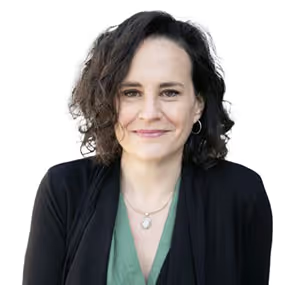
Dr. Ilana Horn, professor of mathematics education at Vanderbilt University's Peabody College, joins the conversation to discuss wrapping up the 2020-2021 school year through reflection. The episode explores how educators can address inequities exposed by the pandemic and build classrooms that motivate and re-engage disenfranchised students.
transcript
Speaker 1 Hello, and welcome to episode 89 of our podcast at Human Restoration Project. My name is Chris McNutt, and I'm a high school digital media instructor from Ohio. Before we get started, I wanted to let you know that this is brought to you by our supporters, three of whom are Jordan Baca, Margaret Clifton, and Steve Sostak. Thank you for your ongoing support. You can learn more about the Human Restoration Project on our website, humanrestorationproject.org, or find us on Twitter, Instagram, or Facebook. In today's conversation, we are joined by doctor Alana Horn. Doctor Horn is a professor of mathematics education at Vanderbilt University's Peabody College who focuses on serving disenfranchised youth through authentic mathematics. She leads a teacher learning laboratory, which focuses on sense making in schools and how teachers and students interact. Further, she is the author of Strength in Collaborative Learning in Secondary Mathematics, and Motivated, designing math classrooms where students want to join in. In our conversation, doctor Horn and I discussed how teachers can wrap up the twenty twenty, twenty twenty one school year through reflection. How can we build a better system after seeing the inequities, problems, and challenges that this year has highlighted? And how do we build a classroom in spite of a system that often demotivates and disenfranchises educators? The school year's been rough, to say the least. Teachers find themselves at a crossroads on their effectiveness as teachers, their motivation to stay in the profession, and really their relative power within the field. And students have had to experience now virtual, hybrid, some people have in person, and that's kind of its whole thing by itself. And on top of all of that, we're also living through a pandemic just day to day. So as we're wrapping up this school year and looking towards the 2122 school year,
Speaker 2 where do we even start with all of that knowledge? I think it's going to obviously vary from community to community because we've seen that the way this pandemic has impacted kids and families and communities in The US hasn't been evenly distributed. Right? And in fact, it's highlighted some of the inequities that we already knew were there, amplifying them. Because I know people in my community who send their children to private schools who have been in school, in person, mostly normal, quote, unquote, you know, instruction from the beginning of this academic year. And then I know people who are working in communities where illness and death and parents being frontline workers or, you know, what do they call it? Essential workers was the euphemism we came up with during this pandemic who've been highly impacted and if where parents are are having to go to work and somehow manage virtual school. So there's not one pandemic experience that our children and communities have had. There's not one pandemic experience that teachers have had. I think, though, that I would love to see administrators both at the school and district levels taking a stance of really wanting to listen and hear what communities, families, and children say that they need and what they're hoping for to kind of I think there's gonna need to be a moment for realignment to make sure we're all on the same page of what this whole project called schooling is about. Right? Because the game we've been playing of supposedly delivering curriculum according to pre predetermined standards that we then measure with large scale assessments, and then we rate how well everyone's doing. That makes no sense. It it hasn't made sense probably ever, but especially in the wake of what everyone's been going through, it makes no sense. And it's you know, I was particularly upset when the president came out with a statement saying that he wanted state tests to proceed this year because that just felt cruel and unusual given what people are experiencing on the ground, both teachers and kids. And, you know, the idea that we're collect it's so we can collect data. There are lots of ways to collect data. Why are those the data we need to collect? So I would like to see us back off on some of these more technocratic approaches to education and kinda take a breath, talk, listen, and maybe use a little more of our imagination about how we can meaningfully move forward off of this terrible
Speaker 1 I think it's been pretty terrible time. The fear that I have is that we're going to really buy into that learning loss narrative because that has been co opted no matter really what political party or or what education reformer is working on it. You know, the the reason why they wanna measure that data is to determine how much learning was lost, doesn't make any sense. Yeah. I mean, just the ignorance about measurement
Speaker 2 and the you know, there's one of the very first things you learn in educational measurement is about issues of validity and reliability. How is data collected right now valid or reliable? Like, what are we actually capturing? And PS, there is no reason why we need to test every single child in every single subject if really what we're trying to do is get a sense of where people are at. For years before no no child left behind, we had the national assessment of educational progress. Right? That that's been called the nation's report card. And that's used as a strategy called matrix sampling where we sort of purposely sample a subset of kids to get a read on how things are going. You don't need to test every kid in every year, in every content area, and the cost associated with it means we usually get go for cheaper data instead of better data. And there's there's so many trade offs that we do in that model that actually works against the idea of validity and reliability that would produce things that might be useful to help guide our action. So we we've bought into this weird idea about what it means to measure that's actually paradoxically working against the stated goals, like you said, across the aisle of both political parties of of wanting to get a handle on on what what's been lost and who's who's been hurt and who might need more help, which are all reasonable things to do. But can we use, like, better systems and strategies for doing that? Yeah. I mean, it warps the narrative. Right? If you're really bought into the system,
Speaker 1 it makes you think, one, I was reading an article recently where one of the proposed solutions to quote unquote learning loss is putting students who don't achieve on standardized tests in mandatory summer school, which I couldn't imagine. I I couldn't imagine. I would I just wouldn't go to school. I would become truant. And the second thing is it also assumes that the students who have gone through the experience of learning in COVID haven't learned a lot of stuff along the way, which isn't traditionally academically measured, and there's a lot of knowledge there. It really has a a very particular lens about it on assuming that if you don't learn these specific things, you are therefore not as intelligent. It's very school centric. Like, the only valuable knowledge that is in this world is
Speaker 2 school knowledge. I mean, the last summer in the middle of the pandemic, there was a group of young people here in Nashville called teens for equality, a group of high school. They were I think they were all young women who who organized for Black Lives Matter here in Nashville. And I was looking at them going, my god. I'm so proud of them. Look at what they're figuring out how to do. They're they're being civically engaged. They're figuring out how to organize, and it was very important to them that they they had nonviolent protests. So they they figured out messaging strategies, and they figured out ways to mobilize people to get the kind of equipment they needed to keep it pandemic safe. And I was looking at those young women going, there is no learning loss happening there. Those those young women are are blowing up, like, what they might learn in a government class in in high school. So, absolutely, it's a very school centric framing. And my every now and then on Twitter, I'll I'll say, okay. So tell me what your kids have learned. What have you seen? And and I I hear all kinds of things about learning to help around the house, learning new games, you know, going out in nature and exploring and finding the names of plants or birds or whatever. Kids are having more interest driven or community driven learning opportunities. But isn't it interesting that we don't have a way of valuing that in school that it's here are the standards. Here is the curriculum. Okay. That's wonderful that you learned how to be a dungeon master, a d and d. That's wonderful that you've, like, learned all the choreography in eighties music videos, whatever it is that you've you've done because it's what your passion was, it doesn't count, and all we're gonna see is what you lost by not staying
Speaker 1 on this arbitrary thing we call grade level in school. And I think that builds well into just thinking about that meaning making process from the last year and how we can take what isn't working and transition that to something that maybe is working. We can see what's been exacerbated by the pandemic. And we can see the problems that we find ourselves in, especially inequity. I mean, the thing that we're really seeing is that particularly white affluent students are the ones that aren't experiencing learning loss, but everyone else is. And that has so many implications for how our society just views young people in general. And then as they become young adults, what they can make out of their lives and and what culturally is being reflected. And specifically, I wanna talk about your work with Teacher Learning Laboratory, how you work with educators, and just what tasks you would give to educators to think about the last year and how they can improve their practice. First of all, a word of compassion to all educators this past year. I think,
Speaker 2 it's been an emotionally difficult year to be a teacher. You know, there was about a hot second there where teachers were heroes. And, you know, during the initial pivot to virtual teaching, and they were being put on this very high pedestal. And I'm someone who has, like, fear of heights when people are being put on a pedestal. I I know it's not gonna end well when someone's being exalted like that. And sure enough, by the time we got to, I don't know, the end of last end of twenty twenty, the people's patience was gone and all of a sudden, these stonewalling teachers who don't wanna do their jobs and schools can't be close to and teachers aren't working and, you know, teachers getting thrown under the bus every which way. And some of the teachers that we've been following in my lab are in communities that have been devastated by COVID and, you know, a lot of illness, a lot of death. How do you just move forward from that? Right? You know, we've had some pretty heart wrenching interviews with teachers who are trying to figure out how to how do you keep going forward if anything is normal in the midst of so much loss and grief. So I think there's an education reporter on Twitter, Jennifer Berkshire. You might know her her. Yeah. And she she did a listening session with students in Massachusetts, and she said that one of the things that she heard repeatedly almost from all of them was, we need help healing from this time. Because kids have lost not only people in their lives, they've lost milestones. You know, I've I have two kids in high school and a a child in college, and there were things that that they had expected out of this year that were just supposed to be a part of their growing up that are gone. You know? No prom. No no freshman year. First time in high school, making new friends. All the all these things that are considered rites of passage and, you know, in the scheme of things, maybe not the biggest deal, but they're a big deal to kids. And and kids are in grief over over those things as well, over over the experience of being isolated and and, you know, not having the same connections with their friends. So I think it's important for teachers to listen to kids. I think that it's important for teachers to help kids value what they may have learned in this time. You know, maybe someone was just a super nerd about COVID tracking, and they learned a lot of things about epidemiology or viral spread that they didn't know. Everyone's been learning something. That's that's just what we do as human beings. So I would love to see teachers helping kids recognize the value of what they did learn in this time as well as paying attention to all the social emotional fallout and grief that they may be experiencing.
Speaker 1 Like, the worst thing that could possibly happen is we return in the fall and it's school, like, just normal old school. I think there's a little bit of calmness around the idea of business as usual. Like, it's the experience that I expect. But at the exact same time, I don't know if I wanna go back to maybe a more boring traditional classroom if I just got done doing virtual hybrid learning. Instead, I could make learning, and I use this word very carefully. I think that we should use that time to make learning more fun, not fun in the sense of like we'll over gamify it or do some wacky activities, but realistically creating grandiose experiential learning that pulls upon those lived experiences and opens up the classroom so kids can actually talk to each other and socialize and get out into the community, like actually get to leave their seats. I mean, the worst part of the year by far has just been there's no group work instead of online. It's not the same. And I can't take field trips. This that kind of stuff is so simple, but it's the most powerful experience. The only thing I remember from high school are taking field trips. So I I think that any chance that we can get to connect with the community and do those hands on people driven projects, the better. Right.
Speaker 2 I mean, I do think that a lot of educators had, out of necessity a crash course in technology use in education. And so I do hope that maybe there will be the potential to find some creative uses of of technology in real time physical world spaces that might allow for more interesting activities and more creative kinds of assignments. Oh, what's something else you said? Oh, another thing that that I've heard a lot from the teachers that we've been following, and I follow mostly math teachers. Actually, for this, I'm only following math teachers at this time, is I think that something about virtual teaching and pandemic teaching has really surfaced some pretty profound issues around student assessment. You know, math teachers love giving tests and, you know, we say what you know and you don't know based on how you produce answers for a test. And especially online, there are so many portals into other sources of knowledge besides the kid. So what does it mean to give a good math test or a math assessment in that kind of an environment? And so it's really kind of uncovered a lot of questions about how do you know what somebody knows? How do you decide? Is it really important that somebody knows something all by themselves without any additional resources? What's the value of that kind of knowing versus a more resourceful view of knowledge, which we as adults definitely use to function. Like, I don't have to know everything all the time at my fingertips. I can look something up, and no one says I'm cheating. Right? So I I kind of wonder if those are two things that we'll see maybe people questioning more as we go forward, like, integrating technology to make more dynamic, interesting, maybe even kid centered lessons, and really digging deeper about what the point of assessment is
Speaker 1 and what we're hoping. It's flipping that narrative. Right? It's moving away from, like, the student's gonna cheat because they have access to resources or that that whole ideology toward I I still remember one of the most profound experiences I've had teaching was probably third or fourth year teaching. And I've always given open note tests for the most part. And we did open note tests over history, but I still had students that didn't do very well because they struggled just to answer the question. So we shifted just saying, you know, just talk to me about this question. Like, what what did you think about it? What do you think about this? And they would have, like, the smallest little thing. Like, we would have, like, question over, like, let's say civil rights, you know, like Martin Luther King. They're like, oh, Martin Luther King. And then they start talking about it. And there was just a disconnect there between not really understanding exactly what's being asked or really what context we're talking about here, even with the notes at their disposal. So shifting from a more traditional sit and get, fill out the answers, even with resources to more of a conversational ongoing piece has been huge because you see students succeed that otherwise wouldn't, at least not in that traditional lens. I I hope that once we move into a new year, we can start to rethink things like how we view students and how they're using things and how they think about things always at a detriment. It's it's always this view of they're cheating, they're plagiarizing, they don't know anything, they're apathetic. Their like cell phones are like ruining their their education because they can't do anything else and play games on their cell phone. All these different ideas that I hear every single day, I don't think are realistic because anyone that's ever done a cool thing in their class knows that kids aren't like that. They actually are hyper engaged. They're just waiting for the moment to shine. You know, through your work, through what you're seeing with teachers, what changes beyond assessment do you think might be a systemic change towards that social justice driven humane education piece? I can speak to the humane part first.
Speaker 2 One of the things we've been hearing from a lot of teachers is that they've learned at this time to ask first, how's everything going? How are you doing? Before they launch into, here are the things you're missing or why haven't you been in class or whatever. You know, we always have to have those check-in conversations with kids when they're not meeting expectations, but it's almost become more glaringly obvious to the teachers we talked to that they need to check-in and see what's going on first because there's a pandemic, and people are getting sick, and people are dying, and people are losing jobs. So you don't just go for, like, school teacher voice. And they have told us some of the teachers have told us that something they plan to carry forward is to start with concern and to start with checking in. And, honestly, a lot of the time, when kids aren't doing what we have expect we expect of them, it's the right thing even if there's not a pandemic going on to see what's going on in your life. Maybe you just had a breakup. Maybe your parents are getting divorced. Maybe your dog died. Maybe you're just having a bad day. But having that little human moment of what's going on? How are you doing? I'm concerned as opposed to a finger wagging kind of reprimand conversation. So I think that's that's something that I hope is more deeply instilled in educators moving forward. Social justice, really am thinking a lot about the structural issues, and and we have such a segregated school system like we were talking about. Right? Like, we have some schools where you hardly know there was a pandemic going on and others where, you know, you get the district's plan for how they're gonna go back to in person teaching, and it involves, like, keeping a window cracked open. And you're like, has anyone been in the building? First of all, some of the rooms don't even have windows, and the other ones that do, the windows won't open. And, like, just the disconnect between what somebody in the public imagination who's determining policy is assuming school buildings look like and what they actually are. I hope that, you know, today, we're recording this on March 11, and the big pandemic relief bill just got signed, and it includes some provisions for education. I haven't looked into the details of it, but my goodness, can we please, please invest in just the buildings and the teachers and the people who are making them go? Because I think that's a real source of discontentment. It's just definitely a place where kids will say to me when I'm talking to them in interviews, they'll say, look at this building. Nobody cares about us. Why why do they care? No one cares that only one of the four toilets in the girl's bathroom down the hall works. No one cares. And it's a place when we neglect the buildings that we ask children to spend their days in, we're telling them that we don't care about them as a society. So I hope that if we mean it, if we really have all come to realize just how crucial schools are to so much of society's functioning, I hope that we are mobilized to invest in all schools for all children to and all teachers who serve all children. That would be, I think, a move forward towards social justice is, like, the very, very beginning. It's a pretty, honestly, low bar, but I hope that all the difficulties
Speaker 1 of returning to school buildings maybe will press us in that direction. I I think about that picture of I don't know if you've seen the picture of, like, the music room where the kids are practicing, and they bought those, like, things you get from Target that you store your coats in. They're, like, super tall. They're, like, freestanding. And they're stepped inside of it so, like, they don't spread the jersey. It just it looks absurd. This is where we're at. This is what reopening meant. And it just doesn't make any sense. In order to meet usually government mandates, some kind of bureaucratic mandate, that's what it's come to, and it's weird. I mean, I've had plenty of students tell me at our school back in person that it actually was easier to learn when it was hybrid or online, Given all of the struggles that teachers are facing to attempt to plan online or in in hybrid, just the ability to have to sit in rows to learn in that fashion, to not really be able to move around easily, those things are counterproductive. So even though they might get to kinda see their friends, it's just not the same. The last question I have for you is just kind of like in spite of all of these systemic problems and a lot of things that feel like they're outside of teachers' control, like standardized testing, funding, things that teachers can rally for and organize against. But day to day, it's still what it is. Is there a way that we can rethink those structures within our classroom and kinda push off and do things on our own that we can build a better system? I think starting with how kids are doing and showing them
Speaker 2 the concern and attention to their full selves is a really good baseline to build off of. Some of the things that we were talking about about being a little broader and how we think about issues of assessment because, you know, I'm I'm in Tennessee, and there's been a proposal to just hold back all third graders this this year. Yeah. Right. So we're gonna be sending kids a lot of messages in the fall about their worthiness, about their competence, about their potential, and I think teachers are the people who build relationships. Standardized tests don't build relationships with kids. Governors don't build relationships with kids. Teachers do. And I think teachers are in a position to maybe mediate some of the messaging that might be coming from these things that are outside of teachers' control. So, you know, a standardized test comes up, and a teacher can say, yeah. This is gonna tell you how well you take standardized tests. I'm gonna be be able to tell what you've really learned, and we can talk about that. So to sort of take away some of the power of these external narratives and instead highlight what you see from interacting with these children day in, day out. And, of course, that requires the teachers to develop what has been called an asset orientation toward their kids and their students, right, to be able to see, wow. Look at all this great stuff you've learned over the last year even though, you know, maybe you don't know your math facts as well as I as the standards say you should. I can see, wow. You really stepped up in your family and learned to cook dinner three nights a week. That's amazing. You know? That's gonna actually, when you're an adult, that's gonna be a better life skill for you. You know? Like, to just have those conversations that really validate what kids have gone through. And then kids will be more receptive to whatever we need to do to bring them along, You know? So that it's not that schooling doesn't matter. We know it's a gatekeeper to a lot of opportunities, and so we can't just be like, oh, what the heck? Whatever. We're just gonna have, you know, fun school where we just hang out and watch movies. That's not serving children either. We need to keep moving them toward this goal that's gonna kinda open doors for them, But we we need to do so in a way that shows care, appreciation, concern, that really sees them for who they are and what they've gone through and what they've they've their resilience, hopefully, that that they've been able to bring to these experiences. So
Speaker 1 it's gonna be tough. I think it's gonna be tough for everybody, but, hopefully, there'll be some healing that happens. Right. I I hope that we learn from the idea of taking it slow and checking in with kids, as you just stated, as well as recognizing that when we change our classrooms to be more community focused and to be more hands on and to have students achieve on real world problems or problems that matter to them, the experience is more challenging. There is a false narrative that progressive education, human centered education, whatever you want to call it, is somehow not taxing, like it's the hippie style class where kids just do whatever and there's no learning going on. But the fact of the matter is is that there is research study after research study after research study that kids learn way more in terms of standardized testing for that matter, and they are motivated and they're engaged. So therefore, they learn more in the future. And I think that these motivational issues are gonna be really, really critical
Speaker 2 in in the fall. I told you I have three children, and one of my children in particular has just become super unmotivated in this particular mode of learning. And it's gonna be a challenge getting them plugged in again and feeling like this whole school business is worthwhile. And I I imagine, you know, teachers have over a 100 kids. I just have my three right now. And trying to plug in with all the different kids. I I would love to see smaller class size to help facilitate those relationships. I'd love to see some more creative use of of student teachers or paraprofessionals or just to sort of get that adult student ratio down in classrooms and to help kids be seen and supported. I you know, one of the things I keep proposing is a lot of college and high school students are not gonna have jobs this summer because the economy is tanked. I'd love to see some kind of, like, job corps, peace corps kind of thing for teens and young adults to be able to just to play based stuff with kids, get them outside, get them moving around, get them out of their houses, give parents a little bit of a break, because I know parents have really been struggling too in doing that work life balance thing when you you're working and living and everything in the same place is is decidedly a strain. So I just think that we could bring a little more creativity if we think outside of the box of standardized tests, grade levels, and and so on and so forth that could help recover some of the mental health, help restore some of the social needs of kids, help solve some of the problems of our older children, our teenagers who who've lost jobs and and lost income sources.
Speaker 1 I I think I I'd love to see more leadership around those kinds of things. That that motivation piece is absolutely huge. I mean, this is anyone who is a teacher, really any adult, any person right now, I'm sure has gotten to the motive, like, you get home, it's like, today's a McDonald's day. Because there's like, there's no way I have any effort to do anything else right now. And if kids have homework or extracurriculars or some still have sports, like, there's all these different things going on, there's a lot of burnout. There's countless numbers of students I know that have dropped all extracurriculars. They've dropped everything else, so they just don't wanna do anything. It's not that they're overscheduled. It's just that it's been so draining. They go through that process. It's also just
Speaker 2 so much of our lives. Well, you said you're in person, but for those of us who are still, like, living online in front of the computer, I know I'm not biologically designed to be sitting here in front of the screen all day. I feel it in my body. I feel antsy. My mind wanders. It's it's very difficult to ask that of children day after day after day, and even some of those extracurriculars and activities are in that modality. And they just wanna, like, run around and hang out and talk and socialize and not have to worry about washing their hands every five minutes. And the anxiety of this time too has, you know, it's been a thing, and I think that that that takes a toll on people's concentration.
Speaker 1 Thank you again for listening to Human Projects podcast. I hope this conversation leaves you inspired and write it push the progressive envelope of education. You can learn more about progressive education, support our cause, and stay tuned to this podcast and other updates on our website at humanrestorationproject.org.
resources
- Strength in Numbers: Collaborative Learning in Secondary Mathematics · Ilana Horn (book) Practical strategies for collaborative math learning in secondary classrooms.
- Motivated: Designing Math Classrooms Where Students Want to Join In · Ilana Horn (book) Guides teachers in designing math environments that build genuine student motivation. link →
- Teacher Learning Laboratory · Ilana Horn (website) Research and resources focused on sense-making in schools and math teaching culture. link →
- TeachLab - Dr. Ilana Horn · TeachLab Podcast (podcast) Dr. Horn discusses her research on math teaching and student engagement. link →
- Dr. Ilana Horn · Vanderbilt University Peabody College (person) Professor of mathematics education focused on equity and disenfranchised youth.