

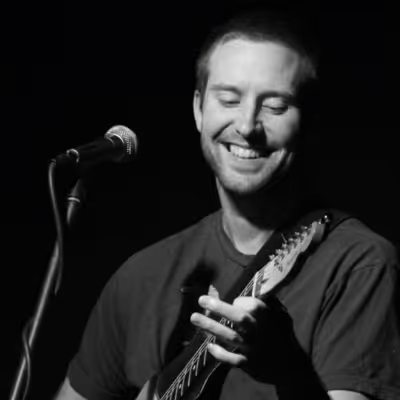
English teacher Sam Shain joins the podcast to discuss his book Education Revolution: Media Literacy for Political Awareness. He explores the growing gap between the urgent need for critical media literacy and teachers' shrinking ability to address it, amid pressure to avoid topics labeled divisive or political.
transcript
Speaker 1 Some would say, well, you know, leave that to college. Leave those discussions to college. And it's like, I can't get into that because it's like it's for some of these kids increasingly, this is the last time they're in a school. So why are we shielding this type of knowledge, whether it's an a real knowledge of US history or media literacy? Like, why are we withholding that from kids who who decide that they maybe don't wanna go to college or enter a trade or something? That is just so absurd to me. Kids are old enough in high school to learn this stuff, and we should be offering it to them.
Speaker 2 Hello, and welcome episode one twenty nine of our podcast at the Human Restoration Project. My name is Nick Covington. As with all of our content, this episode is brought to you by our supporters. Three of whom are Rivka Ocho, Antonio Beeler, and Dylan Wintz. Thank you so much for your ongoing support. You can learn more about us and our work at humanrestorationproject.org. I learned so much about viewing the world, especially mass media, through a critical eye this year. I learned about what traps we fall into while viewing media and how we can prevent that. I also learned about good versus questionable journalism tactics and how this can affect how accurate a news source is. My guest today, Sam Shane, is a musician, artist, writer, former journalist, and current English teacher in Maine. That opening quote was just one student review of Sam's journalism class from his book, Education Revolution, media literacy for political awareness, available from Xero Books. Teaching in The United States has never been more fraught, as teachers across the country are implicitly or explicitly forced to avoid certain topics, texts, and questions that have been labeled divisive, controversial, or worse yet, political. Of course, these topics also tend to be the most immediate and important and are accompanied by intense miss and disinformation. The reality of climate change, systemic racism, COVID nineteen, and the outcomes of our electoral system, to take some examples from just the last couple of years. All of this seems particularly heightened with the new ability of AI to generate audio, video, and images to spread politically motivated narratives easier than ever before via social media, and a receptive population willing not only to accept them, but to participate in spreading mis and disinformation. As the student testimonial I read earlier testifies too, the gap has never been wider between our vital need to teach critical media literacy and our ability to do just that. I hope to bridge that gap, at least in part today, with my guest, Sam Shane. Thanks so much for joining me today. Thank you very much. Happy to be here. Well, your book, Education Revolution, which we will certainly dive into here, has very personal connection to your own experiences as a high school teacher caught up in teaching politics in 2021. And you recounted that experience for us in a piece that listeners can find on our website, one that is eerily similar to my own here in Iowa. So let's begin there. If you could summarize your story for us because I think it sets an important context for the need of this book, and frankly, it's something that teachers are increasingly up against.
Speaker 1 It was one of the worst experiences of my life in the summer of twenty twenty one. I mean, I encourage everyone to read the piece. But just in short, a few things happened in the semester, but the trouble started when I taught, you know, an admin approved book, Rising Out of Hatred. And while I wasn't even there, I was on paternity leave. Well, you know, I I took a few days off after having a baby as as one does in America. Yeah. And I wasn't even there and someone complained and the snap, you know, reactionary decision was to just get rid of the book. And like, we were halfway done reading it, the kids were enjoying it, and they just went to get, like, just ban the book entirely. And, you know, I took time, my son was like a few days old when this happened, and I I was like, well, you know, hold on a second. Like, I I tried to, you know, fight against it. I got back, the kids wanted to know what happened, and I told them. I I said what happened, and they wanted to know what they could do, and I I told them, you know, you could try to talk administration into keeping this book around. Fight for your education. They referred to that in these made up things later that they called informal work evaluations as me, I quote, inciting a student protest, which is just a completely dishonest way of characterizing that. There's so many insane details to that year, but that's
Speaker 2 kind of the gist of where it started for me. Well, what's fascinating about that book, I'm not sure you mentioned it, but the book Rising Out of Hatred is about a white nationalist, the would be heir to the the Klan, Derek Black, and his journey out of white nationalism as a result of the pluralistic, multicultural experience that he has at a, you know, a small liberal arts college in Florida.
Speaker 1 Oh, yeah. So what what did what were people complaining about, in the book? The the story, it is. It's dripping with irony, the the whole thing. Yeah. Head to toe. Yeah. So the complaint was by one single parent, who incidentally, their kid loved both my classes, but the one parent actually hauled the kid out of both classes against their will. The complaint, I guess, was they weren't happy that Eli Sasol, the writer of the book, simply mentioned that like Don Black, Derek's dad, was pretty excited about Trump. They didn't like that. You know? And it's like, that's just what happened. I'm sorry that that is the fact of the matter. In a meeting with them, with both the parents, one set of which did not even complain, they didn't care about any of this. I assured them, I said, you know, look, I I am quick to point out stuff about the Democratic party too. Like, when I when I when we when we talk about the themes to this, systemic racism and, a history of of race in America, I am happy to point out, I mean, I'm sad to point out, I should say, I'm willing that to point Joe Biden is a is an architect of of the crime bill. Like, I have no problem saying that. The crime bill that incarcerated a disproportionate number of black folks, and, like, I'm gonna say that. I don't care about Republicans and Democrats per se. I just wanna get the truth out to kids and give them stuff to think about.
Speaker 2 And it's not like you had put those words into Don Black's mouth. That was what Don Black had said in the book. Yeah. They're mad at something that a different person said in the book that you were reading. That's that's the part that I think is like, it's not bewildering because because, of course, I had the same circumstance. People were upset when I taught about the Charlottesville march, the the right wing march in 2017 that happened down there. When I, you know, when I was teaching about that in my AP European history class in the context of nationalism and white nationalism, the parents who complained about, me teaching about it were mad about what the white nationalists said about Donald Trump. They said Right. The the parent the parent would complain was that it the the content, seemed to portray president Trump in a negative light. It's like, that's nothing that I said. You're complaining about stuff the Nazis said. The guys on the video who said they were Nazis said that they happened to like president Trump. I didn't say anything. Right. So it's like it's like the exact same scenario, which is absolutely wild to me. It's insane. And and and rather than these people ask themselves,
Speaker 1 right, like, is it that I like the same guy that Don Black and Richard Spencer and all these people do? It's let's let's go cancel, if I may. This is a real, like, this is a real cancellation that happened to me. I actually unlike these comedians that whine about canceling, I actually lost my job with an eight month old son. And this this woman caused me to lose my job rather than look at herself and say, why is it that I am mad about this? Why is it that I support the same person that these white supremacists are excited about? And the administration I had, and it sounds like the one that you had as well was would sooner side the same
Speaker 2 admin? Is that what was going on there? I know. Yeah. I said the same thing to my principal too. I I said, how can you not see that this is politically motivated? And they were my admin at the time was just, no. These are just concerned parents. They just, you know, want to do what's best for their kids. And I said, baloney. Like, right away, red flags were going up there. And, you know, they were upset about the things that the Nazis in the video said and as though they were attributing it to myself. It's just like, can you not see the distinction? It's not like I was advocating for those things. Right. You know, we're trying to understand what it is that these guys are saying in their own words. And there's you know, we're using primary sources in the history class to learn about this topic just like, you know, you were using Eli Saslow's book as a piece of journalism in your freshman English class. Absolutely wild to me. In the introduction to the book, in the first few pages there, you say that teaching political awareness is powerful in that it allows teachers to say, this class is political, just in the same kind of political realities you had mentioned, you know, impacting the Democratic Party as well, as as nearly everything is, you say, but most certainly not partisan. None of my classes are partisan, you write in the book, because I would never preach to kids to specifically vote for a certain party or candidate, but it is political in that we discuss politics, current events, and current issues because I am trying to make my class relevant and meaningful. As somebody myself who was told that current events do not belong in history class, I wish that this distinction between being political and being partisan was more widely embraced and communicated. So I wonder, you know, why do you think it isn't, and how do you think we or maybe how can we do a better job of just that? I'd say a lot of the book is setting out to make that argument.
Speaker 1 I am personally just so tired of this notion that there is this all these unbiased forces in our country. Journalism is unbiased. Our court system is unbiased. Our economic system is unbiased. Like, there's just all these myths that we tell ourselves that we have this great these great systems in place that just yield justified righteous outcomes. And it's like, you look into it at all, it it lays waste to these ideas. And knowing about them is going to help us, I would think, fix these things, overturn some of the nonsense that we see, becoming more aware that like, no, I'm sorry, but like, a lot of journalism, if not all journalism, is indeed biased. The court system is biased. The economic system is biased in favor of people who have a bunch of money. Like, why can't we just admit this? Yes. It's political. So is almost anything. You could you could make that charge to almost anything, would say. Anything meaningful anyway.
Speaker 2 What I get really concerned about, and especially back when Iowa was doing this in, gosh, I I think probably this was 2021 now, they had signed a bill that would ban so called divisive concepts from being taught in school. And immediately, again, the red flags for me go up because it really implies a lot of power about who gets to decide what is decisive or what is divisive, what is controversial, what is political. To mention a current event, I just saw today that some charter school in Florida had fired a teacher or a principal. Somebody had been fired over this showing the statue of David to to middle school children because parents thought that that was pornographic. And it just seems like we apply these reflexive labels to, I don't know, anything that we feel is uncomfortable? Anything that we how can we deal with the with the realities of, again, say climate change or who won what election, or, know, God forbid then, to your point about actually addressing systemic issues where we see them in the criminal justice system, or where we see them in legislation, housing, the economy, without actually just like recognizing that those realities are the bare truths at the core of the world.
Speaker 1 Just to debunk the myth of white supremacy, you know, something that I think any administrator without being pressed, do you believe in white supremacy? No, I don't. Okay. Well, in order to, really demolish that idea, the best way to do that is take the things that like a Derek Black would say, look, look at this. Look how many black people are in jail. Look how many are in poverty. See, they're they really are just not as smart. They really are just not as they're prone to violence or whatever. Like, you take those things and say, well, what? This isn't true. Like, we certainly don't believe that. So what is the reason? And then you go back through time and look at the disadvantage of this group of people from the start of the country. Like you said, doing that, actually, instead of just saying don't be racist, don't say the n word, don't say slurs, you're actually teaching them the substance of it, you know? Yes. And it's true, in doing so, doing it the right way, teaching this stuff the right way, so people don't just become hysterical and preachy and, not really know what they're talking about. If you do it the right way, then yes, you could be charged with, Oh, you're being political. The thing that you just said about the statue
Speaker 2 or the what was it? What was it again? The statue of David was taught to middle school kids at a Florida charter school and somebody got fired for that. And it's like that is just like,
Speaker 1 you could take anything. You could get anyone with anything with this whole with these loose ideas of like, oh, you can't be controversial. Could just you could use that as a weapon against anyone. I mean, what like, what about just I'm just thinking here, like, about the Bible itself? Like, you that that has all kinds of sex and killing and all kinds of crazy things in there. Are you going to ban that too? I mean, it's just I I it's wild. It's wild to me that we're allowing these sort of loose laws
Speaker 2 and regulations to be just there to be used as a weapon to to just get rid of teachers like you and I. It does seem like it falls into that legal trap of like, I'll know it when I see it. Like, how do we know what's controversial? How do we know what is pornographic? You know, I I would venture to say that the vast majority of people would not say the Statue Of David is pornography. I mean, it's Right. It's not any different from an anatomical, you know, drawing that you would find on Wikipedia or an encyclopedia, I should say. But it really just kind of becomes in this eye of the beholder or this mob rule mentality that actually has huge legal implications about what we can teach, how we can teach it, the kinds of questions we can ask, you know, of students in there. And I think, you know, one of the concerns that that I have about your context, in particular with teaching the story of Derek Black and the rising out of hatred is one of the things that caused him to begin to question his white nationalist upbringing, because he was homeschooled as a child, was going into that diverse pluralistic community, meeting students who had immigrant who were first generation immigrants, spending time with Jewish students, gay students, and both feeling the heat, but then also, being embraced by some of them, and and kind of having that relationship with him and actually teaching him that his beliefs were wrong. And I worry that these laws preclude a lot of the things that would go would have turned Derek away. And it it's kind of hard to avoid the conclusion that these laws aren't almost designed just to protect, you know, people with the attitudes like Derek had, to prevent him from challenging those beliefs that had been instilled with him by his father, who you said was the, like, the founder of Stormfront
Speaker 1 Right. For God's sake. Yeah. It it is it does protect those viewpoints. And, you know, it's fine to have them, like, when I teach the book, I try to, you know, any kids that say, well, they should have kicked Derek out of the school, which very few do. I try to kind of and this is again, we we deal with moral questions all the time. I would try to steer that student into saying, well, you know, if they kick him out, he's never gonna change. You know? And and it's like, he's welcome to have that viewpoint, but the whole school does not need to capitulate to him and and not teach, like, the girl, Allison, his girlfriend, like, took a class to arm herself with the reasons that he was so wrong, like the factual reasons. That was a big part. Yes, he was greeted with love from people, he was greeted with animosity, but he was also Derrick Black dared to logically look at himself look at the facts say, I am wrong about this. You know, even though his parents, he thought they might disown him. I mean, what a brave person to do that.
Speaker 2 You mentioned Alison taking that class, I think the class was called something about prejudice, so it's like addressing directly the causes and sources of, you know, our bias and our prejudice. Again, part of me wonders, under the new college kind of regime that they have now of all these lackeys that DeSantis put into office there, whether or not that class would be allowed to be offered because it addresses specifically those systemic causes of bias, prejudice, know,
Speaker 1 inequity, and all and all those. Just just to also say this, like like some would say, and I I ran into this when I was trying to get endorsements for my book. Oh, yeah. Some would say, well, you know, leave that to college. Leave those discussions to college. And it's like, I can't get into that because it's like, for some of these kids increasingly, this is the last time they're in a school. So why are we shielding this type of knowledge, whether it's a real knowledge of US history or media literacy? Like, why are we withholding that from kids who who decide that they maybe don't wanna go to college or enter a trade or something? That is just so absurd to me. Kids are old enough in high school to learn this stuff, and we should be offering it to them for the good of of them and and the entire country.
Speaker 2 As though they don't deserve to be forewarned and forearmed with those things before they get to campus and have conversations with people from different backgrounds and experiences and different viewpoints on those issues. I mean, imagine coming into, you know, that college campus entirely ignorant of the Black Lives Matter, you know, the civil rights movement of twenty twenty, trial, or any of those things that are actually gonna inform the relationships in your ability to, you know, be be successful interpersonally on a college campus, you know, let alone academics, but just be able to identify with and interact with and engage with different groups and communities. You kind of become isolated and and, you know, you're you're kind of isolated by your own ignorance if that's the case because you're not prepared and equipped to have those conversations in the same way that students who might come from a place where they have had those conversations before setting out into the world after high school, you know? Absolutely.
Speaker 1 Absolutely.
Speaker 2 Well, let's get into the book. I think it's not typical in the sense that it's intended for a mainstream audience but published on an imprint on Xero books that generally doesn't release pedagogical content. I think this might be the only one that they have that's like, here's a how to teach guide. And that's what this is. It's a guidebook. It's a curriculum map for how to teach critical media literacy in the scope of a traditional school year. You go month by month and semester by semester with the goals and activities and all those things. So I just wanna pick your brain a bit. What were your goals in writing this kind of book? I guess, or even four zero books if that was your original goal. Could you walk us through the ideas, the practices that guide your work as a journalism teacher in such a fraught information environment? And we can get to this in a little bit, I don't wanna throw too much at you, but what in your mind then are those key pieces of media literacy for political awareness as the book's subtitle suggests?
Speaker 1 Okay. Yeah. There's a lot there. Okay. So There's a lot. Take them in order. Okay. So first, you know, I wrote this book. I I've this is only my fifth year teaching. Wrote this book after only, I think, my second year teaching, you know? So I Big step. I was tasked with a journalism class just because I was a journalist at a small paper for a while. And I was gonna do a thing where it was like, okay, I'll start a newspaper. And I got there, you know, I got into class and I was just like, you know, there's a real opportunity here, there's all kinds of crazy things going on where, like, you know, people just don't know what the hell to believe. You know, a big inspiration for me, not necessarily him as a person, but just the book Sapiens, just there's this one quote where he says, teachers should be teaching kids how to interpret, decipher information, opposed to teaching them just more facts and more, you know, just loading more and more things onto them. Try to teach them how to sift through teach them how to think, basically, instead of just more and more different things to put on their plate. And I realized that that is what I should be trying to do. You know, I was already a fan of Noam Chomsky you know, manufacturing consent. I realized, some of the problems with media, some of the problems with social media, and I thought, you know, that that's what I'm gonna do with this class. I'm gonna I'm gonna call it journalism, and it will be more of like a media literacy and critical thinking class. And my my hope, and I I haven't admittedly done a a very good job of this, but like, I'm I I would love to see more people implement this, more teachers implement this. Like, I I think you could do it pretty easily as an English teacher. I mean, I do some of the activities that I talk about in the book just in my regular English classes, you know, with critical thinking stuff, like, I I put those right in right in my writing classes, you know? You can do that. You can do that easily. You can tie them into the standards. The standards are very open ended. Not that I really care for them, but, you can you can do it. You can you can absolutely tie this stuff in with the standards, have them rights give them some all you need to do in English is kind of give them some type of framework and then they can respond to it or think about it or,
Speaker 2 you know, use the skills you give them. That was that second question is, what are those like ideas and practices? You're saying English teachers can go implement these things even though, you know, the book is kind of written through that from your experience as a journalism teacher, but what are like those central key ideas that you're saying, go teach, you know, media literacy, go teach critical thinking. What what are those key themes and ideas? So I'll start the year with
Speaker 1 getting them to buy in to the whole notion of journalism. We need that sort of pillar, that that sort of fourth branch almost to hold people accountable to to, you know, the powerful accountable theoretically. We need that to inform people what's going on. If we're if if this democracy thing is gonna work, we want people to know what, to me, what is actually going on. We need that in a democracy. So then we kind of move in to looking at what journalism should look like, and what I was taught by the journalists that taught that kind of prepped me for my work as a journalist, talking about the inverted pyramid, where you're supposed to like talk about the main things that happen and then the details and the nitty gritty gets further down in the article. And there should be theoretically a bunch of people making sure that it's objective, making sure that it's factual, making sure that there's not too much opinion going on. But then we kind of start to talk about how the whole bias thing is tricky, you know? Like, I get I show them an episode of The Office,
Speaker 2 you know, kind of a crazy activity. I love to read about this. Walk us through that. I I just give give the listeners a sense of that because I think that's really cool. Yeah, it's I I show the episode,
Speaker 1 it's the one where Dwight starts a fire intentionally in the office, and I let them Started the fire, yeah. Yeah. I let them see that, and the other thing is my curriculum keeps getting better. So this might be a little different as I explain it in the book, but I have the kids then put in their top detail, you know, and have them fill in the inverted pyramid for, like, in what order of importance do they think this this crazy event what are the events that happened? Like, what order of importance would you rank them in? And we realized that people kind of all do something a little bit different. And it's a great way to kinda say, like, someone in the Scranton, Pennsylvania newspaper, we've gotta also consider, you know, if I'm your editor here telling you to go cover this story, what if there is a huge homeless problem? What if there is some type of issue with the drinking water? Why are we covering this story instead of some of these other things going on? And it's like you quickly start to realize, okay, even when we set out to have this objective thing, there are other things going on. It's not it's there's maybe more that meets the eye than, like, yes, the news is just giving you everything that you need to know. Like, no, there might be other stuff out there that you need to know. We kinda get into the nature of bias and how you've really gotta dig into things. It's then kinda fun to, you know, see what their own biases are, and, give them a bunch of different quizzes and things like that. We look at bi we look at biases like the media bias chart, but then we talk about how the media bias chart and the quizzes themselves are also biased. They're written by regular people. You can't escape it. Yeah. You can't escape it, right? So it's like to me that that alone is you're getting them thinking. You're getting them like thinking deeper than to just swallow everything that they ever hear. You know? And I tell them, you know, if you're in an English or history class, even in my own class, like, by all means, check what I'm saying, like, look into other stuff, like, do the thinking. Don't just believe or, or like, think that what you're getting in history class is the only way of framing of looking at history, like look into other all kinds of other things. So once we get kind of that foundation, I then have like three units, straight up fake news, you know, which which is just like non like stuff that is just a flat out lie, Corporate media, which, you know, is a is a much trickier thing to go through. Like, I I spend a long time on that. And, you know, I I try to explain to them, like, you know, these other countries that have a state media, I would imagine, and I I from a little bit that I've read, it's like people kind of know, right? Like, this this is the it's it's state media, like, I'm I'm I know that this is biased. Where we have this like veneer here, like like I was talking about earlier, It's like, oh, we're getting this great independent stuff here. And it's like, yeah. Well, let's let's look at who owns, like, 90% of the media outlets in this country. And it's like, no, we're really not getting that unless we kind of dare to look into some independent media and look into some journalists who are actually on the ground, instead of just getting sort of the corporate narrative. Now, the thing is, is I don't want the last thing I want is to have kids conflating fake news with the corporate media problem. You know? I don't want kids to say you know what I'm saying? Like, don't I don't want them to say, oh, look, the corporate media is saying there's a virus. They lie about everything.
Speaker 2 You know, that's that's not what we're going for. Right. Right. Fall into some kind of nihilism that like, oh, nobody is gonna have the truth here. Yeah. How do you how do you overcome that then? Because I I bet that's a pretty that's a convenient way to start thinking, right? Because you're like, oh, if nothing is true, or if nobody's gonna be true through, or if nobody is unbiased, then it must all be the same, right? They must all just be liars all the time about everything. So I I end the year on
Speaker 1 a conspiracy theory unit, where and, you know, a big part of that is like the difference between a conspiracy and a conspiracy theory. We look at like actual conspiracies that like the government has pulled off, And, you know, with this comes, I always say, Ben Burgess has a great line where he says, you know, the government can do things to you or or for you. And the last thing I wanna do there is say, you can't trust the government to do anything because they did COINTELPRO, you know, back in the sixties. Like, I don't want that either. So I I make sure to to have these nuances in there, but like that last unit, we also like that that is accompanied by like looking at fallacies, looking at cognitive biases. I make sure that they are using that themselves. Like, a great a great thing to use for that is, I I show them a video of people explaining crop circles by assuming that it's aliens, and then showing them, like the fact that people can do it too. You know, like people can pull this off and asking them to think what's more likely most of the time. Is it are we getting visited? Which I guess is possible, but where's the evidence? You know? Or, is it people doing it? Ben, the fallacy king Shapiro is another great, tool to use, literally a tool to use, for this as well. The Andrew Neil clip is a great one, and I have them actually identify these fallacies. So the hope is between a robust mental mode of, like, having these critical thinking tools and putting them into practice with a value for looking at all kinds of different sides and actual evidence, you know, looking at documents and studies and hard evidence. Hopefully, they are able to look at any content through a skeptical eye after we've done all of this that I've just described in a in a thorough manner.
Speaker 2 That says a lot too just about the extent to which you just, at the end of the day, you also have to trust kids to, you know, put their critical faculties into play. You can only teach them so much about those tool kits, but if you don't actually let them use them by bringing in, you know, diverse ranges of sources and some at the extremities, some that are nonsense, some of those things too, and just let them flex those muscles, and expect them to go out on their own and do that either. So I think that just exhibits a huge amount of trust in the kids that you're teaching.
Speaker 1 Yeah. And that is the final in the class at this point, is like I it used to be having them debunk a conspiracy theory, now I kind of give them a broad range, like you just said, of of like all kinds of different things. Fake news, a meme that isn't true, a corporate media article that like reports on what CIA sources say, like, completely uncritically, and you know, it's fun to see them say, okay, hold on, like this this Havana syndrome is only quoting a CIA an unnamed CIA official. Maybe there's something going on here, you know, like and and like, what really is what's the evidence that this is some kind of gamma ray harming these these agents? And it's like, right. Exactly. Like, look at what what does the article say? Like, what what are they really reporting on here? Is there anything is there any teeth to this thing? Or is it just speculation? Yeah. And, you know, it went it went very well this year, my my last semester. I had a great group of kids in that, and they did so well with that. It was kind of a new way of approaching that final for me this year, and they they just did an awesome job.
Speaker 2 That's a good transition into kind of the next question, which was I've got a quote that I wanna read over here that you quote from the book, and it's actually from the author of Sapiens. Is it Yuval Noah Harari? Is that the person's name? Yeah. Yep. So you actually quote from a Wired piece that that Yuval wrote. I'll quote from that too just for listeners here too, where where they say, people all over the world are about a click away from the latest accounts of the bombardment of Aleppo or of melting ice caps in the Arctic, but there are so many contradictory accounts that it's hard to know what to believe. Besides, countless other things are just a click away making it difficult to focus. And when politics or science look too complicated, it's tempting to switch to funny cat videos, celebrity gossip or porn. In such a world, the last thing a teacher needs to give her pupils is more information. They already have far too much of it. Instead, people need the ability to make sense of information to tell the difference between what is important and what is unimportant and above all to combine many bits of information into a broad picture of the world. And what I think is is interesting is that obviously the memes about boomers are like low hanging fruit at this point. And I think there's a lot of concern about gen x in this regard too. Like, I'm thinking about Ron DeSantis and Elon Musk and and what's going on there. But us millennials, we're of course perfect and without fault. So let's put gen z in that unfair let's put the the generational spotlight on them for a moment. I remember hearing them referred to as the digital natives in, you know, in my former practice, and and the media environment that they're growing up in though is as fractured as it's ever been. So what would you say are there generational strengths that young people have when it comes to media literacy? Whether that's by virtue of it being a focus of their education or of being, you know, like Bain. They're born into it. They don't know any different. Yeah. So maybe they are just more skeptical. So both the strengths and then maybe like, what are those generational obstacles that we have to seriously address because, you know, the students for whatever reason just have blinders to that kind of thing. They just can't see it because it's, you know, not part of their experience. I don't know. What's what's your take on that?
Speaker 1 Part of me wants to say that they're pretty good at like not believing a meme or a TikTok video, like, out of hand, you know? Like like, part of me wants to say that they're pretty good at that, like, they're not going to just believe something. But then I do also think, like, I I gotta tell you, I I have a lot of kids who believe initially that, like, there's a there's all these schools that have litter boxes for furries to go to the bathroom in. Sure. It's like, you can't believe that just because Joe Rogan said it, you know? And it's like I forgot he was the progenitor of that, you know? He was one of them. Yeah. And it's like Oh, okay. Okay. Well, I don't know. I don't it might have been maybe he was, maybe that was the origin. But I do play that clip for my regular English class, like, and when we're doing a research paper and I I play that clip, and even though, like, other times they can be very savvy, sometimes they're ready to still believe something like that. And again, the goal is just to say, like, look into this a little bit. Like, look into it a little bit, don't just believe it just because it's we're predisposed to say, oh, look, this a train wreck, you know, like, look into it before you believe it out of hand. So I think in some ways they're pretty good at like doing that most of the time and knowing that like the internet's kind of a crazy place that's maybe not to be taken seriously all the time, but they still do fall victim to the same sort of things that anyone does except us perfect millennials, of course.
Speaker 2 Yep, exactly. We don't fall for this. We've been through too much. Yeah,
Speaker 1 real.
Speaker 2 It is so interesting that they may be they might have some kind of like reflective skepticism just from growing up inundated by crap, you know. Just be like, fake video, fake this, this is fake, fake all this. Like, I I kinda get that. And at the same time, it's kind of humanizing too to say like, look, you have you have the same biases and predispositions and, you know, we we fall for the same stuff because we all have these human brains as, you know, legislators who should know better. They take the litter box myth and they bring it on the floor of the the state legislature. And they, you know, enter it into the public record as evidence of what whatever it is they wanna do. Like, we are predisposed to the same things. Right. And that could that could be an interesting way perhaps to even tackle it in the classroom context is like, look, these adults, college educated people who should know and do better, they fell for the same thing that you, you know, a teenager Right. Doesn't even have a high school degree fell for. Right. So I don't know. Maybe there's something to be said about that too. Yeah. Absolutely. And I I like what you said there about, like, maybe they are a little bit better about
Speaker 1 it in some ways. But to get to the second part of this question, they're sort of built in skepticism. In the most heartbreaking moments I've had, and I talk a little bit about this at the end of the book, is like kids who do the same thing I I do sometimes, just throw my hands off and say, like, what is to be done about this? Or not even asking that question and just assuming nothing can be done about any of the number of problems that we have. I mean, these poor kids, think about what they have to see with this like, there was yet another climate report that came out. It just must be so weird to see something like that, and then see no action done. You know? Yeah. We have one party that will completely ignore it and the other will pay lip service to it and do nothing. And that must be so super frustrating. And that is again, though, like, you you get kids sometimes who who just like have no use that I hear so much at the school that I'm at now, kids just say, I hate politics. I don't wanna think about it. And just getting them interested in any number of issues, health care, housing, going to college and the cost of that, like, getting them to understand, like, these decisions that we make, that people make, impact them already. It's important to start thinking about them. You know, you don't like your your school lunch, guess what? We could be giving you guys way better lunches. You don't like how school is run? Guess what? We could be running it a lot differently. You don't like coming to school five days or working five days a week? Guess what? Other countries are doing four day work weeks. You know, like there's other ways to do this. Get them to understand. Again, getting back to kind of the theme here, maybe America hasn't figured it all out. Maybe our institutions are not the most perfect things in the world. Giving them some like helping them understand that maybe there is hope just in the fact that, like, there's other ways to do things is something I think this generation really needs. Because they I think sometimes can be a very cynical bunch that just does not they don't really care. And and who could blame them? When we see our these leaders that clearly don't care or, you know, they don't care about the same things normal, regular, everyday people do. Yeah. It must be a hell of a thing to go through as a teen.
Speaker 2 Adults have not been great models in all of that. And I don't I don't envy a kid, a teenager who has, you know, that awareness of the wrongs and the injustices and, you know, even just the sense of like the growing inconveniences, be it through just inflation or the cost of college and the way that they see their own lives tarnished by the choices that adults have made, you know, about how society has to be run, about the how the economy should work, who benefits, who loses, and then just kind of feeling powerless as like a starting point to say, well, where do I even you know, how do I even fit into this picture? What what can I, 13, 14, whatever, year old do about this other than either fall into the the existing patterns that are that are the the easiest to facilitate, you know, with get a car, move to the suburbs, you know, all the things that are just traditionally reinforced, or do I kinda set myself up for difficulty and all these things by going a nontraditional route? Would I be happier in one place or the other? Would I they they face, I think, a bigger lift than they ever have before. Yeah. I definitely don't envy teenagers and the decisions that they have to make about their lives and their relationship to the world. I think we've really Yeah. Put them in an unfortunate
Speaker 1 position. Oh, absolutely. Absolutely.
Speaker 2 Well, the book is Education, Revolution, Media Literacy for Political Awareness.
Speaker 1 The author, Sam Shane. Thanks so much for joining me tonight. Oh, thank you. I had a great time talking to you.
Speaker 2 Human Restoration Project is a nonprofit dedicated to informing and spreading progressive education through free educational programs, resources, and online materials for teachers, families, and students. You can learn more and follow us at humanrestorationproject.org or on Twitter, Instagram, TikTok and post at humeraz pro.
resources
- Education Revolution: Media Literacy for Political Awareness · Sam Shain (book) Core text for the episode; available from Zer0 Books via John Hunt Publishing. link →
- Sam Shain (person) Former journalist and Maine English teacher focused on media literacy and political awareness.
- Zer0 Books (organization) Publisher of Education Revolution; focuses on politically engaged nonfiction and cultural criticism. link →
- Capital Weekly (organization) Publication where Sam Shain worked as a journalist for several years before teaching.
- Kennebec Journal (organization) Maine publication to which Sam Shain occasionally contributes writing.