

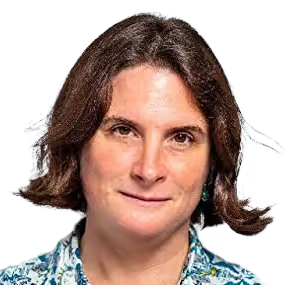
Dr. Naomi Fisher, clinical psychologist and author, challenges the 'science of learning' movement's narrow focus on standardized achievement and explicit instruction. She draws on her expertise in developmental cognitive psychology and her experience with self-directed education to offer an alternative view of how children learn and thrive.
transcript
Speaker 1 So I see some young children who, you know, they're they're pulling their hair out or they're chewing their their their sleeves to shreds because they're so worried about things like, I'm gonna be moved off the sun or I'm not gonna get 10 out of 10 on my spelling test. And I found myself thinking there's something really wrong with this system where we're creating this anxiety in kids, and then they're sending them to someone like me, a clinical psychologist, to try and fix that. Wouldn't it be so much more efficient if we could think about what's this environment that we're putting our kids in? Is it one that's conducive to flourishing? Because really mental health is about flourishing, I think.
Speaker 2 Hello, and welcome to episode one twenty two of our podcast at the Human Restoration Project. My name is Nick Covington and I'm the creative director for the Human Restoration Project. Before we get started, I wanted to let you know that this is brought to you by our supporters, three of whom are Darren Ushinowski, Julia Valenti, and Michelle Edwards. Thank you for your ongoing support. You can learn more about the Human Restoration Project on our website, humanrestorationproject.org, and connect with us to continue the conversation on our Discord, TikTok, Twitter, and beyond. This conversation comes in an interesting time in the broader context of the future of education. In the wake of Progress eight results in The UK and NAEP scores in The United States, there appears to be a narrowing of educational possibilities toward a very particular model of schooling, or at least a model whose proponents have been the loudest in proclaiming victory. It has gone by many names over the years, but recently solidified under the umbrella of hashtag research ed, or the science of learning. The claim here is that we understand and agree upon the ends of education, that is to raise standardized achievement scores, and it's simply a matter of aligning the means around what works to close gaps, raise scores, and at least in the context of pandemic schooling since 2020, combat and reverse learning loss. What works, of course, is the reiteration of adult authority with a laser focus on high expectations and results, The centrality of explicit, direct instruction, and above all, a strict approach to school discipline. It's a model listeners in The United States might associate with Doug Lemov's Teach Like a Champion and listeners in The UK with Katherine Berbelsing's Makayla School, where I imagine the notion of a self directed education would be greeted with the same incredulity as geocentrism. Bolstered by these measures of success in national contexts, this model is increasingly decontextualized and exported as the solution to educational ills the world over. I am joined today by Doctor. Naomi Fisher. Doctor. Fisher is a clinical psychologist and mother of two self directed learners. She has a doctorate in clinical psychology and a PhD in developmental cognitive psychology, focusing on autism. She combines years of hands on experience of self directed education with an in-depth knowledge of the psychology of learning and well-being. Her work has been published in The Green Parent, The Psychologist, SEN Magazine, Juno, and Tipping Points. She is a regular speaker on self directed education, presenting at the Freedom to Learn Forum, Homeschooling Summit, and recently was a keynote at the Rethinking Education Conference in London. She is also the author of Changing Our Minds, How Children Can Take Control of Their Own Learning, which I would highly recommend, and the upcoming book, A Different Way to Learn, Neurodiversity and Self Directed Education, to be published in 2023. Thank you so much for joining me today, Naomi. Thank you. It's really great to be here. Your background, Naomi, as a clinical psychologist working with young people, your cognitive psychology PhD focusing on autism, and as a self directed learning advocate and parent puts you in a fascinating position of seeing the structures and outcomes of what works in an entirely different light. So let's start that conversation with your work as a clinical psychologist and how that informs your understanding of the science of learning, the impact of what works, and how that's compatible with your advocacy for self directed learning?
Speaker 1 Wow. Well, that's a big question to start with. So, I mean, people often say that to me. They say, hang on. You're a clinical psychologist not an educational psychologist. Why are you even talking about this? And I think it's a really a good point which kind of gets to the nub of it, which is that so I don't know if it's the same in The US, but in The UK clinical psychologists are located within the health system. Educational psychologists work in the school system, whereas I was when I worked in the National Health Service, I was based in a hospital or in a clinic, and I would see all sorts of people, adults and children who were distressed, who had mental health problems. And one of the things which started to bother me and actually has bothered me right the way since the beginning of my clinical career is how much we tend to locate problems that children and adolescents have particularly in them rather than in the systems around them. Right now I see quite a lot of children and adolescents in my private practice, and there's a tendency for particularly they come because they're struggling with school. I see a lot of people who are struggling with school attendance, and generally they're sent to me because I'm meant to provide some kind of therapy which is meant to stop them struggling with school. So it's about, you know, this child is anxious, how can we make them less anxious so they can go back into school? The more I thought about this and the more I thought about the school system and I had my own experience of deciding not to send my own children into it, the more I thought, but hang on, we've got this system which is basically creating anxiety. It's in fact, it doesn't just create it, it uses anxiety. So most teachers won't necessarily think that that's what they're doing, but from very early on young children are told, you know, unless you do the things that we want you to do at school, you aren't going to get a good job later on. Or at a more immediate level, unless you do the things that we want you to do at school, you'll get a detention, or your name will be written on the board, or your name will be moved from the sun to the clouds because we want to show you that you need to do what we tell you to do. And some children become highly anxious about that. So I see some young children who, you know, they're they're pulling their hair out or they're chewing their their sleeves to shreds because they're so worried about things like I'm gonna be moved off the sun or I'm not gonna get 10 out of 10 on my spelling test. And I found myself thinking there's something really wrong with this system where we're creating this anxiety in kids and then they're sending them to someone like me, a clinical psychologist, to try and fix that? Wouldn't it be so much more efficient if we could think about what's this environment that we're putting our kids in? Is it one that's conducive to flourishing? Because really mental health is about flourishing, I think. When people come to see me it's often about how can we be less anxious or how can we be less depressed or how can we get over our symptoms of trauma? But really what we want is we want young people to be able to flourish and grow in a way where we're not trying to create anxiety all the time. And unfortunately what's happening with our school system, I think as it's getting more and more rigid, more and more children are struggling with it. And there's a lot of lot of talk in The UK certainly about mental health crises, about, you know, how unhappy our young people are, how unhappy our teenagers are, and I would agree. I think they are very unhappy, a lot of them. And what we're not looking at is what are we doing to them, particularly in school, which is making them so unhappy. And people sometimes say to me often say to me actually, oh, why don't why are looking at school? Why aren't you looking outside school? What about families and everything? And I think the thing is that school is something which is provided by the state. It's something that we make almost all children, make them do it. It's compulsory. You have to be there. What an amazing opportunity that is, really. You know, what an incredible chance that could be to say let's work this could be the most amazing time for you. You come to school and you could learn about yourself, you could learn about the world, you could learn about everything, and instead what we're doing is narrowing it down to let's get you those exam you know, we've to do whatever we can do so you get the exam results at the end, And I just think that's a real tragedy and I think I talk about it as being like the side effects of school that I see in my practice. I see the bits that nobody wants to look at and when people talk about evidence informed practice, they I almost never talk about what is the impact on these young people's mental well-being of what we are doing to them at school. Nobody comes to ask me, you know, when I was working in these clinics I worked in a clinic in East London, teaching hospital, we were seeing all these kids There was no feedback between us and the system. No one ever said to you 'so what are the things that children are reporting?' We couldn't say well actually, you know what, the children are saying they are utterly stressed out of their mind by these exams. They're saying that they're thinking about this all the time. There was no there's no system which says that's actually a result of the system just as much as those exam results.
Speaker 2 And you say that then we situate those problems inside the student to be fixed by somewhere by someone like yourself outside of that education system, and then put them right back in the same thing. Exactly. It's like it's like, taking someone out of a burning building, putting the fire out, then saying, Oh, right back in you go.
Speaker 1 Yeah. We fixed you. And that and it's more than that. It's saying, this time, I think you should put on some better protective clothing and just wear that. And if you do that well enough, you'll get through okay. So we kind of we put the the onus on them, not just to to recover, but also to protect themselves against it, but they go back into it. And something you write about in changing our minds is the notion that those structures of school are really a thing that precedes
Speaker 2 any sort of sense that education should be an evidence based practice in the first place. And what the great irony is then is the more that, you know, those test scores sort of bolster that notion of what works, which is those structures and systems that were established before our our current understanding of the impacts on kids, it all kind of revolves around what B. F. Skinner's behaviorism, doesn't it? So I wonder if you could go into that a little bit. So so what what is it about behaviorism that places itself at the center of school? You were mentioning the the stars and points and moving your moving you from the the sun to the clouds. I'd never heard that one. But then what is the off ramp from that that we could rebuild things around in lieu of that? If we move away from behaviorism understanding the side effects and the consequences, what is the what is the counter narrative to that that we could build flourishing school systems around? So I think that a key thing is that the moment our school system is based around the idea we must make young people learn. We must make them learn things that they don't necessarily want to learn for their own good,
Speaker 1 and that starts really early on. So when we have our in The UK, when we have our five year olds, they go into year one which is the first year of kind of school proper. Before that it's a bit more play based and we start saying to them, you know, now is the time, you've got to have to learn to read, you have to learn to do these things. We sit them down and we set up a system that is really almost the antithesis of what children would be doing by themselves at that stage. So if you have a group of five and six year olds, they're going to play basically. They're going to do all sorts of different kinds of play but they will be playing. So we've created this system where we say instead of playing, the playing is just a trivial thing. The real work here is when you're seated in a desk and listening to a teacher and doing things like writing and reading, which five and six year olds find really hard. You know. This is come it goes against the grain for most five and six year olds. Not all of them, but a lot of them. And also a lot of them at that stage, they're not really they don't really see the point. You know, you can live a very happy five year old life without being able to read and write. So it's all about the future. We take the learning out of context. So we say, you know, in the future you will need to be able to learn to read and write, so we're going to teach you now and we're going to take it out of context and we're going to teach you the system which is also out of context, which isn't about the words you find really useful and interesting, it's about the words that we think you're going to find easiest to learn to read. We're going teach you those ones first. And all of those things make learning a lot harder. And when we do that, in order to get children to comply, we have to control the children, and that's where the behaviorism comes in. We have to basically find a whole system of ways to keep children doing the things we want to do, and so we set up this elaborate system of rewards and punishments. Do we do have people do tell me a lot about charts they have on the walls or traffic light systems where young children will be on the red if they're you know, and then they move to the green, and it's all in public and it's all very much something that children really feel, and we we have to do that because we've decided that education should be something that you have to be made to do. So the flip side, so what I talk about in my book is self directed education and that's something that's often really misunderstood. But basically the way I define self directed education is it's education where the learner is in charge of choosing what they learn, how they learn it, and they can choose when to stop. So it's not an it's not about just, you know, it doesn't preclude anything. It doesn't preclude going to a very, structured school if that's what you want to do. It doesn't preclude taking classes. It doesn't preclude being taught. What it precludes is being made to do those things. And once you take away that element of compulsion, things start to look really different because the task is no longer for schools. A lot of the task is how do we get children into school, how do we keep them there, and how do we make them behave well enough whilst they're there. The task is entirely different with self directed education. The task is how do we help this child learn? Basically, that's it. And however that's working for them right now, how do we help them do more of it? And it really is that open. So when we see with self directed education is that it's it's a rare five or six year old who says I want to be taught to read. Very rare. There are five or six year olds who learn how to read from the because they want to, but they don't usually say I want to be taught how to read. They usually will be pulling in learning from all sorts of different places. So my own children learned to read much later than they would have done if they were at school, but they did it very much through their own process. So my son started learning to read from road signs. He looked up actually, learned to read from Minecraft, but he recognized it from road signs. I think I write that story in my book. So he would one day he just looked up at a road sign and he was like, does that say zombie? And I was like, no. That's odd. Zombie in the road? Probably not. And it said zone. And I was like, oh, you're learning to read because he's picking up zombies in Minecraft. I don't know if you played Minecraft, but all the work that everything has a label. It's very clever. So it says zombie. So my children learned to read words like obsidian quite early on. And in fact, the first words that my children learned how to read was the word free because on the iPad, if you want to buy a game that's free so when they were really quite small, they would come and say, look, it's free, and I'd be like, yep, it is.
Speaker 2 In the book, what I what I love is you actually kind of set up like the the cognitive, the motivational, the like, be because so much of the the the training in in the context of school is set up to reinforce a particular behaviorist way of learning. It's built around this, you know, so so called I'll I'll put it in big scare quotes here, the science of learning, only because I think it's not that it's not scientific, but I think it's a very narrow slice of what the science actually says about how kids learn. But then builds this kind of self reinforcing structure that as soon as you deviate it, it it kind of moves into that language of like, oh, this activity or this learning task doesn't work because it doesn't fit into that system. This way of learning doesn't work. Project based learning, self education doesn't work. So what then in in the book, you actually build those structures and say, like, hey, parents. Here's actually the framework that self directed learners use to through self determination theory and things like that. Could you could you unpack a little bit of that? Because I find that absolutely fascinating. So I suppose one of the things which I think is really key about this what works idea is what does it mean to work? What what do we mean if an education works? And typically what people mean when they say what works is what gets the best exam results?
Speaker 1 And the problem there's a big problem with that idea actually, and the biggest problem is that everybody is never going to get the best exam result. So I find that the whole pressure for achievement and success and everything, I find really difficult because the kids I work with are often those who aren't doing very well, and there's often this push that everything is about doing well in those final exams and those final tests and that no recognition, particularly in The UK, I don't know if it's the same way you are, but a third of our young people fail GCSEs, and that's because they're set up like that. The exams that they take at 16, the exams are graded on a curve, basically. Oh, okay. A third of them have to fail, otherwise, a third of you know, that's how it is, whatever happens. So when when a school really does amazingly well and raises their exam results, that means there's gonna be kids somewhere else whose school whose exam results are gonna have dropped because that's how it works. And yet our system never seems to have acknowledged that this is a problem, you know. We've got all these young people coming through the system, and we've got a system that ends up with quite a heavy percentage of them, a high percentage of them failing. How what works for them? Because we can't just say, oh, well, if they'd worked harder, they would succeed. We can't you know, we just can't because they're not they're not able to succeed, and also because the way that school works, a lot of it is about ranking. So a lot of it is about sorting people out, you know, who goes to the best university, who goes to the top colleges, who goes to the next rank down, who doesn't go at all because they failed. That's what happens at school. So we can't just pretend that that doesn't happen. We can't just say you you could all be the best. They can't be. They just can't be. So once what where where my thinking comes from is if we just acknowledge that and we say they can't all be the best, that's not going to happen. They're not all going to succeed on the same terms. It can't happen. It's not possible. So then what do we want to do with education? Because at the moment, we've got a system that focuses on what works as being this acquiring of information, and that's where the science of learning stuff comes in. So the science of learning is as people talk about it or I often see it hashtag cogsci, cognitive science, it's the science of acquiring information, and it's the science of information processing. And as you know, I've studied quite a lot of psychology, and cognitive psychology does exactly what it's it describes that process of acquiring information and learning information processing with models. I mean, none of it is real. Right? It's all models. Psychologists are very into models that help you think about things, it doesn't necessarily map onto the brain or anything like that. But actually, most of the the studies that were done looking at all that cognitive science weren't done on children at all. Most of them were done on university undergraduates, I think. Certainly when I was at university I took part in quite a lot of those kind of studies. We were paid to do it, and so they kind of take this acquisition of information completely out of context. They say the point of school is to acquire a lot of information. This is the science that tells us the most efficient way to acquire lots of information, so that's what we must do, and we're gonna do it. But it doesn't take into account that around this kind of model of acquiring information is a person and it's a child, and actually should should education be about acquiring as much information as you can so that you can show it as best you can at the end? Because, as I've just said, the problem with that system is not everybody can succeed. They just can't. It's not possible. So do we want that? Do we want a system that tells quite a high percentage of our teenagers at the end you failed? And in fact, it it tells them a lot quicker than that because they know very they know quite early on that they're not the the clever ones, the bright ones. They know all of that, and it's it's a really soul destroying way to spend your your formative years, I think, knowing that you are not going to be one of the stars. And I think people will often say, well, you know that you've got to change your mindset, you could do it. They can't. They can't all do it. It's not possible. One person could do it, but if one person goes up, another person comes down. It's it's how it is. So do you want me to go on and talk about that motivation?
Speaker 2 Yes, please. Okay.
Speaker 1 So so that's the cognitive science bit. So the bit that I think is missing that is why do we do it? What makes us want to learn? And I think that that with children is absolutely fundamental. And I think, unfortunately, the way we organize our school takes away a lot of the motivation of why they learn things. So if you look at young children, they learn because they want to participate in the world. They learn to talk because they want to communicate with us. They learn to walk because they want to get from place a to place b. Everything has purpose because they and that's why they do it. And then and their play is like that, so they acquire skills as they play because they want to they want to play. They want to enjoy what they want to be able to do what they're doing. You know, some children will draw pictures for hours and hours and hours and will become really highly skilled at drawing pictures. Others will become amazing at building Lego models or others will get really good at cycling or, you know, they do all sorts of different things, but they they do it because it's important to them. They don't do it. Left to their own devices, they rarely do it because someone says I really think you should get better at drawing. Why don't you sit down and practice? In fact, once you start doing that with children, you immediately come across a problem, basically. They're basically immediately saying don't don't want to do it. So I think the question of why people do what they do is really important and there's this whole other field of psychology called self determination theory where these scientists Edward Deci and Richard Ryan looked at what is it that that means that people want to do things, really. What is it that leads someone to be intrinsically motivated as opposed to externally motivated? And when we were talking about the rewards and punishments and kind of behavioural behaviourism, that's very much the external motivation type of thing. The internal motivation is when you're doing something because you want to do it, and there's a whole spectrum of that which I go into my book. So people often say to me, you mean that they just just do things they want to do all the time? You know, how are they ever going to learn how to get a job if they just do things they want to do all the time? But actually, it's far more complex than that because it's also about things like my son, for example, practices the piano a lot. He actually really enjoys practicing the piano, but he practices partly because he wants to get better at it. And that is also internally driven. That he's like I want to get better at this goal so I'm going to do this. So it's not just internal intrinsic motivation isn't just about I'm doing this right now because I really love doing it, it's also about what is important to me, what has value to me, and therefore what am I going to do? Which is a really different thing to I will give you this reward if you practice the piano, you know? If you practice the piano every day for a week I'll pay you £10 That is extrinsic motivation. Whereas I'm going to practice the piano every day two weeks because I want to learn how to play this piece. That's internally, and that's much higher quality. So what they found in their research is when motivation is internally driven, you get higher quality learning. They did a lot of work with people at work. You get higher quality work, and yet what we're doing in schools is we're deliberately taking these really self motivated children and we're making them externally motivated. So it's another way we're just saying we make learning harder in schools.
Speaker 2 We make it harder and then we blame the kids for the things that we've Why can't you learn? Yeah. Exactly. Yes. Yeah. That's what I found so frustrating as a high school teacher because so so often the the lunchroom talk or the talk around the the table at PD would be like, know, all these kids aren't self motivated. All these kids aren't self directed. All these kids and I'm like, because we've trained them so well not to be. Exactly. And so we need to do we need to help reignite, you know, that that same curiosity about the world, those same self motivated things? And as I started to do that more in my own practice, I really hit a wall with students. And and it was kind of despairing to some extent because I would ask my high school students. These were seniors Yeah. Who were, you know, 17, 18 on the cusp of the rest of their lives outside of school. And I would ask them, what's the purpose of learning? Yeah. I'd ask them, how do you know when you've learned something new? How do you show to somebody else that you've learned something new? And so often I would get IDK or, you know, I don't know. Or I've never been asked this question before. And I would just there with my with my head in my hands and I'd go, how do you not know what the purpose of learning is? You've been in school for twelve years. You're about to either go on to a college education or the rest of your life outside of it. My goodness. If you haven't figured it out now, how can we expect our school's mission and vision to create lifelong learners to hold any kind of weight if we're not constantly, you know, rewarding,
Speaker 1 punishing, coercing kids into doing that next thing and then turn them out into a life where that's not always the case. You have to be self directed in life. I know. It's so frustrating. It is. But it but also they've learned their lesson well, haven't they? They've been because I bet it I bet if you ask the four and five year olds, would they probably say something different and they would probably have more to say because they know what learning's about, and that's the thing that gets me. We take these sparky motivated young children and we turn them into adolescents who don't know why they're learning things and who just want to learn stuff on the test because we've told them that the important outcome is the test. And so they've learned it, you know, they and we it's like a process of indoctrination. We send them through this whole process where we say what we want you to do is more important, and often when teachers say oh, you know, I couldn't I couldn't let my young people have any choices, they have no self regulation, they have no self direction, what they mean really is they won't do what I want them to do without me telling them. So what do you see what I mean? That's what people often mean by self direction. They mean, I would like you guys to go off and learn the stuff I want you to learn, but I don't want to tell you about it. I want you to learn this write the same stuff yourself. And actually, I think self direction has to start with a detachment outcome the part of the adult. The adult has to say you know what, I don't know what's going to be the right thing for you, for the young person, because it is your process and if you decide you don't want to do those exams at 16, I'm gonna I'll support you in that. I'll support you in learning the way you want to learn, learning what you want to learn. If you want to set a sort of time limit and you say everybody has to do this same standardized thing at the same time no matter what, you've kind of lost the battle already because you've already defined what they're meant to be doing. So so that that's what they think it's all about, and they're right, aren't they? They're not your your your high schoolers went wrong. They know what it's about. It's about passing these tests, so I get to the next level. It just is so frustrating to see how schools kind of build up this ever growing tower of of behaviorism.
Speaker 2 Meanwhile, the science is kind of shifting gears and actually supporting more of that self determination theory, and there just needs to be sort of a separate conversation around once we know what that self determination theory demands, what, autonomy Yep. Competence, connectivity And relatedness. Yeah. Relatedness. Just just building the brand new structure of school around it because I too I'm like a a firm believer in the power of schools and then the way in which we kind of squander that. Like, I view it as such a sacred thing. Like, here you have this wonderful opportunity for these young people to be together in the same place. Like, let's go ask big questions about the world. Like, let's do big, meaningful, important work. What do we have them doing? Worksheets, tasks, Yeah. You know scope and sequence. And it's just like, I I view that as a total waste of time. I wonder too, like, thinking like, if if the goal is standardized, not just standardized processes, but towards a standardized outcome, I I mean, the science of learning is just is not inclusive of people whose brains work differently, who are neurodivergent, who are disabled. The the that research base just doesn't include No. You know, people who are at the, you know, outliers of that basic cognitive model in the first place. So I wonder, like, thinking ahead to the the book that you either are writing or have written, this one that's gonna be coming out in in 2023. Yeah. A different way to learn neurodiversity and self directed education. The more that I, even just in the last year, have talked to neurodivergent and disabled people about their struggles within those ableist structures of school, that's to say that from their perspective, behaviorism is ableism. Right? If you're trying to control my body and my brain towards a particular direction that it can't or won't go, then, right, you are denying you know, you are excluding me from a learning process the way that the way that my brain works. I get more fired up then about the self directed connection to that too. So what what can you tell us about the the origins of this new book and what's going on there? So my interest in neurodiversity,
Speaker 1 although we didn't call it then that then, preceded my interest in self directed education. And it was so I did my PhD in autism a long time ago, and I've been interested in autism for for many years. And it was a surprise to me actually when I started home educating my own kids to discover that I would say at least fifty percent of the kids we met, maybe more, were neurodivergent in some way because I think, like, lots of people have this kind of preconception about self directed education or home education. They think it's kind of the the place where people hot house their kids. I don't know if you have the same thing in The US, but in America and in The UK, we have this idea it's about, you know, accelerating your kids through and that it's something that the really privileged people do like home sort of home tutoring and they, you know, get their kids into university like years earlier and higher and actually the reality on the ground when you get there is it's the kids who don't fit school, and it makes perfect sense. It's the kids who and it's often the parents who didn't fit school as well, so it's the kids who find the whole structures of school so difficult to deal with that they can't learn. So and I think those are kids that now we'd think of as neurodivergent. So it's not just the behaviorism, it works everything. It's everything about how school works. So it's about having being with a large group of your peers all day, not having any time to decompress. The playground, which is meant to be your kind of decompression time, is actually the most stressful time. It's highly it's hectic and chaotic and there's nowhere to get away from anybody, and the toilet smell horrible, and the canteen smells awful and everything is just like it's designed to put some children into this state of heightened arousal all the time which is a rubbish place to learn. You know, you can't learn well when you're in that situation. And so lots of parents see that or their children show them that usually through their behavior, particularly with younger children. The kind of pattern I see is younger children it will often be about a lot of externalizing behavior and then often the schools will respond to that really punitively So the schools will be like, you know, basically get on top of it. They'll tell the parents you've got to punish them, you've got to put them on the naughty step, you've got to do all these things to control them which is horrible for everybody, horrible for the parents. The children start to refuse to go to school, and then often their parents are told you've got to force them in, which again is a traumatizing experience for everybody. And then by the time they get to teenagers, they're at the point where they're not going anywhere. They're shutting in their shut in their bedroom saying I'm not coming out, not doing anything. And I think we're really bad at recognizing the chronic stress that school systems put on our young people because there's a kind of mindset that school must be good. School must be the right place for young people and if young people think that it's not or are saying that it's not, then the problem is them. So this comes back to what we were talking about at the beginning that young people will be sent to me because they're not conforming to the structures of school and I'll be asked can you, you know, fix them basically. They won't say it like that. It'll be how about if we have some therapy for this? If we had some therapy for anxiety, maybe they'd be better at school. But you look at what's going on between the child and the school, and you're like, of course they're anxious. Who wouldn't be anxious?
Speaker 2 Wouldn't be. Yeah. Exactly. Exactly.
Speaker 1 And that's I think my my starting point with neurodiversity. It's like, well, of course they feel this way. Look at the systems and look at their interaction with the systems because everything is always an interaction between the child and the environment they find themselves in. And I think what happens with schools is people tend to assume school is the same for all the children who are there. Know, everybody experiences the school the same way. So people say it's a really good school, it's a lovely school, it's a nurturing school. Maybe it is for some of the kids, but for other kids, it doesn't feel like that. And we're really bad at recognizing the experience of those kids, the ones who say it's not good, doesn't feel like good to me. You know, we tend to think tell them they're wrong. And so a lot of the kids and teenagers and adults I see who are neurodivergent would be saying that my whole school experiences was one of feeling that I was wrong. Feeling that I was wrong to feel the way I did, I was wrong to find this difficult, I was wrong to struggle, I was wrong to get home every day and just be totally exhausted and not be able to do anything but lie on the sofa, or I was wrong, you know. So there's so so I think my starting point with neurodiversity and self directed education is what if we were planning an education which started with its idea at its core of you are okay. You are okay just as you are, you know, and you can learn in a really idiosyncratic way. You can do things really out of sync with what the school system thinks because I think what happens with these kids is we've got a school system that expects things to happen in lockstep. You know, when you're five you should be able to do this, when you're six you should be able to do this, when you're seven and it even starts really early on, you know, when you're three you shouldn't be wearing diapers anymore, you should be able to, you know, you should be able to go to the toilet by yourself, you should be able to change your clothes, you should be able to do your buttons up. There's all these requests, requirements that we have and when children don't fit into that then they get blamed, they get told they're wrong all the way along. And so I think what we can do with self directed education is we can say let's just get rid of all of those requirements for now and let's just start with where the child is right now and work with that and that's where we are. So instead of saying you should be doing this, we'd say how can I help you do more of what you want to do and how can I help you learn the things you want to learn right now? It means and the thing that first got me interested in it actually was observing the children around me and my own kids and imaginative play because I don't know if you know about much about autism and imaginative play, but one of the things that I learned when I was learning about autism a very long time ago was that many autistic children don't play imaginatively the way that neurotypical children do when they're young. So like two, three, four years It's one of the things that people kind of flag up. They start saying, oh, maybe you should think about an autodiagnosis because the child's not playing imaginative. So this is the kind of imaginative play like that really small neurotypical children do, like tea parties or holding a thing up to their head and saying telephone, you know, that kind of really basic imaginative play. And I saw lots of children around me in the homemade community who weren't doing that at that kind of age. But what I saw then was that when they got to, like, seven or eight or nine, a lot of those children did start playing imaginatively but in quite a different way. So they would start playing things like real life Minecraft or real life plants versus zombies or they would start acting it out at the park, and it'd be like, let's go out and let's start mining those trees, or they would be doing imaginative play within Minecraft. Minecraft is this amazing place for imaginative play. And I was thinking that this was quite a long time ago before I wrote my book I was thinking okay, so you know conventional theory would say these children don't do imagine to play. That is the kind of conventional way that I was trained in thinking about autism. But these kids are doing it, but they're doing it a lot later, and if they're in the school system they might well not be doing it because they're in an environment where it's being nurtured and where it's being encouraged and where nobody is saying to them, come on now, you know, you're meant to be focusing now on sitting down and reading and writing, and what if there are actually just developmental stages that are happening at different times and the school system is actually not allowing that to happen because it's defining, you know, that school system for very young children, it basically provides environments for a magic play, but it doesn't continue to do that. It certainly doesn't provide the environment for you to do magic play in Minecraft. That's a real there aren't many schools that would do that. No.
Speaker 2 And then by the time students get into that, the the schooling has moved on. Exactly. They've said, you've had your time for imaginative play, now you're seven It's and
Speaker 1 bookwork. Exactly. Yes. Exactly. So they've missed it, and it doesn't whereas self directed education, you can make the space to do it later on. And I was like, this is actually mind blowing because what if by by doing this with school, we're stopping these kids from doing what they need to do at this particular time? We don't know what long term consequences that's gonna have for them not having that chance to do it. And also a kind of undervaluing of play, which lots of autistic children do, but loads of children generally, an undervaluing of video game play, I think, is also something that you know, I talk to many parents who'll be like, we really we really limit their time or, you know, we don't we don't want to play with them or we don't want to don't want to get them too obsessed with playing whatever game it is. And I'm like, get in there and start playing with them. Play Minecraft with them. It's an amazing thing to do together, and there's so much learning to happen in a Minecraft game. And yet, we don't value it in the same way as we valued those two and three year olds who were having tea parties, and, you know you know what I mean? We've got playing with LEGOs, and Minecraft is essentially virtual LEGOs. Oh, But so much more than Lego. Yeah. Oh, for yeah. Like makes Lego just, you know, yeah. Exactly.
Speaker 2 No. For real. That's what makes it such a powerful a powerfully engaging learning space for kids who are just intuitively curious and motivated because they see that open space with full of potential. Yes, and possibility. And they have that vision in their head even as they get into here's what I'm gonna do. Then the chance encounters and interactions with the environment. There's so many feedback loops that Yeah. We would say would be part of, you know, a a good, rigorous, you know, positive, engaging educational environment. You're like, it exists in this box of the game. Yes. Let them play Minecraft. Yeah. Exactly. So so great for them to I know so many kids who really struggle with social interactions
Speaker 1 in real life, but who could actually manage it in Minecraft. And so it's such a good way as a kind of stepping stone to a different way of interacting with other people because you it's like being in a massive playground together. It's amazing, but we don't value it. So I think that's the key. When I'm talking about neurodiversity and self directed education, the key thing is we value Self directed education allows us to value all different types of being in the world and learning at different stages. So if the way that you want to spend your time is playing Minecraft, we can we can embrace that, you know, whatever age you are. And I think that's quite groundbreaking.
Speaker 2 I wonder if if there has not been a little bit of a shift. And I think the the more that I'm thinking about it here, I wonder if some of the tension that we're seeing now and and maybe it's just something I'm seeing because I'm constantly online. But I'm seeing that tension between sort of these traditional what works, hashtag cogsci models, and then more of an inclusive, neurodiverse, self directed model. Those two things kind of seem at odds because really it's about shifting a perspective from education as something that is done to another person, where the learning takes place in an environment, the learning is something that is transmitted from adult to child, and all of those hierarchies are sort of valued accordingly. And increasingly, the research base, the neuroscience base would support, and I think constructivists have maybe had this right for a hundred years, but learning is something that happens inside here, inside your brain. Yeah. And I think that shift to that model then, and the change in the language, say from like a special education in The United States where it's like, well, your the way that you don't fit into the system has a label. Yeah. And then that label is going to allow you to get the supports that you need to be supported with within it. And I think that's wonderful. I think that's fine. Right? Like, neurodivergent disabled kids should get the supports they need to succeed in those systems. However, a shift to neurodivergence recognizes that no brains are the same Yeah. And that we should really rebuild, those structures of school around that framework, not, say, top down standardized transition model to one that actually starts bottom up and from, like, inside the learner's brains rather than from without. And self directed education, like like you said and and like we've been talking about this whole conversation, doesn't preclude any learners from seeking out any form of direct instruction through YouTube tutorials or Duolingo apps or seeking out instructional methods and teachers for language, for music, for arts, for all those things that, you know, that I just engage with with my own kids when we're when we're playing around, you know. But it does seem like it's just such a it's such a hard sell because it does seem to break that
Speaker 1 that what works model, again, to bring it around full circle to that. Well, I think it's it's quite radical to say children can choose. That's the thing. Because what if they don't choose the things we want them to choose? That's the that's the crux of it. But it's about what works. It's like, but what if they don't choose to do GCSEs? Okay. Well, they might not. You know? They might not or they might choose to do something different, and then people start talking saying, you know, that's gonna be increased inequality because, basically, those who are more privileged, their parents will push them towards doing exams, and those who aren't, their parents won't push them towards doing exams. I think that's really slippery ground to be on when we start saying we have to make them all do something because we think the less privileged kids will make choices that we don't like. I find that really morally uncomfortable, and I think that we need to be thinking much earlier. We need to be thinking right away from the start of how can we provide these kids with loads of opportunities so that they can learn loads of different things and so they can start to see all the different things that they can do because it's just way too late to be doing that at 16, 17, 18. We've already you know, they've already lost so much their spark, unfortunately. For those who for those who don't do well, they're the ones who've particularly lost their spark. That's the problem Because to keep your spark in the school system, you get the approval if you're doing well. You know, you're the teachers like you if you're doing well. You're the you're kind of the star of the week and everything. You get all the positive stuff if you're doing well. If you do badly, you get all the negative stuff. And so it I think it actually widens inequality because the people who struggle most have the hardest time at school, and they feel less good about themselves at school. So we end up with these kids who not only haven't got the GCSEs or the exams that other kids have, but they also feel terrible about themselves.
Speaker 2 And that's that's what I see. On the one hand, it's like a virtuous cycle for kids who can survive and thrive
Speaker 1 and kind of work the system in their favor. They kind of get sorted and separated up to the the top of the Yeah. The pile, and then there's a destructive cycle for kids for whom the system doesn't work. Because it's a punitive one. It's the idea that if we just punish them a bit more, they they try harder, and they do better, and it doesn't work. But But I mean, has to be said further down the line. Yeah. And it has to be said, though, even the high achievers who I also sometimes see in my clinical practice, they will also describe intense anxiety. They will just because they'll say, you know, it always feels like I'm on a knife edge. What if the next time I don't do so well? I'm gonna lose all that. They, you know, they know it's all dependent. It's a highly conditional system where they know it's dependent on them doing well. They don't want to disappoint their teachers. They don't want to disappoint their parents, so they are also suffering. I think the thing about neurodiversity, I wanted to say one thing. So the book that's coming out, I interviewed a lot of this is it's a bit different to my first book because I interviewed lots of families. I also interviewed some neurodivergent adults about their experience of school, and I also interviewed some young people, self directed young people about their learning. And I think the really the really sort of joyous thing about the interviews that I did was that I heard the stories of these families who were really moving away from a deficit laden way of looking at their children. And I think that's another thing that self directed education can really offer neurodivergent children and their families because it enables us to focus on our children's strengths rather than on their weaknesses. And a lot of what happens at school is, you know, if you're if you're not learning to read when everybody else is, for example, there'll be a lot of focus on you learning to read, and you will be focused on learning to read potentially for most of your primary school education because it's thought to be so important. And that is important, but I also see in my work the side effects of that. I see how distressed children become about it all and how they develop kind of phobias about reading, and they stop enjoying it. It becomes something they're made to do. And I think with self in self directed education, there's something so powerful about being able to say, you know what? They're not interested in reading right now, so we're just not going to do it now. We'll we'll we'll wait a few years. You know? We have time. I think there's something about just allowing ourselves to have the time to let our children develop, which is so so important particularly for neurodivergent children.
Speaker 2 Thank you so much doctor Naomi Fischer for joining me today. Thank you. It's been great. Thanks again for listening. You find doctor Naomi Fischer's work and subscribe to her newsletter on her website, naomifisher.co.uk. And follow her on Twitter at naomi c fisher. You can learn more about the Human Restoration Project on our website, humanrestorationproject.org, and find us everywhere on social media by searching for Human Restoration Project. And let's restore humanity together.
resources
- Changing Our Minds: How Children Can Take Control of Their Own Learning · Naomi Fisher (book) Core text on self-directed education from a clinical psychology perspective. link →
- Naomi Fisher's Website · Naomi Fisher (website) Articles and resources on self-directed education and neurodiversity.
- Naomi Fisher on Twitter · Naomi Fisher (person) Follow for ongoing commentary on self-directed learning and psychology of education. link →
- Teach Like a Champion · Doug Lemov (book) Influential text representing the explicit instruction and high-expectations model discussed in this episode.
- Michaela Community School · Katharine Birbalsingh (organization) UK school cited as a prominent example of the strict discipline and direct instruction model.
- ResearchEd (organization) Movement referenced in the episode as a leading voice for the 'science of learning' approach.