

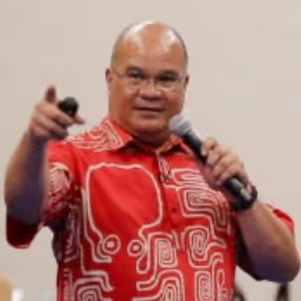
Host Noah Ranz-Lind interviews Dr. Keanu Sai about the history of education in the Hawaiian Kingdom, the effects of colonialism and occupation, and the connection between Hawaiian sovereignty and pedagogy. Dr. Sai is a political scientist at the University of Hawai'i Windward Community College and has represented the Hawaiian Kingdom at the Permanent Court of Arbitration.
transcript
Speaker 1 Aloha, everyone, and welcome to a new series at the Human Restoration Project. My name is Noah Randsland, and I'm a student at the University of Massachusetts Amherst. Before we delve into the rich history of pedagogy in Hawaii, I'd like to take a moment to explain the motivation behind this miniseries. I began interning at the Human Restoration Project in the summer of twenty twenty three, my family having recently moved to Oahu, Hawaii earlier that year. While trying to find a project to work on, I found myself tumbling down the rabbit hole of Hawaiian pedagogy, an area of study largely unknown even to many progressive educators. Often a footnote in American history classes, the nation of Hawaii has a rich pedagogical history and at one time was one of the most literate, reaching near a 100% in both English and Alelo Hawaii. The Hawaiian education system has had a major impact on global history, taking in people from across the world since its inception. A notable historical figure who went to school in the Hawaiian kingdom is Sun Yat sen, the Chinese revolutionary often considered the father of modern China, who orchestrated the overthrow of the Qing dynasty in 1911, developing his theories of democracy and pluralism at the Ayalani and Punahou schools, both of which are still regarded as world class institutions. In addition to its private schools, the Kingdom of Hawaii made public education a cornerstone of its constitution, founding one of the oldest public education systems in 1840, decades before The United States. However, the occupation and subsequent illegal annexation of the Hawaiian Islands by The United States Of America, along with historical revisionism and denationalization that has continued to deprive Hawaii of its national recognition, ultimately led to the negligent mismanagement of a once world renowned education system. Since the overthrow of the Hawaiian government, the Hawaiian public system has been thrown into disarray, and a massive educational gap has formed between native Hawaiian youth and their peers. Yet, despite this, the pedagogical innovation characteristic of the Hawaiian kingdom persists today. And with this miniseries, I hope to highlight some of the amazing work being done to heal the scars left by occupation and the denationalization of the Hawaiian people. First, we will look at the history of Hawaiian education through an interview with doctor Keanu Sai, a political scientist and senior lecturer at the University of Hawaii Windward Community College, political science and Hawaiian studies departments, affiliate graduate faculty member at the University of Hawaii at Manoa College of Education. We will explore the chronology of events that impacted Hawaiian education, education, as well as the legal theory behind the continuation of the Hawaiian kingdom and its ties to Hawaiian pedagogy. Next, we will learn about the work of doctor Stacy Potess, who recently defended her dissertation on ethnomathematics, discussing the need to ground mathematical pedagogy in place, community, and culture with our Aaina based framework. And finally, we will get a glimpse into how these ideas are put into practice at the Hana'aoli School, a pre k through sixth grade progressive school that has been a part of the Honolulu community for over a hundred years. Mahalo nui for joining me on this journey as we explore the history, philosophy, and practices of pedagogy in the Hawaiian Islands. Hello, and welcome to episode one of the three part series on pedagogy in the Hawaiian Islands, where we explore history, philosophy, and progressive developments Hawaiian pedagogy. My name is Noah Ransland, and I'm a student at the University of Massachusetts Amherst interning at the progressive education nonprofit, the Human Restoration Project. Before we get started, I wanted to let you know that this is brought to you by our supporters, three of whom are Anna Wendland, Deborah Covington, and Patricia Jennings. Thank you for your ongoing support. You can learn more about the human restoration project on our website or find us on Twitter, Instagram, or YouTube.
Speaker 2 In
Speaker 1 this episode, we delve into the history of education in the Hawaiian kingdom, the impact of occupation and colonialism, and the link between Hawaiian sovereignty and pedagogical practice here in Hawaii. Today, I'm joined by doctor Keanu Sai. Doctor Sai is a political scientist and senior lecturer at the University of Hawaii Windward Community College, political science and Hawaiian studies departments, and affiliate graduate faculty member at the University of Hawaii at Manoa College of Education. He also served as agent for Hawaiian Kingdom at the Permanent Court of Arbitration, The Hague Netherlands, in Larson v. Hawaiian Kingdom. His research focuses on the continued existence of the Hawaiian Kingdom as a state under international law that has been under military occupation by The United States Of America since 01/17/1893. Hi, doctor Tsai. Thank you for joining me today. I'm glad to be here. So I wanted to talk a little bit about just sort of as, like, a background. I know your history expertise is in Hawaiian history. And in particular, I wanted to talk about sort of, if you could, a little bit, maybe before even Western contact, what education looked like here in Hawaii in the various different islands, maybe even before the kingdom was
Speaker 2 unified? Well, the problem that we have with regard to before captain Cook arrived. Right? Let's use that date, 1778. There was no written record of what was going on. Right? So we call that prehistoric. Historic not not in the sense of dinosaurs, but prehistoric, which is prewritten history. Right? Now, once the the the language was reduced to writing in the eighteen twenties, what began was gathering of stories of elderly people to put things down. So a lot of ethnography was going on. Right? And that was not pushed by any foreigner. It was actually encouraged by instructors at Lahaina Luna, which is a secondary high school secondary school, like a high school and college that the government ran. Okay? Lahaina Luna. And a particular person is Samuel Kamakau. So Samuel Kamakau is one of a few that went out and actually interviewed the warriors under Kamehameha and also under other Alii who are engaged in battles, trying to preserve the stories. And we don't have too much on education. Right? Because the system back then was very different than what we had today. The situation back then was was very futile like, very military. It bore a remarkable resemblance to the Middle Ages, right, and the way lands were held. What can what we can surmise is that education was specifically tasked on what class you were in. So if you're in a Li'i or chiefly class, you were trained, I guess you can call that educated, in fighting. Right? Being a warrior, tactics, strategies, all that. If you were a Makay Nana, commoner, you were trained in fishing. Right? So that's one of the trades that was there, farming. But you can't say there was any particular pedagogy without any evidence. But we do know that it was a thriving system. And our anthropologists today are now recognizing that the island kingdoms in the North Pacific, across the islands, it's multiple kingdoms, were actually archaic states, yeah, or primary states similar to Mesopotamia, Mesoamerica because of the stratification and organization. And Captain Cook referred to that in his observation in the shiplogs as to how everything is so organized and very kingly. Right? So when a when a king issues an order, we call it an. People listen. So you had this this common law that was understood without a written language. And and that, needs more study, more studying for sure. And so then as
Speaker 1 the Hawaiian kingdom, you know, unified and as it started to be more, you know, recognized by, you know, the various global players at the time. How then, you know, in the transition to a constitutional monarchy, how then did those education systems develop, and what political structures supported them, and and what, you know, philosophies Well, one thing that caught the attention of the chiefs
Speaker 2 was what came to be known as Pala Pala. So Pala Pala is reading and writing. Okay? And it was caught on by the chiefs, and there's a story that goes something along these lines that when captain Cook arrived, was he didn't see a lot of screaming as far as marching orders. So he would watch a lieutenant write something down on paper, and somebody runs with it across the ship, the person at the mast in the in the front of the ship looks at it and he starts doing something. And he asked, what is that? And he said, I gave him an order. And that shocked the chiefs because no word was spoken. Right? Something so simple we take for granted. They were like, wait a minute. Now the one thing about the the the culture of Polynesia, especially in the Northern Pacific, the Aliyi system is very autocratic and orders are issued. So we have what is called the kawoha, And and there is a nihopalawa. It's a symbol that chiefs wear. It's a carving, and the carving is of a tongue. Okay? A tongue. That tongue represents the one who issues the order. So so you have to speak the order. To put something on a on a paper and nobody says anything, that was intriguing because they were able to get something across and accomplish when they didn't have to say anything. So I think that right there, just from observation of the chiefs, not the commoners, the chiefs were like, this is something that is it it possesses what will be called what we will say mana, power. Right? It was something unique, something different. Now that began a a a chain of events that would develop into something very big, reading and writing comprehension. So Kamehameha, in 1794, he, in an agreement between captain Vancouver and Kamehameha and his chiefs, agreed to join the British Empire or he became a British protector. Okay? 1794 in February. Now being a part of the British Empire, as a protector, not as a colony. Right? Kamehameha was still able to run the country. Right? But his allegiance was to King George the third. So they considered themselves British subjects. Now they knew that they needed to increment slowly British forms of governance. So that's where we get the prime minister in our history. We get governors. It's all from English forms of governance. Right? But the one thing that we needed to change back then was the religion because the religion of the chiefly system was not Protestant, and it was not Christian, and it was quite brutal. In fact, there was human sacrifices for the war god. Okay? So those were just how things were, right, in in these separate kingdoms throughout the islands in the North Pacific. Member that first knew he needed to begin to make that change, but he wasn't able to do it because of his rank. But his wife and his son will be able to do it because they were of a higher rank, and they won't cause too much disruption. So so what happened after Kamehameha the first died, the the custom is the religion, which is very strict. It's called a kapu. Right? It's lifted, and they call that Noah lifted. And everybody mourns for the king. Okay? The successor is supposed to reinstate the couple. Right? Well, what Liholiu did, which is Komemba the second and his mom, who is Komemba the first wife of a very high ranking chiefist, they just never brought back the kapu. They left it. And now it was basically left it left a vacuum, or should I say an opening for the new religion to come from the English because Kamehameha the first asked captain Vancouver to send British missionaries. Right? So in 1820, one year after Kamehameha died, American missionaries showed up. Right? Hawaiian kingdom didn't didn't ask for them. They were waiting for British missionaries. Same religion, Protestantism, but wrong country. Right? So when they arrived, they heard that the couple was never reinstated was not reinstated. So they thought it was a blessing from God. Right? But when they arrived, they weren't allowed to land because they were American, and this was on the heels of the war of eighteen twelve. So they were looking at the Americans, a, you could be an extension of The United States coming to take over. So they were very hesitant to allow them to land even though you had some native Hawaiians with them who came with them from the East Coast. Right? So what ends up happening is John Young, one of the advisers to Kamehameha the first. He's a bit elderly. Right? But he was British, and he was advising Kamehameha the first on British governance and everything and British tactics in fighting, all these things. So what ends up happening is John Young goes on board to the ship, goes on board the ship, and he explains to everyone the the problem. He says, right religion, wrong nationality. That's why you're not allowed to land. But he was able to convince the chiefs and Komemba the second at that time, who was the son of Komemba the first, allow them one year license to land so they can watch them. And that license was extended three additional times for a total of four. During that time, the chiefs were able to really understand where they're coming from because if they're coming just with the religion, that's all good because they're waiting for it. Right? They didn't come here and need to convert anybody. They're waiting for them. So they finally agreed in 1824 to go teach the people, but more so to teach the Palapala, the reading and writing. And the reading and writing took off because it was through the reading and writing that the missionaries were able to teach the word of God, Protestantism, through reading and also preaching. And the Hawaiians love that because they were more interested in the reading and writing than necessarily the word of God. Right? So you have this kind of, I would say, a bit of synergy going on, but it's still going through its bumps in the beginning. But what the missionaries were running into, there was no hesitancy as to the religion, but they they weren't accepting it as quick as the missionaries wanted it. What they were accepting was reading and writing, and that was flying. Everybody could read and write. Literacy by '18 thirties was universal. Everyone could read and write in the Hawaiian language, and that was that's pretty astonishing. So that right there began to allow the implementation of education. So education is now gonna come on the heels of reading and writing and comprehension. Right? And it starts to flourish. So when they begin to organize themselves as a constitutional monarchy under Kamehameha's second son, Kamehameha the third, Kawi Kiyoli, He begins to do government reform because what's happening is you have gunboat diplomacy. You got the French coming, captain Laplace in 1839, forcing certain things upon the king, preferential treatment for French. Right? The British, Lord Paulette, came in 1843, right, forcing special preferential treatment for British. So Kamehameha was becoming embarrassed, he says. You know? He's not being treated as an independent king. And what he was advised to do, government reform. Government reform that would show these other countries that we are a bona fide government that can provide the rule of law, the protection of rights to everyone who are coming to Hawaii shores but under Hawaiian law. And that began the process of learning political science. It was taught at Lina Luna by William Richards. They adopted Francis Whelan's elements of political economy, also the moral science. And this was all toward making sure that they control their government. So they're taking these in these influences and these these the multiple histories of different countries, but they're putting it in their own words. They're putting it in their own action because this was not foreigners coming to Hawaii to tell them that they needed to do something. They did this by circumstance. Right? And they began to adjust. And that began the evolution of a constitutional government, very progressive, but also the broader aspect of of Western thought, not Western thought to be imposed, but Western thought in particular, the enlightenment era. Right? So John Locke, the the consent of the governed, these principles of of of law. Right? Also, the science revolution led by Newton. You know? Hawaiians were grabbing onto that. I mean, they're like a sponge just sucking it all in. And and that's what ended up becoming a very robust educational system in the Hawaiian Kingdom that actually by the eighteen eighties had a student study abroad program where the Hawaiian Kingdom would send students to Europe, Japan, and China to learn and come back home. And that predates what countries are doing today by sending students out to other countries and come back home. Hawaiian Kingdom was already doing that. So Hawaii, its history has always been thought of as oppressive, the white man king, the missionaries king. That is all false. There is no evidence of that. None at all. It's it's it's it's sometimes it ventures into conspiracy theories. It's it's not true. The evidence don't support it. Now the fall of the Hawaiian educational system occurred when our government was overthrown after being invaded by US marines, that's when things started to change because the natives, being the majority of the national population, were the threat were the threat. Very enlightened, understood their laws, participated in their government. The majority of the attorneys in the kingdom were native because they were good orators. Right? And you just start to see a a a systematic move to denationalize the population. So in America, overthrew our government illegally, which president Cleveland acknowledged was illegal, and he sought to restore the queen, The issues of Pearl Harbor was was a driving force with the congress. They always wanted Pearl Harbor as a naval base and to use Hawaii as a military outpost to protect the West Coast Of The United States. That then started a chain of events that were not in line with the Hawaiian kingdom, but in line with American expansionism. And by nineteen o six, after not being able to acquire the Hawaiian Kingdom by a treaty, all they did was pass a law in 1898 during the Spanish American war saying we got you. Well, US laws have no effect beyond the borders. So how do you conceal that obvious illegality? Right? Well, in nineteen o seven, nineteen o six was the formal implementation by The United States here of denationalization, and that is when they began to obliterate the national consciousness in the minds of schoolchildren. Now that is my grandparents' generation. By the time it got to my parents, it's already institutionalized. By the time it got to me, it's already complete. My mind had no memory of how the country operated. None at all. And that is pretty much what you have today. So when you have American education being imposed here, it's the socioeconomic aspect that has a very powerful influence on children learning because their parents don't have good jobs. Right? The parents might come from a culture of drug addiction, spouse abuse. Right? These are real issues that did not exist before the Americans invaded us, but it did come to existence when you subjugate the natives of their own country, when they become strangers to their own country, and it just becomes a matter of survival. So when you look at education and pedagogy today, that is reacting to the take to the consequence of the takeover, not really looking at how the Hawaiian Kingdom operated through its pedagogy that was very successful in in in in ensuring that the country's education is key and important because the Hawaiian kingdom understood that was the future of the country. That is why the legislature in the in the kingdom was very not hesitant, very open with their, budget, right, for education. Very different today.
Speaker 1 Yeah. Yeah. I think that's that's that's really interesting. I think that's a perspective that maybe a lot of Americans don't really get to hear. You know, I I I remember when I learned American history, you know, I took APUS history, which I think is supposed to be considered one of the more robust and and and, you know, all encompassing ways that you can learn American history, at least, you know, in your typical public school. I know that the that was not the history that I learned, and and that I think it it, at times, fit a lot more of the description of of what you're saying before, that that stripped sort of Hawaiian of it Hawaii of its historical sovereignty and hit and its, historical role as an independent nation. And then, you know, just blatantly disregarded the, you know, illegal occupation and and the role that The United States played in, you know, stripping Hawaii of its sovereignty. But I I I'm curious to hear more about before the overthrow of the government, what could you identify as sort of uniquely Hawaiian characteristics of the pedagogy, that was practiced in the Hawaiian Kingdom? And then how did those pedagogical principles change, after the overthrow?
Speaker 2 Well, in the kingdom, it's it's western. Right? It's a western system, but it wasn't a matter of oppression. It was adopted. The the Hawaiians brought it. I mean, well, accepted it. They sought it. And that's very different than the colonial context that it was imposed by the colonizer or to force people to assimilate so that you can become what we are as opposed to what you are. Right? In the Hawaiian Kingdom, it was no different than you look at Japan. Right? So Japan today is not European, but it's Western because it's West it's Western not because of the European ties. It's Western because of the the the concepts of Western thought, the idea of voting, the idea of equal representation, the idea of science, of of falsification, of research, that is not limited to people living in Europe. That just is something that is important. Right? It helps explain things. So you evolve. So the Hawaiian Kingdom was no different than Germany. I'm sorry. No different than Japan, but at the same time, different from Germany, and yet Germany is European. The Hawaiian Kingdom was not European. Right? So its approach to teach was in line with what was going on throughout the world. So I'll give you an example. In 1884, Bernice Pauwahi Bishop, she was a high ranking chiefess who established what came to be known as the Kamehameha Schools, and that still exists today. And when the Kamehameha Schools was established in 1887, it was established as a secondary school. In the kingdom era, secondary schools were also called colleges. Right? So in each college or each secondary school, there was a way of teaching that will be called pedagogy, but also the approach on not necessarily how to teach, but what to teach. So what was unique to Kamehameha Schools, which I'm a graduate of, and I graduated back in 1982, not from the kingdom era when it was operating in a very different way, but they adopted what was called manual training. K? Manual training is not manual labor. Manual training is hands on engineering. That's the key. And it was actually introduced at one of the world fairs in the eighteen eighties, I believe, or eighteen seventies. I believe it was one of the Nordic countries that introduced I think it's maybe Finland on a way of teaching. And I believe Northern Dade picked it up. Right? And you actually had teaching manual training, which was engineering, but hands on wood, carpentry, these kind of things. So you start to apply that. Commemment schools adopted that that form of teaching manual training. Now after the overthrow, the most of majority of the trustees actually yeah. Well, the majority of the trustees of the commitment schools were all the insurgents. They changed it. Commemment schools later came to be known for manual labor Mhmm. And not manual training. And that they started to train people who went to government schools for the workforce, to be police officers, to join the army, join the navy. It it it did not adhere to manual training as it did before 1893. So that's an example of of a type of pedagogy that was applied to a native Hawaiian secondary school because it was limited only to native Hawaiians. Preference was for native Hawaiians to attend that school. That was according to the the Bernice, Hawaii. So that's that's that's one example. Other places like at Lahaina Luna, if you take a look at I sent you the the 1882 annual exams. That's a reflection of what was being taught. Right? And they would use pedagogy that would be used in, let's say, Yale, Harvard. Right? And points were excelling. So they weren't falling behind like how you have it today. But Lionel Luna, secondary school, I mean, they went from geometry, algebra, trigonometry, calculus. Every four years, every one in those classes required math, not it was inelected. Plus, you had world history. You had political economy. You had constitutional classes on how the constitution of the country operated in Hawaiian Kingdom. So very different. So the way they operated back then was education was a part of a country. And the future of that country called the Hawaiian Kingdom was dependent upon good education. And that's what was reflected in the school system before 1893.
Speaker 1 Yeah. I I that's that's really interesting, and I think it it speaks to a lot of the reasons why today, you know, Hawaii is falling so far behind in education, the element of subjugation, which sort of, from what I understand, really permeates Hawaiian political structures now, you know, as a state in The United States. I think you see what you're saying a lot. You know? You just you walk around and and you see the schools, and and then I think it's it's hard not to see exactly what you're saying. So I'm curious how you personally would characterize now the relationship that Hawaii has to The United States, and what you feel needs to change both sort of at a larger level, but sort of honing in on the education system, what changes you think really, like, need to happen.
Speaker 2 Okay. So what we see today is is consequential to what occurred in the past. It it and and incidental because the Hawaiian that exists today in this society is not the same Hawaiian that existed previous to 1893 and the overthrow. There are two different societies, two different ways of thinking. And it goes back to the illegality of the American presence here. That's important. When I say that Hawaii is an occupied state, that it is not a part of The United States, that's not a political statement. That's a statement of fact. And a statement of fact that history can confirm. And the way it can confirm it is to understand Hawaii's position in the world at that time with regard to international law. So back in the nineteenth century, the Hawaiian kingdom was only one of 44 independent states, which includes The United States. Only 44 independent states existed at that time. Today, the United Nations has 193 members who are independent states. A lot of them came about through decolonization. Right? But the Hawaiian Kingdom was an original independent state. It was never a colony of another country, let alone The United States. Under international law and those rules that apply to those countries, 44 countries, as it would apply to the hundred ninety three or so today, is that when a military invasion overthrows a government of a country, it doesn't equate to an overthrow of the country. It's just the government. Right? So under international rules, there's a separation between the country, which is a state, and its government. International law called international humanitarian law, the laws of war, require an oblique that the invader who overthrows the government must provisionally be that government to maintain public order. So they have to administer the laws of the occupied state, not impose their own laws. So when the government of Japan was overthrown in 1945, general McCarthy became a military governor over a government that was formerly Japanese to continue to administer Japanese law until you get a treaty. And that happened in 1952, which is when the occupation of Japan ended, 1952. The same thing applied to Germany. Right? Because Germany's government, the Nazi government, was annihilated, Germany, like Japan, didn't lose any sovereignty. They just they didn't have control of their sovereignty because the government was overthrown, and that's important. So what we had in the case of the Hawaiian Kingdom, they overthrew our government with the purpose of securing Pearl Harbor as a military outpost, a naval base. Today, Hawaii houses 100 and military sites 118 military sites. It is headquartered for the Indo Pacific Combatant Command. That's where we are today. Now how did we get to that point? Well, The United States was unable to acquire a treaty from the Hawaiian Kingdom after they overtook the government. So in 1898, during the Spanish American war, The United Spanish American war, the United States Congress, based on this military necessity as they argue, we need to take Hawaii in order to fight the Spanish. So they passed the joint resolution in 1898 purporting to annex a foreign country. Now The United States could no more pass a law in congress annexing Canada. Right? Then they could annex a the Hawaiian Kingdom by passing a law, period. It's limited to their territory. Now what ends up happening is when United States now takes over the government of the Hawaiian Kingdom that was being held by insurgents that they installed, they start to implement that plan of denationalization. And they begin to brainwash the children, not the adults because they knew Hawaii was occupied, but they began to brainwash the children that they are no longer Hawaiian subjects but Americans and that Hawaii was acquired by a treaty and that you must speak English. And if you don't speak English, you get beaten. That right there is a war crime. In 1919, The United States and the allied powers in World War one accused Germany, Austria Hungary, and Bulgaria for committing the war crime of denationalization to Serbian schoolchildren. That's a war crime. They were doing it here. Where the war in in in the first World War only lasted four years, so it was more of an attempt to be nationalized. What we got here is a hundred thirty years of denationalization that has gone unfettered, no accountability. That creates a devastating effect to the psyche of a people who were led to believe that they're part of The United States and then Americans start migrating to The United States where the American population in 1890 according to the government census. Did you know there was only 1,900 Americans? Yeah, 1,900. By 1950, according to the US census report, that population exploded to 500,000. And here we are today with more. So you have Hawaiian subjects who believe they're Americans through brainwashing trying to survive in a system that they don't know how to exist in because they have always been put down the jobs. Right? They weren't allowed to go to high school during the territorial days. Did you know that native Hawaiians only went up to the eighth grade? Then they started to work. Oh, yeah. That was a policy. And who was allowed to go to the high schools? White people. In fact, it's clear. They even say it. It it it that that their their purpose was to make sure that the high schools were not only American as far as students, but also American in blood and being white. It's in the newspapers. So you start to see where that that past, it has a direct link to where we are today. I have some native Hawaiians that excel. They they were able to get good jobs. So the social economic problems were not part of them, but you have many others that didn't. And what you have is a collection of people trying to survive in a in this type of socioeconomic system that is not theirs. Now, what is my answer to this? Right? Not that I exacerbate the problem. I'm just identifying the problem so that we can have a proper diagnosis on how to provide a remedial solution. The first thing is under the law of occupation, which still exists today, that the occupier must begin to administer the laws of the occupied state, not American law. Even though a hundred thirty years passed, that law still applies. Now once you begin to administer the laws of the occupied state, you also have to bring back and align today's society with the status quo of what the Hawaiian kingdom was before the invasion. Its institutions, its territory, its education, its language, those are the rules. Now that's pretty lofty as far as what should happen. Well, it gets down to one point, and it needs to be important to know as to whether or not the Hawaiian kingdom still exists, or am I just saying it? So I was part of a group of Hawaiian subjects that restored the Hawaiian kingdom government very similar to how governments in exile were established during World War two. And I also have a military background. So I used to be a field artillery officer. Got on as a captain. So I have a lot of experience from the military side. So we we restored the government and we came up with a strategic plan, an operational plan to address this monolith of a problem with limited resources and manpower. Right? So we came up with the three phases of a strategic plan. First phase, we need verification that the Hawaiian Kingdom continues to exist as a state. A state is an international law country. Once we get verification by some reputable body, which at that time, we didn't know where, but we needed to get it. Once we get verification, then we move to phase two, exposure. Expose the Hawaiian state politically, economically, through education, legally, and basically just get everybody uncomfortable because everything you thought was is gone. All your property you think you own in the Hawaiian king in the Hawaiian Islands, you don't have title. Every title stopped in 1893. Who's the notary public? Right? The the the rules were not abide by. Contracts. Right? Barack Obama. People say Barack Obama, you know, the birthers, you know, they were right for all the wrong reasons because, oh, he was born here, and he was born outside of American territory. He was born in the Hawaiian Kingdom. So he's an American by parentage from his mom, but he's not natural born. That's an example of how you get things hot because when people start to feel uncomfortable is when it's real. Right? So that's phase two, and that is gonna lead to war crimes. That is gonna lead to criminal culpability where now it's individuals gotta think about what they're doing and not one standing behind The United States, and they're gonna protect me. No. No. You can get hit with a war crime, and there's no statute of limitation. In fact, Germany prosecuted a 97 year old secretary for Nazi war crimes from a concentration camp. That shows you there's no statute of limitation. So it kinda plays on you. Now to all that means all that would not be able to take place unless we get past phase one. Verification, the Hawaiian Kingdom still exists as an independent state. So what occurred in 1999, there was an arbitration case. Lance Larson, a Hawaiian subject who who went through an unfair trial because he was trying to claim he had rights as a Hawaiian subject and that these laws of the state of Hawaii are illegal, he was eventually incarcerated. His attorney alleged that the council of regency, the restored government, was liable for not protecting him because we're allowing American laws to be imposed. That was their argument. And we denied it, but we entered into an agreement, an arbitration agreement, to take it before the permanent court of arbitration in The Netherlands, which is a a body that will resolve international disputes. It's not a domestic dispute. So when the the notice of arbitration was filed, we knew, the council of regency knew, that we can get past phase one. Because under the treaty that established the permanent court of arbitration in 1899, which The United States was a part of. Right? They provide that any contracting state to that treaty will help maintain the permanent court of arbitration. So if they have any dispute, they will they can use the facilities the facilities at no cost. But article 47 of the treaty allows noncontracting states to have access to the institution to resolve an international dispute, but they have to pay at cost. Right? So today, you have a 123 members contracting states of the permanent court of arbitration. You have a 193 members of the United Nations. That means the balance of the 122 members of the UN are noncontracting states, but they can still have access to the permanent code of arbitration at cost. Right? The others, no cost. We knew that it's our way to get verification because we're we are a non contracting state, and the proceedings would have to pay at cost, would have to be borne by both parties. In fact, it would be borne by the plaintiff, not us because we're the defendant. But in order to get accepted into the permanent court of arbitration, article 47 of the treaty has to be fulfilled. So when the case was initiated in November 1999 in The Netherlands, in The Hague, the secretariat, which is the the body that runs the permanent court of arbitration, its secretary general contacted me. And this was the case started was initiated November 1999. I was contacted by him in February 2000. Between November 1999 and February 2000, they were doing their due diligence as to whether or not the Hawaiian kingdom continues to exist under article 47 to allow it access. So he's on the phone with me, and he says that because I was the lead agent for representing the Hawaiian kingdom. He says, mister Sai, the secretary here in The Hague can find no evidence that the Hawaiian Kingdom ceases to exist because there's no treaty. So he tells me. And I said, okay. And he goes, you would highly recommend that both the Hawaiian Kingdom and Lance Larson's attorney agreed to provide a formal invitation to The United States to join in the arbitration when they create the tribunal, which they did in June 2000. And The United States, we had a meeting with them at the US State Department in on March 3 in Washington. They're apprised of the offer. And two weeks later, we get word that they denied the invitation, but they never contested the Hawaiian kingdom's existence or the tribunal being formed. All they asked is permission from the council of regency and Lance Larson's counsel if The United States can have access to all records and pleadings of the case. For us, regarding our phase one, we got it. During our oral hearing in The Netherlands on in December 2000, We had oral hearings there. We're gonna use that oral hearing to begin exposure of the Hawaiian kingdom on that bully pulpit, and we're gonna make sure it's in the transcripts. And once we finished that, we were contacted by an ambassador from Rwanda who was at the court because at the International Court of Justice, which is housed in the same Peace Palace, they're in the same building. Right? International Court of Justice was they had a case, Congo versus Belgium, because Belgium had issued an international arrest warrant for the Minnesota Foreign Affairs of Congo for genocide, and they wanted to arrest him outside of Belgian territory. So that was the issue at the International Court of Justice. Across the hall was the Hawaiian Kingdom case, and it caught the attention of the ambassadors who were in attendance because what is Hawaii doing in the Peace Palace, which is a building? Well, he went to the permanent court of arbitration secretary of the registry and asked if you could have access to all records and pleadings. So what we did was we made it not only for The United States to have an act to have access, any country can access the records. He contacted us on the last day of our hearings. We had three days of hearings, oral hearings up in The Hague. On the last day he contacted us, he says he he has important information to convey to us. If we can meet him in Brussels, Belgium. So myself and my legal team got the train. We had a meeting with the ambassador. He explains to us that his government in Kigali had reviewed all the records, and it is clear Hawaii is occupied, and this cannot be tolerated over a hundred years. And that Rwanda, with the consent of the council of regency, is going to be able to offer bringing this to the attention of the United Nations General Assembly by putting us on the agenda, always occupation. Now that prompted a meeting that I needed to have with my legal team because we're about to move from one mountain to another mountain, and our people back home have no clue what's going on. Right? So we had a quick meeting. I sat back down in front of the ambassador, and I said to him, please convey to your president our sincere gratitude and thanks, but we cannot accept this offer at this time. It's too premature. Our people back home have no idea of Hawaii's profound status as a country that still exists but under occupation. We need to address denationalization head on, And and thank you again. So the meeting came to a close. We caught the train back to The Netherlands in The Hague. We had a meeting, and it was agreed upon that since I already had a bachelor's degree from the University of Hawaii in 1987 in sociology, I know what they're teaching about Hawaii's history, colonization, indigenous peoples. It's all wrong, completely wrong. Since I already have the bachelor's degree, the plan was for me to enter the political science department master's program, get a master's degree specializing in international relations and law, and they get my PhD and start changing the understanding of our history from inside. And that triggered many different doctor dissertations, master's theses, peer reviewed article, library articles that speak to these issues, which is where we are today because people are becoming educated. And once you start to get educated, then you can make an informed decision on how to fix the problem. And right now, we are in secret we're in negotiations with senior leadership of the state of Hawaii for the transformation into military government in order to comply with the law of occupation. So it's being taken very seriously, very seriously as a result of education. So just as the insurgents and The United States weaponized education to satisfy their agenda and to conceal any legality, we utilize education and we weaponized it as well in a positive way, apply scientific thinking, falsification, research, theory, footnotes, evidence, you know, and that's where we are today. So we are continuing where our where our ancestors were what they understood in the kingdom era, the importance of education. And here, we're using that, the importance of education to right the wrong, and we're walking on that path. We don't we don't need to wage warfare. I like to call what we wage is lawfare. Mhmm. And education base is the key.
Speaker 1 Yeah. Yeah. It's interesting. It it it really seems like today just as education, you know, learning about Hawaiian history and and Hawaiian culture and and the full scope of what Hawaii as a, you know, kingdom and as a community of people has done was essential in the recognition of the Hawaiian Kingdom. So it is now in reclaiming that status as a, you know, sovereign independent nation. To shift gears a little bit, I wanted to ask you about so I've been reading recently a lot about sort of indigenous Hawaiian progressive pedagogy and the sort of core elements of that. And you sort of touched on a little bit one of the things that's discussed a lot, the sort of hands on learning. You know, I I I've spent some time, at the Hana'aoli School. I don't know if you're familiar, but it's a school that, is, you know, it's it's it's constructed around sort of the ideas of of progressive era education. And so I'm interested in whether you feel that this sort of this indigenous Hawaiian pedagogy that focuses on Hawaiian cultural practices as a center point for education, you know, in particular, that sort of, you know, hands on approach. Other elements include sort of the the notion of place based pedagogy, the element of, or family, in, you know, the education and and pedagogical philosophy. I'm curious whether you feel that that sort of new progressive movement that's forming is a continuation of what's come before or whether you feel that it's something entirely new that's coming up as a reaction to the century plus of occupation.
Speaker 2 Well, it it comes with a lot of baggage as far as the approach. K? And inherent in this pedagogy is colonization, the rights of indigenous peoples, the state itself that tribal nations exist within and are trying to take control through self determination in controlling their form of education. Okay. Now the problem with that is it's counterproductive counterproductive to our situation because the word or the term indigenous peoples, peoples plural refers to nations. The definition is that indigenous peoples are tribal nations that exist within a state not of their own their own making. So the Navajo Nation, the Choctaw, the Maori Nation of New Zealand, Aotearoa. Right? They are tribal nations that exist within a metropolitan state not at their making. Now, in the case of Tonga and Samoa, which are members of the United Nations, they're not indigenous. They're not an indigenous people because they created their state. Right? There are no tribal nations in Tonga. There are no tribal nations in Samoa. Samoa and Tonga was made up of their people who evolved to a point of making a state of their own. Hawaiian kingdom did the same thing in 1843, internationally recognized as an independent state. So when you bring in the idea of of of indigeneity, it murkies everything. It it it it's like you have to say, yeah, you're in The United States, but I know you're occupied. But you can't be in The United States and occupied at the same time that mutually exclusive. You're either occupied or you're part of The United States or not. So what ends up happening is because money is tied to research and education in this current system, you can only get money within this system if you play the tribal card. Right? And with that, you bring the baggage. There is no money in research to to educate people who have been denationalized as a war crime. There's no money there unless you go find it outside of The United States. Right? So you can see a lot of the the academy here in Hawaii. It's cut they're caught. Like, they have to say this in order to get this, in order to teach this, but it accomplishes nothing. Those those families that are in the charter schools, they're trying to find an alternative to teach or have education for their children because maybe it's special needs, maybe have difficulty reading and writing. Right? That's charter schools come with alternatives than the public schools. Right? Well, because they have those problems at this age is indicative that the family has a problem socioeconomically in how to even survive in in these islands under this current system, which prompts them to leave the island and go to America because of the cost of living here. You know, so these these attributes of the American occupation puts everybody in a bind where it's survival. Right? Now, if you talk about hands on, well, hands on is what exactly what manual training was at Kamehameha Schools in 1887, you know, and it wasn't from America. That's from a Nordic country that America adopted some of the colleges like Notre Dame. And then, in fact, in 1887, this was interesting, they invited a a lieutenant from a US naval ship that was in Honolulu Harbor visiting, not taking over, visiting. They actually asked the lieutenant to give a presentation to the student body of the Kamehameha Schools on manual training and how he benefited because he was an engineer on that ship. So he was speaking. This is what you can become. Right? An engineer. And I learned it, and that's what you folks are learning too. So Hawaii's sense of education was worldly. Right? It wasn't parochial. It wasn't us against them. Another thing that the Hawaiian indigeneity movement has, which is problematic, comes a big problem, is that the academics of today probably began, I would say, nineteen eighties. It didn't exist before that. There was a movement here to align themselves up with the American Indian movement and indigenous peoples through through Halani Trask. And our system, Mililani Trask, was also on the permanent form of indigenous rights. And that was operating on on a false premise and always a part of The United States, but maybe we have rights as a tribal nation. So we have to kind of organize ourselves that way. So what they ended up doing, I don't know whether it was intentional or not, they began to manufacture the story that the American missionaries were the colonizers of The United States. And when they came to the Hawaiian Kingdom, they controlled everything. They created the government to benefit them. They created the constitutional system. They created the the land system. Complete fabrication, fabricated, and it's already been rebuked. Right? So when they start teaching in the charter schools, it's infused with Hawaiian Kingdom was foreign, The foreigners controlled it, not us. The chiefs were in were were aligned with the foreigners. The Makaynana, the commoners, we were the one abused. It's all made up, completely made up. And that is what the university is going to right now because research has already rebuked all of that and research done by native Hawaiians themselves. So it's not an issue of ideology. It's called get your facts straight and apply the right theory. That's all it is. So you might say everybody's trying to explain a football game using baseball rules and getting angry because things don't make sense. You have to explain a football game using football rules, and that's called the law of occupation. Now everything makes sense, and that's the difference.
Speaker 1 And then sort of as a last question, I want you to sort of tell me what you imagine Hawaii could look like, what it could be, and, you know, from an educational perspective, but just sort of generally what what you wanna see.
Speaker 2 So there's a a Hawaiian concept, and it it places importance on the past. Right? So the word in Hawaiian for future is kava mahope. And so va is a short term for manava or time. So is literally the time of the past. K? Is a directional. So when you tell the Hawaiian, look to the future, they turn to the past. Right? Now in that past are all the stories that happened from one minute ago to a hundred years ago to five hundred years ago. And these stories is what we call mo'olelo. Each story is important because you capitalize on successes and you learn from mistakes. Once you process that film of the past, you will naturally have what is called, and we say in Hawaiian, You have foresight. Now you see something you didn't see before. And from what you now see, you have an informed decision in what you gotta do. K? So so that's a concept. Another way of saying it is the practical value of history is that it's a film of the past run through the projector of today onto the screen of tomorrow. That film never changes, but your projector has to get updated. Once you update the projector, you see something bigger. What we have to be and according to what the rules are with the law of occupation especially. The whole thing about the law of occupation, its purpose is to maintain the status quo of the occupied state before the invasion and before the occupation. That's a standard. So you cannot deviate from the creating or changing the institutions, the people, the territory, and so forth. Right? Well, what we have to do is we have to take we have to go back to what we were. K? That's important. So we have to align everything up to what we were before the invasion and then bring it up to date with the development of new ideas, new issues that have to be addressed by the legislature, but we can now have a starting point. So we have to go back to what we were, not what I think we should be. That's too futuristic in the in in in a nonsensical way because that's hypothetical. Right? That's that's in a vacuum saying something like that. But if I can go, Kamehameha Schools was manual training, we have a starting point. Let's look at Kamehameha Schools today. You gotta align. You gotta bring that back. Right? And how do you do that? Well, that's where people gotta get creative. In the army, we call that necessity, and necessity is the mother of all inventions. But as long as there's a baseline, that's why it's important. We need to know our past before we look into the future because the future is merely a product of our past. And I've seen that operate in how we've been implementing our strategic plan. That past that we brought out has created huge changes, major changes. And at no point as I have I ever said, this is what I think we should do in the future. All I said, this is what happened. And that leads to what needs to happen. It happens. It happens. Permanent court of arbitration, very everything that's in line. That's that's also just being sensible, not nonsensical. And that's why when I was in the army, you don't come up with a battle plan out of thin air. You gotta have intel first. You gotta study your opponent. You gotta know who they fought. How did they fight? How did they lose? How did they win? See, that is gonna inform your battle plan against that opposing force. That opposing force that we're dealing with here, the insurgents are all dead. Right? The American administration that took us over, they're dead. They're gone. Our opposing force, our op for from a military standpoint, ignorance. We're dealing with ignorance. And how you address ignorance? Education. Now we weaponize it. See, and that is when it's power, and that is important. And I can tell you, I've been a part of that, and I've seen major changes come since we returned from The Netherlands in 2000. Major change in the university, also worldwide with regard to Hawaii situation because we have treaties with many countries in Europe, including The United States. By 1893, we had over 90 embassies and consulates all over the world. There's more information outside of Hawaii that speak to this issue and not just here. So Hawaii's position is we're very worldly and we need to keep that in mind. We're not parochial, and it's not us against them. No. It's us against ignorance. That's the key. And that's how we approach it.
Speaker 3 Thank you again for listening to our podcast at Human Restoration Project. I hope this conversation leaves you inspired and ready to start making change. If you enjoyed listening, please consider leaving us a review on your favorite podcast player. Plus, find a whole host of free resources, writings, and other podcasts all for free on our website, humanrestorationproject.org. Thank you.
resources
- Dr. Keanu Sai (person) Political scientist and senior lecturer specializing in Hawaiian Kingdom existence under international law.
- University of Hawai'i Windward Community College (organization) Institution where Dr. Sai teaches in the Political Science and Hawaiian Studies Departments.
- University of Hawai'i at Manoa College of Education (organization) Graduate faculty affiliate home for Dr. Sai; a resource for Hawaiian education research.
- Permanent Court of Arbitration (organization) International body that heard Larsen v. Hawaiian Kingdom, relevant to sovereignty and international law.
- Larsen v. Hawaiian Kingdom (article) Arbitration case at The Hague in which Dr. Sai served as Agent for the Hawaiian Kingdom.