
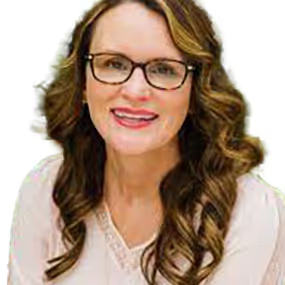
Dr. Jennifer Williams joins the Human Restoration Project to discuss connecting the UN Sustainable Development Goals to authentic classroom projects. The conversation covers how to spark student inspiration, identify useful tools, and take projects into the community for real-world impact.
transcript
Speaker 1 Welcome everybody to our summit, with doctor Jennifer Williams. So this is a free PD event brought to you by our Patreon supporters. Quick plug about that. You can learn more about human restoration project on our website, which is humanrestorationproject.org, And that's where you'll find a bunch of free resources for educators. You'll find podcasts. You'll find all of our previous PDs, and more pertaining to progressive ed. So thanks for people that bring that to us. One thing to note, this PD works best when everyone participates and shares ideas or questions or, you know, reflections, things of that nature. In the bottom left hand corner of Jitsi, you'll find three buttons. The big ones that pertain to you are the second button, which is the raise hand button. So if you wanna jump in but you still want to turn your your webcam on randomly, that's a good way to indicate to us that you wanna speak. Or the third button, which is the chat button. So that just allows you to bring up the chat window. You can ask questions there as well. So I'll quickly introduce myself, and then, Jennifer, I'll turn it over to you. My name is Chris McNutt. I'm the founder of Human Restoration Project. I teach digital media and design full time at a public high school. I teach ninth grade. And experiential learning for me is huge, especially social justice work through art. I've been doing a lot of cool stuff this year with, basically empowering learners by giving them the tools that they need to communicate power through design. That's been really interesting because I've never taught it before. So it's it's working. It's going.
Speaker 2 And and then, Jennifer, over to you. Yeah. Thanks for having me. I appreciate it. Good to talk again. I know we talked, with Julia, what was it, about a month ago, six weeks ago? Yeah. Love that conversation. So thrilled to be back and thank you for hosting this this hour all around SDGs and taking action for the world. I'm Jennifer Williams. I'm here from Florida, my home, and I am the executive director of Take Action Global with my partner Kun Temmers. He's currently in Nairobi heading back to his home tomorrow in Belgium, and we work to connect educators and students to their passions through social action and student activism. I'm also the cofounder of Teach SDGs, a movement a global movement of educators working to bring the SDGs to classrooms and empower student voice through taking action around all of the 17 sustainable development goals. I'm a professor here in Florida. And my background, I was in k 12 education for twenty years, started as a speech pathologist, really on the science side of communication, then moved to a Montessori World School where my eyes were open to peace curriculum, global collaboration, building global competencies with students, and really finding, kind of shifting from the science of communication to to the art. So, excited to talk with this group you have
Speaker 1 assembled here today and ready to take action with you all. Awesome. So thanks again, Jennifer. I'm, like, stoked right now. I'm I'm super excited to share out some stuff and build some cool things. I think we can all walk away with some really valuable insights to how we can basically radicalize our classroom to have kids change the world. So, I mean, you can't get much better than that. So we have three questions here that will kind of go around. We don't necessarily have to hit these in order or even hit all of them, but they're just starter questions. And I'll stop sharing my screen here in a second so we can actually talk to each other. But all the questions are framed around starting SCG related prod projects. So talking about how do we get students interacting with them, how do we get started, how do we coach students through the process? And basically, how do we get inspired to do these things? So, Jennifer, I'll let you start off with this first question here, and then we can just take it from there. We can just discuss things. People come in, ask questions, give feedback, etcetera, as we go. But let's just start with how does one become inspired to start an SDG related project, and how can we incorporate student inspiration and voice to the planning process? These
Speaker 2 these questions are kind of everything, aren't they? Yeah. And maybe just to back up one step in case people aren't aware of what the SDGs are, and I know we're we're joined today by a lot of our SDG change makers, so they're they're well informed on what the STGs are, but anyone listening in that doesn't know. And I think at one point I saw, and this was several years ago, so this this may have changed that 90% of the world aren't even aware of what the SDGs are. So SDGs, also known as the global goals, some may call them the global goals, the sustainable development goals. These are 17 goals that we as a world, all of us, have agreed upon to, work towards. They came out through the UN in 2015, and then we are working together to reach them by the year 2030. So they cover things like poverty and hunger and life on land and life below water and climate action and peace and partnership. SDG seventeen, one of my favorite goals. We actually have our very own goal in goal number four, which is quality education, for all, and those two words have kind of, taken over my profession at this point. So seeking out quality education for everyone anywhere. And so we as teachers, we do all of these goals, though. Right? It's not just SDG four where we fall in. It's it's it's all of them. So when we talk about SDGs in the classroom, which is kind of new, with the goals only being out since 2015, I think we had some people jumping in in 2015, 2016, even 2017, but something big happened in 2018, and all of a sudden, we just saw this explosion of teachers really connecting to the goals. So the last few years, we've seen a lot of a lot of great things happening around the goals. So it also we see teachers that have been I mean, they've been doing this work forever. If it had the name SCG on it or not, project based learning, place based learning, social justice, student activism, all different words for the same thing. And really how are we empowering our students in the classrooms to take action on the work that they want to and the change they want to see in the world? So let me I'll pull up your questions here. So your first one, it's kind of a two parter. So how does one become inspired to start an SCG related project? It's it's interesting right now, and I just came back from IdeaCon in Chicago talking a lot of educators there talking around ed tech. Ed tech, educators in the ed tech space are at the forefront, I think, of this work because they're already starting to find ways to empower student voice through different forms of technology. It doesn't have to be ed tech. I mean, we have a lot of great things happening in an analog way, but I think, really, for me, it's about innovation, innovating with ideas and actions. But a big a big theme there and I've been seeing is how are we moving our students from this place of consumption. So, like, for me, and I've talked about this before where when I started teaching, which was a long time ago, I was basically handed my my boxed curricula and kind of told to push go. And I had this guidebook, and I I knew knew what I needed to do, and that never really felt right. So now what we're starting to see is this move towards from consumption to creation, getting students to create and think and inquire. But for me, this is this work, what we're talking about here, is one step further, and so we're moving it from consumption to creation to then taking action. And it's definitely a process. I think with that, though, with consumption, creation, taking action, it's not this linear path where take action is the the end goal and we we forget about the others. I think we still have this role that we need to play as teachers in sharing high quality and relevant reliable information with our students. So it's not like consumption, in my opinion, should just go away. We need to just have this this healthy balance. But when we look at the SDGs and and I look to to social work, which really has been the profession to lead lead this for so long, and educators have been doing it but really didn't understand if that was their role, but we're talking about environmental justice and sustainability and social inclusion and peace and harmony and collaboration. So when we're wanting to get them started, for me, a lot of teachers that I see are ready to jump right into the project and and move right to that point where, okay, let's pick something today that we're gonna work on, and then we'll go from there. And that's the fun part. I mean, that's definitely where the energy is, but I think there's so much work to be to be done before even getting that to that point. For me, I I think a good starting point for teachers that are are ready to move into work around SDGs is to look at space and time. I think that's a a great place to begin. And looking at spaces, first off, is your space set up for social good work, student activism? And so I got very interested in learning space design through my, my role in Montessori, and environment is key in Montessori. And so as I left k twelve in 2014, I started was my thing. You know, it's always been my thing, and so I was trying to go out and get schools to kind of jump into this work for because it changed so much for me. And they were kinda and then 2014, were at that point where a lot of schools had taken on technology. They had gone one to one. They were bringing in carts, and all of a sudden, they were saying, okay. Now we brought in all this tech and, hardware, but now we we're finding that our spaces aren't prepared for this. So these rows of desks aren't gonna work with our one to one initiatives. So we started to see some some interest in space design. I kinda see the same thing happening with student activism and social good work because even if we've moved to tables and collaborative spaces, have we yet looked at our even our own spaces in terms of social good and optimizing those spaces for the conversations that we want want to inspire? So are our students represented in our own classrooms first, like, there? And then and then looking at time too. So we've seen some really cool things coming about in terms of scheduling and time, like genius hour and 20% time. It's a good start. It's a good start. But for me, I think and I think we've talked about this as a group in the past. This, I believe, needs to be part of everything, you know, part of the DNA of of the classroom. So True. So for me, that's the first point, is just looking at space and time before we even get to the conversation of how do we begin with the projects. Yeah. That's I I really like that that idea of space and time, and I would imagine that people here today or maybe that are listening in
Speaker 1 maybe feel like they're up against a wall. Like, if you teach in a more traditional or, like, legacy style environment and someone wants to shift the schedule around, sometimes that might come across as hard to do or or difficult. What suggestions would you have for those that are highly constrained as in they teach in a very traditional environment? It's like a forty five minute period. You have you're you have the desk that you got. You're not necessarily one to one, although you might have, like, a a laptop cart. Because I can think of so many people on that boat that every day I mean, it's it's a struggle, but I know you can still do at least something with this. Yep. That that's such a great question. And so
Speaker 2 I get that a lot because the variables when we talk about space design, the first thing that often comes to educators' minds, the physical space. So when we I'll go in, and it's almost like this. I know what's gonna happen because when I go in to do a a room or a school transformation, first question that's often asked, like, most of the time is, what color should we paint the walls? So walls take precedence, and and it's, you know, it's important to think through, but it needs to be an intentional process. So so walls, and then next is chairs. So they want movable chairs. Casters is a big conversation. But the variables that, teachers can't control are the things that come into our mind first. So there's things that we won't be able to control. Budget might be one thing. Number of windows in a room, number of chairs and desks. So for me, it's let's shift it to the things that we can control. So a couple things. So one would be looking at so the space that you do have, the furniture in your room, looking at it in terms of accessibility. So access to the information that you're providing or the information that the students are going and exploring. And that can be as simple as you sitting in every chair in the room. So making sure if you sit in the very back of the room, what is the relationship that the students have with the information you're providing from that spot? What about the front spot? So that's number one. And then the questions that we're asking our students. So this is huge. So if we're showing them that we see them, that they matter, are we asking them, how does the temperature feel for you? Are you able to hear me in the back of the room? Where do you see yourself represented in our space? So if we start with those things and we commit to those types of questions, over time, then we see a change, in behavior and engagement.
Speaker 1 Awesome. I I I really like that concept of, like, sitting in every single chair. I've never thought about that before. I I like the idea of universal accessibility and ensuring that everyone is is is capable of understanding what's going on. Do you see then a pairing between when you think about getting student inspiration voice into the planning process of an SDG project, do you think the best place to get started is waiting for students to kind of come into the room and say, hey, this is an issue. I want to solve it. Or what is the role of the educator in inspiring students to get started? I know it's kind of like a chicken and the egg argument. Yeah. But, you know, how do we typically go about doing these things? Mhmm.
Speaker 2 So my best advice for teachers is to show up as you. And, I mean, like Julia is here today, if you show up as you and you're you're unapologetic about that and say, these are my passions and this is what I'm doing and you're fired up about it. I mean, Julia, before we jumped on just the beginning of this, saying that yesterday her students together were crying, seeing what's happening out in the world because they're so moved, this emotion. So showing up as you, I think, bringing your passions in, and the best advice I got is start before you're ready. Like, just you've gotta just jump in. And I think if you do that instead of waiting for them to come because I think a lot of times, our students don't yet know what their passions are. I think they're passionate, but I'm not sure if they know where to place that energy. So, just kinda helping them go through that process, and it doesn't have to be like, I was passionate about Africa when I was eight years old. It was just something that was in me. But I was also passionate about baking cupcakes for the students in the hospital down the street. So, I mean, there's there's a lot of things when we're especially going through adolescence that are gonna pop up that we want to take action on. So I see our role maybe not guiding that part of it, like, where are they what are they gonna end up putting their energy into, but showing them what that process can look like. I think it's a really good point. Julia, I know you wanted to jump in.
Speaker 3 Awesome. I just wanna really, I love the idea of time and space, and I think for me, it also is about mindset. It's about meeting our kids at the door and that first day saying, I see you. Let's create this classroom space together. These are the this is the time, like, we get to be present with each other and share these moments with each other. So, like, in my classroom, we create our common vision together. We create the space. We create just the synergy of a group collaboration revolves around PBL. So it's there's a central question that we start with at the beginning of every year, but we we take the first I don't even know how long to build those relationships, just between people, but in the classroom and in our school. We we travel around. We do a gallery walk. We really because I I have the gift of getting to teach sixth graders. So they're this is their first experience in a middle school, and they don't they they don't quite know where they stand yet. And at the same time, they are so eager to just jump in and learn and become their future selves that when you offer them that launch point to, hey. Here's a question that that's really about you. Where do you fit in? How do you want to make your mark on the world? Our our question is how do you wanna make a dent in the universe? But when you offer them the opportunity to share their voice and grow their voice in a way that allows them to open their eyes in a different way than they've opened them and they've seen the world before, you just get to step back, and they share everything they're looking for with you. That's what's so powerful for me about the SDGs and Take Action Global. It's just it's a launch point for kids to choose to learn and see the world in a way that allows them to connect authentically not just with themselves, but what's with what's happening in the world around them. So I would just add love time, love space, but for me too, it's so much about mindset and a shared vision for global citizenship that includes every voice in the room and elevates kid and amplifies the voices of kids everywhere.
Speaker 1 That's amazing. I I'm I'm completely with you. And I I I really like that idea of, providing a voice for students first before. You didn't say anything about content, which I think is telling. I think that's, you know, it's intentional. But it's about the student first, and then we can you know, they'll get the content from doing things. But I think often when we do PD, that's not really brought up. So it's it's great that we have this intentional focus on student voice authentication and recognizing the learner for who they are and giving them that voice or providing them the space for that voice. That would be a better way to say it. That's that's awesome. Nick, go ahead and jump in.
Speaker 4 Yeah. For sure. So so Chris had asked a question about, you know, kind of overcoming barriers traditional barriers in terms of seating and scheduling. And one thing that I kind of think about in terms of trying to to break down some of the barriers to teachers in, you know, everyday public school classrooms is is trying to find a standards connection to it. And I wish my my copy of teach boldly is in school right now. And I know you have that crosswalk that's in there that connects it to to to oh, dang. I don't remember the framework for it. But but how standards. Yes. Yes. Mhmm. So how do you how so so I imagine that you had that in there. It's like right in the beginning of the book for for a reason to help teachers see that, like, there's connections to your standards right away. But do you have experience or or have you had positive experiences helping teachers, you know, make those connections to curriculum and those kinds of things? Yeah. That's that's that's what I'm really curious about.
Speaker 2 Abs with the goals, absolutely. And and it's the goals of what I've seen, it's really interesting because it doesn't matter if you're a humanities teacher or a science teacher or if you're ELA or we were even talking about art at the beginning. These cross curricular content area type of learning, these goals are in it already. And so I haven't found teachers struggling to find connections with standards because I think they're like, oh, yeah. Like, when we talk about any of these projects, they're like, yep. I can start pulling here and here and here and this. Then it's almost like those light bulbs. Like, oh, I've been trying to figure out a way to get this standard in. So kinda going back to the point of not having it be something distinct or separate, but bringing it right into the work that you're doing. So it brings our students out of the textbook, out of the stories that they're reading, and brings them right into the story that they're that they're creating. So probably I mean, I think we I think even it's we've gotta find those standards, that we believe in, for a lot. And I'm at the university level, and so my we we have we're kind of handed our our standards that we're gonna work with. And if you've been in education for a while, they're gonna switch. You know? You're gonna see some movement with those. For, for me, there's ones that I really align to. There's there's, frameworks that are put out by the Asia Society that I think are really great. ISTE standards for students, educators, education leaders, and coaches really resonate with me. I think so there's there's ones beyond the ones that we're we're using within our districts that we can look to as well. And so you mentioned the SD standards with teach boldly. So so, yeah, I I I think that, it hasn't been too much of a problem with the teachers I've I've talked to.
Speaker 4 That's awesome. That's great. Because that's one thing that I think, like, I I'm an I I teach economics and that's where I try to I bring I tried this semester to bring in that SDG approach. And and fortunately, I'm in a context where I'm kind of able to like like, I think Chris and Julie were saying, kinda start with students and then we can we can always make a standard connection to things. So for example, I had a group of students that I worked with pick the the the life underwater SDG, and they wanted to look at advances in, you know, marine life exploration and something and bring those things to the classroom too. And so I thought that was really cool, but if I tried to justify that and tried to connect it to the economics curriculum, like, don't I I would make us I I would have a hard time justifying that. But as far as, you know, connecting students to the world outside of class, connecting them to those interdisciplinary things, like, I think it's super vital. But and and I don't so I don't know if there's some tension in there, you know, between those content standards and putting content kind of first before students and the SDGs. That's kind of one thing that I'm just interested in kind of exploring going forward anyway.
Speaker 2 And I think too, like in that case, I've had teachers that have to design for it. So there's teachers that would join projects, and they'll go, yeah. Like what we were saying, this is good because this aligns to something that I've already been working on or working toward. But if you're if you're on Twitter and been following, there's two educators. They they've never met. They're in different parts of The United States, and so Ron and Spencer, and they have created this project. And they were just inspired around the work of the SDGs wanting to bring it into their their classrooms in a meaningful way. So it's shoes for a cause with SDGs. They have this they already had the space, and so they were trying to find a meaningful way to use it. Beautiful classroom spaces. They have the students that are eager and ready, and then they had them go through this maker experience to prototype these shoes, and each pair of shoes was aligned to one of the SDGs. So they were in. They're problem solving. They're collaborating. They're using all of these engineering concepts, and then, they took it to that next level. So, you know, thinking of creation to taking action, they then took it to the next level. They created a website. They had bidding up for each of the pair of shoes, so then they're starting to see the the economic connections to their work. And then they selected three causes that then the money would go towards funding. So and they were they were in it, like, all of that process, not a teacher standing saying, okay. I created this project for you. So student voice was infused through it all and standards and what we know we need to hit with with our standards of practice. That's incredible. Yeah. It was so cool to see. Can I jump in really quickly? Yeah. For sure.
Speaker 3 Sorry. So that project is phenomenal, and I reached actually out to Ron, and he shared his whole slideshow. And he is someone who just he's so open to sharing everything. I feel like anyone, though, who's working with the SDGs right now is. Anyone who participated in the goals project last year, the library that you created, Jennifer, that that showcases each of those projects, my kids are infatuated with. They're each choosing a project to connect to for their current project. And so when you share the work of teachers and students and kids get to see what's going on in the world, they get to bring that into the standards. Like, that's my favorite thing to do is it's it's more than just, you know, look at my standards. I have the gift of being a language arts teacher, so we get to read and we get to write, and I can choose books that connect to every single SDG. Right now, we're doing an SDG book club, and my kids are reading everything from Parkland, the book about the experiences of the Parkland kids because they've chosen SDG 16, and they're doing their entire project on school violence to the boy who harnessed the wind, and they're super into seven and clean energy. But, again, more than just choosing a book or choosing the content that connects with the SDGs, my favorite thing to do is put the standards in the hands of the kids. Like, I literally put the Colorado standards in their hands and say, where does global citizenship fit in? Which goal is it? Where do where where do the goals fit? And then I put in our school's mission statement, and I'm lucky because my school's mission statement is phenomenal, and I was on like, I helped to create it, and our kids helped to create our mission statement in our school because we're so invested in kid kid voice. But put your mission statement in front of them. Put your district's mission statement in front of them, and let the kids get their hands messy into what is a standard, and what does this mean, and how can I connect with this? And if you look at it like this, then maybe it, oh, wow. Look at that. Responsible consumption and production right there. Like, I'm a learner in a classroom. I get to choose how I experience my world. This is not about anything other than me owning the space that for me to be me and become my best self. My school district wants me to be a responsible global citizen in this space. And when kids know that and they feel that, everyone's mindset changes. Everything. Time, space, everything shifts because everybody's invested and everyone believes in the learning process. So I just offer that up to any teacher who's struggling with how does it fit or, hey, I'm supposed to put content first, use that as a tool to create access for your kids because it's there, and just sit down with them and help them see it.
Speaker 1 Yeah. I think that's a really good point, I I think it reflects too, I mean, the research. I mean, there there's plenty of research that demonstrates that students who maybe cover, quote, unquote, less content, meaning that they have less worksheets or they're they're not going through the standards as traditionally as a as a, quote, unquote, normal student would, actually do a lot better on traditional means of assessment. So they do better on standardized tests. In other words, it works, because students are interested. They're motivated. They're not bored at school. It's interesting. It connects to things. So if we were viewing this from a purely academic standpoint, it's good in that way too. And, obviously, the the major thing is, of course, the fact that the students are doing something that matters. It's authentic, and they they get to really change the world. And that's it's it's awesome. And I I wanted to move into the second question, Jennifer, which deals with where do you go to find materials? So you have all these students. They're they're ready to start this project. They have an idea about what they wanna do. But how do you then coach them through this process? What, websites are there? What things are like, for example, you have, like, teach SDGs with the project page. What things are out there that students could reference? Mhmm.
Speaker 2 Yeah. There's a lot, and it's hard right now, I think, because teachers are trying to navigate through it. But for me and and I think even to Julia's point, as you described standards and you what I picture when you you were talking was you as a colearner with your students even around standards. And that's what I feel like the beauty of these newer movements like teach SDGs and even things like Maker, even a tech to a degree is that these are new spaces for us as teachers. I mean, the SDGs are new for everyone. So we are forced to be colearners with our students. So instead of, like, I'm ELA as well, Julia. So, like, if we talk about phonemic awareness and phonics, I got it. Like, I've been doing that my whole career. I feel like an expert in that. But when we talk about things like partnership for the goals, this is something I'm working through right now, and I'm I'm trying to find the best resources, the best path to get there. So I'm going through my own, design thinking process. But I think that's that's kind of where I would direct teachers first is to look at, which whatever design thinking process you adhere to. So I adhere to human centered design. So design thinking being a five phase approach to problem solving. Human centered design, I feel works really well in education, or just an innovation in general, moving through a three phase approach, which is implement, inspiration, ideation, implementation, and then it kinda starts over. And starting there. So going through that process with your students, and the process will guide you to the resources just by by the way it works. I think being intentional about incorporating research into the work and also thinking about the community resources you have as well. I I I think that, I could probably get some pushback on this, but I know we've for so long, we were at these local levels, and then there was this big trend to go global, which I'm all global. Like, global is my thing. But I really think we're gonna start to see this this, reverse back to local levels and seeing what what do we have here just because of everything that we're gonna be seeing in the next fifteen to twenty years. So what do we have right in front of us before we start to move out to to different resources? I think IDO, if you're talking about website resources, IDO is a great one to look at with human centered design. So there's they they break it down by mindsets. They break it down by phase of where you're at in the process. So, maybe not looking at one specific tool like, okay. Today, we're gonna use fill in the blank. It's let's figure out what that tool is together. Strategies. I'm I'm big on strategies over tool, and so things like dot voting and story storyboarding and gut checking and bundling ideas to find affinity. So it's definitely gonna be more of an exercise than a platform. And then so if we look at things like dot voting, which I I really, really, I love doing with any groups, we could do that in an analog way, or we could look to tools like Nearpod has a great, feature called collaborate that's awesome for drop voting, stickies.io, Padlet. So it's kind of the tools at the end, and thinking about what's the best the best direction to to guide our students. So, but there's a lot of if we're looking at using ed tech resources, creativity, creation tools, collaboration, anything that's gonna enable our students to request and receive feedback, really important in this work around SDGs, and then also storytelling. But there's there are there's we're seeing more and more groups that are aligning to the SDGs, but it's not like there's gonna be this one curated library that you go to, and that's where you're gonna end, which I think is the beauty of it. Like, I don't know if we want that. And we've we've been really hesitant to do that with teach SDGs because we get a lot of people going, just kinda show me the path. Give me that step by step playbook that takes me exactly where I need. I need a, b, and c, and we're though we could do that really easily, we say, you know what? Just put it back to your kids. Put it back to your kids and and see what they come up with because that's kind of what it's all about.
Speaker 1 Yeah. I I like that idea of moving away from, it's it's exactly the same as I think we want with our students, which is we don't want them to be, like, technicians. We don't want them to follow a step by step guide and just learn how to do things by rote memorization. So, of course, teachers are learning the exact same thing, which in my opinion requires a lot of unlearning. I think it's difficult, especially if you've been in the field for a while or you just went through a traditional teacher education program to get to the point where you feel comfortable, kind of ditching the script because the majority of people, at least in my opinion, still follow that script. So you feel kind of rebellious. So, you know, you have all these different frameworks. You have all these different ideas. Is the is the concept then just to jump in? Do you just do it? Or are there steps that you would take where it's like, hey. For one week, I'm just gonna try doing this?
Speaker 2 I think it's gonna just depend on the teacher and his or her, style and approach. For me, it's kind of a mix. Like, it's a jump into the work, but it's a very intentional process because I think of it like if, you know, like, if we were gonna build a house. Like, yeah, I could go out right now and just start building. But if I don't have that blueprint and I don't have that project management plan project management is huge for our kids. Like, the world they're going out into, do they have these skills and knowing how to move to that place of creating something? So so I think no. I think that having an idea of where you're heading and then work backwards from there would be the way I would do it. It's gonna look very different. I like how Julia's point of having it be very messy. I think messy is is good in not knowing the answers, but I I feel like like kinda going back, we need to have we need to have our spaces prepared and ready. We need to have availability within our schedules. Time has to be there. And then we just immerse ourself in the process and stay there for a long time as long as you can, for for me. That's that's where I I see that magic start to happen and being okay if you need to pivot. You know? We're like, okay. We were heading in this direction, but now we're seeing that something else came up, being ready for change, inviting change. And then at that very last point when the kids are like, okay. I wanna get that, you know, video created. And that's a great point of celebration, but everything that happens up until that point is really gonna be, where the learning's gonna occur.
Speaker 1 I love that idea of pivoting because I I know it's something that's happened in my class multiple times. Go go ahead. Thanks.
Speaker 3 I'd like I just I love the way that I envision it is literally like I've been saying, it's a launch point. So I, like, picture almost like a rocket in my classroom, and I picture these dotted lines that show, like, where do we wanna go and how do we wanna make it happen? And each kiddo's trajectory gets to be different, and we get to cross over each other, and we get to create different flight paths, and we get to adjust for weather or adjust for change. And it's so it's a building up and out and a reaching a kind of a a global or and individual goal together. So instead of jumping into something that can feel like, wow. It's it's kind of closing in around you in a way, it's a it's an opening up and outward with momentum that does create that messiness and does collect, all kinds of, like, cosmic dust along the way. It just it allows for invention and opportunity and innovation and inspiration and every day to be absolutely different from the one before it based on a kid's choice and voice and what's going on in their life and in the world. So it's it's kids becoming their own teachers in the classroom and us stepping aside to just provide a framework and hold space for that launch pad so kids can can move themselves into the world. Like you said, Jennifer, like a kind of like a project manager. We're just, hey. What else where else would you like to go? Let me help you find the connections because that's, to me, the the strategy and the tool that kids need most right now. Like, I'm feeling this. What do I do with it? Where do I go with it? How can I get connected here? How do I talk to an expert? What do you mean I need to send be able to send this email or talk to somebody on the phone to ask this question? It's about teaching them the life skills that they need to be able to make sense of the world and then go follow through in what they are passionate about and what they do wanna take action on.
Speaker 1 So that's how I see it. That's so good. I love that statement. Teaching life skills they need to make sense of the world. I think you I mean, I I that's a how can you get more relevant than that? Just doing it, and just working through every single step of the process. I I think at this point, it actually would make some sense since we have so many people here who are engaged in teach SDGs or at least familiar with it to potentially talk about the project that they've done. And I know, Julia, you've been you've kinda going with that. And I know, Jennifer, I'm sure that you have a plethora of examples that you could share. But I I think it would just be cool to just bounce ideas because I know for me that as we were talking about in that first step, and developing passion and purpose amongst our students, having some ideas to say, hey. You know, what do you think about this? Can bring students down that pathway to potentially really running with it. They they might need the first step of figuring out what it is they wanna do, and learning from other's projects is a good process of getting there. So, Jennifer, I don't know if we wanna start with you, and then we can just kinda, like, go around and just share some ideas of things that we've done or things that were cool, to potentially inspire those to engage in the SDGs.
Speaker 2 Mhmm. Mhmm. Well, something that I'm involved in right now, and this is not necessary. We haven't made the direct connections to SCGs, but, and we didn't we I mean, student voices all over our conversation today, but we didn't go deep with that yet. But something I'm preparing for my session on student activism for South by Southwest. And I'm I'm with this great panel who have done, all of them, incredible work within The United States. And so as we were saying, you know, we started planning and saying, okay. We're talking about student voice, student activism. Where are the students in this? I mean so I think us taking a step back and, saying, let's kinda rethink this here and which is something like that that check-in, you know, check-in with your students, check-in with yourself, because anything around innovation, around SDGs, when we're talking global, becomes big really fast, and it becomes fast really fast because it's like, okay. As Julie said, it just starts to build and build and build. And I think how can we slow it down, also simplify it? So we we, these are coming in where I think up to nearly a 100 now responses. We said, let's just get the kids in this. And so we put out a, simple Google form survey and asking them some questions like, to my parents, I wish you knew. To my teachers, I wish you knew. To strangers, to haters, to friends.
Speaker 1 Alright. Hey. Sorry for the interruption. It seems like we lost the last eight or nine minutes or so of the PD. So I'm just gonna fill in with our notes here. Sorry about that. We're still trying to figure out the best way to do video conference without any weird recording errors, but we're working out. We'll make it work. So anyways, Jennifer wrapped up her points with this amazing forum that she had where she collected student responses about how they're perceived by the world. And then, I interjected with a point about The Mask You Live In, which is a documentary where in the documentary, it's about young men, but it it could be used for any context, talking about what the world sees versus how you truly feel. And what you do is you take a group of students that you know very well, and I would preface this by saying that in certain contexts, might not work. You want might wanna make sure that there's some support because it can get pretty heavy. You you don't just wanna, like, throw this out there. But you have students sit in a circle and you tell them, hey, this is gonna be a quiet serious activity, so just, you know, you shouldn't be talking to each other, put some things away, that kind of stuff. You pass out a sheet of paper to everybody and you have them draw a mask on one side. And this mask is like a a masquerade or like a superhero mask, something of that nature. And either on the mask or outside the mask, they'll write words about how they want their friends, family, peers, how they want to be seen. And usually, you know, it's things like, they wanna look cool, they wanna seem nice, they wanna seem generous, etcetera, pretty, that kind of stuff. Then you tell them, hey, just again, we gotta be quiet, don't discuss this, but I want you to flip over that sheet of paper and I want you to write about how you actually feel about yourself or what you worry that people might think of you. The the kind of the the deep dark reality of who you truly are. And that's a really serious discussion, but I just think it's something that we need to open up to students to have those spaces because sadly there's not a lot of spaces for those things to be shared. And it helps build this connection later on. So you have them write down those those words, those descriptors. And a lot of times they all write down very similar things like they don't wanna feel like they're ugly or that people if the people actually like them or not. They're worried that they'd be sick, that that kind of stuff. So this is not the the happiest activity typically. So after they go and write down these different words, they crumple it up and I just have them throw it into the center of the room. So you then collect those crumpled up sheets of paper and then you redistribute them to people in the room. I should note I I should have mentioned this earlier, but you don't have them write the names on the sheet of paper. So you redistribute them and then silent silently to themselves, the students will then read that sheet of paper, and you you don't discuss it, really, you just all hand it back in. And the point of that activity is to showcase that everyone has this innate human connection and many of our concerns are the same no matter who we are. And it builds that classroom culture that Jennifer is getting at, which is a lot of times, especially in PBL or a traditional classroom, there's a strong teacher student relationship, which is good, but you definitely wanna have that. But a lot of times what's lacking is the student to student relationship. They might have their own friend group, but outside of that friend group I mean, I've had classes before in the past where students didn't know someone else's name almost a year into the the school year. So there's just not a lot of student to student interaction. And the goal of that activity is to develop those bonds. So anyways, that was one thing that was shared. There were only two other things, luckily, that we missed. So Julia Fliss shared out this project that she's been working on in Kokuma, which is a city in Kenya that houses a refugee camp. And according to the website, fifty five percent of people in Kokuma children do not have a school to go to. So Julia's students had just been reading a book. They had been reading A Long Walk to Water, which is by Linda Sue Park. And the main character, Salvadude, he starts the nonprofit in real life called Water for South Sudan. And her students were inspired by the story and were looking for ways to help and it just eventually developed into the idea of helping to build a school in Kenya, in Kokuma. And it just came to life, like the school is actually being built based in part on the actions of Julia's class, raising money, giving donations, raising awareness, which is awesome. I mean, you you can't get more authentic than that actually building a real tangible thing that helps real people. So I can't recommend enough checking more of that out. You can find Julia on Twitter for Julia Fliss, f l I s s, as well as there's some links in the show notes to the project. Finally, Jennifer showcased the work happening at tag.community. I would definitely look at that. There's a preregistration window. From this recording, there's a week to register, and then it lasts for a couple of months. So tag.community is a way to tackle global goals in the classroom, developing the SDGs. And what makes it unique is, first off, it's all free. So you get to connect with all these other educators for absolutely free. And it's a good way that your students as well as you can connect with other educators around the world and work on these things together. A lot of times, the biggest part of project based learning is developing those connections and networking. Well, this gives you the tools to get that and it's entirely free. You just register and then you do some stuff. And, Jennifer wanted to call attention to the fact that you don't need to dedicate every single day for two months make this project work. Everyone has different context, different levels of flexibility on what they can do. Even if it's just like a week, that's still more meaningful than doing nothing at all. So definitely check that out. Attached in our show notes is everything else. We have all the notes. We have a ton of resources in there that you can look at. I wanna call special attention to, first off, at the aforementioned tag.community, but there's also teachsdg.org. It has a ton of project ideas and templates from the past on what people have done, not necessarily to follow as a step by step guide, but maybe to look at as a teacher and also for your students to look at when they're trying to come up with ideas. They can play off of other people's ideas and remix them and come up with new ideas of their own. Further, there's also the IDEO framework, IDEO framework, the ISTE, I s t e standards, and teaching tolerances social justice standards. All of those are really cool ways to look at framing SDGs in your class and framing experiential learning in general. And then obviously, can tie in your standard content standards as you go along. It's all about just trying to find different ways to look at things, to look at it from new perspectives, and develop the best possible project you can and just bring in those different ideas. So thank you again to our attendees for appearing on the summit and sharing their amazing knowledge and ideas. It's always just so energizing to hear what people have to say and see the amazing work they're doing inside their classrooms. And a special thank you to doctor Jennifer Williams. I mean, her knowledge on the SDGs is unparalleled. She has fantastic things pertaining to experiential learning. So thank you to doctor Jennifer Williams. As well as, if you like this summit and you, wanna attend a future one or maybe see a past one, you can visit us at humanrestorationproject.org. On there, you'll find a variety of free resources, our podcast, our writings, as well as all of our events, as well as ways to support us. If you wanna see more future summits and appreciate what we do, I encourage you to check out our Patreon. So thanks again for joining us and have a fantastic day.
resources
- TeachSDGs · Dr. Jennifer Williams and co-founders (website) A hub of resources connecting educators to the UN Sustainable Development Goals. link →
- Teach Boldly · Dr. Jennifer Williams (book) A guide for educators on purpose-driven, globally connected teaching practices.
- Take Action Global · Dr. Jennifer Williams and co-founders (organization) A nonprofit supporting educators and students in taking action on global challenges.
- Episode Notes and External Links · Dr. Jennifer Williams (article) Google Document with full conversation notes and curated SDG project resources. link →
- Dr. Jennifer Williams (person) Co-founder of TeachSDGs, executive director of Take Action Global, professor at Saint Leo University.