
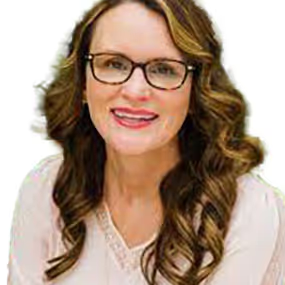
Dr. Jennifer Williams and Julia Fliss join Nick Covington to discuss bringing the UN Sustainable Development Goals into classrooms. They explore how to motivate students around 17 large-scale global challenges and how to navigate implementation in politically complex school environments.
transcript
Speaker 1 Hello. Before we get started, I want to let you know that this podcast is brought to you by the Human Restoration Project's fantastic patrons. All of our work, includes free resources, materials, and this podcast, is available for free due to our Patreon supporters, three of whom are Sheila n, Shannon Oliveira, and Burton Hable. Thank you for your ongoing support. You can learn more about the Human Restoration Project on our website, humanrestorationproject.org, or find us on Twitter, Instagram, or Facebook. Hello, and welcome to season three episode 18 of Things Fall Apart, our podcast, the Human Restoration Project. My name is Chris McNutt, and I'm a high school digital media instructor from Ohio. Today's discussion is all about the sustainable development goals or SDGs, with specific questions surrounding their implementation. If you're not familiar, the SDGs were adopted in 2015 and consist of 17 major problems the world aims to solve by 2030. Countries are working in partnership to solve these issues such as ending world hunger, establishing gender equality, taking climate action, and reducing inequality. Each of these goals has many organizations working with the indicators, which are the specific tasks within each goal. And we've linked specific resources for educators concerning the SDGs in the show notes. And our discussion today is surrounded with three different people. We have Julia Fliss, who is a language arts instructor at Evergreen Middle School in Evergreen, Colorado. Doctor Jennifer Williams, who is this could be quite the CV. Who is cofounder and executive director of Take Action Global, cofounder of Teach SDGs, professor at Saint Leo University College of Education and Graduate Education, author of the recent book, Teach Boldly, among many other things, as well as also probably a couple other companies that I'm pretty sure I didn't write down, but a lot of different things on there. And also, Nick Covington, who's the creative director of Human Restoration Project and a high school social studies teacher. So thank you all for joining us. It's nice to see all of you. Yeah. Thanks for having us. Excited to be here. Thanks, Chris. Yeah. So this is gonna be really interesting because rather than talking about strictly just the SDGs, I want to dive more into talking about how to implement them in a logical way and also in an era that's increasingly politicized politicized, and has just a lot of interesting discussions surrounding the UN, but also just how we saw world issues. But before we get there, I think it would be probably beneficial, especially for for you, Jennifer, to introduce who you are, what you do, how you got involved with the SDGs, and kind of how you fit into all of this. Yeah. I'd be happy to share. So,
Speaker 2 again, thank you so much for having me. I love any opportunity to share on the work that this amazing team of global educators around our world are doing around the global goals and to take action for social good. For me, as you mentioned, now I'm in higher ed, and I I work with global class rooms. And but my background really started in k 12. So I was in k 12 for over twenty years, and I started off more on the science of education as a speech pathologist, then moved to a mono Montessori World School where we were hyper focused on global ed and even things like geography that aren't necessarily the focus of early childhood curricula. And also, there wasn't as much need for therapy. So I started doing a lot of work around literacy. We were early adopters with tech, and so we had iPads slammed on our desk. We weren't quite sure what to do with them, so we said, let's align it to our work around global education and development of global citizens. And so we did that with our youngest students. So age even we had age four students doing some global projects. This was way back when. And students up through eighth grade, we had incredible opportunities to take them abroad. And so we'd start to work with them over the course of the year and connect virtually, and then we would travel to places like Russia and Spain and China and and be able to work with the other classrooms in person. So yeah. And then moved out of k twelve to higher ed in 2014, and that gave me the opportunity to really start moving all in on what my passion was after that experience in k twelve of how can we find ways to empower every student to take action on their passions, not just students that are able to fly across the world and and go to Russia and Spain and and China to to work together. And that's when I kind of started doing a lot of work with Twitter and and finding other teachers that were equally as passionate and saying, yes. This is it. This is what I wanna do. It took a long time. So in the beginning, I would put in sessions for global ed and zero people would come, but there was a lot of interest around things like tech integration and learning space design. So I used that as my entry point saying, okay. Well, let's start talking about that, and then weave global into it. And then we had these beautiful goals come out in 2015 that we all say in our in our teach SCGs network, they were really that glue. So that that point when teachers started to say, yeah, I see myself in this conversation, and I belong here, and my students need to be here as well. So it has been an interesting journey since then, and we we talk about this story a lot, but we shared a tweet saying to the UN, who's doing this work? So in 2015, when the goals came out, we said, yes, Finally, this is it. Who's doing this work? Because we we were sure someone was in education, and we have our very own goal. So, you know, who's doing this? And the UN responded and say said, we're interested in finding out that answer as well. So that's kind of how teach SDGs formed, and now we just announced this week our fourth cohort of ambassadors, and we have, yeah, amazing group of educators from all parts of our world that are doing the work every day and are ready to really get busy in 2020 because we have ten years to get moving on these goals, and we have a lot of work to do. That's so cool. I I love the, like, the authenticness of everything considering that it's it's literally a worldwide initiative.
Speaker 1 I can't get more authentic than that. And I I want to kinda turn it over to Julia for a second to talk about basically how you're using the SDGs as a part of that cohort and how this is all meshing together.
Speaker 4 Great question. So as a language arts teacher, I am a very project based, always have been, since my start in high school, actually. I'm a I'll give you a little background. I'm kind of an inside out teacher. I didn't go to, quote, teaching school. I packed my Volkswagen after college, drove west. I speak Spanish. They needed some teachers in Denver, so I started at Denver West High School. And my kids taught me how to teach. I mean, I went to all the alternative licensure stuff, and I went through everything, but I learned through them. And when I needed to learn more, I asked them or I found a resource to help them kind of, like you said, Jennifer, be a part of that conversation in their own learning because that's what it was about for me. That's what it's about, I think, in any classroom. So after spending time at West High School and then helping to open Denver Public Schools online high school, I came up to the mountains, landed in Evergreen. First started teaching as a world language and cultures teacher and Spanish teacher. And then when a language arts position opened up, I grabbed it. So I've always had that kind of open perspective, open minded, globally minded, hey, let's look outside of ourselves in order to learn more of ourselves on the inside. I always have used the hero's journey to kind of help kids see out of struggle, because as I was at West High School, I mean, those kids were in deep struggle. Maybe, you know, not in comparison to some kiddos I can think of in Africa right now or some refugee children in Belgium right now, but they're they were in their version of a deep struggle, and they needed to be able to see out of it. So what I love to do with my kids in the classroom is help them tell their own stories by looking at the stories around them and identifying, kind of making their own mark in terms of what do I want to be part of my story, how do I want that to be part of my story, what can I learn from other people's stories, and how can I be sure that any bias I have around my story or another story doesn't become so ingrained in me that I think it's truth? So in the classroom for me, the s g g's are a launch point. They're an access point. They're hey, what are you interested in? What do you love? What's your passion? Where's your voice? What do you care about Starting in, like, at ground zero. My kiddos sit in their chair. We start with a writer's notebook every day. We talk about what's going on with them. I give them space to write, think about, talk about, and share their voice. And as they start to realize that they have someone who cares and they're in a space that's that's not just shared space, it's and safe space, it's brave space. Like, I want them to speak up, and we cheer when someone shares something powerful, or we snap when someone says something that's really profound. We just we build up this kind of collective I call it effervescence where we just bubble up. And when I learned about the SDGs last year by doing my own PD, I'm one of those forever kids, lifelong learners, life wide learners who's always looking to learn more because my kids deserve that and I crave that. I took a genius hour course from Annie McNair, and I was scrolling through just to get a start and saw the global goals. I'm like, I don't know what that is. So I opened that particular module, and I did not move from my seat. Like, I jumped up and down. People watched me, and I was like, oh, where has this been my entire life? This is it. And then my heart started racing. I couldn't I had more tabs open on my computer than I've ever had, and I run with a lot of tabs, just saying. I just I couldn't get enough. And as I brought that passion and energy into my they call my CAP documents, my curriculum and planning documents, as a language arts teacher, I have the luxury of I get to teach genre study. So personal narrative to start the year gets to be, let's study some world changers, like Ayush Chopra. Let's study, like, people who are doing things in the world to make magic happen, to get connected. So we do a and I've done this for, I think, five or six years, like a world changer PBL. And then this year, when we joined in the goals project, we brought in goal 16, peace, justice, and strong institutions. We just like, it all just kinda laid itself out into how can we use the global goals, the SDGs as an accent access point to dig deeper into the pages of curriculum that are typed out that my kids don't even like, I read it, and I translate it, and we talk about it, but to read a personal narrative about, like, Salvador, who is what is a was is a lost boy, and, you know, his story of coming out of a story that was told for him and turning it into a story that he gets to tell the world with connected to SDG number six, connected to like, my kids will tell you every single goal connects to this book because that's their passion. But, like, you get to use that access point as a way to help create connections in personal narrative. Our next unit is informational writing, and PS, sorry, I'm totally taking over the conversation. I think it's because I'm so nervous. Informational writing is next, so we're doing, you know, our PBL launch. Last year, it was an infomural, and this year, I'm asking the kids to write their own PBLs about the global goals. I want the kids to write the curriculum. I want them to be the ones to say, hey. This is what we should do, and here's how we'll connect, and, you know, what if we do this, and how can you connect to this? And I want them to reach out to schools. And then our last genre study unit is persuasive and argumentative writing. So that's kind of a no brainer. We can go from PSAs. We can do I mean, we there's so much magic there. They're going to tell me what we're going to do next. So that was a long answer to your question,
Speaker 1 but there you go. It's amazing. Seriously, if I even had, like, 10% of, like, your energy and enthusiasm, I could be, like, the total person. It's it's honestly amazing, everything that you're talking about and how how well it all works together. And it actually makes this my next couple of questions really awkward because I feel like I'm shifting it to something that's way more, not negative, but challenging to the the concept of implementing the SDGs. Here's, like, where I'm at on this. So going back actually to what you were talking about there with the the hero's journey and students that are struggling, especially students that struggle in school or maybe are struggling at home and therefore are struggling at school. When these SDGs are implemented, and this question could be for really anyone, how do you deal with just how daunting they are? As in, like, these things are about, like, solving inequality or solving world food security, which are all giant issues that need to be solved. They they have to be solved in order for human development to sustain itself. But as a result, do you feel like the daunting nature can lead to apathy? As in it's barrier to entry because it's like, well, I can't solve food insecurity. I'm just a teenager, quote unquote. How do you deal with that motivational barrier of letting students realize that they can change the world if they work together and reach those points and set those goals. It is more than possible. It's just a matter of realizing that you can. I can I can jump in on this one? Just backing up a second. Julia,
Speaker 2 I think everything you said just makes me wanna be a student in your classroom. I need to say that because I'm just listening to you going, you know what? I wish I I wish I could be in your costume every day, and I think it's that passion you have that is really what's getting your students on fire about learning about these goals. But switching over to your question Thank you. I think that for me and it's even bigger than the SDGs because I think when we think about anything that is massive, like the SDGs and and making change on that scale. For me, it even strips down a little bit more to just education. And I so I have these university students that come in to me, and they're, like, breaking down the doors to get into their first classroom. They're like, I can't wait to get into my first classroom and have my first bulletin board, and I can't wait to get my table set up. Like, this is like no other profession I know, you know. Where where do we have this? Where we have this much positive energy. And then I think oftentimes, we as teachers look at education as this massive machine, like, oh, do I make the change that I signed up for? Like, I signed up to be a teacher. I ask my students all the time, why? Why are you here? You know, it's not gonna be for the glory or the money, and I wanna make a difference in the lives of children and for our world. And so when they start to feel like, how can I, one person, make that change that I really envisioned, it becomes a little overwhelming, and you start to feel that that enthusiasm and that and that passion kind of dwindle? But then and I think that's the thing about the SDGs, and you see it come to life with Julia and these other teachers that are in our network. The goals for me like, they're the goals for the world. Like, these are our world. We all together agreed upon these goals. Our world is working toward these, and and we have to act fast. But it's it's not to me, like, okay, we need to solve gender equality, though that's what we're aiming for. These are these opportunities just for opening up questions. And I think that the teachers that we are working with that are using the goals, yes, they may be aiming towards life underwater or climate change or partnership for the goals of sustainable cities. That but it's kind of a lens they're using. I mean, we can look at even project based learning or design thinking or any of these different frameworks that just get kids talking and thinking and taking action, and moving. Like and even if it's moving in small ways, what I think we're finding is all these small little ways that we're finding were impacting change in positive ways for the world really is adding up. And there's a lot of us. Like, there are a lot of teachers, and there are a lot of students, and we are doing the work every single day on learning. And so learning, which can be action, which can be changed, like, are already set up. We're already set up to do this, whereas other industries maybe are also aligned and working towards the goals, but it's gonna take them a little bit longer to get there because we're already, I think, set up to to do this work. But on the point of the SDGs, if we have students or teachers that are feeling this way, apathetic towards the goals, I'm almost seeing the reverse. So we just did a goals project, and we had teachers we had we had 1,600 classrooms. So we had a lot of teachers working towards these goals. Some of them had never even heard of the goals. They just this was something they saw on Twitter, they said, I wanna be a part of this, whatever it is. And everybody kind of was signing up blindly because we were building it as we went. And so with that many teachers, we had some saying, I'm gonna need a rubric. I'm gonna need to buy step by step directions. And we, by design, said, no. This is we are just opening up questions for your students. Just just see what happens. And by the end, we had so many coming to to us saying, you reminded me why I got into education. You reminded me of my purpose, because they started to see it wasn't about the grade, it wasn't about the standard, it wasn't about having to answer to someone else's extrinsic motivation. It was purely what was happening in the moment with the kids. I love that last point that you make surrounding,
Speaker 1 like, the restoration of intrinsic motivation is huge. Thank you for listening to this podcast so far. Are you interested in diving deeper into progressive education? If so, Human Restoration Project would love to serve as a platform to amplify your voice. We're seeking writers to help contribute to our magazine. And if you really want to deep dive, we'd love to hear your ideas for something else. You can reach me at chris, chris,@humanrestorationproject.org to learn more. Now back to our discussion. And something that I was thinking about while you were talking is there's also that place for motivation in terms of, kind of like place based learning or just the concept of seeing yourself in the goals. All of us, I'm sure, have students that, you know, go home every day and they see the inequality, in their daily lives. And by engaging in civic participation, understanding the world around them, they are kind of learning how to organize and change these things for themselves and empowering them to give them the tools to make a better world, for everyone. It makes me think back to a a few episodes back we had doctor Richard Wilkinson on, and his studies are all framed around how inequitable societies make everyone less happy. So even those that are incredibly rich and, quote, unquote, successful and very powerful, they are actually sadder and more depressed and more anxious as a result of living in a very inequitable world. So finding ways for students to see themselves within those SDGs to make their own lives better Mhmm. Seems like it has some place in terms of at least trying to marginally solve that apathy problem in whatever way that we possibly can.
Speaker 3 Nick, what are your thoughts on this? Yeah. Well, I was I was gonna chime in and just say that I think, you know, for for a little bit of context with this, what kinda got me even thinking in this direction in the first place was was like my own, experience with PBL and my economic engagement project. And and I I just pulled up a list of some of the questions that my students are asking. Like, how does gender inequality present itself in the modern workspace? Are the things kids are learning in school beneficial for their adult lives? Are African Americans getting the right education they need? How can students make an impact on mental health in schools? And so, so I felt like this semester, those are the questions that kids are asking, but I kind of felt like they're, they're spinning their wheels because it's kind of one and done, right? They're just kind of their individuals or their groups of two or three or four, you know, students all trying to do that work just by themselves. It feels like Atlas, like they're, they're just lifting it themselves. And I felt like I have a chance because I teach a semester long class to, you know, what can I do to make that better for second semester? And so the first person I reached out to to do that was Julia because I remember she talked about those SDGs at one of the summits we had like in August right before the school year started. And and I and I think I I I tweeted at your message or someone was like, what's that thing? Like, I don't remember what the name was. I tried googling all of it. And and that was right before Thanksgiving break. And and in that thread, Julia linked me to like this, it was like to a certification thing for Microsoft. Yeah. And it was so funny because when you said the first time you heard about it, you had all those tabs open on your thing. That was totally my computer because as I was going through it, it had all those videos and all those links and all the Twitter accounts. And I was like, following people and I was bookmarking things and I was like organizing folders of stuff and it does. It just felt like I had found that missing link that made, that like made that work connected to something bigger than just kids in my room, you know, like, so that way they didn't feel like they were just spinning their wheels. They felt like they were contributing to a global goal, you know, like that is what the cool power of this is. And and and when you mentioned earlier, like, it gives gives kids a chance to be able to tell their story. Like I think about in the sense of like human centered learning and the goals that we all have here, that can't be a monologue or that they can't be one unidirectional from teacher to student. If we're having kids explore the stories of, like you mentioned, Oprah or or any of these other, you know, people around the world as it related to those goals. Well, they're gonna naturally insert themselves and invite them into that conversation. So it's like, it's humanizing just because the nature of it is, it involves discourse and dialogue and involves learning about other cultures. And it's just like it really, it did. It felt like I I when you shared that link and then, you know, talk with Jennifer Williams too and and I gotta get my book. I've gotta get my Tish Boldy book. It it just felt like I'm finding the missing link and all this stuff. So I'm really working hard in the next couple weeks to try learn more about those and how we can connect that work that students want to do. Right? They wanna know about mental health in schools and, the different kinds of education and and health effects on young people. Constitutional rights, like what's happening to the bees was a question one of my kids asked. So it's like all of those things all connect now that I kind of see that map, the multicolored grid map. Like I see that on there and it just, it makes those connections. So yeah, I'm just I'm stewing. I'm excited. Like I wanna get going tomorrow and all that stuff. Right
Speaker 4 on. Can I pipe in? So love that. I I think one of my favorite parts is that it gives kids permission to ask questions about the world. For sure. Like, it's big. Yeah. And there's I don't even know. Like, I have a whole stack. I don't know if you guys can see these, but there's, like, there's targets for each goal. Like, there's sub targets, and that's what we use for the infomerules. You pick one sub target, and they're like, but what's that one, and how does it differ from that one, and what do I do with that one if I really care about three of them? Like, they're just asking questions, they're, like, information gathering, like, I've never seen. It's phenomenal. Then they get in conversations with each other. Like, we do stand up debates in my room where, you know, the kids actually started doing them on their own, and by the end of the second one, if you really had a powerful point you needed to share, then you stood on your desk to make sure people knew, hey, I have something to say about this. Right? So the power of giving kids not just permission, but the floor. Like, give them the floor. Give them the space to use their voice to make change and connect with the ecosystem that we are as a planet as and as a people. And there, that's my vision of the cure for any kind of apathy. It's connect. It's connection. You know, you can tie it to cell and sources of strength. You can tie it to so many different things. It's giving kids permission to connect in a way that's authentic to them so that their voice is honored and they own their own learning.
Speaker 3 And that's what's crazy when we we know, like, we think about that that issue of apathy and are the questions too big? Like like, oh, we're never going to end poverty, but, like, listen to how you're talking about it and how students respond to those kinds of things. It makes it feel like those those, those things are manageable because we're not doing it by ourselves. You know, it's not the responsibility of any single person, but together we can do those. So it's, yeah, the only way we're going to do it is if we make those connections and grow together. Like, there's there's not a more a better message in education than that. So that's it's perfect. Like planet literacy.
Speaker 4 Right? It's a different level of literacy.
Speaker 1 Yeah. I think that, pretty pretty, well answers that question. I I think that's pretty, solid. Maybe maybe my free slicing questions were were awkward, because I feel like I'm about to, like, alright. Let's take it all back down, folks. Let's let's go over to, to polarization and neoliberalism. That's great. But, just to kinda throw it out there, we live in an increasingly politicized world, polarized world. As a result, the United Nations as well as really the solutions to every single one of these problems is politicized and on very firm lines. Some of us, I don't know about everyone. I teach in a very conservative district. And it's interesting to note the conversations that come up when you talk about things like inequality or gender equality or even things like environmentalism, and how you go about solving those problems and whether or not those problems need to be solved. So I'm curious how exactly we go about implementing change via these policies without people automatically assuming that the goal is to politicize their children. Because I don't want to take the stance that they're not political. They all are political. Education is itself inherently political. But at the same time, I don't want someone coming into my classroom and saying,
Speaker 2 You're brainwashing my student, or something like that. How do we go about navigating that political discourse? Well and and that is happening. I mean, that absolutely is happening, and we've we've witnessed it with some of our projects. I think that we I mean, we are, in my opinion, in the most exciting time in education, but it's also it's a challenging time, especially when we talk about things like social good and incorporating the SDGs into our classrooms. So work around these topics like you're talking around environmental justice, and we if we're starting to think on social inclusion and shared humanity, peace, justice, all of it, those were areas that were really reserved for social work. So though we're doing that in the classrooms, and we have been for a long time, particularly at the high school level, but even as we go down into the younger grades. But it was kind of reserved for a different profession. But educators, I think, are saying, you know what? I'm doing this. I have students in my class that are refugees. I have students asking these questions around gender equality. I am obligated to give them the right answers, to give them the resources that they need, and to, just as Julia said, be that safe space where they can come and feel okay to inquire. So a lot of it though is US centric. So we have teach SDGs educators from all around the world that are working on incorporating these goals into into their instructional design, and it's a non issue. It is. We as we are mandated by the government, every industry, including education to incorporate the SDGs. So they need to have alignment, and it they're way ahead of us. They're like, yep. We're already there. We're moving forward, and and they're a passionate bunch, especially in Africa. Obviously, we have some really charged, fired up teach SDGs ambassadors that are like, they're going to their ministries of education. They're advocates. They're activists. Here, when we're talking about The United States, I think we still do have some teachers that are quite nervous because they even though some of us are saying, you know what? We're unapologetic about this. We're doing this work. We believe in this, and we're gonna find a way. There are some teachers that say, but I can't lose my job. I mean, I I I have pressure from my administration, from my school board, from my community members. We had the goals project, and some of the goals like, if they're talking about life underwater, they don't get pushed back. If they're talking about s c g 13, which is climate action, they're shut down. Mhmm. So we we must be empathetic towards that. And instead of saying, well, that's wrong, I think this is just another opportunity for us to open up and say, well, I'd like to hear your perspective. And if it's gonna take all of us to reach these goals. And so if we're looking down party lines or if if we're in a very highly conservative communities, I think that it invites it's challenging when we think about the goals, but I think invites opportunity for us to have shared experience and and just open up our own eyes. So if we believe in the goals and we believe in things like climate change, yes, that's something that I feel strongly about, but I'd like to hear someone else's perspective. And that's going to when we talk about mastery learning, that's gonna make Julia says she does debate in her class. Like, that's gonna make you have to have stronger convictions in what you believe in. So I think when if the SDGs themselves are areas that teachers are it's just off limits for them right now. And then, again, it's right now. Maybe as we get a couple years because a couple years ago, no one even knew about the goals. And so, like, as Nick says, like, these are new for me or Julia a year ago, these are new for me. It's they're new for all of us. So which what a beautiful opportunity for us to colearn with our students and our communities. But I think we also have to be patient, though we have this urgent, you know, agenda that we have to meet. We also have to have patience, and we need to be kind to each other, and we need to just slow down and listen.
Speaker 1 And I I really appreciate that standpoint because I think that a lot of times when people are pursuing curriculum development, they have a tendency, and we kinda do those sometimes on accident, to make teachers feel like if they're not doing something that they're in the wrong, which has a tendency to contribute to a lot of burnout when, really, it's just a push towards a new initiative that's not meant to single anyone out. And I it's it's very difficult to communicate that message in a way that doesn't come across as saying, like, if you're not doing this, then you're you're doing something wrong. As opposed to if you're not doing this, let's have a conversation to figure out either how you can do it or why it's not happening or, you know, some some form of dialogue. Julia, have you had the same have you had any experiences in your classes with the SDGs and pushback of any kind? Definitely.
Speaker 4 And within that cadre of teachers that Jennifer referenced, the SDG women, we've we share all the time about this just happened and that just happened, I'm not getting support, and what can I do? So for me, the way that I kind of open any discussion around the SDGs in my room is that we're navigating uncertainty. These are uncertain times, we need to make sense of them and we get to make sense of them in a way that makes sense to you. We all have our own brains. We all have our own filters and way of seeing the world. Thank goodness. And so you get to find your way to make sense of this, and it's going to be some information sifting questions, and you might run into some people who don't agree with you or people you learned so much from. And each of those people, each of those experiences, each book you read is like, it's a mark, a milestone in your life, and you get to like absorb that and become a new you and a different you and a better you. So that's how we contextualize it in my class, but I'm a huge believer in transformative pedagogy. So like I want the kids to connect with curriculum in that way. Some of my colleagues are not. I have a certain group of colleagues right now who are saying that I'm stepping on their toes because in sixth grade, the social studies teacher is only supposed to cover the Western Hemisphere. And so if I'm talking Eastern Hemisphere, which you have to do when you talk about any of the goals, I, like, got called out in a faculty meeting in a really kind of passive aggressive way, and I just got to speak my truth and say, you know what, I don't feel like I'm stepping on anyone's toes. Here's where I'm coming from. I'm using the goals as an access point. Here I mean, I just described the way that we're talking about the goals in the class, and there's still tension, but there's an opening, and there's an invitation to come talk at my door, and no one's no one's shown up yet. But I think that's it. I think the goals create the opening to understand and have conversations about making sense in the world, and there's that's a gift. There there's one universal access point of of people and working together to create not just student agency, but educational agency. Like, we get to make learning what we want it to be. And if we don't ask the kids, we are just doing ourselves such a dis disservice because they're the ones who know. They're the ones who should be sitting in the driver's seat, in my opinion, and they're the ones who are the leaders right now as evidence of the biggest momentum we've seen on the planet in terms of a shift for consciousness raising and awakening that I've seen in my lifetime. And like you said, Jennifer, it's so exciting. It's so exciting. So that's there's some for me.
Speaker 3 And I think what's that lunch tray behind you is I think a testament to that too. Like, you just have the artifact of that and me so much about that conversation about you're only supposed to teach the Western Hemisphere and then they'll get the Eastern Hemisphere somewhere else is it's so interesting, right? How in, in, in a more, in more traditional settings, how those we, we, we, we basically have to choose right between those silos and the the the goal of the curriculum and these sustainable development goals. So either you can meet the SDGs and look at things from a global lens, or you can teach in the predetermined silos that the, that the curriculum says. And, and it it isn't that so interesting that as educators were forced to make that choice between, you know, colleagues and collegial relationships and the curriculum that we've been given or, right, teach to these SDGs to meet not just kids where they're at and help them tell their stories, but help them connect to these bigger pictures. It just that there's there's so much tension in that. That seems ironic from like an educational from an educational lens. Why wouldn't we get kids fired up about ending poverty or environmental justice and then turn them loose to solve those problems? Silos silos be damned. Like, that's that's that's that gets my hackles up a little bit about that.
Speaker 1 Yeah. Yeah. Exactly. It's it's a it's a great another example of systems have to work together in order to solve the education system. You gotta have critical pedagogy. You gotta decolonize the curriculum. You gotta give students voice and choice. You gotta use experiential learning. As soon as you do one, all the other ones are kind of a requirement for that other thing to exist. You realize that And Jennifer mentioned, you know, the teachers, the need for rubrics or for some of those other things too. How do we grade these kinds of things? But again, if the focus is on solving those problems,
Speaker 3 well, we might not know for ten years if the goal is ten years out, right? Getting an a in SDGs in 2019 is it doesn't mean we've met the goal. So it kind of seems it kind of see. Yeah, it just, you have to make a choice between that authentic, meaningful, real world work that we're all contributing our little slice of the puzzle and and, know, those pieces of our lives to or meeting these short term artificial, you know, goals that, you know, might contribute to a credential but don't have a bigger impact. Like, there's trade offs involved in that, you know? Right.
Speaker 4 Right. So my tray, Jennifer is right behind me. I had these two sixth graders who decided that they were done. They couldn't believe that we still had Styrofoam trays in our cafeteria, plastic utensils, all this. So this is before I even knew about the SDGs. And we wrote proposals in leadership council. We did our world changer. We're like, okay. And they they lobby to the PTA. We they've created a slideshow presentation that we shared with the superintendent. And this year, just this year, these are their signatures. We now have recyclable trays, and we have sustainability coming to school. And they're connecting with, you know, everything SDG now, and it's it's powerful to watch. It's the whole it's it's take action global. It is give students the place to speak and use their voice and then help them learn how to use that as agency to make change. It's it's what it's teach SDGs. It's just like feel like I really feel like there's this, like, this ripple, like this this energetic vibrational frequency that you just tap into when you start to see, wow. This is this is what it this is what why we're here. Like, this is what's happening on the planet. The planet's asking us to wake up. Let's do this together. So it's it's powerful. It's awesome. There's my tray.
Speaker 1 I mean, honestly, this this conversation has been incredible. It's it's making me very, very much motivated to do this tomorrow. I I I really, really love this conversation, and I appreciate you all joining us for this. Really quick, I think it'd probably beneficial. Jennifer, can you give us, like, a one to two minute summary of teach boldly so we can learn a little more about that? So
Speaker 2 well, teach boldly as the book is my book that I published with ISTE, and it's really meant to be this guidebook and an invitation for teachers to consider their own practice and connect to purpose on their own to then guide students to start to take action on their own passions and purposes. And there are six chapters that guides teachers through starting to look at some exemplars. We, again, we're in this really neat time where everything we've worked for in global education for many, many years, getting students to the point where they can advocate for their own interests, we're there. We we're at that moment with students like Greta and and others. And so we start off by or I start off by talking about some of these wonderful students that are out in the work world doing the work, then looking at our own spaces, so environment first, looking at digital storytelling, having teachers be conscious consumers because we as teachers now are decision makers. It's different from when I started teaching a long long time ago and your your curriculum was handed to you and you went page by page as you as you traveled through the year. And then concluding just with ways that teachers can can develop and grow on their own. And so that's teach boldly the book. And then we have this this community and social spaces like Twitter that are using this hashtag teach, along with hashtags like teach SDGs and take action that are just out and making a change every single day and and transforming
Speaker 1 our world for people on planet. I will link in the show notes to all that stuff, so that way everyone can access as they like if they like and learn more, maybe purchase a book or rent it from the library, support the work, do that kind of stuff. That's great. Other than that, I appreciate all of you joining me today talking about SDGs and basically how we can change the world. Thanks for having us. We appreciate it. For having us. Thank you again for listening to Things Fall Apart from the Human Restoration Project. I hope that this conversation leaves you inspired and ready to push the progressive envelope of education. You can learn more about progressive education, support our cause, and stay tuned to this podcast and updates on our website at humanrestorationproject.org.
resources
- Sustainable Development Goals Overview · United Nations Development Programme (website) Official UNDP page explaining all 17 SDGs and their targets. link →
- TeachSDGs · TeachSDGs (organization) Educator network connecting teachers to SDG resources and global collaboration. link →
- World's Largest Lesson · World's Largest Lesson (website) Free classroom materials designed to introduce students to the Global Goals. link →
- Teach Boldly: Using EdTech for Social Good · Dr. Jennifer Williams (book) Practical guide for using educational technology to pursue social good in classrooms. link →
- Take Action Global · Dr. Jennifer Williams (organization) Nonprofit co-founded by Williams connecting educators and students to climate action work.
- Dr. Jennifer Williams (person) Co-founder of TeachSDGs, professor at Saint Leo University, and author of Teach Boldly.