

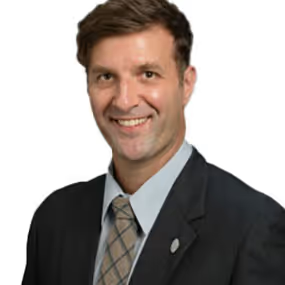
Dr. Jon Hale, professor at the University of Illinois Urbana-Champaign, joins Chris and Nick to examine the history of voucher programs, pandemic pods, and the Bezos Academy. The conversation asks how educators can push for school reform while defending public institutions and unions against market-driven school choice policies.
transcript
Speaker 1 This podcast is made possible by supporters of the Human Restoration Project, three of whom are Paul Kim, Rachel Lawrence, and Trent Kirkpatrick. You can learn more about the Human Restoration Project on our website, humanrestorationproject.org, or find us on Twitter, Instagram, or Facebook.
Speaker 2 Are pandemic pods just the latest tool through which white parents use their financial and political clout to separate out their children, thus increasing segregation?
Speaker 3 Well, again, tonight's resolution reads, to combat inequality, greater investments must be made in public schools so as not to accommodate the formation of pandemic pods by affluent parents.
Speaker 4 Pandemic pods are grounded in a racist history, and we have to consider the underlying racist principles that form pandemic pods. The fit the money should follow the child. The money that already exists in the education system for that child should follow them to wherever they're getting an education. That could be in a private school to pay for tuition and fees, and that could be in a pandemic pod, which is the main point of this, discussion today. Call the uneasement. The uneasement. Call It exposes a deadly pandemic that has killed nearly 200,000 people after an administration even really practically denied that it was an issue. So it's requiring greater investment in communities
Speaker 1 that have been ravaged by them. Hello and welcome to episode 80 of our podcast at the Human Restoration Project. My name is Nick Covington and I'm a public high school social studies teacher in Iowa and the creative director here at HRP. Today, Chris and I are joined by John Hale, whose biography you will hear at the beginning of the interview. John was recently the guest of a SoHo Forum debate on the topic of pandemic pods, which you heard excerpts of at the beginning of this episode and can find in its entirety on YouTube. Since the Human Restoration Project has primarily been focused on pedagogy and changing the structures of school, I wanted to have John on to talk more about the history and ramifications of education policy and help us unpack what's really going on in our current conversations about pandemic pods, voucher programs, and the recently announced Bezos Academy. How can we simultaneously acknowledge that school need to change while being critical advocates for the need for public institutions and employee unions? How have market oriented takes on so called school choice actually subverted the original intent of independent and charter schools. It's a really interesting conversation and it was great to talk to John. I'm sure we'll have him on again to talk education policy, history, and organization in the future. So here's our conversation with John Hale and I hope you enjoy it. So this is Nick Covington, and we're talking to John Hale, an associate professor of education policy, organization, and leadership at the University of Illinois Urbana Champaign. He's focused on the history of teacher and student activism and finishing up a book on the history of school choice with the working title, The Choice We Face. You could look for that on September 2021, just in time for next year's school year, assuming there's gonna be another one. But, hi, John. How are you doing?
Speaker 4 Hi, Nick. I'm doing well. Alright. Thank you for having me. Alright. Great.
Speaker 1 So for a little bit of context for our listeners, we we asked John to be on today because he was involved in a debate a couple of weeks ago now on September 16 with the SOHO Forum. And the SOHO Forum was a, libertarian space where they kind of get together and debate ideas of importance to that community. So past topics have included things like who should libertarians vote for in the next presidential election or is there systemic racism in policing, what should the government do about lockdowns during COVID. And the premise that you were debating with Corey DeAngeles, and we'll talk more about him in a second, was quote, to combat inequality, greater investments must be made in public schools so as not to accommodate the formation of pandemic pods by affluent parents, end quote, with you in support of the affirmative and Corey DeAngeles arguing the negative. So I just have to add in there too that Corey, or that the SOHO Forum rather is sponsored by the Reason Magazine and Corey DeAngeles is the director of school choice at the Reason Foundation and an adjunct professor at the Cato Institute. So it's not like you have to really guess where Corey's allegiance falls on that premise. And if you're interested, you can watch the debate on YouTube or listen to the podcast version of the debate and we'll link that stuff in the show notes. So, yeah, at at the Human Restoration Project, we've really focused on like the pedagogical side of progressive education and I'm not really sure that we've ever hashed out the problems with like market based approaches to so called school choice and voucher programs. And and where Corey argues that student funding dollars should be attached to students and not schools, you should be able to give that voucher to the per with the per pupil amount to take and spend wherever you think is in your child's best interest. So how do advocates of public education get that message across to people who are skeptical of the value of public institutions or view sustaining it as, in Corey's words, throwing money at the problem or, you know, what's the fundamental case against market based reforms like vouchers or these pandemic pods, John?
Speaker 4 Yeah. Well, you know, I don't think there's unlike, you know, I think Corey and others would give us clear almost universal solutions, is having the money follow the family and student and and, you know, funding individually each family, let them make decision like that sort of solution. Unlike that, we don't have, there's not one way to to combat, if you will, or to address people who have lost faith in the public education system because there are so many people who have lost faith in the public education system for different reasons. The debate with Corey DeAngelis and libertarians was one of a they have an economic theory or belief that schools should be run by as a business or like a business. You'll notice Corey kept on talking about Walmart and or Trader Joe's. Right? Which our schools should be run like that, which, you know, is is it's disheartening and it's also problematic because our schools aren't grocery stores. And they're not they're not businesses. They're not for profit entities. So I think in in addressing that crowd, the the major point, it's not always affected because that I mean, so many of us have already made up our minds. Right? We're not willing to listen. I think you do see that in the debate, I'm not wrong, that people, especially if you could see the the chat box, they've already sold on this idea. Right? But it it's to argue that historically, our schools have never been viewed as businesses, and they've been viewed as social and political institutions that were directly connected to the health and vitality of our democracy. So that requires a degree of investment that looking at a looking at schools like a business doesn't require. So the first part is to get people to sort of see that our schools are these very vibrant, dynamic, but yet challenging social and political spaces that are connected to the well-being of our country and the well-being of our democracy as opposed to either making money or making schools, quote, unquote, more efficient. Or, you know, for instance, now lately, the past couple weeks, we see Jeff Bezos and Amazon in these preschools treating students like customers. Right? Literally, that's what the point of it is. So it's it's getting people to see the much broader function and purpose of schools.
Speaker 1 Yeah. And it that is so interesting to bring up the Jeff Bezos what did he what did he call this? Bezos Academy?
Speaker 4 Bezos Academy. Wish it Bezos Academy. The
Speaker 1 interesting part about that, right, is is in like the press releases and things that I've seen for it, like talking about it as a Montessori inspired preschool that will that will that includes self directed activity, hands on learning, and collaborative play, which, you know, from from like a progressive education standpoint sounds like, yeah, why wouldn't we want to have more of those things in there? So so and that's the thing that that I think is is is sort of the the problem with it. So how can how can how would you try to sell maybe somebody on saying, like, what's what's the problem with Bezos Academy? Like, why can't we have two a billionaire philanthropist opening up these these free private academies that that maybe serve their own economic interest but provide free education for marginalized communities. What's the catch?
Speaker 4 Yeah. I I you know, there's a couple of issues there. The first of which is that why can't a billionaire philanthropist who's not paying taxes build a whole new separate system of schools? Is that what other profession do we have people who aren't even educated in or trained or certified to actually lead and build an entire system that that fills that need. So, I mean, if if we're in the medical profession as you've just experienced, Nick, I bet I bet you wanted someone with an MD or trained to be in that hospital to address and fix what was going on with you. Correct? Absolutely. Yes. So why do we have in this field of education that just because if you have a ton of money that you are somehow qualified to say what's best for other people's kids. First, I I think it's just problematic about who we allow to sort of run and build these schools and call that effective reform that we all need. That that that, to me, is just one of the most problematic issues with that. Right? And then if I may just add on the second major issue is that, you know, there's nothing wrong. That's great that people want to change the system and that they want to make education a stronger field and better system that's more attuned to the needs of all students, that's great. But why don't we work with the system that's right in front of us that I think everyone can agree and I would agree with Corey DeAngelois and Jeff Bezos on this, that it does need to be fixed. But we've learned historically that the second you start pulling out of that system like these pandemic pods are doing and sort of doing your own thing, that benefits a a a few people on the margins. Those who are able to get into Jeff Bezos Academy or whatever is called Amazon preschool. And I'm sorry for getting the name. But you you get what I'm saying these whatever these separate schools are because you're investing in something completely separate and segregated from the public school system, which over 50,000,000 students rely upon. And that's problematic because what do you do then with the mainstream of students who need that reform? Because you're exactly right. This Montessori method is proven to work. It reaches all students. It is a very sound pedagogical tool. It would be great to have that in the public schools as well if people wanted it. It it it takes a strong investment. It requires specialized teacher training to be a good Montessori teacher. It requires different types of classroom. You're scrapping a textbook and and and working with materials that students are actually literally building with. So, you know, just creating a separate system leaves behind the millions of students who don't get a benefit from this very small number of of schools that adopt state of the art or that, you know, build a state of the art facility and have the best trained teachers out there. You're not actually addressing the problem. You're just sort of you're throwing a life raft out there for the few who can hold on to it while you're watching this massive
Speaker 1 ship sink right in front of you. I think that's a great analogy. And and even to a certain extent, I mean, you're you're throwing water onto the other ship while you're making your exit on the life raft because, I mean, you're taking that those funds and that money away from students who may have needs that exceed, you know, that of a so called average student and right, I I I so in the conversation example for with Corey, he's talking about these pandemic pods, I'm wondering like, what does that look like for students with special needs? Are those are those parents also going out there and hiring paraeducators? Are they also going out there and hiring, you know, a team of specialists and people who can, you know, help assess their child's needs and then work to address it. I mean, I've got some students in my building, in my public high school, who work with a team that's probably $250,000, you know, worth of human capital in in a given day, just to help help that student get through a a day at school. And I wonder, you know, for the price of a voucher, how far is that gonna get somebody who actually does have really dramatic, you know, level two, level three needs in a in a public high school where that's free for parents at like the point of service, switching to the market based model leaves a whole bunch of people behind and it impoverishes the people who are there already and leaves them with fewer resources. So yeah, it it's so interesting to hear Corey say, and he said it several times to say, oh, parents can choose the public school if they want to. That's that's totally up to them to choose that, or they can take it elsewhere. But,
Speaker 4 yeah. That's that's just one really interesting sort of thing about this too. Well, you you undermine the whole field when you when you say something like because of the point you're bringing up, which is such an important point to think about and to discuss and to work into our policy decisions because students with special needs require something that's quite different from a student without special needs. You know, you just pointed to the the human and professional capital that's that are invested in in educators and the wraparound services that can help a student with special needs. That requires an investment that's far beyond our student without special needs. Right? And so it's not an evil it's not a level or even playing field. The reality is that not every student learns the same way, and not every family can make the same decisions. If you're looking at parents who have a a child with special needs, that requires a very different skill set. And pandemic pods, and when you start to take the money or when you start to adopt formulas where the money follows a student, something that, you know, Corey and Reason and the Libertarians advocate, you're that pressure and that, burden, really a burden on on parents to sort of find what works best for them. And a lot of times, as we know, students and families with special needs don't have the time. You know, they they're entitled to by law to go to the school that's close to their house and be provided these services. When you disrupt that, you're disrupting the services that children need. And just quickly add in, we research already shows that this market based reform strategy is problematic and often detrimental to students with special needs because if you look at the Charter example, research studies time and time again have demonstrated that students in, with special needs and and families who must provide or ensure that they get a good education are kept out of the best choice schools like charter schools. You know, when you apply to a school, a charter school is independent law that that says they have to take them, students with special needs, but a public school does. So it just shows the inequity in the very system. So people can see that what it looks like from the perspective of a student with special needs. You see very clearly and quickly that they need investment in their public schools, and you can't just go ahead and recreate the Jeff Bezos Academy because it sounds good or the theory is good when on the ground you have students with special needs and, you know, millions of other students who require something different and more than just
Speaker 1 a voucher from the government. Right. And and and what what I thought was really interesting, and and I latched on to this too in Corey's argument to talk about, he he mentioned something about preschool and it really got me got me going because, John, you you have kids. Right? Yes. I have two I have two kids, ages two. Okay. So, I mean, I have a two year old and a five year old. So we've we've had this preschool, you know, conversation going back before our first born was even born. And, you know, if if if if you wanna look at the landscape of school choice for preschools and how a, inequitable and expensive and inaccessible it is for, like, middle class families, you know, that that's really the the landscape for school choice that they want to project onto k 12. They want you to have to be on a wait list for six to twelve months or longer, and they want you to have to pay $1,800 a month, you know, for for care for your kid in in tuition. And I think, you know, by the time both of my kids get out of preschool, I will have paid for a college education for at least one of them, you know, just by the time they hit five years old and then can get into, you know, a public school program. So yeah, so Amazon preschool, like you called it earlier, doesn't doesn't sound like a like a great deal for me because it it sounds like stress, it sounds like it's not gonna be affordable, it's not gonna be accessible, it's gonna mirror the exact experience that millions of parents have with with school choice and preschools
Speaker 4 for their, you know, newborns or for their unborn kids that they're trying to get into a quality preschool education. And people without means have zero access to those things. Exactly. And and that's just one of the points too is what you you just said, you know, people without means don't have that access. And we really don't take into account those families without means to figure out this convoluted choice process or to find out, you know, where's Amazon preschool. Right? I mean, that requires so many people dismiss this fact, but that requires time. It requires capital to sort of understand the process. It it requires all these elements that you're burdening families with. Those that have the means at times even struggle with that. You know, just talk to parents who are trying to figure out the choice system. It's stressful. It it it's, you know, you're on waiting list. You know, you you have to figure out what's best for your child in a very short amount of time. It's putting a tremendous burden on them. It's not liberating. It's not freedom. It it it it's burdening families with the task that constitutions have required states to make. It's allowing these state legislatures to pass that off on someone else because they don't wanna do it, essentially. It's an it's an abdication of that constitutional responsibility of the states. Exactly. And and that's what all these, you know, some people call them these Robin Hood cases. Right? All these that are in nearly every state across, these United States where state legislatures are being sued because they are not, you know, they're not fulfilling their constitutional constitutional obligation. Right? Why these court cases exist across the country? Because of that very fact. Right? So we know that these states aren't doing that. So at this moment, when we know that they're not doing that, they go ahead and turn it over to Jeff Bezos or or charter school operators or other private school operators as well. You know, they're they're giving up on this responsibility to provide a quality public education for all students.
Speaker 1 Just to kinda process that a little bit too, fundamentally, it's not just an abdication of the constitutional responsibility that states have, but it's like it's an abdication of that entire democratic process. You know, as as you think about school boards being elected by a democratic process, state legislatures being elected by a democratic process and having a stake in what happens in those public schools. It it it advocates that whole thing towards what what we've been talking about there with those market reforms and sort of this like a la carte build your own school system. And there was a great podcast a couple weeks ago from Have You Heard with Jack Schneider and Jennifer Berkshire where where they had a guest on there and he said, well, you know, what if what if we applied the same logic to airports? You know, I don't I don't like this airport. I wanna I wanna go build my own airport and do that. Well, you you can't do that because the infrastructure and the time and everything else takes continuous investment over decades to get infrastructure to a point where you can, you know, like you were saying, fill it with the the the capital and then the the people and the everything else that makes a school system function. You can't attempt to imitate that overnight and expect it to be successful at all. Exactly right. And and you're right to say that, you know, legislators and policymakers are, you know, advocated on their constitutional responsibility to provide a public education.
Speaker 4 At the same time, they are also ignoring this historic sort of precedent before them, which is to create public schools for the benefit of everybody. And people have a hard time with that. They say it's not a public good. It's not a common good. But we need research and history tells us that that is the purpose of public education to strengthen our democracy. And if we don't see that need now, especially after if for those of us who tuned into the debate, we're just we're just missing the mark on that one in in a criminal way to not see why we need these sort of shared common spaces right now. Right? To learn how to participate in democracy. And you can't put a you can't put a dollar sign on that. So in into about the airport, you know, that analogy is exactly correct. Right? We to expect individuals to build the separate system. Right? But again, whether it's an airport or or a Walmart, you're breaking down education to a very simple formula to provide a product, to to inculcate and to share a curriculum with our students. But, you know, Nick, having gone in schools, right, we know that that is not the sole or only function or purpose of schools. Schools and teachers are asked to do so much and to reduce it to that and then take away their meager resources to actually do that undercuts the entire system. And it it it makes their their their, quote, unquote, market highly unequal when you both advocate, if you will, and give up that reconstitutional responsibility and break down and simplify education to a number or to a service. Right. Just just it it misses the mark entirely about what public schools are supposed to be doing, and that, in fact, quite honestly, that they need to be doing right now.
Speaker 1 And and I think to to add to that point too, like, I'm thinking about, when I read Jonathan Kozel's, book, and I I forget which one right now, but but he mentions in there how a lot of the, like, the accountability reform measures that that were put on to to urban schools. And in a lot of cases, what ends up happening is that a big big wig administrator comes in, turns over a bunch of teachers, gets a temporary or even a fake, you know, boost in test scores, they get they get headlines, they get a raise, they go on the speaking tour, they become education consultants and whatnot. And then in two years when kids transition, say, from middle school to high school, the the gains that that were supposed to be the miracle of whatever the program was, those gains vanish along with the administrator who's taken their money and run anyway, and then we're back to blaming teachers, and we're back to blaming kids, and we're back to blaming communities. And so I wonder just kind of thinking, like, looking at that critical role that we need to play to make our schools function better. Right? Understanding the role that schools have played in perpetuating, you know, structural racism, in perpetuating those biases. And even with your work, you know, in the in the freedom schools of the fifties and sixties that, you know, were born out of a radical democratic voice, which which we would hold up as being like, this is a hallmark of of of democracy right here, was training generations of students to to be active in their communities and to fight for, at the time, what was radical change, especially in the in the black community. So so I don't know if there's a couple questions in here, but how can we acknowledge, you know, the the sort of the dehumanizing aspects, the disengaging, the racist aspects of school. Maybe they even talked a little bit about in that dual pandemic framing of your argument in the debate, while also like being critical friends and acknowledging that crucial democratic role that they play, even while we look at historical precedence of schools that have come from a different, more radical place and been successful, and they've been held up as as examples. So, like, how do the values of democratic schooling and those freedom schools and even, like, some charter programs, how do those fit into our public school ecosystem,
Speaker 4 and how can we be defenders of that structure while acknowledging those things? Yeah. And that's why I I really like how you how you frame that because that that's also why it's so difficult not just to go into a libertarian lion's den and to argue for greater investment for public schools. I mean, that that's literally an impossible it's it's possible, but you're not gonna win that debate. Right. Well, know, but it has to be said. And it's it's also difficult because you like you said, you have to acknowledge the dehumanizing experience and aspect of public schools while also making the argument that, well, this is we still need to invest in these structures. Right? And to and to go to families who have experienced generations of of public school failure, that's very difficult to do. But you can do it, and it has been done. So like you said, you know, some charter schools are really, really successful, and and they work well. Some magnet schools work really well. Know these private schools where they're paying $25,000 a year to go to are working well. Right? So what it is is we and we know what works. We you've been able to get degrees in education at the graduate level or above for over one hundred years. And that's a lot of people that who have been educated to know what's going on, who have studied the problem professionally. The problem is one lack of willpower. So we have and our willingness to be honest with what the system is doing, and, it's also a problem of trust. Because in order to really make this work, we have by acknowledging this with these structural inequalities, whether it's racism, misogyny, ableism. Right? If you recognize how this is baked into the structure and you really understand it, I feel like that also leads to an awareness that one of the solutions are empowering those who are closest to the the the the, quote, unquote, problem. Right? To actually invest in the the parents of students with special needs, for instance, not just with a voucher, but with the actual say on this or a vote on the school board to to because parents are experts in what in knowing what's best for their children by empowering them to make decisions about where to spend the money, about removing particular teachers or principal that aren't meeting the needs of their students, you know, working in what they suggest into the actual school structure itself. So by acknowledging that, you're actually acknowledging one of the solutions to it, which is to bring those who rely on public schools into that and allow entrusting people to sort of run the schools themselves. And I will say, I try to bring this up in the debate, of course, but if you look at the civil rights history, like freedom schools, like you mentioned, and you connect it to today, there's a lot of civil rights advocates who are charter school founders. There's a lot of black power community organizers who support school vouchers. They're not supporting in in my oral histories and the research I've done, it's not so much supporting school choice per se, like the Reason Foundation is doing because it it's this economic theory that Milton Friedman puts out and, you know, for whatever reasons. It's for a very different reason is that it gives control and power back to the community who needs it. If you can start your own charter school and run it, that's that's community control and community empowerment, not school choice. If you allow a community to sit on a private school board and to determine admissions or or or something like that, what you're doing, you're empowering it. It's not choice that people want. It's just to be heard and to be respected by, allowed the keys, if you will, to control and really have a heavy say in their own children's education. And it's really not that difficult. It's just people just have a hard time with relinquishing control. Right? And going to these billionaire philanthropists in in in some very notable instances as opposed to just going to the local school and working with the structures that are already there.
Speaker 1 Yeah. That's so interesting because there's nothing there's nothing about what you just said about increasing community voice and having a say in that education that necessitates, you know, raising the public school to the ground and growing a bunch of Amazon preschools. Like, there's nothing there's nothing implicit in in saying that. And and I think that's a really interesting, like, segue into it may be the last question, which is exactly about that, you know. It's about that idea of collective voice and the and the power that's in that as opposed to the fractured market nature. Maybe we'd call that the neoliberal nature of the marketplace that is supposed to empower individuals in competition against each other. To what you said, communities don't necessarily want that, right? They want collective voice and collective action, but like increasingly that's viewed as a negative thing. And so one of the one of the talking points that Corey even had in the debate, and I've heard a lot of time as, I mean I've been a labor organizer myself, and I know you've done work in this too, is that they're a menace to society. I mean, every time he talks about the California school system, he brings up teachers' unions and and the inability to change because something about the teachers' unions is this insidious organization. Right? It's almost conspiratorial The teachers' unions won't let us, fix the problems that are in the schools. But what is really interesting is that as I have advanced in in my career and in both in labor work and in the classroom, the more that I learn about the way that these public institutions work, my inkling has never been to shatter them and break them. It's to strengthen that collective voice, you know. And Corey mentions that charter schools benefit from that lack of unionization and what better way to say that bring Walmart and Amazon up as as like the panacea for for I guess retail choice, but there are also places that are just infamous for being anti union and worker exploitation. I mean you hear horrible stories about Amazon warehouses and and Walmart wages, etcetera. I think that's maybe, I don't know if that's an ideological hurdle that we have to get over, but I think part of the the PR of public goods is is saying that like collective things have value. So how do we bridge that gap and maybe what's going on there between the notion of like having solidarity, you know, with communities and teachers and institutions and the collective power that I view as uplifting all people and the perception of unions, especially public sector unions, like, as a menace to society. I I don't know if you have any thoughts on that. That's like three podcasts worth of you, because the attack on teacher unions since their founding in the early nineteen hundreds, right, with Margaret Haley in Chicago.
Speaker 4 It's it's a lot to unpack. You know, I just and I agree with you. I find it so curious that, you know, Corie D'Angelo and others will say, well, one reason charters are doing so well or why they're an attractive option in this market is that there are no teacher unions there. Well, then why are are why did, the city of Chicago witness the first charter teacher strike in the country? Because they're not working and they're not getting paid and their their insurance is messed up. Right? Then it's so great. Why are teachers and charter schools in in in Chicago actually doing that? In Los Angeles, and you you have to fact check it. They were talking about that, what you do with the charter teachers because they are, you know, how they were being treated in the schools. And then also look at these right to work states, right, across the South and Southwest. I don't think those state education systems are doing that well. And I'm I'm saying that sarcastically. Right? This is a bottom of the barrel, and you can directly correlate that onto, correlate that with the fact that there aren't any teacher unions there, that they are not allowed to collectively bargain to not only raise their salary, but strengthen the profession. And if you strengthen the teacher, you strengthen the school, and you strengthen the the working conditions, right, which allow professionals to effectively educate their students. So what what you do about I I don't know what to do about it. This this has been a losing battle since especially with Scott Walker, what we saw in the Midwest and and, you know, the the breakup of teacher unions and collective bargaining. Right? But it's to see that through collective strength and through the professionalization of teachers by way of collective bargaining. That is one way to, of course, strengthen the public school system. Like, you can correlate research shows the correlation between higher teacher salaries and standardized test score, less teach or a stronger teacher retention, teachers actually staying in the schools. Right? And if you look at some of the ideas of teacher unions, like Al Shanker, I'll put it out there. His original idea, was based on Ray Ray Buddy's idea, charter school idea, was that this was a teacher controlled experiment where they went back to the public schools after five years to test what works. That was the original concept before it was bastardized, if you will, by corporations and million millionaires and billionaires who didn't know what it was like to teach, co opted the idea. So I mean, the idea of collective, strength by way of teacher unions is also baked into the system. Right? And it's there. It's just we're ignoring it, and then we're going in a very new direction without research to show that we're better off hiring, teachers who aren't unionized as if that's gonna work. The history tells us it's quite different and far from reality.
Speaker 1 Yeah. Man. And it it is so interesting to to think about that correlation since since, you know, the seventies or maybe, you know, the rise of the Reagan conservatives in the eighties and and really, like, labor unions and attacking public institutions. It almost seems like the twenty year trajectory from that to say no child left behind, and then the the twenty years onward, that ideological side is in search of a solution to the problem that they caused, which is which is exactly that. Right? Deprofessionalizing teachers, lowering wages, fracturing trust in public institutions, etcetera, and then having to, like, provide the solution in these market based things that aren't necessarily shown to work any better or worse, but just seem to sort by socioeconomic status, which may maybe that's an inherent goal in what they wanna do. I mean, I you know, I'll I'll try I'll try to give them the benefit of the doubt there, but it's really interesting in all of these experiments that we've said to have tried in education, going back forty years maybe, we haven't tried more unions raising teacher pay, putting more money into schools at the margins in an underserved communities. And you know what I mean? It's it just seems like we're always coming back to these market ideas that which again, to me, and maybe there's a there's a bias here, I I just don't see that working. And I'm and I'm like, why don't we try the flip? Why don't we try let's unionize more. Right? Let's let's do more of those kinds of things. Let's raise pay. Let's fund schools. And then let's see how test scores come out. And if it's a if it's a disaster, then at least we will have tried it. But, like, what what why not try more of that? Exactly. And then it's also, you know, why do we trust people like Jeff Bezos, for instance, because it's,
Speaker 4 so current right now. To to reform these schools, what he you know, he's never taught, you know, to what extent has he been in a public school. But we're trusting him or looking to that as the as the type of solution as opposed to ignoring professionals who are in gate who who sign off on a contract where they know they're underpaid because they love the position and they love their students. Right? Why don't we listen to people who are making the decision to make it work as opposed to someone with no experience with it? Like, what type of world is that where that's in fact logical? And then we keep going back to a market based reform. I mean, it it doesn't work well when when people are organized to fight for more money to protect themselves and their health and their working conditions. Right? That never works. So it is a a direct not even ulterior motive. It is a direct motive to eliminate that barrier, right, of teacher unions because people can't get what they want done with these pesky teachers in the way because they're gonna make sure that things are done well. And on top of that too, it's this idea that through collective bargaining and teacher unionization, that we have you know, the the again, the solutions are in there because it's been passed down for so long that teachers are highly trained and they know what to do best. And it's so easy to blame the teachers because, you know, you were referencing before it's ideological. It's cultural. It's in our movies. Right? When we it's on our billboards. It's on the cover of Time magazine with Michelle Rhee and that broom in 2008, like, like, sweeping away these teacher reforms, attacking on these attack the union. It it's it's worked itself into our collective consciousness, if you will, that teachers are bad, that teacher unions are evil. So we're fighting against this culture or this cultural idea. And it's so easy to do because we're sort of been socialized to see it. And it's so convenient for those who are interested in reforming schools by themselves because if you can blame a teacher, that means you're not blaming you're not looking at the system itself. The system policies need to be changed. Legislators need to be challenged, and we can't allow billionaires to run things. It's sort of like, if you allow me to make a comparison or analogy here, at the end of Al Gore's the the, his first, inconvenient truth. All the solutions at the end of the documentary are individual. Use less water. You or, you know, big turn your lights off if you're not using them. At the end of it, it'll be more conscious. Well, how about creating policies that companies can exploit the environment for profit? How about putting caps on emissions output? How about, you know, put creating policies that don't allow countries to level forests in order to make a profit off the meat industry? Right? I mean, we're we're trained to think that teachers are bad, and we can handle this at the individual level. And we're trained away from thinking about the real problem, which is a structural issue, you know, that requires much more than individual effort. It requires a collective effort, which teacher unions can in fact bring.
Speaker 1 I think that's such a useful lens. I mean, just just for looking at all of the conversations that, like, we're having in society right now is exactly that. Like, individualizing systemic problems and either blaming individuals for systemic outcomes or looking to individuals to solve those systemic problems themselves. So whether we're talking about structural racism, you know, the the argument for people who for whatever reason don't believe that's a thing will say, oh, if you just grew up in a two parent household or if you if you had just done this, then racism would not be an issue in your life. Same thing could be said about police shootings, know, for for for Breonna Taylor, you know, the the the rally that you were at tonight, John, I've made myself sick, you know, watching people on on the news or on Twitter talking about if Breonna Taylor or if this person had just done this, then this event would never have happened. It it allows you to blame the victim and individualize those things. And in education too, exactly, it says, let's not look at systemic underfunding for communities that need more than the suburban school to overcome generational divides in education and in funding and everything else that white middle class suburban kids might not need. But no, they blame teachers in in urban schools for for what? Not shouldering the burden of generations of, you know, systemic and structural inequality. So it that's such a useful lens just to look at basically every structural issue right now. And and maybe, you know, that's looking ahead, or connecting to politics. Maybe that's just that's the argument we're having. We're not having an an ideological one because I don't know if that exists anymore, or won by parties, but we're talking about, right, whether you believe that structural problems have structural solutions or whether you want to defer those to individuals and never solve those structural problems.
Speaker 4 Yeah. I mean, which is, you know, I hate this comes to mind, but a dilly of a pickle, if you will. Right? Because the the structural problems are immense, and you do need individuals to do that, but it requires an understanding that moves far beyond a quick fix. Right? And trusting individuals
Speaker 1 to lead the charge as opposed to a historical and collective approach. Yeah. But but there's what what where's the money in the historical and collective approach? In in in playing the long slow game.
Speaker 4 Exactly. And that's just just and sometime, you know, then if if we go down the question of these larger, deeper questions, our country wasn't built upon those principles. Right? So, I mean, how do we expect it it's an uphill battle to say that because our country never really embraced or practiced those principles as other countries have done. To trust a long term process, when in fact, solutions like that are why other countries succeed. Trust other people, professionals, and and expecting parents to become involved in the process more as well. It's just it's just not part of our of The United States' ideological, political, and economic infrastructure. So I mean, it's really an uphill battle, unfortunately. So it's spaces like this. It's it's it's, you know, publishing where we can. It's it's talking if we can do it at home at the holidays. Right? It sort of changed that way of thinking.
Speaker 5 I'm sure you're familiar with, like, Deborah Meyer's work involving, like, school reform and school choice and kind of that co option or differing of, for lack of a better way of saying it, like, school choice versus school choice, like school vouchers versus the idea of schools within schools or public system where students get to choose. Based off of your expertise in writing and, you know, what you know from history, does it make sense to structure a school system like that where parents have multiple options or students have multiple options, but they are all within a public system? Yeah. So that's and and Deborah Meyer's work is really interesting too because
Speaker 4 I'll say too and I'm sorry. I'm just, you know, trying to wrap my brain. That that's a big question too. Deborah Meyer, so for instance, would be part of the, like, you could call it the small schools movement or, we mentioned Jonathan Kozel before. We had a lot of union members or union sympathizers with you or the left, if you will, for lack of a better I I don't necessarily always agree with that distinction, but people who would believe in greater investments actually wanted to pull out of the public system because it was so bad. Right? Like, Deborah Meyer supported that. Jonathan Kozlov and the free school movement. Right? And I'm forgetting the name of of Deborah Meyer School in Brooklyn. Right? The community The Central Park East. Yes. Central Park East. Right? And she actually publishes in the early nineties that school choice is a good idea. You know, she's she's made a more nuanced argument as you're pointing to, Chris. Now. So we have to recognize what what what people how they actually are complicit in using choice as a model today. So I do think it's problematic to kind of turn over an entire district to choice because the way that those reformers are talking about because that assumes that everyone can make a rational equal decision based on the choices in in front of them. And we just know way too much now to say that there's no parity among people to even make that choice. So to turn it over to choice, we have to have an equal playing field to start with. And we just know in 2020 that that's not the case. So it is problematic. There are instances of what people call controlled choice. So we actually see that in Champaign Urbana, Illinois. It's what they worked with in Boston, and you actually see this in Berkeley, where the entire district is actually a choice district. Right? So in Champaign, much to my chagrin, I actually have to choose a school and you have to rank order them, and you have to do this in Boston as well. And to if I'm not mistaken, I don't know if they're still doing the Berkeley or not. And the idea is it's it's built on principles of of racial and socioeconomic integration that you can't get below a certain point to do that. And that works to some extent. It really does. I mean, it they're less segregated than they would be with that system. The issue is white people still leave the city of Boston. Right? Here, they they move to the next town over if they don't like that system. And, also, if you look at what the Reason Foundation and Corey Dion just has published this idea before, then that controlled choice isn't choice because that mean old government is sort of controlling that system. So if you go down that route, Chris, long long story short, I guess, is to say, if you do an equitable choice system, then you really can't call it choice. You you have to call it community empowerment or something like that because the way choice has been used and bastardized over time is is really not choice. So I I do think that the rhetoric around choice is harmful, and it just makes too many assumptions when you put out there in the public market, if you will, to try to co op some of their language. That we just know it's so unequal that the the framing of choice now won't work.
Speaker 5 That's that's fascinating. That's a that's a really, really interesting, very nuanced answer. I I appreciate it, because it's something that comes up a lot. There there's so many different weird alignments between the language of neoliberal reformers and what I think many progressive educators see as like this, like, mecca of, like, students kinda going off and doing their own thing and and being able to do that for free in a equitable system. A lot of that language is is very much, over the top and shared. Because, yeah, it's just really, really interesting.
Speaker 4 They're they're very strange bedfellows. Right? To to say Deborah Meyer, Jonathan Kozel put in the same realm in some ways of Jeff Jeff Bezos in in terms of belief of the the power of starting your own school and to improve the system. And that's where the rhetoric of choice falls short because of it doesn't allow us that nuance to really say that, well, Jeff Bezos is not, you know, Jonathan Cole or Deborah Meyer. Right? Like, they're they're very different, and they come up for every different reason. But what are they talking about? Pulling out of the public school system or creating your own system. Also, what what gets me to and I'll just quickly bring this up too about, you know, Donald Trump, someone else's president, during the summer, right, where school choice is a civil right of our time period. This is something that he said over the path during his, administration and Betsy DeVos says as well. So here's someone like, you know, Trump and DeVos saying school choice is a civil right. And then you have, you know, someone like James Forman junior, son of the black power organizer James Forman. Howard Fuller based in Milwaukee, but he actually founded Malcolm x Liberation University in North Carolina in the late sixties. Like, true civil rights advocates making that same claim that Trump is. Now in our right minds, we would never lump them together, but they're using the same rhetoric. Right? So we need so the term choice itself is so harmful because it doesn't allow us to see the nuance, and it really doesn't allow us to see what people are after. Is it pure profit and privatization, or is it more community empowerment? And that's what I'm I I guess I try to do that in debate. And thank you, Chris and Nick for tuning in because I think I got two votes that kept me in the positive. But one thing is to is to see that the truth is just it just doesn't allow us the the space, to really look at and and and parse out what people mean when they say choice. It's just that it is very muddled
Speaker 1 way to sort of talk about reform right now. It's almost like the the label is so tainted. You can't you can't use it without people having a a neoliberal association with it when we're talking about something that's, like, truly democratic.
Speaker 4 Like, why should we chastise well intentioned people grounded in the community who are in the schools when they say choice? But so many people are so against choice that they do. Howard Fuller shouldn't be, you know, criticized and and publicly humiliated in some cases because he believes that. What he's getting at is choice of the vehicle to to empower I I I I never wanna I won't speak I'm not speaking for him, but my interpretation is what he really looked at. He worked with Derek Bell in the nineties. I I'm sorry, in the late eighties to come up with this plan that led to vouchers. Right? Which then Tommy Thompson and the Wisconsin legislature took over and turned into a privatization mechanism when it started out as a black power solution to failing public schools. So it just goes to show that, you know, choices label just doesn't really work that well. It doesn't fit that well for the realities that we're
Speaker 5 For sure. I mean, the the the I mean, that's that's like a neoliberal one on one thing. It just you take a term and you warp it to the point where it no longer means what I meant, and then you spend all of your time discussing what the term means as opposed to talking about the actual reform that could occur. That that is particularly bad in progressive I mean, Jeff Bezos is calling his school Montessori inspired school, which is all based around, like, a free free public education. Yeah. Yeah. It's fast. Yeah.
Speaker 4 And notice too, I think in the press release, quick ad, where he also then talks about students as customers. So he's talking about honors story in this pedagogically sound technique, and then in the next sentence refer to to kindergarten or preschoolers as customers. Like, you gotta be kidding me. You know, I mean, you're exactly right. How people use that. And then, literally, the next breath contradict the very notion of Montessori.
Speaker 1 It it is very interesting though, how the tools that can be used for community empowerment can be co opted and undermined by wealthy interests with those market things in mind. Right? So so it's like they wanna take those tools and those labels, but then you use them for for ends that actually end up concentrating wealth and power for them, whereas it was originally a community tool meant to serve the the majority of people, and and now it just can't.
Speaker 4 And why what stopped what what would really stop someone like Jeff Bezos to go into a school district and say, you know, here's x amount of million dollars, and let's we have to have criteria for people who use it, that they have kids in the school, they they're from the community, they're recognized community leaders. You go into any community and you can find out that network pretty quickly. Right? Why don't people just sort of say, we're going to fund this with serious strings, but have criteria to sort of evaluate it? But that's rarely if ever tried. And I say, where I wanna sit to rarely because we actually see this. I don't wanna get down a tangent rabbit hole. I know we're trying to wrap up. But if you have to look at what LeBron James is doing in Cleveland, the more I'd look into it, I I don't wanna come to this conclusion yet because I have to do more research on it. But what he's doing is he took a a school in a public school district, and he maintained its public school status. And correct me if I'm wrong, but it's not a charter school. It's not a magnet school. He's working within that structure and just providing the funding and the space and the time and the sort of holistic investment, which includes financial investment, to turn around that school. I don't know why more people aren't so far, it appears to be working well and that the principal is right, and it's grounded in a history. We know that works. So it's just to show that you can do it. It's just not being done.
Speaker 1 Alright. Well, is there anything that we that you wanted to talk about, John, or anything that you wanted to say that, you know, our questioning questioning or the discussion didn't quite get to at all?
Speaker 4 No. I I I think, you know, I appreciate the invitation to to speak with you. I appreciate the opportunity to sort of put these ideas out there and then also talk them through a little bit more, especially because my book manuscript was due yesterday. So I can always make changes in how we, you know, approach this very really quite complex issue. So I I appreciate, the opportunity and the time, and thank you so much. And Nick, you know, getting to know you, you know, on Twitter. It's funny how you get to know someone on Twitter. You're very early on. We're sharing sources of which which, you know,
Speaker 1 I appreciate it. And in the lion's den, you really come to appreciate those who extended the helping hand. So Chris and Nick, thank you so much. Very cool. Well, yeah, it's been great to get to know you too, John. And and and probably this we won't just stop talking to each other after this. So let's let's keep the lines of communication open. I love to I love to dig into these issues. Maybe maybe the next when your book comes out, we'll we'll have you back on again around this time next year.
Speaker 5 Yeah. Thank you so much, John. That would be great.
Speaker 4 Great opportunity to keep the conversation going.
Speaker 1 Thanks for listening. If this conversation leaves you wanting to learn more about our fight for humane education, you can learn more about us and support our cause at humanrestorationproject.org. And of course, this podcast and all of our materials are brought to you by our donors and patrons.
resources
- Savage Inequalities · Jonathan Kozol (book) Examines deep resource disparities between wealthy and low-income public schools. link →
- Small Schools and Choice Revisited · Deborah Meier (article) Revisits the original progressive intent behind small schools and school choice. link →
- Are 'Pandemic Pods' a Symptom of the Public School Monopoly? A Soho Forum Debate · Soho Forum (video) Debate featuring Dr. Jon Hale on pandemic pods and public school policy. link →
- Jeff Bezos is opening a tuition-free preschool for underserved children · CNN (article) Reports on the Bezos Academy model and its stated mission to serve underserved children. link →
- Dr. Jon Hale · University of Illinois Urbana-Champaign (person) Professor of educational policy, organization, and leadership; author of 'The Choice We Face'.