

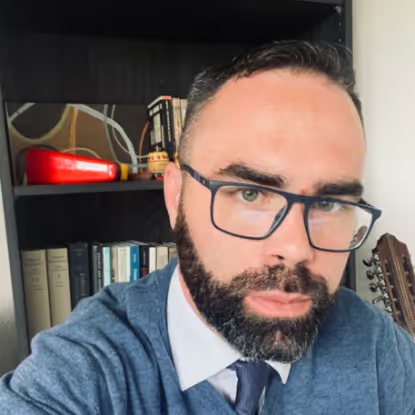
Professor Jenaro Abraham examines Puerto Rico's education system through the lens of colonialism, US influence, and the island's push for self-determination. He draws on his research in Latin America and the Caribbean to explore how schooling shapes Puerto Rican identity. The conversation weighs statehood, independence, and what genuine educational autonomy might look like.
transcript
Speaker 1 I can say that I have heard so many stories about Puerto Ricans in that have, you know, grew up in this system, this educational system, the public system, that they owe their anticolonial outlook to a teacher that taught them the history of Puerto Rico. And with that, I think I I would have to say that the anticolonial movement in Puerto Rico owes a great debt to teachers. Teachers were always at the forefront of anticolonial resistance, and making Puerto Rico just a place that's actually sustainable.
Speaker 2 Hello, and welcome to episode one forty seven of the Human Restoration Project podcast. My name is Nick Covington. Before we get started, I wanted to let you know that this episode is brought to you by our supporters. Three of whom are Corinne Greenblatt, Joel Ostrich, and Brandon Peters. You can learn more about Human Restoration Project on our website, humanrestorationproject.org, and connect with us anywhere on social media. I'm joined today by professor Renato Abraham. Professor Abraham specializes in researching social movements, politics, insurgencies in Latin America and The Caribbean, alongside analyzing US foreign policies, historical effects on human security, development, and peace. His extensive fieldwork in Colombia informs his ongoing research in Colombia, Puerto Rico, and Venezuela. Additionally, he contributes to studies on social movement integration, labor and social welfare policies, the Venezuelan migration crisis, and mental health policies in the region. Beyond research, professor Abraham coordinates a Colombian peacebuilding initiative, collaborates with advocacy groups for Puerto Ricans and immigrants, and serves as vice president of the Puerto Rican Independence Party in the diaspora. In this conversation, we discuss key issues that people in the Mainland US may be missing about the historical and current relationship between The United States and Puerto Rico. The extent to which Americanization is still a goal of the Puerto Rican education system, what role educators have played in its anti colonial movements, and what role they may play in determining the possible futures of Puerto Rico as either the fifty first US state or as a fully independent nation in its own right. Last year, I spoke with Trinidadian YouTuber Andrewism in part about the colonial history of Trinidad And Tobago, in its relationship to The United Kingdom. I was fascinated by how much of the current education system there was still a holdover from the British colonial system that, despite having achieved independence, still operated under essentially a colonized and colonizing educational system. In 2023, we also published a three part in-depth on the ground series on the pedagogy of the Hawaiian Islands, hosted by Noah Rands Lind. And I wanted to have a similar conversation with Professor Abraham today about the overall shape of the education system in Puerto Rico. I always learn so much from these conversations, and I hope you do too. Thanks so much for listening. Thank you so much, for taking the time to talk with me today.
Speaker 1 No. Thank you for having me. It's a pleasure. Could you just describe, you know, your background, your work, your research interests for those who aren't familiar with you and the work that you do? My name is Hernado Abraham. I'm an assistant professor of Latin American politics in at Gonzaga University in Washington State. It's in the city of Spokane. It's on the Eastern side of the state, the border of Idaho. Most of my research focuses on social movements, contentious politics in Latin America, and more particularly anticolonial struggles in Latin America. I think many of the things that I study come from, I guess, my own personal background in Puerto Rico. I despite the fact that I was born in The United States, like, probably two thirds of Puerto Ricans, I grew up from the age of 12 onward in Puerto Rico, and I came to Puerto Rico at a very sobering moment, wide eyed Puerto Rican that was just discovering my quote unquote homeland. Right? And coming there, this was in the middle of the struggle of Vieques, Puerto Rico. Vieques is an island off the coast of Puerto Rico. It's 20 by five miles. It was a bombing range for the US Navy. And on both sides of the island for about sixty odd years or so, they were being used just as as target practice with live uranium, and it brought social movements to, you know, go up in arms and protest the existence of the US Navy there, and it was this island or this nationwide movement to get them out, to get the US Navy out of Vieques and to stop the bombing there. Mind you, at one point in time, Puerto Rico or Vieques, Puerto Rico had one of the highest cancer rates in all of The US and its outlying territories. And with that, well, I was 12 years old. My father was an educator, and he brought us to the restricted area, which was where they bombed, with a bunch of other folks that were connected to the Ecclesia like, the ecumenical communities and the religious communities in Puerto Rico, they built a church in the whole bombing range. You know, thwarting authority, like, you're not gonna bomb a church. Right? And I guess that was my big eye opening experience to not only continue to study social movements and the change that they can make in the world, but also to become a teacher. So that's that's, I guess, some of my background.
Speaker 2 That that's incredible. That's worthy of its own story. I think we'll tell for perhaps an an another podcast at another time. Let's go ahead and let's just dive into Puerto Rico starting big. Know, when we were trying to arrange this conversation, I mentioned it. I'm approaching it largely from a perspective ignorance. Like, I don't know what I don't know about Puerto Rico to even ask you about it. Its history, its relationship to The United States, the education system, and even before we clicked record, you know, you gave me a little bit more insight that helps that's gonna help shape this conversation. And I think despite Puerto Rico being an American territory, which I think is a fact that many Americans don't even know, right? Many many on the Mainland don't even realize this, and millions of Puerto Ricans living in the Mainland United States. What are the key issues that you think the vast majority of Americans are missing, either in the historical or the current relationship between The United States and Puerto Rico?
Speaker 1 Well, I think one of the big things that a lot of Americans miss has a lot to do with, well, its own kind of ideological outlook as a benevolent kind of force in the world, which isn't necessarily wrong in every case, but it is definitely problematic when it comes to what the state actually does to other places. Right? And what its policymakers have done for the longest time. Puerto Rico is a colony of The United States not by accident of it's not an accident of history, it was a purposeful imperial move on part of The United States when it was, I guess, got drunk off the idea that it could continue to expand from sea sea a shining sea. And, well, there was a push, an impetus to to kind of move by way of the the Monroe Doctrine and its and I guess the hegemonic idea of American exceptionalism and all that fun stuff, to go to the outlying islands and outlying territories that have I guess, that that were easy to take and to take them. And during the Spanish American war, four places were, I guess, taken from the Spanish imperial rule, right, which was Guam, The Philippines, Puerto Rico, Cuba. And Puerto Rico, given its particularities during the Treaty of Paris of 1898, was ceded to The United States. And after that, every institutional relationship that Puerto Rico suffered from 1898 onward was molded to fit the extractive imperial interests of The United States. And we can see this from the nineteen thirties during the from, like, from 1898 to the nineteen thirties relatively, during the the sugar industry and how The United States tried to mold the interests of its mold Puerto Rico to to fit the extractive interests of The US sugar industry, given the fact that there was an overdependence on beet sugar coming from Europe, while they wanted to turn Puerto Rico into this place where they could just set up shop and get sugar a lot cheaper. And this obviously cemented a lot of social relationships from the past and and colonial relationships from the past. It also reformed others. Right? It it privileged US sugar conglomerates to take away land from others. And with that, there was a negotiation and even somewhat of a tug of war between Puerto Ricans and, like, US sugar conglomerates in this very limited spaces that Puerto Ricans had to endeavor politics to stop these extractive industries from taking control. And with that, basically, the education system was also molded to fit the extractive industries of The United States, the extractive interests of them. During this time, there was a belief that governed, I think, every foreign policy interaction that The United States had. And Puerto Rico, despite it not being foreign in that sense, it was incorporated into The United States, it was taken, it was still treated as something foreign because it was its intention was to keep it that way, to keep it as a colony. And with that, you had the development of institutions that were subservient to The United States, where governors were placed by were put in were appointed by congress directly or appointed by the executive branch directly. And anything that Puerto Ricans would decide in their own political institutions that were created after 1898 also had to deal with the possibility of veto powers coming from The United States that would not let them do the things that they feel they wanted to do with their own nation. Education was not exempt of this. And with this, once the Foraker Law was enacted, which was a law that ended military rule in Puerto Rico and overturned to, like, a civilian local government, but, you know but still under the the subjugation or by the subjugation of The United States, you had a series of educational institutions that were set up to Americanize. And so a lot of the English instruction was imposed over the Puerto Rican nations. For those of you who don't know, Puerto Rico is a Spanish speaking nation, and it's a nation that considers itself by and large Latin American. It does pride itself in more recent years as being more bilingual than other places and whatnot, but still our language is Spanish rather. And in that context, you see the development of institutions that were geared towards Americanizing Puerto Ricans because there was an underlying idea that Puerto Rico's racial inferiority, like, that was the hegemonic idea that was under which The United States operated, right, to to come in and oppose its its imperial rule. Yeah. Americanization required that Puerto Ricans learn the American ways and with that, they would be more amenable to the impositions that would come. This didn't last long. It was by and large considered a failure. A lot of local politicians in Puerto Rico actually opposed these matters. A lot of people see this as, in fact, the consolidation of the nation, that there was a sense of resistance against the educational system that tried to impose Americanization. And then I think come the nineteen forties to the '19 maybe fifties or so, maybe nineteen thirties to nineteen fifties roughly, Puerto Rico was undergoing a transition, modernizing transition, you know, entering the modern world, industrialization. And with that, educational institutions were kind of geared towards those ends. But with the intersecting variable of Puerto Rico also negotiating or being imposed and having to negotiate their interest in that imposition under the concept of that imposition, their their existence. And with that, the the ruling party at the time, the Papillopo Pula Democratico, created a new constitutional order that was negotiated with The United States to an extent that basically enforced the relationship that we know today in Puerto Rico. That relationship did create some of the greater institutions that we know today, the university system, the one I actually graduated from in Puerto Rico, my bachelor's, my master's degree. And it while the first university on the island happened under under the under US rule, It's didn't really the UPR didn't really expand as a public institution till much later, particularly during this industrial period where there was a need to kind of suffice the interests of of industrial industrial output. But this happened, though, at the same time when there was a the existence of a peasantry that was diminishing in Puerto Rico, and that well, a lot of Puerto Rican authorities and US authorities for that matter thought that we had to do away with. And they understood that to do away with this, there was all obviously, the you had to, you know, industrialize them and kinda push them into the working class and to the workforce. But those there was only so much space for Puerto Ricans to actually be able to to fit into that to the cogs of that system. And with that, and in consonance with The United States and and farm and all kinds of agricultural conglomerates in The United States, there were migrant labor programs that were geared towards sending the most vulnerable out. And with that, there was a lessening of social pressures that is were often thought to kind of bring colonies to well, to challenge the status quo. This, however, did not necessarily quell all of the the anticolonial resistance. There was much anticolonial resistance happening at the time. 1950, there's a revolt against The United States that was squashed by military rule. There was also a there's a the Nationals Party at the time had went to the Blair House and shot up shot into the air and in protest of the new constitution that was being imposed because there was no real vote on it except for a yes or no vote, which a lot of independent argued that people that, you know, that challenged colonial rule argue that this kind of obscured real resistance against these things. And the funny thing about this, I think, in all of this this hodgepodge of things that was happening that that were happening at the time, teachers, given the fact that they were at the lower echelons of society and the working class, and that they came from the lower echelons of society, the bulwark in a lot of senses against this imperial kind of imposition. They were some of the first people to create independent unions in Puerto Rico that were very that they that they challenged not only the local kind of impositions of, like, salary and all this the labor stipulations they felt were unfair, But they were also some of the first kind of the people that that helped mold the organic law of education that we know today, that which at the time was one of the most progressive laws, educational laws known to Latin America. And it created all kinds of really cool stipulations about, you know, about tenure there, about, you know, being able to stay there and getting promoted and salary and all kinds of stuff. And a lot of this was all also happened because of the fact that a lot of the Puerto Rican teachers' unions were very adamant during the sixties and seventies about not being associated with American unions because there was a history in Latin America of American unions coming down, and the teachers' unions were not exempt of this. Coming down and kind of tried to mold unions and their and their resistance to any imposition in the workforce, in their in their in their workshop, right, which is the classroom, to try to mold them away from radical politics and to and to kind of make them more amenable to things that, you know, patrons would would accept. This is all part of the the alliance for progress kind of outlook. Puerto Rican unions in this context started creating their own centrals, their own unions, and and with that became, like, some of the not only challengers of the status quo when it came to anti colonial politics, but they also became the the first challengers to neoliberalism. You know, they were they were out on the streets all the time, the strikers. They were also, as of today, the lowest paid teachers in all of the in all of The United States and its outlying territories. The places where a lot of independent school districts go down there to poach bilingual teachers and send them out. And we do have an unfortunate problem of teacher brain drain, if you will. You know, because there's our best and brightest are often taken out of there. But I can say that I have heard so many stories about Puerto Ricans in that have, you know, grew up in the system, this educational system, the public system, that they owe their anticolonial outlook to a teacher that taught them the history of Puerto Rico. And with that, I think I I would have to say that the anticolonial movement in Puerto Rico owes a great debt to teachers. Teachers were always at the forefront of anticolonial resistance and making Puerto Rico just a place that's actually sustainable. And I guess that after that, you know, if to conclude, I guess, what Americans should know about the situation, about this extractive situation that kinda molds institutions and teaches institutions. The come the neoliberal era, the seventy three crisis afterwards, the big oil crisis that kinda created a lot of fissures, economic fissures and political fissures that we knew in the world at the time that brought your Reagan's to power, that brought your your Thatchers to power, that liberalized China, and that, you know, created the situation where economies were, in fact, much more liquid and also susceptible to to the to the logics of the market. We saw Puerto Rico also kind of fall to these these problems, right, where education became a something that you put a price tag over. And with that, the purpose of these educational institutions for the status quo was different. Right? It was one that would prioritize money and and and, you know, money coming from certain interests to fund education And the state of absolving itself of its responsibility of actually having to take on the burden that is education and it's and yeah. And and everything that entails. And we see this particularly in the last few years by way of the appointing of people like Julia Kelleher, who was an American, she was secretary of education, she was from I think she's from Pennsylvania, I'm not oh, she's from Penn. I don't know. She's from particularly from Pennsylvania. But she was sent down, she was hired by the Puerto Rican government to reorganize and revamp the educational system and kind of implement these policies that they've been throwing out there in the government to try to create education vouchers and to try to make our education system more they have to privatize it completely. And with that, they brought in the language of community oriented things or whatever and say, let's make these school districts autonomous and let's make them and which essentially means get your own money elsewhere. Right? And when she tried to revamp that, she also got caught up in the colonial corruption here and was charged and was indicted and was arrested. And, yeah, unfortunately, the colonial education system has also been susceptible to the fact that while many people have taken it as a political bastion in Puerto Rico, you know, that are promoted to the position of being secretary of education are connected to one of the two main colonial parties. And with that, they implement a series of policies that are amenable to, well, extract the interest of The United States. This does not mean necessarily The United States is acting like a that the the education system is acting at the behest of American interests, but definitely on behalf of them.
Speaker 2 So it's like in the same sense that there were these extractive economic practices. You're saying that there were some similar extractive educational practices as well. And I wonder, in what sense then today is that Americanization, which I can imagine as being, right, at at some point an explicit policy goal of the education system in Puerto Rico. Is there a sense today that that is still a goal of the of the system, either implicit or explicit in some facets of it? Either with the appointment of these officials to participate in in the formal government in particular ways or whatever. And then I wonder too just about that on the ground resistance. You had mentioned of the the role of teachers and and their independent unions playing in an anti colonial movement. To what extent is that anti colonialism? It it almost is feels anachronistic to refer to it as that in 2024. Right? But really, that's what it is. So to what extent is the Americanization still an explicit or implicit part? And then, again, to what extent are teachers forming the resistance backbone to those anti colonial movements? Or have they been successful in what ways?
Speaker 1 Well, I think that's a very good question. Right? Because I think Americanization probably meant a lot of different things as time passed. Right? As the interest of The United States changed, the American model, I guess, also changed. Right? So I I could mention some some big trends. Right? One of the big ones is that, well, you know, during the during this first thirty years of Puerto Rican history, most education systems were most much of the education system was molded, like, for was molded in a way that it it resembled, like, naked coercion. You know? It was an out and out Americanization. During the industrial area era, there there was a kind of a pulling back of that. Right? And there was an acceptance of of the fact that we were a nation, but we were a nation that was effectively excluded from the rights and responsibilities of The United States, but with the fact that we were subservient to these interests that came from afar. And with that, we had to play to the tunes of The United States, and we had to kind of bow down to these interests that were there in our educational system, then had to had had to mimic The United States in ways that were amenable to the industrial interests that were taking place in Puerto Rico. That did make it a little different than The United States, of course, because of the fact that, well, Puerto Rico was a tax haven. So the industries that would come down were obviously very different. There was all kinds of patent laws that were there was a lot of exemptions for intellectual property that allowed for pharmaceutical companies to to set up shop in Puerto Rico for all kinds of, like, different industries that were high-tech to set up shop in Puerto Rico. With that, you had the development of, well, institutions that were geared towards creating engineers or creating, like, well paid workers. Right? However, when these things kind of when these tax exemptions timed out, they became poached by The United States, and they just kinda left. So there was, a brain drain. So I wouldn't say necessarily there was an Americanization in that sense. There was a I guess there was an Americanization in the sense that we were taking advantage of, and we had to we were kind of pushed and shoehorned into the logics of a market that wasn't ours and that did nothing for our economy. And given the fact that we're we were a tax haven, funds for education were always lacking. Right? And they always we're always dependent on, like, The United States to kinda send funds for education. And it creates this kind of stranglehold relationship that we're that's really hard to get out of. And I would say that if there is an aspect of Americanization that continues to persist in our education system now, right, it's the fact that most of the schools themselves are being thought of as these centers for simply getting employed elsewhere. The university systems themselves are now molding themselves to this trend of people leaving Puerto Rico. You wanna get a job that makes you hireable in The United States? You know, come to our university. You wanna get a job that actually, you know, sends you out and sends your best best and brightest afar. I can I can testify that? Right? Most of my friends that that studied with me education and that studied even masters and doctorate degrees or whatever are now here in The United States where you didn't stay. There was no a lot of teachers feel like there's no place for them in Puerto Rico. When I left, teachers would make $1,700 a month. And mind you, in a in an in an island where an archipelago where we have are burdened by a shipping monopoly. So with that, you you could imagine the prices going up just like Hawaii and just like Guam. You know, our our shipping costs bring prices food prices through the roof. The only thing that kind of allows for people to to kind of survive, I think, is the fact that Puerto Ricans do have local community based economies. We do depend on each other, you know, there is a very different moral economy that's at the the community level and whatnot. And I think that allows for Puerto Ricans to kind of subsist. And I mean, don't get me wrong. The beach is a great it's it's a wonderful thing to to not think about the the horrors of of of capitalist exploitation. But at the same time, the beach won't pay your bills, you know. So at one time or another, I think Americanization, a lot of senses, has less to do with the cultural aspects that they wanted to impose now and more to do with what they wanna take from us, you know, and how those logics are seen as natural, and that we have to accept those logics as natural. And to your second question about the role of teachers in this Yes. Yes. My goodness. Yes. I I I don't even know where to start. Like I said before, I feel like the teachers, we owe a debt to teachers. Teachers have been I mean, I think that if you go to Dallas ISD or you go to to places like Winston Salem, North Carolina, like, any of these these big ISDs that had now had an influx of Latino students that required bilingual teachers can testify to the quality of of Puerto Rican teachers. They're amazing teachers. They're people that have a really critical outlook and that a lot of anticolonial movements saw this and also invested inordinate amounts of resources in trying to, well, to bolster unions. Right? And some of the best labor leaders on the island, on the archipelago, were were teachers, you know? And there was an understanding that, you know, one of the few places that you can actually, you know, reach Puerto Ricans, every Puerto Rican family, and speak to them directly about the ills of their exploitation, and come and meet them where they are, what their economic needs and everything that and and hear them out. The teachers had a very special and a very privileged role in that sense. They had they were able to to reach every family in Puerto Rico where, you know, the impending effects of industrialization were compartmentalizing it, separating us. And with that, I think teachers were the the glue that kept a lot of the anti neoliberal kind of movements in Puerto Rico together. If it weren't for teachers, don't think we'd have as much, you know, anti neoliberal resistance. And I think that the role that they play at large has always been one that attempts to uplift Puerto Ricans in the most hoard of situations. If you look at the test scores that Puerto Ricans from the lower echelons of society receive or or or they get. I mean, at one point or another we have to we have to accept that they're they're receiving a condition, so they receive a bad test score. Right? That they well, they're very low. Some of the lowest in in in all The United States. It's created this two tiered economic or two tiered educational system that reflects the economics of Puerto Rico, where if you're part of the quote unquote middle class, you send your kids to private school. And you send them to the private school, and you expect them to get a little bit better education. And then usually, the kids in private school don't see Puerto Rico as an option for staying there necessarily. They leave. And then you see another a second tier kind of system where a lot of universities, private universities have set up shop to kind of suffice the needs of local economic interests. And with this, you do see universities kind of impart instruction in certain trades that have to do with baking or you know, accounting or things that they you can get a job immediately afterwards. Things are much more technical. And you see that there is this kind of two tiered class system that exists when it comes that that is reinforced by the education system. You don't trust the education system in Puerto Rico. You don't trust the fact that, well, a lot of Puerto Rican teachers end up having to leave, and that there's an absence of teachers. There's not enough teachers to give class to the nation's most vulnerable. And despite that, there's been a recent closing of, like, almost 300 schools in the last ten years because of the demographic brain drain to The United States. It's created this problem where it's just hard it it's a self perpetuating problem that never allows the education system to be meaningful for Puerto Ricans. Right? It can get them a job. It can it can help them it can function as a trampoline to leave the island. But the resistance of teachers has been always to make to help build the world anew for for Puerto Rican youth, one that they can use to stay. Does that make sense?
Speaker 2 It does. Yeah. It it seems like all of the basically, the system is designed to send as as sort of a recruiting ground for, as you said, the best and brightest, not to stay and enrich the land or the archipelago, as you've been calling it, itself, but to, right, contribute their gifts to the the mainland in this disproportionate, you know, social, political, economic relationship. Returning our attention a little bit perhaps to the future of Puerto Rico, its relationship to The United States. You know, I've learned a lot very recently from our mutual friend, Gilberto, about the historical contemporary discourses about statehood versus self determination and independence. So how do you imagine the pros and cons of either path, be that statehood, independence, or just the status quo? And what do you imagine the impact of change on that extractive education system that you've outlined here? Perhaps going from one that is a trampoline into, you know, the Mainland United States, the successful extraction there, or, you know, one that can be more aligned towards the self determinant goals, perhaps, of the people and of Puerto Rico themselves.
Speaker 1 So concerning the the issue of the Puerto Rican status. Right? It's often used, and I I appreciate the question because it's the thing that I think burdens most Puerto Rican political conversations. Right? It's the one thing that you don't talk about at the dinner table. Right? It's the one it's the one thing that divides us all. And it is one thing that is very contentious for sure. It's most Puerto Rican politics at one time or another, probably a little less so now than maybe a few decades before. But the issue of status divides us between, like, three big trends. Right? People that believe in statehood as a solution to the woes that I'm describing. People that believe in independence to the woes that I'm describing as a solution to these things. And people that believe that the status quo should stay, but it should be maybe battered or or tweaked a little, more and more people are realizing that the status quo was not an option. Right? It seemed like an option when there were great industrial gains, like post World War two to the seventies. It seemed like an option when, well, there were gains for very high paying jobs. Right? Like engineers and chemists working in the pharmaceutical industries for the sake of, like, a data point. At one time or another, Puerto Rico produced 60% of the over the counter medicine that you buy in Walgreens or CVS or any of these it became this place that would export so much drugs and medical technology to The United States that, you it was a very lucrative industry, but none of that money actually stayed there apart from the salaries of employees, which were, by and large, much smaller than the ones you'd get in The United States anyway. So was also it was cheap labor for, basically the all the medical technology and stuff you get in The United States. So it worked then. Right? It worked for a very brief moment, but it could never really mitigate the terrible inequalities that existed in Puerto Rico. And it could never really create a sustainable safety net for the most vulnerable Puerto Ricans. And what that Puerto Ricans receive inordinate amounts of federal money. They're dependent on federal money, whether it be food stamps, whether it be, you know, Pell grants, whether it be all kinds of things that have to do with sustaining their livelihood, right? Know, come the eighties and come the nineties when a lot of these tax exemptions timed out, we saw that the status quo was not working. Right? And there was this kind of there was a slow polar movement to the different options that weren't the status quo. The folks on the statehood camp have been the ones that have won the most elections, I think, in recent years. And because of that, they have managed to create this hegemonic discourse that you hear in The United States about Puerto Ricans wanting statehood. And they win the elections of our only representative in congress, our what you call the resident commissioner, that that person was it's not a voting member of congress, but does get to voice opinions about Puerto Rico and can vote on, like, local committees or whatever. But, yeah, it's a really kind of pathetic position because you don't really can't really do anything. Right? You're just kind of voicing the opinion of the ruling party. And mind you, the ruling party won the executive branch this past electoral cycle with 33% of the vote. Like, it was nothing. So it's not a very popular party either because it's always associated with some of the same ills that were implemented for the greater part of these last, you know, five decades. What I wanna get at with their with their hegemonic discourse and their outlook about how things would change for Puerto Rico, well, they argue and have argued to the American people that Puerto Rico is a civil rights issue, that we are simply afforded differential rights because of our status, and that colonialism is defined by that legal status, that in between legal status that we have, not by the extractive interests that, you know, that kind of govern Puerto Rico. Folks that are on the independent side say, obviously, it's the legal relationship, but it's also the relationship that has to do with what's always been taken from us. Right? It's extractive in nature. So I guess what I wanna say with this is that folks that want independence and the folks that want statehood have two different definitions of what colonialism means. Colonialism for, you know, for the pro statehood people is just a tweaking of the system to continue the status quo, but with maybe some more rights and benefits in their mind. And they see The United States and their their existence in Puerto Rico and their dominance in Puerto Rico as something that was inherently good, but could be better. Right? And then the people that believe in independence, such as myself, I I happen to be part of the Puerto Rican independence party here in the diaspora. We believe that, yeah, it's it's defined almost exclusively by its extractive interest, almost exclusively by this kind of ingrained understanding of racial inferiority of Puerto Ricans, and it is one that has always governed the right for The United States to extract, right, from us. And we believe that the education system, by and large, could be something much more meaningful where Puerto Ricans can actually take charge of their future. Right? And that sounds lofty. It might sound like up in the air, pie in the sky kind of thing, but it is something that Puerto Rican teachers have always fought for. And they fought for in meaningful ways, and they've been able to resist the onslaught of neoliberal education cuts by continuing to challenge the status quo by right of just simply existing. Imagine teaching for 1,700, $2,000, two it's a little higher now because of federal funds that were allocated to Puerto Ricans that are not going to be there necessarily after a certain amount of years. They are they are roughing it out. I mean, they are they are doing everything that they can and basically in a in a voluntary sense. Right? They do much more than what they they're ever paid for. I mean, same thing can be said about any teacher. Right? But I think in in in places where colonial rule still exists, it's it's it's so much more accentuated. Right? It's so much yeah. The relationship is so much in your face. Right? It's right there. You can see it. It's it's latent. And I think that moving away from the understanding that education has to be simply for, you know, for profit, for for emboldening the industries of people that make money from from very far lands rather than kind of, you know, using it, leveraging it, instrumentalizing it to making a Puerto Rico that's actually sustainable will have gains. Gains that are some will be quantifiable. A lot of them will be, however, much more meaningful than what the numbers will ever portray. You know? They will allow us a real sense of sovereignty. Right? A real sense of thinking and feeling that we have the ability to change the world around us, which is something that has been denied to us. Right? I think Puerto Ricans suffer, like many colonial kind of people, right, colonial subjects suffer from this idea that they could not be anything without their colonizer, that they are nothing without them, that they could never imagine, or they could never even that they could only imagine, right, that that's the only thing they're allowed to do. Imagine a world without The United States, that they are only going to be afforded the hell that's been imposed over them, and that in itself is natural. And I think that independence itself will have a really rejuvenating feeling and and and spirit over the educational system, and that it can allow Puerto Ricans to feel that, well, they're in control of their destiny.
Speaker 2 We are only going to barely scratch the surface of the surface of the surface of any of this. I imagine if people want to continue to learn more and kind of carry on this conversation in in their own right after this, what should they read? What thinkers, writers should they turn to? What should they listen to? What should they watch? What's kind of on your CliffsNotes kind of one zero one, or where would you point people in the direction of if they wanted to learn more following this conversation up?
Speaker 1 There's a really wonderful book by two great academics. One's name is Cesar Ayala, who's from in UCLA, and Rafael Bernabe, who's actually running for the senate in Puerto Rico, and the who's also was a labor leader and a professor at the University of Puerto Rico. The the book is called Puerto Rico and the American Century, and it's a history of Puerto Rico from 1898 onward. It's out of North Carolina University Press, UNC. UNC Press, yeah. I think that one's probably the best kind of general overview of Puerto Rico's colonial situation with all of its caveats. Right? Like, not everything in an empire is ever imposed completely. There are negotiations, and I think that that book also kind of touches on those nuances in very meaningful ways, talks about the labor movement, it talks about the independence movements, and it also talks about the anti neoliberal movements. It does need a little updating because it's about ten years old, but it is it's a wonderful start. I would also pay very close attention to some of the scholarship that's coming out of Centro. They also have some things that are actually much more accessible to folk that want to learn more about about Puerto Rico's colonial situation in the present, post disaster, you know, post Maria, post hurricane Irma. And I would also just pay attention to and I hate to be this like this self what do you call it? These these people that that advocate for themselves and Self promoting. Yeah. Self promoting, yes. So I hate to be this like self promoting kind of a figure here, but I will say that the Puerto Rican independence party does have a podcast. There's also a really good podcast called, that's in Spanish, but the there's a podcast in English and in Spanish that we're endeavoring with the Puerto Rican independence party that kind of talks about the colonial walls and how the diaspora and people that are not in the diaspora can get involved and trying to build Puerto Rico anew.
Speaker 2 Genero, thank you so much for taking the time to talk with me today.
Speaker 1 No. Thank you for having me. It's been a pleasure.
Speaker 3 Thank you again for listening to our podcast at Human Restoration Project. I hope this conversation leaves you inspired and ready to start making change. If you enjoyed listening, please consider leaving us a review on your favorite podcast player. Plus, find a whole host of free resources, writings, and other podcasts all for free on our website, humanrestorationproject.org. Thank you.
resources
- Puerto Rico in the American Century · César J. Ayala and Rafael Bernabe (book) Examines US influence on Puerto Rico's political and social development over the twentieth century. link →
- CentroPR - Center for Puerto Rican Studies · Hunter College, CUNY (organization) Research center providing data, publications, and resources on Puerto Rican communities and policy. link →
- Prof. Jenaro Abraham · Gonzaga University (person) Researcher specializing in social movements, US foreign policy, and education in Latin America and the Caribbean. link →
- Puerto Rican Independence Party in the Diaspora (organization) Political organization advocating for Puerto Rican self-determination; Abraham serves as vice president.