

The following is an excerpt from the upcoming Human Restoration Project Primer. You can also listen to an audio narration of this essay.
In the early 2000s, Vladislav Surkov, the Kremlin’s chief political strategist, had a fascinating yet twisted idea. He funded neo-Nazi skinhead movements alongside liberal human rights organizations. He backed parties opposed to Putin while orchestrating Putin’s messaging. Then he outright let everyone know he was doing it. In the end, the goal was not to make one of these sides win out or to make Putin look good. Instead, it was to make all narratives suspect, leaving citizens in a state of confusion where nothing felt real and resistance felt pointless. As journalist Peter Pomerantsev documented in Nothing Is True and Everything Is Possible (2014), the Kremlin’s aim was to make the truth feel unknowable, so dark and complicated that you just want to switch off. Nothing Is True and Everything Is Possible: The Surreal Heart of the New RussiaResearch summary (based on library-catalog synopsis): Peter Pomerantsev draws on his work in Russia’s television and film industry to portray social life and political power in the post-Soviet...View source →
This became known as the “Firehose of Falsehood” model: a media technique with high volume, multichannel, rapid and continuous communication, with no commitment to consistency. The Russian "Firehose of Falsehood" Propaganda Model: Why It Might Work and Options to Counter ItResearch summary (based on the primary publisher or institutional source): Paul and Matthews analyze Russian propaganda through a model characterized by high message volume, multiple channels, rapid...View source → It became even easier with the growth of social media both inside and outside of Russia (and in recent years, artificial intelligence).
Over the first two decades of the 21st century, Russia’s Internet Research Agency created fake accounts to inflame American political divides, the 2016 Brexit referendum, the invasion of Ukraine, and more. Inside the Troll Factory: Russia's Internet Research AgencyResearch summary (based on reported explainer): This explainer describes Russia's Internet Research Agency and the organization of coordinated social-media influence operations. It discusses accounts...View source → Each day this campaign operated, it became more and more difficult to determine what was real, with Oxford Dictionaries naming “post-truth” its Word of the Year in 2016. Political theorist Hannah Arendt warned about this decades earlier, writing, “[t]he ideal subject of totalitarian rule is not the convinced Nazi or the convinced Communist, but people for whom the distinction between fact and fiction, true and false, no longer exists.” The Origins of TotalitarianismResearch summary (based on library-catalog synopsis): Hannah Arendt investigates the historical development and operation of totalitarianism, examining European antisemitism and imperialism alongside...View source →
The reason is straightforward: when no one can agree on what is real, those already in power face no organized opposition. Surkov did not need Russians to believe in Putin. He needed them to believe that figuring out the truth was not worth the effort. Exhaustion, not persuasion, was the product. The strategy worked because it exploited something genuine about human cognition: we do not have infinite capacity to evaluate competing claims. At a certain point, we default to the familiar and the convenient, or we stop trying altogether. This is what makes the firehose model so dangerous and so portable. It does not require a centralized propaganda state. It only requires more noise than any individual can filter — and any institution with enough reach, be it a government, a media ecosystem, or a social platform optimizing for engagement, can reproduce the effect, intentionally or not.
This problem extends to various issues facing our world. Despite more and more research proving humanity’s impact on climate change, how inequity is expanding across all systems, or the dangers of growing authoritarianism, we have seen more people rejecting said research. The Effects of Climate Change DenialResearch summary (based on academy article summary): The Royal European Academy of Doctors summarizes José María Baldasano's writing on climate-change denial and opposition to climate action. It...View source → The question for educators is no longer just “what are the facts?” It is whether truth, as a stable category, still functions the way our institutions assume it does, especially in a world of large language models and AI video generation.
Is Reality “Real” at All?
Writing decades before ChatGPT generated a single sentence, philosopher Jean Baudrillard argued that the distinction between reality and what he called “simulation” had already collapsed. Simulacra and SimulationView source → He laid out four successive phases of “the image,” or how we view the world, with each phase marking a further detachment from reality. Each phase showed a more simulated world where what is around us isn’t really “real,” but a version of the real world offered to us by powers greater than ourselves, namely corporations. This culminates in what Baudrillard dubbed hyperreality, where the simulated version of our world feels more real than actual reality — “more real than real.” Baudrillard’s work can be difficult to picture because it’s philosophical, and frankly sort of weird, but when applied to classrooms these concepts are actually very easy to understand.
In the first phase, “the image” reflects a profound reality. This is, for example, a classroom roleplay: students pretending to be 1970s disco dancers for a history lesson. Everyone knows it is a simulation. The real event is referenced honestly, and the activity draws its meaning from that reference.
In the second phase, “the image” masks and distorts a profound reality. Consider a teacher administering a perceived-as-real high-stakes, yet ultimately fake literacy test for students to “experience” unjust poll test practices in the Jim Crow South. The exercise is pedagogically useful, but it bends reality. Students experience discomfort without experiencing real danger. The simulation distorts the scale of what actually happened, but it still points toward something real. The referent exists, but the representation is imperfect.
In the third phase, “the image” masks the absence of a profound reality. It starts getting odd here. This is the teacher delivering a sanitized version of the Thanksgiving story because students are “not ready” for the full, darker history. The representation does not distort the truth; it conceals the fact that the truth has been removed entirely. The cheerful construction-paper pilgrim hats are not a bad version of history; they are a placeholder where history should be. As in, they mask history’s absence.
In the fourth phase, “the image” has no relation to any reality whatsoever — hyperreality. This is the teacher delivering the mandated curriculum faithfully, not realizing that the script itself is inaccurate, and having no framework through which to recognize the inaccuracy. The curriculum is correct because the curriculum is all there is. There is no outside reference point. The simulation has replaced reality so completely that the question of accuracy no longer arises. As in, we have hit a point of hyperreality: the curriculum is real because it is the curriculum, therefore it is real. It is “more real than real.”
(Notably, Vladislav Surkov was well aware of this concept — commenting on how everything is only “simulacrum” and “simulacra.”) Nothing Is True and Everything Is Possible: The Surreal Heart of the New RussiaResearch summary (based on library-catalog synopsis): Peter Pomerantsev draws on his work in Russia’s television and film industry to portray social life and political power in the post-Soviet...View source →
In Baudrillard’s words:
In the first case, the image is a good appearance. In the second, it is an evil appearance. In the third, it plays at being an appearance. In the fourth, it is no longer of the order of appearances, but of simulation.
Simulacra and SimulationView source →
Schools (and arguably our entire media ecosystem) have been drifting toward the fourth phase for decades.

The Vanishing Point
There’s a major parallel in this “simulated reality” to the growth of generative AI.
Over time, AI collapses in on itself. Researchers at Oxford and Cambridge published a study in Nature documenting what they call “model collapse”: a degenerative process in which AI systems trained on AI-generated content begin “forgetting improbable events over time, as the model becomes poisoned with its own projection of reality.” AI models collapse when trained on recursively generated dataNatureAbstract Stable diffusion revolutionized image creation from descriptive text. GPT-2 (ref. 1 ), GPT-3(.5) (ref. 2 ) and GPT-4 (ref. 3 ) demonstrated high performance across a variety of language...View source → The outliers, the unusual perspectives, the minority viewpoints: these are what the model loses as it trains on its own outputs. What remains is an increasingly narrow, increasingly average, increasingly circular version of knowledge. This is essentially an ouroboros: the serpent consuming its own tail, where each generation of output becomes the input for the next, each cycle a little more hollow than the last.
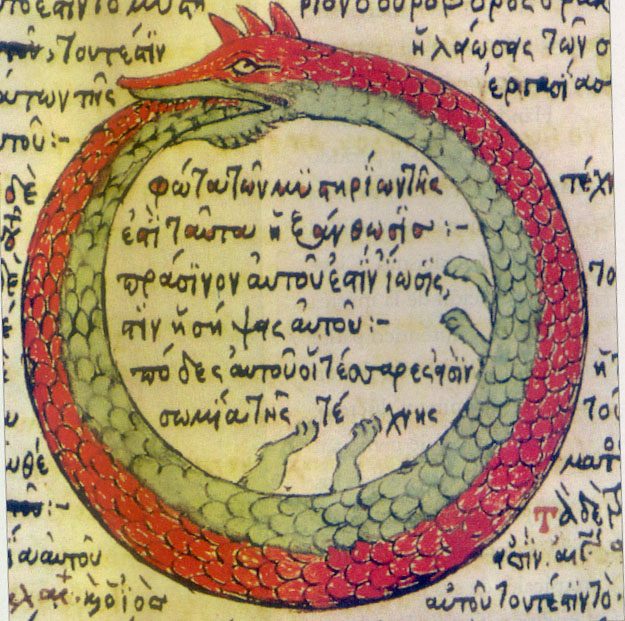
This is not a small technical problem. If the systems we rely on for information are progressively narrowing what counts as knowledge, if the unusual and the marginal are being stripped away by the recursive logic of the machine, then the AI is not just simulating reality, it is flattening it. The data “collected about genuine human interactions,” the researchers note, “will be increasingly valuable” precisely because authentic human knowledge retains the diversity that recursive AI output eliminates. In a world saturated by AI-generated content, human messiness becomes a scarce resource.
Of course, this is not limited to AI-generated content, it has a direct parallel to schooling and what/how we teach. Baudrillard described this condition in The Illusion of the End as a kind of vanishing point: the closer we get to perfect reproduction, the more the thing itself disappears. The Illusion of the EndResearch summary (based on publisher synopsis indexed by Google Books): Jean Baudrillard questions the idea that history progresses toward a definite endpoint. Writing as the millennium approached,...View source → The more perfectly something is simulated, the more the original becomes irrelevant. We are not approaching this vanishing point and preparing for it… we have likely already passed it either through an obsession with education standardization or AI-generated videos. The question is not how to avoid it but whether we can escape it. Generative AI has made the production of pure simulacra trivially easy for anyone with an internet connection. The institution designed to teach students how to read reality was already deep in simulation. Now the tools for manufacturing unreality are everywhere.
Students growing up in this world are not “digital natives” in the shallow and misguided sense that phrase usually implies. They are, essentially, “hyperreality natives.” They are living in a world where the distinction between the real and the simulated was never stable for them to begin with. And to be clear, it isn’t that AI has brought about this simulation; it’s just that AI has made it more inescapable.
The Interpassive Classroom
Frederick Winslow Taylor published The Principles of Scientific Management in 1911. In what would be dubbed “Taylorism”, work could be scientifically analyzed, broken into discrete tasks, timed with a stopwatch, and optimized to find the “one best way” to perform any job. “In the past the man has been first,” Taylor wrote. “In the future the system must be first.” The Principles of Scientific ManagementView source → Workers were stripped of autonomy and judgment, and managers monopolized knowledge and decision-making. Raymond Callahan’s Education and the Cult of Efficiency (1962) documented how aggressively schools adopted this model during the massive spread of public education between 1910 and 1930. What emerged was a new professional class of school administrators whose priorities were financial, not pedagogical. The result, Callahan argued, was not better teaching or deeper learning but an obsession with cost cutting. Education and the cult of efficiency: A study of the social forces that have shaped the administration of public schoolsResearch summary (based on library catalog synopsis): Raymond Callahan examines the historical influence of business ideals on public-school administration, particularly between 1910 and 1930. His...View source →
Wayne Au, writing in the Journal of Curriculum Studies, called contemporary high-stakes testing the “New Taylorism.” “Public school teachers in the US are teaching under what might be considered the New Taylorism,” Au argued, “where their labour is controlled vis-a-vis high-stakes testing and pre-packaged, corporate curricula aimed specifically at teaching to the tests.” Teaching under the new Taylorism: high‐stakes testing and the standardization of the 21 <sup>st</sup> century curriculumJournal of Curriculum StudiesResearch summary (based on indexed source text): This critical analysis connects contemporary high-stakes testing and scripted curricula with earlier forms of scientific management in U.S. schooling....View source → This is the logic of scientific management continued a century later, now enforced not necessarily by stopwatch-wielding foremen but by standardized assessments and pacing guides.
Expanding on this historical context, Baudrillard points toward what might be called anti-pedagogy: an education system that forecloses genuine autonomy by pre-coding all possible responses. Students are not invited to think independently. Instead, they are trained to reproduce the correct “signs”. The institution does not fail because of a crisis of funding or legitimation; it fails because education itself has become a simulation of what it once was, a dead form that continues to function precisely because no one inside it can see the difference. Jean baudrillard and radical education theory: turning right to go leftIn Jean Baudrillard and Radical Education Theory: Turning Right to Go Left, the authors argue that Baudrillard has been underappreciated in philosophical and theoretical work in education. They...View source →
In other words, the curriculum has reached that final stage: it is “more real than real” — the success of a given curriculum is its adherence to the curriculum. Or more bluntly, corporations can capitalize on teaching to the test by providing a single source of truth on teaching to said test, and the test can mimic the corporate training materials to hone in on “best measurement.” This is, again, a vanishing point or ouroboros — what we are actually meant to teach becomes a simulated version of what it means to “know something,” “what matters,” or what the “purpose of schooling” is.
Philosopher Slavoj Žižek introduced the concept of interpassivity, later elaborated extensively by Robert Pfaller, describing situations where an external object consumes, enjoys, or believes in the place of the person. Interpassivity: The Aesthetics of Delegated EnjoymentResearch summary (based on publisher description): Robert Pfaller develops the idea of interpassivity: delegating consumption or enjoyment to other people or devices. He uses examples from everyday...View source → Žižek’s famous example is the VCR: because it can record a show, the owner watches fewer shows, not more. The VCR “watches for” the viewer. The viewer is relieved of the duty to engage. Canned laughter on a sitcom works the same way, as Žižek wrote:
Even if, tired from a hard day’s stupid work, all evening we did nothing but gaze drowsily into the television screen, we can say afterwards that, objectively, through the medium of the other, we had a really good time.
The Lacanian Real: TelevisionResearch summary (based on philosophical essay): Slavoj Žižek uses television and other cultural examples to explore Lacanian psychoanalysis. Rather than simply applying theory to media, he asks what...View source →
When a teacher follows a mandated curriculum, the platform “teaches for” the teacher. Critical theorist Michael Apple documented this process decades ago, arguing that teachers lose the time and skill to plan their own curricula and instead become isolated executors of someone else’s plans and evaluative mechanisms. Teachers and Texts: A Political Economy of Class and Gender Relations in EducationResearch summary (based on publisher description): Michael Apple examines connections between schooling and unequal social power, focusing on class and gender relations. The book analyzes teachers'...View source → Likewise, theorist Henry Giroux says it reduces teachers “to the status of specialized technicians within the school bureaucracy, whose function then becomes one of managing and implementing curricular programs rather than developing or critically appropriating curricula to fit specific pedagogical concerns.” Teachers as intellectuals: toward a critical pedagogy of learningAn investigation of the political nature of schools, calling on teachers to center critical pedagogy and advocate for more just societies.View source → The student, in turn, is “measured” on their ability to reproduce predetermined output. Even in competency-based frameworks, “measuring” creativity or critical thinking becomes self-consuming: the skill is not applied but performed for the purpose of assessment.
This can become further entrenched. Without proactive use, AI accelerates interpassivity into what Jenny Anderson and Rebecca Winthrop in The Disengaged Teen (2025) have dubbed “passenger mode.” The Disengaged Teen: Helping Kids Learn Better, Feel Better, and Live BetterResearch summary (based on publisher description): Jenny Anderson and Rebecca Winthrop examine adolescents' relationships with learning and offer guidance for parents and educators supporting...View source → The role of the student shifts from active participant in making sense of the world to passive consumer of whatever the curriculum (or now, algorithm) outputs. The question “is this true?” gets replaced by “does this sound right?” and eventually the question stops being asked at all.
We become trapped in this system: we cannot change the curriculum without changing the assessment, but we cannot change the assessment without changing the policy, but we cannot change the policy without changing the public’s understanding, but we cannot change the public’s understanding without changing the curriculum. One has to occur before the other, and so nothing occurs at all. There’s an obvious parallel to American healthcare or gun control: it is easy to become nihilistic when every lever of change is blocked by every other lever.
If our education system continues to reform only through the narrowest ways, or if we nihilistically throw up our hands and stop advocating for reimagination, we will be stuck in this vanishing point, forever. This only gets worse over time, as we become more and more removed from what was possible to begin with. Author Kurt Vonnegut described this endpoint in Breakfast of Champions:
In the interests of survival, they trained themselves to be agreeing machines instead of thinking machines. All their minds had to do was to discover what other people were thinking, and then they thought that, too.
Breakfast of ChampionsResearch summary (based on library-catalog synopsis): Kurt Vonnegut’s satirical novel brings the writer Kilgore Trout into contact with a Midwestern car dealer who interprets his fiction as truth....View source →
Toward a Rhizomatic Future
That said, Vonnegut, in the same novel, offered an antidote:
Let others bring order to chaos. I would bring chaos to order, instead, which I think I have done. If all writers would do that, then perhaps citizens not in the literary trades will understand that there is no order in the world around us, that we must adapt ourselves to the requirements of chaos instead.
Breakfast of ChampionsResearch summary (based on library-catalog synopsis): Kurt Vonnegut’s satirical novel brings the writer Kilgore Trout into contact with a Midwestern car dealer who interprets his fiction as truth....View source →
Gilles Deleuze and Felix Guattari offered the rhizome as an analogy for what knowledge could look like if we abandoned “the tree.” A rhizome (like the underground networks of ginger or grass) has no center, no defined boundary, and no clear hierarchy. It is made up of semi-independent nodes, each capable of growing and spreading on its own. Different kinds of plants and fungi can be linked together. The rhizome can be broken at any point and start up again on one of its old lines or on new ones. This is counter to a tree, which depends on its roots, trunk, and leaves (or else branches begin to fall, or the tree falls itself). “We’re tired of trees,” they wrote in A Thousand Plateaus. “We should stop believing in trees, roots, and radicles. They’ve made us suffer too much.” A Thousand Plateaus: Capitalism and SchizophreniaResearch summary (based on publisher description): Gilles Deleuze and Félix Guattari extend the critical project begun in Anti-Oedipus, reassessing ideas associated with Freud and Marx without...View source →
Educator Dave Cormier extended this into education with the concept of “community as curriculum.” In rhizomatic education, knowledge is “created by a broad collection of knowers sharing in the construction and ongoing evolution of a given field.” Curriculum is “constructed and negotiated in real time by the contributions of those engaged in the learning process.” Rhizomatic Education: Community as CurriculumResearch summary (based on author-posted scholarly article): Dave Cormier develops rhizomatic education as a response to knowledge that changes too quickly for fixed, expert-designed curricula. He...View source → There are no pre-packaged answers, no fixed learning objectives, no expert-driven march through predetermined content. Students are not empty vessels; they are nodes in a network of meaning-making. Paulo Freire called this critical consciousness: the capacity to “read the world,” not just the word. Literacy: reading the word and the worldFreire and Macedo analyse the connection between literacy and politics according to whether it produces existing social relations, or introduces a new set of cultural practices that promote...View source → Teaching students a mandated curriculum will not fix systemic misinformation if we ignore the structural power dynamics and economic incentives that produce it, nor if we ignore the real-world experience of everyone in the room.
The answer requires a shift: from content transmission to constructionism. This is the same shift that has been proposed for over a century of progressive education and over centuries beyond the Western system. Students need to understand not what is true but how truth gets made, by whom, and in whose interest. Less “here is the French Revolution” according to the worksheet, and more “what does it mean to represent revolution in history, and what gets lost in how we tell that story?” Less “verify this claim” and more “understand the architecture of the system that produced this claim and ask who benefits from you experiencing it this way.”
In some schools, these concepts are taught, but it tends to be that working-class students learn tools instrumentally: here is how to use the software, here is how to code, etc. As in, here is how to operate within the system someone else built. Students at well-funded schools learn to understand how power operates, which gives them the capacity to shape systems rather than serve them.
That gap gets exponentially worse with AI because the tool itself is presented as a black box. If you are only learning it instrumentally, you are entirely dependent on whoever built it and whoever controls its outputs. You have zero critical consciousness about what you are participating in. This is a dystopian world where some people understand the architecture of reality-making and others consume whatever the algorithm decides to show them. Writer Mark Fisher called this “capitalist realism”: the sense that the current (economic) system is so total that imagining an alternative feels impossible, not because alternatives don’t exist but because the system has colonized imagination itself. Capitalist Realism: Is There No Alternative?Research summary (based on library-catalog synopsis): Mark Fisher examines the conviction that capitalism is the only politically realistic social order. Using examples from public life, work,...View source → In the future, each generation reproduces the same ontology, each iteration produces people less equipped to question it, and everyone becomes more and more dependent on external authorities to tell them what counts as “truth.”
Again, it is worth noting that this “colonized imagination” is not some faraway dystopian world; it is the world we are currently living in. It can be easily argued that the majority of schools simply teach what is expected of them, typically delivered through corporate-owned curriculum products, Au’s New Taylorism. Through no fault of their own, many educators accept this at face value, because it should be assumed that the curriculum is accurate, or that the “science” backing these curricula must lead to results. The problem is, at risk of belaboring the point, that if our curricula are designed to simply raise test scores, they do not necessarily teach students about shaping and transforming the world — they just regurgitate preset information. This colonized imagination extends to changing the system itself: even the inclination to move away from it leads us to assume that the alternative — allowing students to find information on their own or co-constructing curriculum together — is beyond the expertise of students or even adults.

Further, as each generation becomes embedded in this system, it becomes the status quo. Curricula and pacing guides are no longer questioned; we just build “better” and “more standardized” curricula and pacing guides. Hyperreality extends even further: we no longer question these practices, but scoff at the idea that not doing them.
Harkening back to the beginning of this Primer, Octavia Butler offers a different path. A Few Rules for Predicting the FutureEssenceButler reflects on the practice of imagining the future, arguing that prediction is not about prophecy but about identifying problems we are neglecting and projecting their consequences forward.View source → Her speculative fiction, and the tradition of Black speculative pedagogy that has grown from it, treats world-building as an act of resistance. Butler did not ask readers to find some kind of hidden truth; she asked them to construct alternative realities with different power structures and different ways of being human. Or in other words, if you understand how this world got built, you can imagine building differently.
In a system designed for compliance, AI is just one more tool of interpassivity, one more layer of delegation between the student and the act of thinking. But it does not have to be. In a reimagined classroom, the same technology could be used to model alternative systems, to generate possibilities that students then pull apart and rebuild on their own terms. This is a “DIY” technology or Luddite praxis. Teach Like a LudditePhi Delta KappanResearch summary (based on education commentary): This article argues that educators should question technologies whose promises of efficiency displace teaching expertise or create additional...View source → The question is whether students are consuming AI’s outputs or interrogating them. The technology does not determine that, the pedagogy does.
This is why the firehose of falsehood works: not because people aren’t taught, but because the system they were educated in never taught them to build knowledge, only to receive it. Surkov did not need citizens incapable of thinking; he needed citizens who had never practiced it in conditions that mattered. The antidote to manufactured confusion is an education that makes students into builders of meaning rather than consumers of it.
This requires institutional support and time that most schools do not provide. Which loops back to the structural problem: the system cannot change itself because change requires resources it will not allocate. We must stop waiting for the system and start building anyway. Not within the master’s house but in the ruins of it, in the cracks where something rhizomatic can take root.